Q.An electron is accelerated through a potential difference V. Write the expression for its final speed, if it was initially at rest.
🔒You're viewing a preview — the full solution, concept, methods & PYQ mapping are locked.
🔒 Start your 14-day free trial to unlock the full solution →Concept understanding — Electric Potential
Electric Potential
The Idea
When you lift a book onto a shelf you do work against gravity, and the book gains gravitational potential energy that depends on where it sits. Electric charges behave the same way in an electric field. Electric potential is the electrical analogue of "height" in a gravitational field: it tells you the potential energy a unit charge would have at a given point.
Formally, the electric potential at a point is the work done in bringing a unit positive charge from infinity to that point, slowly (without giving it kinetic energy), against the electric field.
V=q0W
Here W is the work done to move a small test charge q0 from infinity to the point. Because both W and q0 are scalars, electric potential is a scalar quantity — it has magnitude but no direction. Its SI unit is the volt:
1 V=1 J/C
Potential Due to a Point Charge
For a single point charge q, the potential at a distance r from it is
V=4πε01rq
Notice it falls off as 1/r, whereas the electric field of a point charge falls off as 1/r2. The potential is taken as zero at infinity, our chosen reference. A positive charge makes the potential around it positive; a negative charge makes it negative.
Potential Difference
Usually we care about the potential difference between two points A and B:
VA−VB=q0WB→A
the work per unit charge needed to move a charge from B to A. This is the quantity a voltmeter reads and the "voltage" that drives current in a circuit.
Relation Between Field and Potential
Field and potential are two views of the same thing. The electric field is the negative rate of change of potential with distance:
E=−drdV
The minus sign says the field points from high potential toward low potential — a positive charge, left free, rolls "downhill" in potential. Where the potential changes steeply, the field is strong.
Superposition
Because potential is a scalar, the potential due to several charges is just the algebraic sum of their individual potentials — no vectors, no angles:
V=4πε01(r1q1+r2q2+⋯)
This makes potential far easier to compute than the field, which needs vector addition. Once you have V everywhere, you can get the field by differentiating.
Equipotential Surfaces
An equipotential surface is a surface on which the potential has the same value everywhere.
- No work is done in moving a charge along an equipotential surface (since ΔV=0).
- The electric field is always perpendicular to an equipotential surface. …
The work done by the accelerating field, eV, is entirely converted into the electron's kinetic energy since it starts from rest, so $eV …
Using energy conservation eV=21mv2, the final speed is v=2eV/m.
Concept. When a charge e is accelerated through a potential difference V, the electric field does work W=eV on it. This appears as kinetic energy (a staple of the CBSE Class 12 Physics 2018 board paper).
Why this formula. The work–energy theorem gives Wfield=ΔKE. Starting from rest, ΔKE=21mv2−0.
Step-by-step. …
Showing the 12 most recent of 20 on this concept.
- GUJCET 2026Set x1 markMCQQ.The total charge on a uniformly charged spherical shell having radius R is Q. Then electric potential at a distance r=R/2 from the centre of the shell ______. (A) 4πε0RQ (B) πε0RQ (C) 2πε0RQ (D) 8πε0RQ
›Reveal solutionSolution
Inside a shell, V is constant =Q/4πε0R.
For a uniformly charged spherical shell, the field inside is zero, so the potential everywhere inside equals its surface value:
V(r≤R)=4πε0RQ. …
- GSEB Higher Secondary Certificate (HSC) Examination 2026Set ANNUAL1 markMCQQ.At ___ distance electric potential due to a electric charge 4 x 10^-7 C will be 4 x 10^4 V.(a) 9 m(b) 9 micro-m(c) 9 cm(d) 9 mm
›Reveal solutionSolution
The potential due to a point charge falls off as V = k q / r, so the distance at which a given potential is reached can be found by rearranging for r.
r = k q / V
Given q = 4 x 10^-7 C, V = 4 x 10^4 V, k = 9 x 10^9 N m^2/C^2.
…
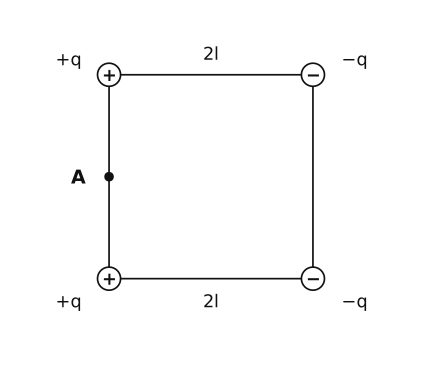
- GUJCET 2025Set 031 markMCQQ.As shown in figure charges +q, +q, −q and −q are placed on the vertices of square, each side length is 2l. The electric potential at mid-point 'A' of charges +q and +q is ______. [FIGURE: a square of side 2l with +q at top-left and bottom-left, −q at top-right and bottom-right; A is the midpoint of the left side, between the two +q charges.] (A) Zero (B) l2kq[1+51] (C) lkq[1−51] (D) l2kq[1−51]
›Reveal solutionSolution
A is a distance l from each +q and l5 from each −q; VA=l2kq(1−51).
A is the midpoint of the left side, so its distance to each left charge (+q) is l. Its distance to each right charge (−q): horizontal 2l, vertical l, so (2l)2+l2=l5. …
- GUJCET 2025Set 031 markMCQQ.Charge 1.6×10⁻⁷ C are distributed uniformly over the surface of spherical conductor of radius R. The ratio of electric potential inside the spherical conductor to the electric field on the surface is ______. (A) 1.6×10⁻⁷R2 (B) R (C) 1.6×10⁻⁷R (D) R1
›Reveal solutionSolution
[!TLDR]
Inside potential =kQ/R and surface field =kQ/R2, so their ratio is R.
Concept
For a charged conducting sphere, the potential is constant everywhere inside and equal to its surface value V=RkQ; the field just outside the surface is E=R2kQ.
Solution …
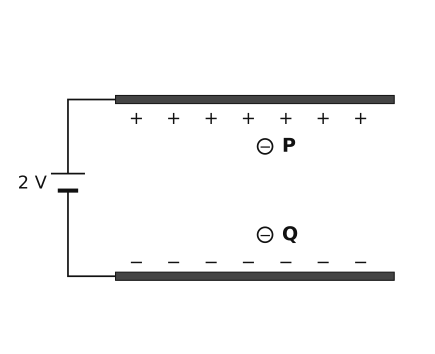
- GUJCET 2025Set 031 markMCQQ.The potential difference between two plates of parallel plate capacitor is 2V. As shown in figure electrons are placed at point P and Q. So [FIGURE: a parallel plate capacitor with a positively charged top plate and negatively charged bottom plate, potential difference 2V; electron at point P near the top plate and electron at point Q near the middle/lower region.] (A) Electric forces acting on both the electrons are same. (B) Electric force acting on the electron at point P is greater than the electron at point Q. (C) Electric force acting on the electron at point P is less than the electron at point Q. (D) Electric forces acting on both the electrons are zero.
›Reveal solutionSolution
[!TLDR] Both P and Q lie between the plates of a parallel-plate capacitor, where the field is uniform, so the electric force (F = eE) on each electron is identical regardless of position.
The field between the plates of a parallel plate capacitor is uniform: E = V/d, the same magnitude and direction at every point in the gap. It does not depend on how close a point is to either plate. The figure shows both P and Q located between the plates. The force on an electron is F = eE. Since E is the same at P and at Q, the electric force on the electron at P equals the force on the electron at Q. The forces are non-zero (there is …
- GSEB Higher Secondary Certificate (HSC) Examination 2025Set ANNUAL1 markMCQQ.Calculate the potential at a point P due to a charge of 4 x 10^-7 C located 9 cm away.(a) 4 x 10^4 V(b) 4 x 10^-4 V(c) 4 x 10^5 V(d) 4 x 10^3 V
›Reveal solutionSolution
The electrostatic potential due to a point charge at distance r is V = kq/r.
…
- GUJCET 2024Set 131 markMCQQ.If an electron is accelerated by a potential difference of 2.5 V it would gain energy of ________. (Take charge of electron 1×10⁻¹⁹ C) (A) 2.5 erg (B) 2.5 MeV (C) 2.5 eV (D) 2.5 J
›Reveal solutionSolution
Accelerating an electron through 2.5 V gives it energy qV=e×2.5V=2.5eV by definition of the electron-volt. …
- GUJCET 2024Set 131 markMCQQ.A radius of spherical charged shell is 10 cm and electric potential on its surface is 100 V, then the potential at 2 cm from the centre of the shell will be ________. (A) 0 V (B) 1 V (C) 200 V (D) 100 V
›Reveal solutionSolution
Inside a charged spherical shell the potential is uniform and equal to its surface value, so at 2 cm (inside the 10 cm shell) it is 100 V.
Concept. For a charged conducting/spherical shell, the field inside is zero and the potential everywhere inside equals the surface potential. …
- GUJCET 2023Set 091 markMCQQ.A charge Q is placed at the centre of circle of radius 10 cm. Find the work done in moving a charge q between any two points lying on the arc of this circle. (A) KQq J (B) 0.1 KQq J (C) 0.5 KQq J (D) 0 J
›Reveal solutionSolution
[!TLDR]
Points on the arc are equidistant from Q, hence equipotential, so the work done is zero.
Concept
The work done in moving a charge q between two points equals q times the potential difference: W=q(VA−VB). On an equipotential surface this difference is zero.
Solution …
- GSEB Higher Secondary Certificate (HSC) Examination 2023Set ANNUAL1 markMCQQ.Figure shows the field lines of a positive and negative charge respectively. Give the sign of potential difference V_Q - V_P, V_B - V_A.(a) -ve, +ve(b) +ve, -ve(c) +ve, +ve(d) -ve, -ve
›Reveal solutionSolution
Near a positive charge the closer point has higher potential (V_Q - V_P > 0); near a negative charge the farther point has the higher (less negative) potential (V_B - V_A > 0). Both are positive.
Potential of a point charge: V = kq/r.
Positive charge (left): Q is nearer, P is farther. V decreases with r, so V_Q > V_P:
V_Q - V_P = positive (+ve).
…
- GSEB Higher Secondary Certificate (HSC) Examination 2023Set ANNUAL1 markMCQQ.The electric potential energy of 2 microC charge is 3 x 10^-5 J at a point in a uniform electric field. The electric potential at that point is ___ V.(a) 5(b) 15(c) 6(d) Zero
›Reveal solutionSolution
Electric potential = potential energy per unit charge, V = U/q = 3x10^-5/2x10^-6 = 15 V.
Electric potential is the potential energy per unit charge: …
- GSEB Higher Secondary Certificate (HSC) Examination 2023Set ANNUAL1 markMCQQ.Equipotential surfaces at a very large distance from the collection of charges whose total sum is not zero are approximately ___.(a) paraboloids(b) planes(c) spheres(d) ellipsoid
›Reveal solutionSolution
At large distances a collection of charges with nonzero total behaves like a single point charge, so its equipotential surfaces become concentric spheres.
…
🎓Unlock everything free for 14 days
- ✓Full step-by-step solutions
- ✓Concept-first explanations
- ✓Methods, shortcuts & mistakes
- ✓PYQ mapping + timed mock tests
Full access for 14 days. No credit card required.