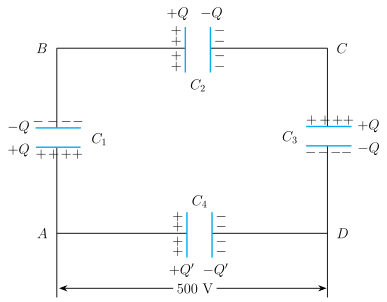
Q.A network of four 10 μF capacitors is connected to a 500 V supply, as shown in Fig. 2.29.
🔒You're viewing a preview — the full solution, concept, methods & PYQ mapping are locked.
🔒 Start your 14-day free trial to unlock the full solution →Concept understanding — Capacitor Network Analysis
Capacitor Network Analysis
Imagine you have a bucket of water and a pipe. The bigger the bucket, the more water it can hold for a given water pressure. A capacitor does the same thing with electric charge — it stores charge when a voltage is applied. The "size" of the bucket is called capacitance (C), measured in farads (F).
Now, what happens when you connect several buckets together with pipes? That's a capacitor network. The analysis is about finding one equivalent bucket (a single capacitor) that behaves exactly like the whole network.
The Core Idea: Charge and Voltage Must Match
When you connect capacitors, two things are always true:
- Charge conservation: Total charge in a closed part of the circuit stays the same unless a battery pushes more in.
- Voltage is shared: The voltage across each capacitor depends on how they're wired.
There are only two basic ways to connect them. Everything else is a combination of these two.
Series Connection: One Path, Shared Charge
Connect capacitors end-to-end, like train cars. The same current flows through each, so each capacitor stores the same amount of charge Q.
But the total voltage across the combination is the sum of the individual voltages:
Vtotal=V1+V2+V3+…
Since V=Q/C for each capacitor, we get:
CeqQ=C1Q+C2Q+C3Q+…
Cancel Q (it's the same everywhere):
Ceq1=C11+C21+C31+…
Intuition: Adding capacitors in series makes the equivalent capacitance smaller than the smallest individual one. Why? Because you're effectively making the "bucket" longer and narrower — harder to fill.
A common mistake: students treat series capacitors like series resistors (adding reciprocals for resistors, but adding directly for capacitors). It's the opposite. For resistors in series: Req=R1+R2. For capacitors in series: 1/Ceq=1/C1+1/C2.
Parallel Connection: Multiple Paths, Same Voltage
Connect capacitors side by side, like buckets with their bottoms connected by a wide pipe. Each capacitor sees the same voltage V across it.
But the total charge stored is the sum of charges on each:
Qtotal=Q1+Q2+Q3+…
Since Q=CV for each:
CeqV=C1V+C2V+C3V+…
Cancel V:
Ceq=C1+C2+C3+…
Intuition: Adding capacitors in parallel makes the equivalent capacitance larger — you're just adding more bucket area. Easy to fill.
| Connection | Equivalent Formula | What happens to Ceq |
|------------|-------------------|----------------------------------|
| Series | 1/Ceq=∑1/Ci | Gets smaller than smallest |
| Parallel | Ceq=∑Ci | Gets larger than largest |
How to Analyze Any Network
- Spot the pattern: Look for capacitors that are clearly in series (only two terminals, no branching between them) or clearly in parallel (both ends connected together).
- Replace step by step: Replace each simple series or parallel group with its equivalent capacitor. Redraw the circuit after each step.
- Repeat until you have one capacitor.
This is exactly like simplifying resistor networks — but with the reciprocal formula for series. If you can do resistor networks, you can do capacitor networks. Just flip the series formula.
A Worked Example
Suppose you have three capacitors: C1=2 μF, C2=3 μF, C3=6 μF. C2 and C3 are in parallel, and that combination is in series with C1. …
The key idea is Capacitor Network Analysis — simplifying series and parallel combinations to find equivalent capacitance, then working backwards to find individual charges.
Step 1: Identify the network structure.
Capacitors C1, C2, and C3 (each 10 μF) form a series path between nodes A and D. Capacitor C4 (also 10 μF) is connected directly across A and D, in parallel with that series combination.
Step 2: Find equivalent capacitance of the series branch.
For three equal capacitors in series:
Cseries1=101+101+101=103⇒Cseries=310 μF
Step 3: Combine with the parallel capacitor.
C4 is in parallel with Cseries:
Ceq=Cseries+C4=310+10=340 μF≈13.33 μF
Step 4: Determine charges.
The supply voltage V=500 V appears across both C4 and the series branch. …
Equivalent capacitance Ceq=340 μF≈13.3 μF. Each of C1,C2,C3 carries 1.67×10⁻³ C; C4 carries 5×10⁻³ C.
Reading the network (Fig. 2.29). C1 (between A and B), C2 (between B and C) and C3 (between C and D) form a series chain running A to B to C to D. C4 is connected directly across A and D, so it is in parallel with that series chain. The 500 V supply is applied across A-D.
- Equivalent capacitance. Series combination of the three 10 μF capacitors:
C′ in parallel with C4:
C′1=101+101+101=103⟹C′=310 μF
Ceq=C′+C4=310+10=340 μF≈13.3 μF
- Charge on each capacitor. Series branch - C1,C2,C3 share the same charge, equal to the charge on their equivalent C′ held across 500 V: …
Method: Reducing a Capacitor Network to Find Equivalent Capacitance and Individual Charges
This method applies to any circuit diagram showing several capacitors wired together across a supply, where you must find the equivalent capacitance and then the charge on each individual capacitor.
Steps
Step 1: Trace the circuit to identify series and parallel groups
Follow the wiring node by node. Capacitors sharing a single unbroken path — one after another, with no branch point in between — are in series. Capacitors connected across the exact same pair of nodes are in parallel. Most networks reduce in stages: a sub-group of series capacitors first, then combined in parallel with another branch, and so on.
Step 2: Reduce each sub-group using the standard combination formulas
Series: Ceq1=∑iCi1Parallel: Ceq=∑iCi
Work from the innermost sub-group outward until a single equivalent capacitance for the whole network remains.
Step 3: Find the voltage across each branch …
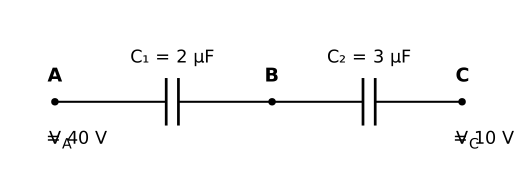
- GUJCET 2023Set 091 markMCQQ.The potential at the point B in the given figure is ______ V. [FIGURE: point A (VA=40 V) — capacitor C1=2μF — point B — capacitor C2=3μF — point C (VC=10 V), capacitors in series] (A) 30 (B) 50 (C) 22 (D) 25
›Reveal solutionSolution
Series capacitors carry equal charge; 2(40−VB)=3(VB−10) gives VB=22 V.
For capacitors in series the charge is the same on each: Q=C1(VA−VB)=C2(VB−VC).
2(40−VB)=3(VB−10) …
- GUJCET 2022Set 171 markMCQQ.How will you connect 4 (four) capacitors, each of capacitance 4 μF for having equivalent capacitance 1.6 μF? (A) Two in parallel and two in series (B) All four in series (C) All four in parallel (D) Three in parallel and one in series
›Reveal solutionSolution
Put two capacitors in parallel (8μF) and two in series (2μF), then combine these two groups in series: 8+28×2=1.6μF.
Concept: Each capacitor is 4μF.
- Two in parallel: 4+4=8μF.
- Two in series: 84×4=2μF. …
- GUJCET 2021Set 151 markMCQQ.Find the equivalent capacitance between two points A & B, for given figure (electric circuit). [Capacitance of each capacitor is C=3μF] [FIGURE: network of capacitors, each of value C, arranged as two bridge/diamond sections between terminals A and B] (A) 1 μF (B) 3 μF (C) 2 μF (D) 4 μF
›Reveal solutionSolution
[!TLDR] Heart (month 1) → limbs & digits (month 2) → first movements (month 5) → fine hair covering (~24 weeks), i.e. III, II, I, IV.
Concept
This follows the NCERT/CBSE-aligned account of human embryonic and foetal development month by month. Organs appear in a fixed sequence, so ordering the events is really about knowing the landmark timeline of pregnancy.
Solution
- III) Heart formed — the heart is the first functional organ; it is formed by the end of the first month.
- II) Limbs and digits — most major organ systems, along with limbs and digits, are formed by the end of the second month.
- I) First movements of the foetus — quickening is felt around the fifth month, along with appearance of hair on the head. …
- GUJCET 2020Set 071 markMCQQ.2μF capacitor is connected with 50V supply & 3μF capacitor is connected with 100V supply. Now after removing battery if two plates of same type of charges are placed to form new capacitor then potential difference is ______ V. (A) 200 (B) 333 (C) 80 (D) 75
›Reveal solutionSolution
Joining like-charged plates adds the charges (400μC) across the summed capacitance (5μF), giving V=80 V.
Concept. Initial charges: Q1=C1V1=2μF×50=100μC and Q2=C2V2=3μF×100=300μC.
Same-type plates connected (parallel, like charges add). …
- GUJCET 2019Set 131 markMCQQ.In the figure area of each plate is A and the distance between consecutive plates is as shown in the figure. What is the effective capacitance between points A & B. [FIGURE] (A) d4Aε0 (B) d2Aε0 (C) d3Aε0 (D) dAε0
›Reveal solutionSolution
[!TLDR]
The three gaps (2d, d, 2d) act as capacitors in parallel: C=2dε0A+dε0A+2dε0A=d2ε0A, so the answer is (B).
Concept
A parallel-plate capacitor has capacitance C=dε0A, where A is the plate area and d the separation. When several such gaps connect the same two terminals A and B, they behave as capacitors in parallel, and parallel capacitances simply add. This is the NCERT/CBSE Class 12 electrostatics (capacitance) result the GUJCET physics syllabus follows.
Solution
The four plates create three gaps between A and B with separations 2d, d and 2d. Each gap is a capacitor: …
🎓Unlock everything free for 14 days
- ✓Full step-by-step solutions
- ✓Concept-first explanations
- ✓Methods, shortcuts & mistakes
- ✓PYQ mapping + timed mock tests
Full access for 14 days. No credit card required.