Q.Explain the process of respiration in man with labelled diagram. Explain the role of haemoglobin in transport of gases. OR Explain the structure and function of the human excretory system. How is osmoregulation controlled by the kidneys?
You're viewing a preview — the full solution, concept, methods & PYQ mapping are locked.
Start your 14-day free trial to unlock the full solution →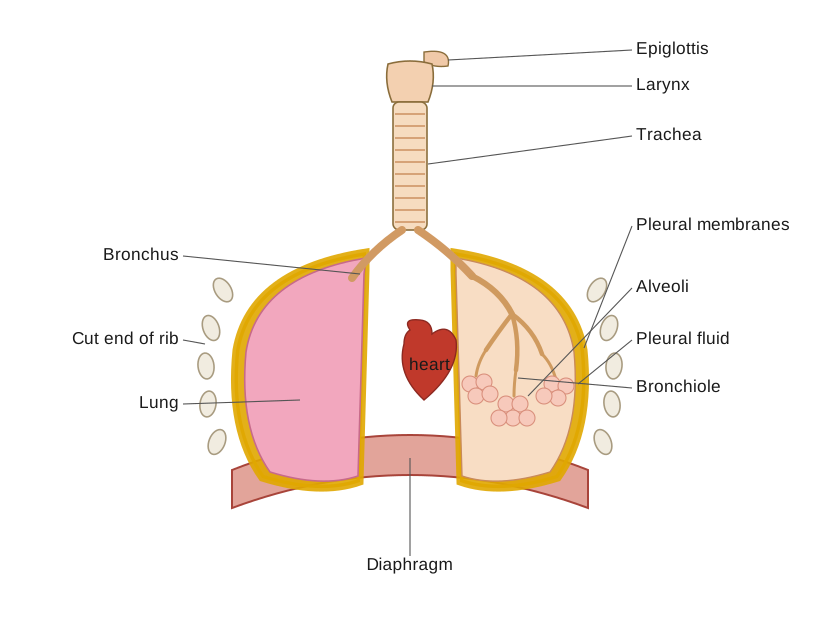
Air is conducted through a branching tube system down to the alveoli, where haemoglobin in the surrounding capillary blood picks up oxygen (and releases CO₂) purely by following partial-pressure gradients, then carries that oxygen throughout the body.
Structure of the human respiratory system (as would be labelled on a diagram): Air enters through the external nostrils into the nasal cavity (lined with mucus and hair, which warms, moistens, and filters incoming air), passes into the pharynx (a common passage for air and food), then the larynx (voice box, containing the vocal cords, guarded by the epiglottis to prevent food entering the airway), then the trachea (windpipe, held open by C-shaped cartilage rings), which divides into two bronchi (one to each lung), which branch repeatedly into progressively smaller bronchioles, ending in clusters of thin-walled, balloon-like sacs called alveoli — the actual site of gas exchange, each surrounded by a dense network of pulmonary capillaries.
Mechanism of breathing: Breathing is a pressure-driven process (following Boyle's law: pressure and volume of a gas are inversely related). During inspiration, the diaphragm contracts and flattens (moving downward) while the external intercostal muscles contract, lifting the ribs up and outward — together these increase the volume of the thoracic cavity, which decreases pulmonary pressure below atmospheric pressure, so air flows in. During expiration, the diaphragm relaxes and domes upward, the ribs move back down, thoracic volume decreases, pressure rises above atmospheric, and air is pushed out.
Role of haemoglobin in gas transport:
- Oxygen transport: about 97% of the O₂ carried in blood binds reversibly to the iron-containing haem groups of haemoglobin inside red blood cells, forming oxyhaemoglobin (only about 3% dissolves directly in plasma). Binding and release are governed by the local partial pressure of O₂: high pO₂ in the alveolar capillaries favours binding (loading), while the lower pO₂ in respiring tissues favours release (unloading) — a relationship visualised as the oxygen-haemoglobin dissociation curve.
- Carbon dioxide transport: haemoglobin also helps carry CO₂, about 20–25% of it bound directly to the globin portion of haemoglobin as carbaminohaemoglobin; most CO₂ (around 70%) is actually transported as bicarbonate ions in plasma (formed with the help of the enzyme carbonic anhydrase inside RBCs), and a small fraction dissolves directly in plasma. …
Unlock everything free for 14 days
- Full step-by-step solutions
- Concept-first explanations
- Methods, shortcuts & mistakes
- PYQ mapping + timed mock tests
Full access for 14 days. No credit card required.