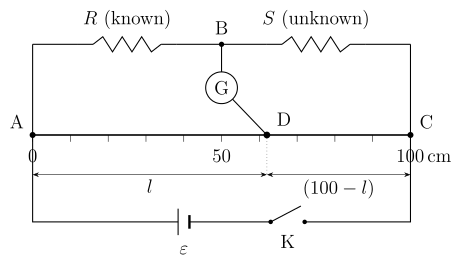
The Intuition: Finding a Hidden Resistance
Imagine you have a box with two terminals sticking out. Inside is a resistor of unknown value — call it X. You want to find out how many ohms it is. You have a collection of known resistors, a battery, and a sensitive galvanometer. How do you measure X without cutting it open?
The trick is to compare X against a known resistance R in a clever circuit called a Wheatstone bridge. The idea is simple: if you arrange four resistors in a diamond shape and adjust one of them until the galvanometer shows zero current, the four resistances satisfy a neat proportion. At that "balance" condition, the ratio of two adjacent resistors equals the ratio of the other two. So if three are known, the fourth is found by cross-multiplication.
A meter bridge is just a practical, cheap way to build that Wheatstone bridge using a single metre-long wire as two of the four resistors.
The Setup
Take a uniform wire exactly 1 metre long, stretched taut on a wooden board with a metre scale beside it. The wire has a constant cross-section and uniform resistivity, so its resistance per unit length is constant. That means the resistance of any piece of the wire is directly proportional to its length.
Now connect the circuit:
- The unknown resistor X is connected in the left gap.
- A known resistor R (from a resistance box) is connected in the right gap.
- A battery is connected across the ends of the metre wire (points A and C).
- A galvanometer has one end connected to the junction between X and R (point B), and the other end to a sliding jockey that can touch any point on the metre wire.
The jockey is the key. By sliding it along the wire, you effectively choose two resistances from the wire itself: the length l from the left end to the jockey, and the remaining length (100−l) from the jockey to the right end.
Finding the Balance Point
Slide the jockey gently along the wire while watching the galvanometer. At most positions, the needle will deflect. But at one particular point — the balance point — the galvanometer shows zero deflection. That means no current flows through the galvanometer, and the bridge is balanced.
At balance, the Wheatstone bridge condition gives:
RX=resistance of right segment of wireresistance of left segment of wire
Since the wire is uniform, resistance is proportional to length. So:
RX=100−ll
where l is the length (in cm) from the left end to the balance point.
X=R⋅100−ll
That's it. Measure l from the metre scale, plug in the known R, and you get X.
Why This Works — The Physics
The wire is not a magic component. It's just a long resistor whose resistance you can tap at any point. By sliding the jockey, you are effectively turning the wire into two variable resistors that always add up to the total resistance of the whole wire. The ratio l/(100−l) can be any value from nearly 0 to nearly infinity, so you can always find a balance for any X by choosing an appropriate R.
The beauty is that you don't need to know the wire's resistivity or its exact total resistance — only the ratio of lengths matters. That cancels out all material properties.
A common mistake is to forget that l is measured from the same end every time. If you measure from the left end for one reading, always measure from the left end. Also, the wire must be truly uniform — any kink or damage changes its resistance per unit length and ruins the proportionality.
A Worked Example
Suppose you take a known resistance R=10 Ω. You slide the jockey and find the balance point at l=40 cm. Then:
X=10⋅100−4040=10⋅6040=10⋅32≈6.67 Ω …