Q.Light is travelling in a medium of refractive index n₁ enters into medium of refractive index n₂ such that n₁ < n₂. Derive relation between n₁, n₂, u, v and R, if light incident on concave spherical surface. OR OR What is diffraction ? Explain it with the help of diagram. OR [Competancy Based Question] Fig. shows an equiconvex lens (of refractive index 1.50) in contact with a liquid layer on top of a plane mirror. A small needle with its tip on the principal axis is moved along the axis until its inverted image is found at the position of the needle. The distance of the needle from the lens is measured to be 45 cm. The liquid is removed and the experiment is repeated. The new distance is measured to be 30 cm. What is refractive index of the liquid ?
You're viewing a preview — the full solution, concept, methods & PYQ mapping are locked.
Start your 14-day free trial to unlock the full solution →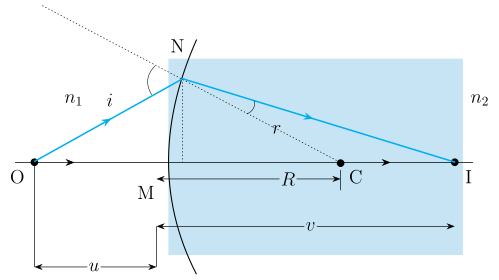
Applying Snell's law with the small-angle (paraxial) approximation to a single ray refracting at a spherical surface gives the relation n2/v − n1/u = (n2 − n1)/R, which works for both convex and concave surfaces with proper signs.
Setup: Let a spherical surface of radius of curvature R separate medium 1 (refractive index ) from medium 2 (refractive index , with here). Let O be a point object on the principal axis at distance u from the pole P of the surface; let I be its real/virtual image at distance v. C is the centre of curvature.
Consider a paraxial ray from O striking the surface at a point M very close to the pole P, making a small angle with the axis. Let the angles the incident ray, refracted ray, and the normal (along MC) make with the axis be respectively (small angles, so in radians).
From triangle geometry (exterior angle theorem applied to triangles OMC and CMI):
where i and r are the angle of incidence and angle of refraction at M.
By Snell's law (paraxial): (since angles are small, ).
Substituting and :
Using the paraxial approximations for the small angles in terms of the heights and distances (with the usual sign convention: distances measured from the pole, positive in the direction of incident light):
Substituting and cancelling the common height h:
…
Unlock everything free for 14 days
- Full step-by-step solutions
- Concept-first explanations
- Methods, shortcuts & mistakes
- PYQ mapping + timed mock tests
Full access for 14 days. No credit card required.