Q.Establish the formula of refraction for a spherical surface that is separating two mediums of refractive index and .
You're viewing a preview — the full solution, concept, methods & PYQ mapping are locked.
Start your 14-day free trial to unlock the full solution →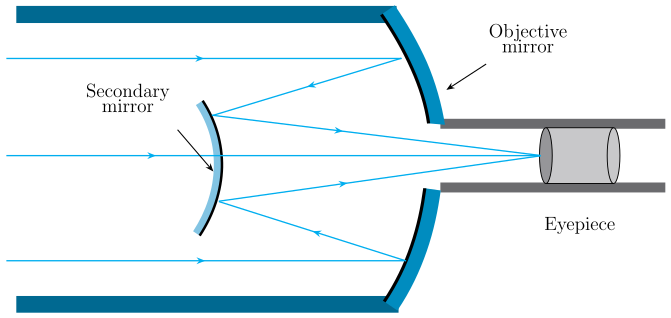
Applying Snell's law with the small-angle (paraxial) approximation at a single spherical refracting surface gives the refraction formula relating u, v, and R.
Main question:
Consider a spherical surface of radius of curvature (centre of curvature C, pole P) separating medium 1 (refractive index ) from medium 2 (refractive index ). For a paraxial ray from an object point O on the principal axis, refracting at the surface and meeting the axis at image point I:
Using the geometry of the ray triangles (with small angles so that ), the angle of incidence is and the angle of refraction is (for the standard convex-surface, real-image construction), where these angles are expressed in terms of the perpendicular height and the distances , , (using the Cartesian sign convention, distances measured from pole P, in the direction of incident light taken positive).
Applying Snell's law for small angles, , and substituting the angle expressions in terms of , , , and simplifying, gives the refraction formula at a single spherical surface:
OR:
A Cassegrain reflecting telescope uses a large concave (paraboloidal) primary mirror with a small hole at its centre. Light entering the telescope is reflected by the primary mirror towards a small convex secondary mirror placed near the focus of the primary; the secondary mirror reflects the converging light back through the hole in the primary mirror, where it is finally focused and viewed through an eyepiece.
Why a concave mirror (not a lens) is used as the objective in modern telescopes:
…
Unlock everything free for 14 days
- Full step-by-step solutions
- Concept-first explanations
- Methods, shortcuts & mistakes
- PYQ mapping + timed mock tests
Full access for 14 days. No credit card required.