Q.Explain the structure of a Transverse section (T.S) of an anther with a neat and well labelled diagram. OR What is Pollination? Explain various kinds of Pollination on the basis of source of Pollen.
You're viewing a preview — the full solution, concept, methods & PYQ mapping are locked.
Start your 14-day free trial to unlock the full solution →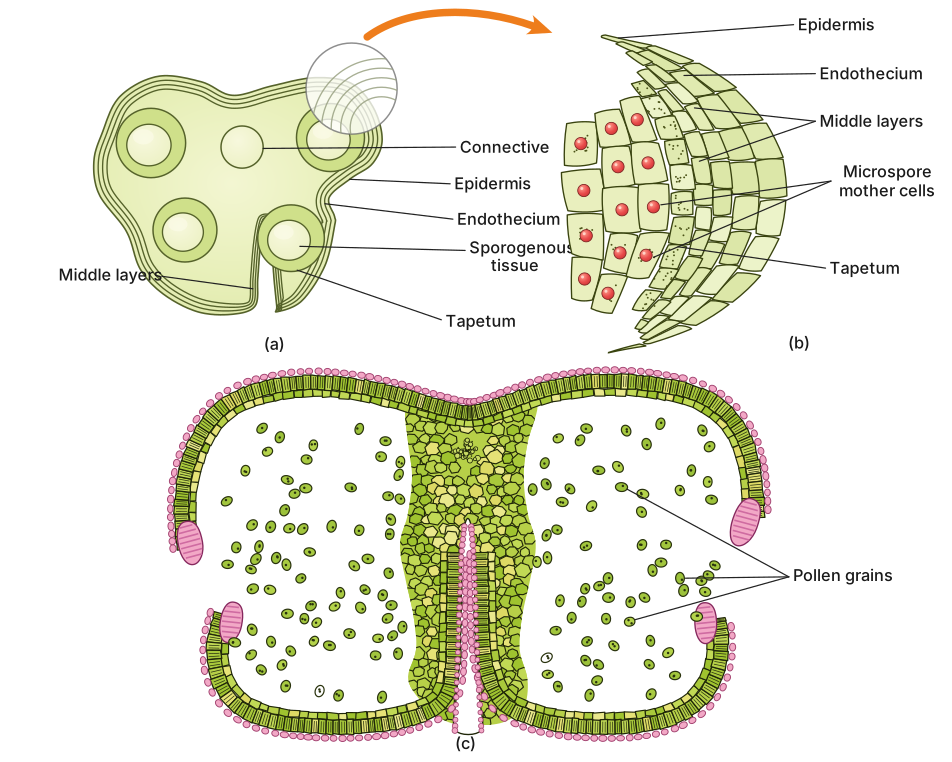
A young anther in transverse section is a four-sided (dithecous) structure with a wall of four layers (epidermis, endothecium, middle layers, tapetum) enclosing four microsporangia/pollen sacs filled with microspore mother cells.
Structure of a Transverse Section (T.S.) of an anther:
A typical angiosperm anther is bilobed, with each lobe having two theca (dithecous), giving four microsporangia (pollen sacs) located at the corners, when cut in transverse section. Each microsporangium, as it matures into a pollen sac, is surrounded by four wall layers, from outermost to innermost:
- Epidermis — the outermost, single-layered protective covering.
- Endothecium — a layer beneath the epidermis; its cells develop fibrous, radial thickenings that help the anther dehisce (split open) at maturity to release pollen.
- Middle layers — 2–3 layers of thin-walled cells, which are ephemeral (get crushed as the anther matures).
- Tapetum — the innermost wall layer, which nourishes the developing pollen grains (nutritive layer); its cells have dense cytoplasm and often more than one nucleus.
Inside each microsporangium, a group of compactly-arranged sporogenous cells called microspore mother cells (pollen mother cells, PMC) are found; each PMC undergoes meiosis (microsporogenesis) to produce a tetrad of four haploid microspores, which develop into pollen grains.
OR: Pollination and its kinds by source of pollen:
Pollination is the transfer of pollen grains from the anther to the stigma of a flower. Based on the source of the pollen, it is of three types:
- Autogamy (Self-pollination): Transfer of pollen from the anther to the stigma of the SAME flower. Requires the flower to be bisexual, and anther and stigma to be positioned close together and to mature at the same time (synchronised anther and stigma maturation, homogamy). …
Unlock everything free for 14 days
- Full step-by-step solutions
- Concept-first explanations
- Methods, shortcuts & mistakes
- PYQ mapping + timed mock tests
Full access for 14 days. No credit card required.