Q.(i) Draw the structure of alpha-D-(+)-Glucopyranose.
You're viewing a preview — the full solution, concept, methods & PYQ mapping are locked.
Start your 14-day free trial to unlock the full solution →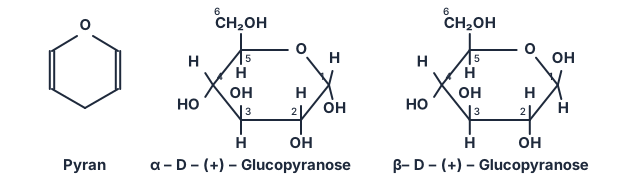
α-D-(+)-Glucopyranose is glucose's six-membered ring hemiacetal form with the anomeric –OH in the axial/α (down) orientation; glycogen is the animal storage polysaccharide, more highly branched than starch's amylopectin.
(i) Structure of α-D-(+)-Glucopyranose
Glucose (an aldohexose) cyclises when its C5–OH attacks the C1 aldehyde carbon, forming a stable six-membered oxygen-containing ring (a 'pyranose' form, analogous to pyran). This creates a new stereocentre at C1 (the anomeric carbon), giving two anomers:
- In the α-anomer, the newly formed –OH at C1 points to the same side as (down, i.e. trans to) the terminal –CH₂OH at C5 in the Haworth projection — i.e., the C1–OH is drawn below the ring plane.
- (In the β-anomer it would point up/above the ring.)
Haworth-style description of α-D-glucopyranose: a six-membered ring of 5 carbons (C1–C5) and one oxygen; substituents — OH at C1 (down, α), OH at C2 (down), OH at C3 (up), OH at C4 (down), and CH₂OH at C5 (up, above the ring, defining the D-configuration).
(ii) Glycogen vs starch
Glycogen is a homopolysaccharide of α-D-glucose units, serving as the storage form of carbohydrate in animals — it is stored mainly in the liver and muscles, and is mobilised quickly to release glucose when energy is needed (hence sometimes called 'animal starch').
Difference from starch: Both are glucose polymers joined by α-1,4-glycosidic bonds with branching via α-1,6-glycosidic bonds, but:
…
Unlock everything free for 14 days
- Full step-by-step solutions
- Concept-first explanations
- Methods, shortcuts & mistakes
- PYQ mapping + timed mock tests
Full access for 14 days. No credit card required.