Q.What are Skeletal Muscles? Give a detailed account on the mechanism of muscle contraction. OR Define a Neuron. Describe the process of generation and conduction of nerve impulse in man.
You're viewing a preview — the full solution, concept, methods & PYQ mapping are locked.
Start your 14-day free trial to unlock the full solution →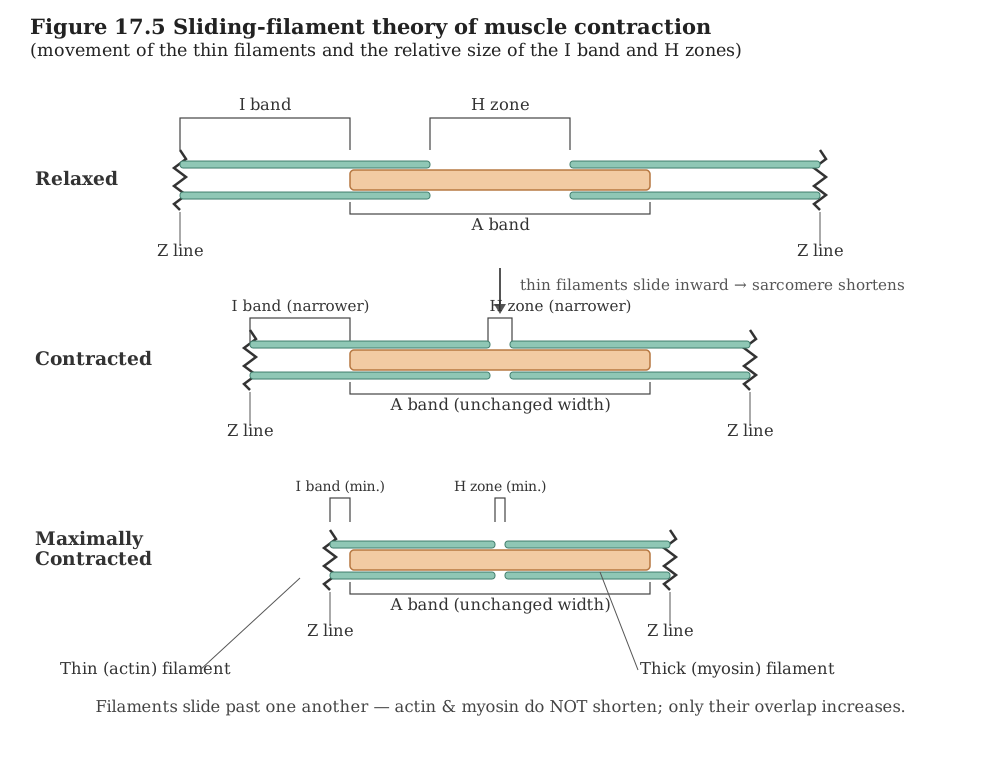
Skeletal muscles are voluntary, striated muscles attached to bones; they contract by the sliding filament mechanism, in which myosin cross-bridges use ATP to pull actin filaments inward, shortening each sarcomere and hence the whole muscle.
Step 1 — What are skeletal muscles?
Skeletal muscles are a type of muscle tissue that is:
- Striated: shows alternating light and dark bands under the microscope, due to the highly organised arrangement of actin and myosin filaments.
- Voluntary: under conscious control of the nervous system.
- Attached to bones, usually via tendons, and responsible for body movement, posture, and locomotion. Each skeletal muscle is made of many long, cylindrical, multinucleate muscle fibres, each fibre containing many myofibrils, which in turn are made of repeating contractile units called sarcomeres (the region between two successive Z-lines), built of thick filaments (myosin) and thin filaments (actin, along with troponin and tropomyosin).
Step 2 — Neuromuscular initiation.
A motor neuron releases the neurotransmitter acetylcholine (ACh) at the neuromuscular junction, generating an action potential that spreads over the muscle fibre's plasma membrane (sarcolemma) and travels deep into the fibre via T-tubules.
Step 3 — Calcium release and cross-bridge exposure.
The action potential triggers the sarcoplasmic reticulum to release stored Ca²⁺ ions into the sarcoplasm. Ca²⁺ binds to troponin, causing a conformational change that shifts tropomyosin away from the myosin-binding sites on the actin filament, exposing them.
Step 4 — The sliding filament mechanism (cross-bridge cycle).
- The myosin head, energised by ATP hydrolysis (ADP + Pi remain bound), binds to the exposed site on actin, forming a cross-bridge.
- Release of ADP + Pi triggers the power stroke — the myosin head bends and pulls the actin filament inward, towards the centre of the sarcomere.
- A new ATP molecule binds to myosin, causing the cross-bridge to detach from actin. …
Unlock everything free for 14 days
- Full step-by-step solutions
- Concept-first explanations
- Methods, shortcuts & mistakes
- PYQ mapping + timed mock tests
Full access for 14 days. No credit card required.