Q.Write IUPAC names of the following compounds:
Concept understanding — IUPAC Nomenclature
IUPAC Nomenclature (Organic Compounds)
IUPAC nomenclature is a systematic way to name a compound so that its name alone tells you its exact structure, with no ambiguity. Every organic name follows the same underlying recipe, whatever the functional group.
The Recipe
-
Identify the principal characteristic group. If the molecule has a functional group senior enough to be named as a suffix (carboxylic acid > ester > amide > nitrile > aldehyde > ketone > alcohol > amine, and so on down the seniority order), that group decides the suffix and must be included in the parent chain. A halogen is never senior enough to be a suffix — it is always named as a prefix ("halo-"), whatever else is present.
-
Choose the parent chain. The parent is the longest continuous carbon chain that contains the principal characteristic group (if there is one). Among chains of the same length, the one with the most substituents wins.
-
Number the chain. Number from whichever end gives the LOWEST LOCANT to the principal characteristic group first. If there is no principal group (e.g. a simple haloalkane, or an alkene with a halogen substituent), lowest locant goes to the site of unsaturation (double/triple bond) first, then to substituents as a set.
Watch outWhen two numbering directions give the SAME locant for the principal group/unsaturation (a genuine tie), the tie-break is the lowest locant SET for the substituents as a group — compare the two sets at their first point of difference. Only if the sets are themselves tied does the alphabetically-first substituent get the lower number.
-
Name and cite the substituents as prefixes, in alphabetical order (ignoring multiplying prefixes like di-/tri- but not ignoring structural prefixes like iso-/cyclo-), each with its own locant.
-
Assemble the name: locants + substituent prefixes (alphabetical) + parent chain name + suffix (if any).
Worked Example
CH3−CH(Cl)−CH(CH3)−CH2−CH3: the longest chain is 5 carbons (pentane), no principal characteristic group (just a halogen substituent), so number for the lowest locant set. From the left: Cl at C2, methyl at C3 → set {2,3}. From the right: methyl at C3, Cl at C4 → set {3,4}. {2,3} is lower, so numbering from the left wins: 2-chloro-3-methylpentane.
A locant TIE (both directions give the same first-point-of-difference number) is common on short/symmetric chains — always check both directions explicitly rather than assuming "number from the end nearer the first substituent mentioned in the name" is automatically correct.
Common Mistakes
- Picking a chain that is NOT the longest one just because it "looks simpler" — always verify no longer chain exists, including chains that run through what looks like a branch.
- Forgetting the alphabetical-order rule for citing substituents (locants are chosen by the lowest-locant rule; the ORDER they're written in the name is alphabetical, not by locant).
- Treating a halogen as if it could ever be the principal characteristic group / suffix — it cannot; it is always a prefix, however many are present.
IUPAC nomenclature is a foundational skill taught in the NCERT/CBSE Class 11 Chemistry chapter on Organic Chemistry: Some Basic Principles and Techniques, and ‘IUPAC nomenclature rules and examples’ is one of the most searched important-question topics for board exams, JEE Main and NEET. Naming organic compounds correctly underpins almost every other organic-chemistry question asked in competitive exams.
Why this formula?
IUPAC Nomenclature: Why the Rules Work the Way They Do
IUPAC nomenclature is not a single formula, but a system of rules designed to give every organic compound a unique, unambiguous name. The "why" behind these rules lies in clarity, consistency, and communication — ensuring that a chemist in Tokyo and one in Toronto draw the same structure from the same name.
1. The Core Principle: The Longest Carbon Chain
Rule: Identify the longest continuous chain of carbon atoms. This becomes the parent chain (e.g., pentane, hexane).
Why?
- The longest chain represents the backbone of the molecule.
- It gives the most stable, fundamental name — shorter chains would be branches, not the main structure.
- Example: In a molecule with 5 carbons in a row and a 2-carbon branch, calling it "pentane" (not "ethane") tells you the core skeleton is 5 carbons long.
Key idea: The parent chain is the maximum continuous path — not necessarily the one that looks "straight" on paper.
2. Numbering: Lowest Locants (The "First Point of Difference" Rule)
Rule: Number the parent chain so that substituents get the smallest possible numbers. When there's a tie, compare the first point of difference.
Why?
- This ensures reproducibility — two chemists will always number the same way.
- It avoids ambiguity: "2-methylpentane" is unambiguous; "3-methylpentane" would be a different compound.
- The first point of difference rule: If you have substituents at positions 2,4 and 3,5, choose 2,4 because 2 < 3 (the first number is smaller).
Example:
- For a methyl group on carbon 2 vs. carbon 4 of a 5-carbon chain:
- 2-methylpentane (correct)
- 4-methylpentane (wrong — higher number)
3. Alphabetical Order of Substituents
Rule: List substituents in alphabetical order (ignoring prefixes like di-, tri-, sec-, tert- but not iso-).
Why?
- Alphabetical order is a universal sorting convention — no need to remember priority based on size or complexity.
- It makes names searchable and predictable.
- Example: "3-ethyl-2-methylpentane" (e before m) — not "2-methyl-3-ethylpentane".
Exception: Prefixes like iso- and neo- are considered part of the name (e.g., isopropyl comes before methyl because "i" < "m").
4. Multiple Bonds: The "Lowest Locant" Rule for Alkenes/Alkynes
Rule: Number the chain so that the double or triple bond gets the lowest possible number, even if it means giving a substituent a higher number.
Why?
- The functional group (alkene/alkyne) is more important than alkyl substituents.
- The bond position defines the compound's reactivity and geometry.
- Example: In pent-2-ene (not pent-3-ene), the double bond is between carbons 2 and 3 — the lower number (2) is used.
Priority order:
- Principal functional group (e.g., -OH, -COOH, C=C)
- Multiple bonds
- Substituents (alkyl, halo, etc.)
5. The "Suffix" and "Prefix" System
Rule: The principal functional group determines the suffix (e.g., -ol for alcohol, -al for aldehyde). Other groups become prefixes (e.g., chloro-, hydroxy-).
Why?
- The suffix tells you the most important chemical feature at a glance.
- Prefixes are secondary — they modify the parent name without changing its core identity.
- Example: "3-chloropropan-1-ol" — the "-ol" tells you it's an alcohol; "chloro-" is just a substituent.
6. Why "E/Z" and "R/S" Exist
Rule: Use E/Z for alkene geometry (based on Cahn-Ingold-Prelog priority) and R/S for chiral centers.
Why?
- Simple cis/trans fails when there are more than two different substituents.
- E/Z and R/S are unambiguous — they assign priority based on atomic number, not just "same side" or "opposite side".
- This prevents confusion: (E)-3-methylpent-2-ene is a specific isomer; "cis" would be ambiguous here.
Summary: The "Why" in One Table
| Rule | Purpose |
|---|---|
| Longest chain | Defines the core skeleton |
| Lowest locants | Ensures unique numbering |
| Alphabetical order | Universal sorting |
| Functional group priority | Highlights reactivity |
| E/Z, R/S | Handles stereochemistry |
Final thought: IUPAC nomenclature is a language, not a formula. Every rule exists to eliminate ambiguity — so that a name is a perfect blueprint for a molecule.
Alcohols/diols/triols take the '-ol/-diol/-triol' suffix on the longest -OH-bearing chain; methyl-substituted phenols are numbered from the -OH carbon; ethers are named as alkoxy substituents on the larger group.
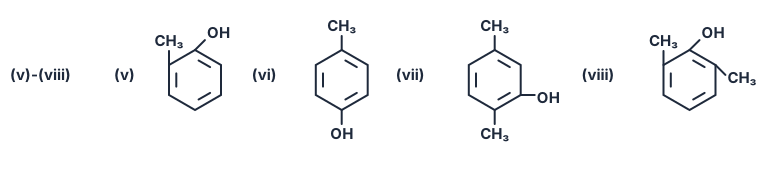
(i) 2,2,4-Trimethylpentan-3-ol (ii) 5-Ethylheptane-2,4-diol (iii) Butane-2,3-diol (iv) Propane-1,2,3-triol (v) 2-Methylphenol (vi) 4-Methylphenol (vii) 2,5-Dimethylphenol (viii) 2,6-Dimethylphenol (ix) 1-Methoxy-2-methylpropane (x) Ethoxybenzene (xi) 1-Phenoxyheptane (xii) 2-Ethoxybutane
Each name comes from choosing the correct parent (the longest chain carrying the hydroxyl group(s) for the alcohols, the ring for the phenols, the larger group for the ethers) and numbering for the lowest locants.
Step-by-step
- CH3-CH(CH3)-CH(OH)-C(CH3)2-CH3: five-carbon chain with -OH at C-3. Numbering from the C(CH3)2 end gives two methyls at C-2 and one at C-4, so it is 2,2,4-trimethylpentan-3-ol.
- A seven-carbon chain (heptane) bearing -OH at C-2 and C-4 (a 2,4-diol) with an ethyl branch at C-5, so it is 5-ethylheptane-2,4-diol.
- Four-carbon chain with -OH on C-2 and C-3, so it is butane-2,3-diol.
- Three-carbon chain with -OH on all three carbons, so it is propane-1,2,3-triol (glycerol).
- Phenol with a methyl ortho to -OH: 2-methylphenol. (vi) Methyl para to -OH: 4-methylphenol.
(vii) -OH at C-1 with methyls at C-2 and C-5 (the lowest locant set for this pattern): 2,5-dimethylphenol.
(viii) -OH at C-1 flanked by a methyl on each adjacent carbon: 2,6-dimethylphenol.
(ix) CH3-O-CH2-CH(CH3)-CH3: the larger group is the four-carbon 2-methylpropane; methoxy sits on C-1, so it is 1-methoxy-2-methylpropane.
(x) C6H5-O-C2H5: ethoxy on benzene, so it is ethoxybenzene (phenetole).
(xi) C6H5-O-(CH2)6CH3: a heptyl group on a phenoxy oxygen; named with the ring as a phenoxy prefix on heptane, so it is 1-phenoxyheptane.
(xii) CH3CH2-O-CH(CH3)CH2CH3: the larger group is butan-2-yl (a four-carbon chain), so ethoxy sits on C-2, giving 2-ethoxybutane.
(i) 2,2,4-Trimethylpentan-3-ol (ii) 5-Ethylheptane-2,4-diol (iii) Butane-2,3-diol (iv) Propane-1,2,3-triol (v) 2-Methylphenol (vi) 4-Methylphenol (vii) 2,5-Dimethylphenol (viii) 2,6-Dimethylphenol (ix) 1-Methoxy-2-methylpropane (x) Ethoxybenzene (xi) 1-Phenoxyheptane (xii) 2-Ethoxybutane
Method: Comprehensive Principal-Group Nomenclature Method (Alcohols, Diols, Triols, Phenols, Ethers)
Core Concept
Every name is built the same way: find the correct parent (longest -OH-bearing chain for alcohols/diols/triols, the ring itself for phenols, the larger alkyl/aryl group for ethers), then number to give the principal group(s) the lowest possible locant(s), and cite every other substituent as an alphabetised prefix.
Steps
- Classify the compound: does -OH sit on a chain carbon (alcohol/diol/triol) or directly on an aromatic ring (phenol)? Or is the functional group an ether linkage (-O- between two carbon groups, no H on that oxygen)?
- For alcohols/diols/triols: find the longest chain through ALL -OH-bearing carbons; number from the end giving the lowest locant SET to the -OH groups; name remaining alkyl branches as prefixes.
- For phenols: -OH fixes ring position 1; number substituents around the ring to give the lowest locant set (checking both directions of numbering).
- For ethers: identify the two groups on oxygen; keep the larger as parent (chain, ring, or in special cases an alkyl chain even against an aryl group per the convention used), name the smaller as an alkoxy or phenoxy/aryloxy prefix, and number for the lowest locant on the parent.
- Assemble each final name and double-check the locant set is truly the lowest possible by testing numbering from both ends/directions.
Applying this across all twelve parts: (i) 2,2,4-trimethylpentan-3-ol (five-carbon chain, -OH at C-3, two methyls at C-2, one at C-4).
(ii) 5-ethylheptane-2,4-diol (seven-carbon chain, -OH at C-2 and C-4, ethyl at C-5).
(iii) butane-2,3-diol (four-carbon chain, -OH at C-2 and C-3).
(iv) propane-1,2,3-triol (three -OH on three carbons = glycerol).
(v) 2-methylphenol (methyl ortho to -OH).
(vi) 4-methylphenol (methyl para to -OH).
(vii) 2,5-dimethylphenol (methyls at C-2 and C-5 relative to -OH at C-1).
(viii) 2,6-dimethylphenol (methyls flanking -OH on both sides).
(ix) 1-methoxy-2-methylpropane (larger 2-methylpropane parent, methoxy at C-1).
(x) ethoxybenzene (benzene parent, ethoxy substituent).
(xi) 1-phenoxyheptane (heptane parent since the alkyl chain is longer/named as parent with phenoxy prefix).
(xii) 2-ethoxybutane (larger butan-2-yl parent, ethoxy at C-2).
Key Exam Point
With this many parts in one question, the most common scoring loss is a SINGLE wrong locant from numbering the chain/ring from the wrong end (e.g., writing 3,4-dimethylphenol instead of 2,5- for part vii) — always explicitly compare both numbering directions before finalising each name, rather than numbering by inspection alone.
- JKBOSE Class 12 Annual Regular Examination 2022Set SZ1 markQ.Write IUPAC name of OHC-CH2-CH(CHO)-CHO (the third carbon, CH, carries a CHO branch as drawn in the paper).
›Reveal solutionSolution
OHC-CH2-CH(CHO)-CHO carries three -CHO groups on a 2-carbon skeleton, so it is named as a tricarbaldehyde of ethane: ethane-1,2,2-tricarbaldehyde.
Rule for naming polyaldehydes:
- With only ONE -CHO group, its carbon is part of the parent chain, named with suffix "-al" (e.g. propanal).
- With exactly TWO -CHO groups at the two chain ends, both CHO carbons are counted in the parent chain, named with suffix "-dial" (e.g. OHC-CH2-CH2-CHO is butanedial).
- With MORE than two -CHO groups (three here), not all of them can sit at chain ends, so NONE of the CHO carbons is counted in the parent chain — every -CHO becomes a substituent named "carbaldehyde" on the longest chain that excludes those carbons.
Structure: OHC-CH2-CH(CHO)-CHO. Removing the three CHO carbons leaves a 2-carbon parent chain: -CH2-CH<, i.e. ethane. Numbering it C1 (the CH2, bearing one CHO substituent) and C2 (the CH, bearing two CHO substituents — one written as the branch "(CHO)" and one as the chain-continuation "-CHO"):
- C1 bears 1 carbaldehyde group -> locant 1
- C2 bears 2 carbaldehyde groups -> locants 2, 2
Name: ethane-1,2,2-tricarbaldehyde.
✓Final answerEthane-1,2,2-tricarbaldehyde — three -CHO groups on a 2-carbon (ethane) chain, one at C1 and two at C2.
- JKBOSE Class 12 Annual Regular Examination 2020Set SZ1 markQ.Give IUPAC name of: CH3-CH(OH)-CH3 (OH group attached to the middle carbon of propane)
›Reveal solutionSolution
CH3–CH(OH)–CH3 is a three-carbon chain with –OH on the middle (second) carbon.
The compound CH3–CH(OH)–CH3 has a straight chain of 3 carbon atoms (propane skeleton) with a hydroxyl (–OH) group attached to the middle (C-2) carbon.
IUPAC naming steps:
- Parent chain: 3 carbons → propane → as an alcohol, suffix '-ol' replaces the terminal 'e': propanol.
- Number the chain to give the lowest locant to the –OH group: numbering from either end gives the –OH group position 2 (since it's on the middle carbon).
- Insert the locant: propan-2-ol.
Common/trivial name: isopropyl alcohol (or isopropanol).
✓Final answerPropan-2-ol (common name: isopropyl alcohol) — the hydroxyl group is on C-2, the middle carbon, of the 3-carbon chain.
🎓Unlock everything free for 14 days
- ✓Full step-by-step solutions
- ✓Concept-first explanations
- ✓Methods, shortcuts & mistakes
- ✓PYQ mapping + timed mock tests
Full access for 14 days. No credit card required.