Q.Write structures of the compounds whose IUPAC names are as follows:
The key to writing structures from IUPAC names is to identify the parent chain (the longest carbon chain containing the principal functional group), number it to give the functional group the lowest locant, then attach all substituents at the correct positions. Each name is decoded step by step below, and the final structures are given in the answer block.
The Concept: Decoding IUPAC Names
IUPAC nomenclature is a systematic way to name organic compounds. To go from a name to a structure, you work backwards:
- Identify the parent chain — the longest continuous carbon chain that contains the principal functional group (the one with highest priority, e.g., -ol for alcohols, -oxy for ethers).
- Identify the suffix — tells you the functional group (e.g., -ol = alcohol, -oxy = ether, -ene = double bond).
- Identify the locants — the numbers before the suffix and before substituent names tell you where things are attached.
- Identify substituents — groups like methyl, ethyl, phenyl, chloro, etc., with their locants.
- Assemble — draw the parent chain, number it correctly, attach substituents at the given positions, and add the functional group.
Let’s work through each compound.
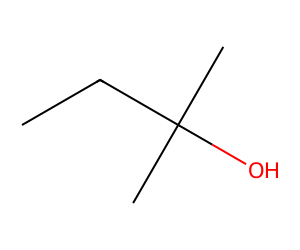
(i) 2-Methylbutan-2-ol
- Parent chain: “butan” means a 4-carbon chain. The suffix “-2-ol” means an alcohol (-OH) at carbon 2.
- Substituent: “2-methyl” means a methyl group () at carbon 2.
- Numbering: The parent chain is numbered so that the -OH gets the lowest number — here it’s already at position 2.
- Structure: Butane backbone: C1–C2–C3–C4. At C2, we have both an -OH and a methyl group. That means C2 is a quaternary carbon (bonded to four carbons: C1, C3, the methyl, and the -OH).
So the structure is:
- C1:
- C2:
- C3:
- C4:
In condensed form:
The “-2-ol” suffix tells you the -OH is on carbon 2. The “2-methyl” tells you a methyl is also on carbon 2. So carbon 2 has four different groups attached — that’s a tertiary alcohol.
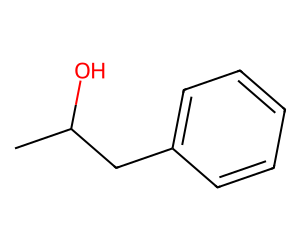
(ii) 1-Phenylpropan-2-ol
- Parent chain: “propan” = 3-carbon chain. “-2-ol” = -OH at carbon 2.
- Substituent: “1-phenyl” means a phenyl group () at carbon 1.
- Structure: Propane backbone: C1–C2–C3. At C1, attach a phenyl ring. At C2, attach -OH.
So:
A common mistake is to put the phenyl on carbon 2. The locant “1-” explicitly places it on carbon 1. Always check the number before the substituent name.
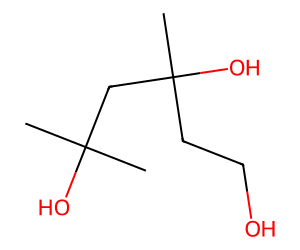
(iii) 3,5-Dimethylhexane-1,3,5-triol
- Parent chain: “hexane” = 6-carbon chain. “-triol” means three -OH groups.
- Locants for -OH: “1,3,5-triol” means -OH at carbons 1, 3, and 5.
- Substituents: “3,5-dimethyl” means methyl groups at carbons 3 and 5.
- Structure: Hexane backbone: C1–C2–C3–C4–C5–C6.
- C1: (so )
- C2:
- C3: has both an -OH and a methyl group (so )
- C4:
- C5: has both an -OH and a methyl group (so )
- C6:
In condensed form:
Carbons 3 and 5 each have two substituents (an -OH and a methyl), making them tertiary alcohol carbons. Carbon 1 is a primary alcohol.
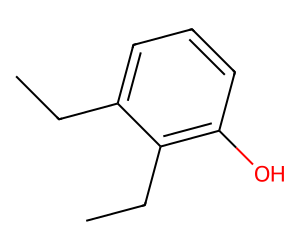
(iv) 2,3-Diethylphenol
- Parent: “phenol” means a benzene ring with an -OH group directly attached. The -OH is always at position 1 by definition.
- Substituents: “2,3-diethyl” means two ethyl groups () at positions 2 and 3 on the ring.
- Numbering: The ring is numbered starting from the carbon bearing the -OH as position 1, then going around so that the substituents get the lowest numbers — here 2 and 3 are already the smallest possible.
Structure: A benzene ring with -OH at C1, ethyl at C2, and ethyl at C3.
In skeletal form:
    OH
     |
    1
   / \
  2   6
  |   |
  Et  5
  3---4
  |
  Et
(Where Et = )
In phenols, the -OH is always at position 1, so you never write “1-phenol”. The locants for substituents are given relative to that fixed position.
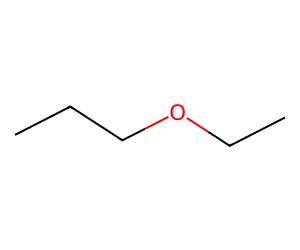
(v) 1-Ethoxypropane
- Parent: This is an ether. The name “1-ethoxypropane” means the parent chain is propane (3 carbons), and there’s an ethoxy group () attached at carbon 1.
- Structure: Propane backbone: C1–C2–C3. At C1, instead of a hydrogen, we have .
So:
Ethers are named as alkoxyalkanes. The smaller alkyl group (here ethyl) becomes the “alkoxy” part, and the larger chain (propane) is the parent.
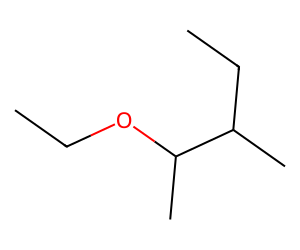
(vi) 2-Ethoxy-3-methylpentane
- Parent chain: “pentane” = 5-carbon chain.
- Substituents:
- “2-ethoxy” means an ethoxy group () at carbon 2.
- “3-methyl” means a methyl group at carbon 3.
- Structure: Pentane backbone: C1–C2–C3–C4–C5.
- C1:
- C2: (the ethoxy is attached via oxygen)
- C3:
- C4:
- C5:
In condensed form:
The ethoxy group is attached through oxygen, not directly as an ethyl. So at C2, the carbon is bonded to H, the ethoxy oxygen, and the rest of the chain.
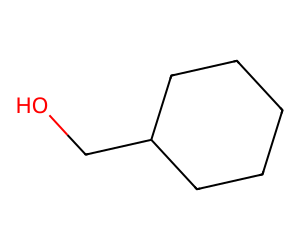
(vii) Cyclohexylmethanol
- Parent: “methanol” means a one-carbon chain with an -OH group — that’s , but here the methyl is substituted.
- Substituent: “cyclohexyl” means a cyclohexane ring attached to the methanol carbon.
- Structure: The methanol carbon (C1) has -OH and is bonded to the cyclohexane ring.
So: (where is a cyclohexyl group).
“Cyclohexylmethanol” is the same as “(hydroxymethyl)cyclohexane”. The -OH is on a carbon attached to the ring, not directly on the ring.
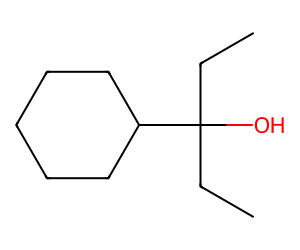
(viii) 3-Cyclohexylpentan-3-ol
- Parent chain: “pentan” = 5-carbon chain. “-3-ol” = -OH at carbon 3.
- Substituent: “3-cyclohexyl” means a cyclohexyl group at carbon 3.
- Structure: Pentane backbone: C1–C2–C3–C4–C5. At C3, we have both an -OH and a cyclohexyl group. That makes C3 a tertiary carbon (bonded to C2, C4, the cyclohexyl, and the -OH).
So:
Carbon 3 is a tertiary alcohol carbon because it’s attached to three other carbons (two from the pentane chain and one from the cyclohexyl ring).
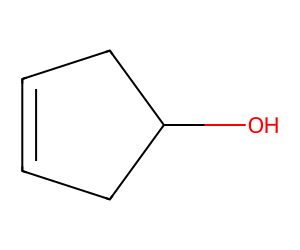
(ix) Cyclopent-3-en-1-ol
- Parent: “cyclopent” = 5-carbon ring. “-3-en” means a double bond between carbons 3 and 4. “-1-ol” means an -OH at carbon 1.
- Numbering: The ring is numbered to give the -OH the lowest number (1), then the double bond gets the lowest possible locant (3).
- Structure: A 5-membered ring with a double bond between C3 and C4, and an -OH at C1.
In skeletal form:
    OH
     |
     1
   /   \
  2     5
  |     |
  3=====4
(Where the double bond is between C3 and C4)
The double bond locant “3” means the bond is between carbon 3 and carbon 4. The -OH is at carbon 1. Make sure the numbering goes in the direction that gives the -OH the lowest number.
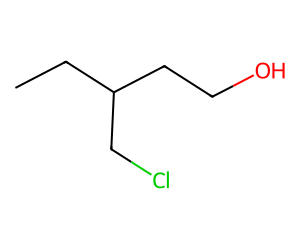
(x) 4-Chloro-3-ethylbutan-1-ol
- Parent chain: “butan” = 4-carbon chain. “-1-ol” = -OH at carbon 1.
- Substituents:
- “4-chloro” means a chlorine atom at carbon 4.
- “3-ethyl” means an ethyl group at carbon 3.
- Structure: Butane backbone: C1–C2–C3–C4.
- C1: (so )
- C2:
- C3: (ethyl group attached)
- C4: (chlorine attached)
In condensed form:
The ethyl group at C3 makes that carbon a chiral center (four different groups: H, C2, C4, and the ethyl). This compound can exist as enantiomers, but the name doesn’t specify stereochemistry.
The structures are: (i) ,
(ii) ,
(iii) ,
(iv) a benzene ring with -OH at C1 and ethyl at C2 and C3,
(v) ,
(vi) ,
(vii) ,
(viii) ,
(ix) a cyclopentene ring with -OH at C1 and double bond between C3 and C4,
(x) .
Unlock everything free for 14 days
- Full step-by-step solutions
- Concept-first explanations
- Methods, shortcuts & mistakes
- PYQ mapping + timed mock tests
Full access for 14 days. No credit card required.