Q.State and explain Kirchhoff's laws.
🔒You're viewing a preview — the full solution, concept, methods & PYQ mapping are locked.
🔒 Start your 14-day free trial to unlock the full solution →Concept understanding — Kirchhoff's Current and Voltage Rules
Why Ohm's law alone is not enough. Ohm's law, V=IR, is directly useful only for simple, single-loop circuits with a single emf source. Real circuits frequently contain multiple loops, multiple junctions, and sometimes multiple emf sources, for which Kirchhoff's two generalised rules provide a complete and systematic method of analysis.
Kirchhoff's first rule (current rule / junction rule). At any junction of a circuit, the algebraic sum of the currents is zero -- current entering the junction is taken as positive, current leaving as negative. This is a direct statement of the conservation of electric charge: whatever charge flows into a junction in a given time must also flow back out, since charge cannot accumulate or vanish at a point. For a junction with several currents I1,…,I5 meeting it, the rule reads I1+I2−I3−I4−I5=0, i.e. total current in equals total current out.
Kirchhoff's second rule (voltage rule / loop rule). In any closed loop of a circuit, the algebraic sum of the IR products (voltage drops across resistors) and emfs around that loop is zero. This follows from the conservation of energy: the total energy supplied by every emf source around the loop must equal the total energy delivered to every resistor in that loop. The sign convention is essential: an IR term is positive when the loop is traversed in the SAME direction as the assumed current, negative when traversed against it; an emf is positive when traversed from the cell's negative to positive terminal, negative the other way. The voltage rule may only be validly applied once every current in the circuit has reached a steady state (no longer changing in time). …
Kirchhoff's two laws extend Ohm's law to circuits too complex for simple series/parallel reduction — the current law enforcing charge conservation at each junction, and the voltage law enforcing energy conservation around each loop. …
Kirchhoff's two laws extend Ohm's law to complex circuits that cannot be reduced to simple series/parallel combinations: the current law (KCL) enforces charge conservation at junctions, and the voltage law (KVL) enforces energy conservation around loops.
1. Kirchhoff's Current Law (KCL) — Junction Rule.
Statement: At any junction in an electrical circuit, the algebraic sum of all currents meeting at that junction is zero:
∑I=0
(currents flowing into the junction are taken as positive, currents flowing out as negative, or vice versa).
Explanation: This follows directly from conservation of electric charge — since charge cannot accumulate indefinitely at a junction in steady state, whatever current flows in must flow out. For example, if I1 and I2 flow into a junction and I3 flows out, then I1+I2=I3.
2. Kirchhoff's Voltage Law (KVL) — Loop Rule.
Statement: The algebraic sum of the changes in potential (EMFs and IR drops) around any closed loop in a circuit is zero:
∑ε=∑IR …
Showing the 12 most recent of 16 on this concept.
- CBSE 2026Set ANNUAL1 markMCQQ.Kirchhoff's junction rule for electric circuits is based on which of the following physical quantities?(i) Mass(ii) Energy(iii) Electric charge(iv) None of these
›Reveal solutionSolution
Kirchhoff's junction (current) rule is just conservation of charge at a node.
Kirchhoff's junction rule states that the algebraic sum of currents meeting at a junction is zero (∑I=0). Since current is charge flow per unit time, this rule is a direct statement that charge can neither be cr …
- CBSE 2026Set ANNUAL1 markQ.The value of current 'I' in the given electric circuit will be ______ A.
›Reveal solutionSolution
By Kirchhoff's junction rule (conservation of charge), the total current entering a junction equals the total leaving it. Here 4.2 + 3.1 + 1.2 A flow in and 5.1 A + I flow out, so I = 8.5 − 5.1 = 3.4 A.
Kirchhoff's junction (current) rule states that the algebraic sum of currents at a junction is zero — equivalently, total current in = total current out, because charge cannot pile up.
From the figure, list the currents at the junction network:
- Entering: 4.2 A (from the left), 3.1 A (diagonally, from the upper-left), and 1.2 A (diagonally, from the upper-right).
- Leaving: 5.1 A (diagonally, toward the lower-right) and the unknown current I (to the right). …
- CBSE 2026Set ANNUAL1 markMCQQ.Kirchhoff's first law of electricity follow which conservation law?(a) Mass(b) Momentum(c) Energy(d) Charge
›Reveal solutionSolution
Kirchhoff's Current Law (junction rule) is a direct consequence of conservation of electric charge.
Kirchhoff's first law states that at any junction in a circuit, the algebraic sum of currents meeting at that junction is zero (∑Iin=∑Iout). Charge cannot accumulate at a junction in steady state, so whatever charge flows in per second must flow out per second — this is …
- CBSE 2025Set A1 markMCQQ.First law of Kirchhoff of current distribution follows —(i) Law of energy conservation(ii) Law of charge conservation(iii) Law of conservation of momentum(iv) Law of mass conservation
›Reveal solutionSolution
Kirchhoff's Current Law (junction rule) is a direct consequence of conservation of electric charge.
Kirchhoff's first law, also called the junction rule or current law, states that the sum of currents entering a junction in an electrical circuit equals the sum of currents leaving that junction (ΣI_in = ΣI_out), i.e. the algebraic sum of all currents at a junction is zero. Since current is the rate of flow of charge, and charge can neither be created nor destroyed at a junction (charge does not accumulate there in steady state …
- CBSE 2025Set ANNUAL1 markMCQQ.The algebraic sum of all the currents at any point in an electrical circuit is(a) positive(b) negative(c) zero(d) infinite
›Reveal solutionSolution
Kirchhoff's junction rule is a statement of conservation of charge: at any point (junction) in a circuit, charge cannot accumulate, so current flowing in must equal current flowing out.
If currents entering a junction are taken as positive and currents leaving as negative (or vice versa), then since no charge can pile up at a point in steady state:
…
- CBSE 2025Set ANNUAL1 markMCQQ.Kirchhoff's junction rule is reflection of:(a) conservation of current density vector.(b) the fact that the momentum with which a charged particle approaches a junction is unchanged as the charge particle leaves the junction.(c) conservation of charge and the fact that there is no accumulation of charges at a junction.(d) None of the above.
›Reveal solutionSolution
Kirchhoff's junction (current) rule follows directly from conservation of electric charge.
Kirchhoff's junction rule states that the algebraic sum of currents meeting at a junction in an electrical circuit is zero, i.e. the sum of currents entering a junction equals the sum of currents leaving it.
…
- CBSE 2024Set A1 markMCQQ.Kirchhoff's second law of electricity is related to (A) conservation of mass (B) conservation of charge (C) conservation of energy (D) conservation of momentum
›Reveal solutionSolution
Kirchhoff's voltage (loop) law: sum of EMFs = sum of IR drops around a loop — a statement of energy conservation.
Kirchhoff's second law (the loop or voltage law) states that the algebraic sum of potential changes around any closed loop is zero: ∑ε=∑IR.
…
- CBSE 2024Set ANNUAL1 markMCQQ.The current I in the following circuit given below is(a) 1.7 A(b) 3.7 A(c) 1.3 A(d) 1A
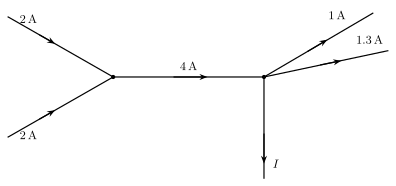
›Reveal solutionSolution
Kirchhoff's current (junction) law: total current into a junction equals total current out; applying it at each junction of the circuit gives I = 1.7 A.
At the left junction, two branches each carrying 2 A flow in, so by charge conservation the single wire leaving that junction toward the right junction carries their sum: 2A+2A=4A.
…
- CBSE 2023Set MODEL1 markMCQQ.Kirchhoff's second law relates to:(a) Conservation of mass(b) Conservation of charge(c) Conservation of energy(d) Conservation of momentum
›Reveal solutionSolution
Kirchhoff's voltage (second) law is a statement of energy conservation in a closed loop.
Kirchhoff's second law (the loop rule) states that the algebraic sum of changes in potential around any closed loop in a circuit is zero. Since potential difference is energy per unit charge, this is equivalent to saying that the total energy gained by a charg …
- CBSE 2023Set ANNUAL1 markMCQQ.Kirchhoff's loop rule is a direct consequence of law of conservation of(1) Charge(2) Momentum(3) Angular momentum(4) Energy
›Reveal solutionSolution
The loop rule says the algebraic sum of potential changes around any closed loop is zero — this is just a statement that the electric field is conservative, so energy is conserved.
Going around a closed loop and summing all emfs and IR drops, ∑ΔV=0. If this were not true, a charge taken around the loop would gain or lose energy for free, violating conservation of ene …
- CBSE 2023Set ANNUAL1 markQ.Are Kirchhoff's rules applicable to both a. c. and d. c. ?
›Reveal solutionSolution
Kirchhoff's rules follow from conservation of charge and energy, which hold at every instant, so they apply equally to a.c. and d.c. circuits.
Kirchhoff's current rule (junction rule) is a statement of conservation of electric charge, and Kirchhoff's voltage rule (loop rule) is a statement of conservation of energy. Both conservation laws hold at every instant of time, regardless of whether the currents/voltages are steady (d.c.) or varying with time (a.c.). Hence, at any given instant, the algebraic sum of currents at a junct …
- CBSE 2020Set ANNUAL1 markMCQQ.Kirchhoff's point rule is a direct consequence of law of conservation of(a) Energy(b) Linear momentum(c) Angular momentum(d) Charge
›Reveal solutionSolution
Kirchhoff's two rules each restate a conservation law: the junction rule restates conservation of charge, and the loop rule restates conservation of energy.
Kirchhoff's point rule (also called the junction rule or current law) says that at any junction in a circuit, the sum of currents entering the junction equals the sum of currents leaving it:
sum of I_in = sum of I_out
…
🎓Unlock everything free for 14 days
- ✓Full step-by-step solutions
- ✓Concept-first explanations
- ✓Methods, shortcuts & mistakes
- ✓PYQ mapping + timed mock tests
Full access for 14 days. No credit card required.