Q.State and explain Huygen's principle. Prove Snell's law of refraction on the basis of Huygen's principle. OR What is diffraction of light ? Explain diffraction of light at a single slit and derive an expression for width of central maxima.
You're viewing a preview — the full solution, concept, methods & PYQ mapping are locked.
Start your 14-day free trial to unlock the full solution →Huygens' principle treats each point of a wavefront as a source of secondary spherical wavelets whose common tangent gives the new wavefront; applying this at a plane interface yields Snell's law. Diffraction at a single slit produces a bright central maximum flanked by weaker secondary maxima, the central maximum being twice as wide as the others.
Huygens' Principle & Snell's Law
Huygens' principle states:
- Every point on a wavefront (the locus of points at the same phase) acts as a source of new secondary spherical wavelets, spreading out at the speed of light in that medium.
- The new wavefront at a later time is the forward common tangent (envelope) to all these secondary wavelets.
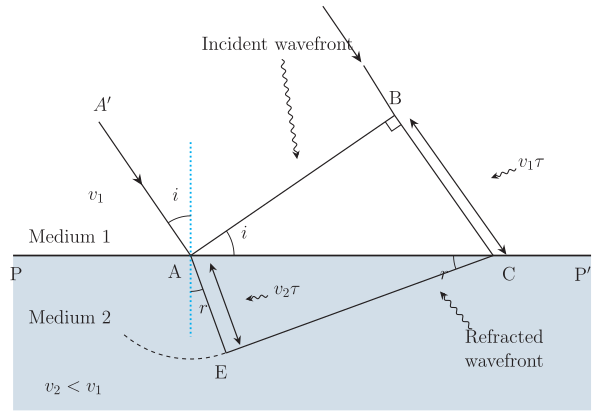
Derivation of Snell's law: Let a plane wavefront AB, travelling in medium 1 (speed ), be incident on a plane refracting surface at angle of incidence , and refract into medium 2 (speed ) at angle of refraction . While the point B of the wavefront (still in medium 1) takes time to reach the surface at C, the secondary wavelet from A (which reached the surface earlier) spreads into medium 2 to reach D, in the same time . Then and , with AC as the common side along the interface.
From the geometry of the two right triangles sharing side AC:
Dividing:
Since refractive index , i.e. , :
This is Snell's law of refraction, derived purely from the wave picture of light.
OR — Diffraction at a single slit
Diffraction is the bending of light waves around the edges of an obstacle or aperture, and their spreading into the region of geometrical shadow — most pronounced when the obstacle/aperture size is comparable to the wavelength of light.
…
Unlock everything free for 14 days
- Full step-by-step solutions
- Concept-first explanations
- Methods, shortcuts & mistakes
- PYQ mapping + timed mock tests
Full access for 14 days. No credit card required.