Q.Define electric dipole moment. Derive an expression for the electric field at a point on equatorial (broad-side-on) position of an electric dipole. OR State Gauss's theorem in electrostatics. Use this theorem to derive expressions for electric field due to uniformly charged thin spherical shell at a point
You're viewing a preview — the full solution, concept, methods & PYQ mapping are locked.
Start your 14-day free trial to unlock the full solution →An electric dipole's moment is p = q(2a); using Coulomb's law and vector addition for a point on its perpendicular bisector (equatorial line) gives a field E = kp/r^3, directed antiparallel to p — weaker than the axial field by a factor of 2, and this OR question's primary part is answered (the Gauss's-theorem alternative is not separately solved).
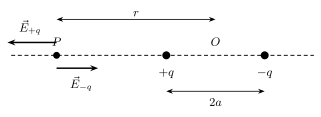
DEFINITION OF ELECTRIC DIPOLE MOMENT: An electric dipole consists of two equal and opposite point charges (+q and -q) separated by a small distance 2a. Its electric dipole moment is a vector
p = q * (2a),
directed from the negative charge to the positive charge along the dipole axis.
FIELD AT AN EQUATORIAL (BROAD-SIDE-ON) POINT: Consider a point P on the equatorial line (the perpendicular bisector of the line joining -q and +q), at a distance r from the centre O of the dipole.
STEP 1 — Distance from each charge to P: Since P is equidistant from both charges' actual positions,
distance from +q to P = distance from -q to P = sqrt(r^2 + a^2).
STEP 2 — Magnitude of each individual field at P:
E(+q) = E(-q) = kq / (r^2 + a^2), where k = 1/(4pi*epsilon0).
STEP 3 — Direction and vector addition: E(+q) points away from +q, and E(-q) points towards -q. By symmetry, the components of these two fields perpendicular to the dipole axis cancel, while the components parallel to (anti-parallel to) the dipole axis add up. Each field makes an angle theta with the axis such that cos(theta) = a / sqrt(r^2+a^2). The resultant field is along the direction opposite to p (from +q side towards -q side):
…
Unlock everything free for 14 days
- Full step-by-step solutions
- Concept-first explanations
- Methods, shortcuts & mistakes
- PYQ mapping + timed mock tests
Full access for 14 days. No credit card required.