Q.Derive an expression for the electric field at a point on equatorial (broad side on) position of an electric dipole.
You're viewing a preview — the full solution, concept, methods & PYQ mapping are locked.
Start your 14-day free trial to unlock the full solution →Add the fields of the +q and -q charges at an equatorial point; their components along the axis cancel and the perpendicular components add, giving a net field antiparallel to p that falls off as 1/r^3 for large r.
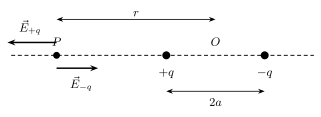
Consider a dipole made of charges +q and -q separated by 2a, with the dipole moment p = q*(2a) pointing from -q to +q. Let P be a point on the equatorial line (perpendicular bisector of the dipole), at distance r from the centre O.
Distance from each charge to P: d = sqrt(r^2 + a^2), the same for both +q and -q by symmetry.
Magnitude of field due to each charge at P: E_+ = E_- = (1/4piepsilon_0) * q / (r^2 + a^2)
By symmetry, the components of E_+ and E_- ALONG the dipole axis are equal and opposite, so they cancel. The components PERPENDICULAR to the axis (i.e. parallel to -p, since the field of +q points away from +q and the field of -q points toward -q) add up. Each perpendicular component is E_+ * cos(theta), where cos(theta) = a / sqrt(r^2+a^2).
Net field: E = 2 * E_+ * cos(theta) = 2 * [(1/4piepsilon_0) * q / (r^2+a^2)] * [a / sqrt(r^2+a^2)]
…
Unlock everything free for 14 days
- Full step-by-step solutions
- Concept-first explanations
- Methods, shortcuts & mistakes
- PYQ mapping + timed mock tests
Full access for 14 days. No credit card required.