Q.What is electric dipole? Explain its physical significance. Derive the expression for the electric field due to electric dipole at a point located in its equatorial plane. OR Using Kirchhoff's rules related to electric circuits, derive the condition for balanced state of any Wheatstone bridge. For the following Wheatstone bridge circuit, determine the value of unknown resistance R in the balanced state - [FIGURE: A Wheatstone-bridge diamond circuit with four vertices (left, top, right, bottom). Arms: left-to-top = 20 Ω, top-to-right = R (unknown), right-to-bottom = 20 Ω, bottom-to-left = 10 Ω. A galvanometer (shown as a circle with an arrow, marked 80 Ω) is connected across the bridge diagonal between the top and bottom vertices. A battery E is connected across the left and right vertices via the outer bottom wire.]
You're viewing a preview — the full solution, concept, methods & PYQ mapping are locked.
Start your 14-day free trial to unlock the full solution →Dipole = model for polar molecules; equatorial field derived by vector addition of the two charges' fields, giving E ∝ 1/r³ for r >> a.
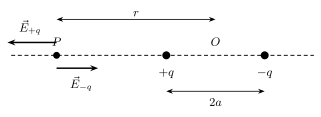
An electric dipole is a pair of equal and opposite point charges separated by a small distance ; its dipole moment is , directed from to .
Physical significance: many neutral molecules (e.g. water, HCl) have their centres of positive and negative charge separated and behave as permanent electric dipoles; the dipole model is also the leading-order approximation for the far-field of any localized, overall-neutral but asymmetric charge distribution, and underlies the polarization response of dielectric materials in an external field.
Field on the equatorial line: Let P be a point on the perpendicular bisector of the dipole, at distance from its centre O. Distance of P from each charge is , and each charge produces a field of magnitude at P, directed along the line joining that charge to P. By symmetry, the components of these two fields along the dipole axis cancel, while the components perpendicular to the axis (anti-parallel to ) add up. The resultant is , where , giving , directed opposite to . For : .
…
Unlock everything free for 14 days
- Full step-by-step solutions
- Concept-first explanations
- Methods, shortcuts & mistakes
- PYQ mapping + timed mock tests
Full access for 14 days. No credit card required.