Q.What is Biot-Savart law? Derive an expression for the magnetic field at a point on the axis of a current carrying circular loop.
🔒You're viewing a preview — the full solution, concept, methods & PYQ mapping are locked.
🔒 Start your 14-day free trial to unlock the full solution →Concept understanding — Magnetic Field on the Axis of a Circular Current Loop
Generalising the centre-of-loop field calculation to any point P on the loop's axis (the line through the centre, perpendicular to the loop's plane) at distance z from the centre requires resolving each current element's contribution into an axial and a perpendicular component; by symmetry, the perpendicular components from diametrically opposite elements cancel exactly, leaving only the axial components to sum. Carrying out this integration gives Bz=2(z2+R2)3/2μ0IR2 for a single-turn loop of radius R (or with an extra factor of N for N turns), which correctly reduces to the simpler centre-of-loop formula when z = 0. …
The Biot-Savart law gives the field contributed by each tiny current element, and integrating (summing) these contributions around the whole loop -- using symmetry to keep only the axial components -- produces the closed-form expression for the field on the axis. …
Sum (integrate) the Biot-Savart contribution of every current element around the loop; by symmetry only the axial components survive, giving B = mu_0IR^2/[2*(R^2+x^2)^(3/2)].
BIOT-SAVART LAW: it gives the magnetic field dB produced at a point P by a small current-carrying element of length dl, carrying current I:
dB = (mu_0 / 4*pi) * (I * dl * sin(theta)) / r^2
where r is the distance from the current element to the point P, and theta is the angle between the current element's direction dl and the line joining the element to P. The direction of dB is perpendicular to both dl and r, given by the right-hand rule. (In vector form: dB = (mu_0/4*pi) * I * (dl x r_hat) / r^2.)
FIELD ON THE AXIS OF A CIRCULAR CURRENT LOOP: Consider a circular loop of radius R, carrying current I, lying in a plane. Let P be a point on the axis of the loop (the line through the centre, perpendicular to the loop's plane), at a distance x from the centre O.
For any small current element dl on the loop, the distance to P is r = sqrt(R^2 + x^2), the same for every element by symmetry. Since dl is always perpendicular to r (the line from the element to any axial point makes the current element tangential, and geometrically the angle between dl and r is 90 degrees for this configuration), sin(theta) = 1, so
dB = (mu_0/4pi) * Idl / (R^2+x^2)
…
- CBSE 2026Set ANNUAL3 marksQ.Using the Biot-Savart law, find the expression for the magnetic field at any point on the axis of a circular coil carrying current.
›Reveal solutionSolution
Each current element contributes a Biot–Savart field perpendicular to the line joining it to the axial point; by symmetry the components perpendicular to the axis cancel in pairs, and only the axial components survive, integrating to B=μ0IR2/2(R2+x2)3/2.
Setup
Consider a circular coil of radius R, carrying current I, lying in a plane. Let P be a point on the axis of the coil, at a distance x from the centre O.
Every current element Idl on the coil is at the same distance from P:
r=R2+x2
Biot–Savart law for one element
dB=4πμ0r2Idl×r^
Since dl (tangential to the circle) is perpendicular to r (the line from the element to P) for every element on the coil, ∣dl×r^∣=dl, so the magnitude of each contribution is:
dB=4πμ0r2Idl=4πμ0R2+x2Idl
The direction of dB is perpendicular to the plane containing dl and r.
Resolving into axial and perpendicular components
By symmetry, resolve each dB into a component along the axis (dBx) and a component perpendicular to the axis (dB⊥, lying in the plane perpendicular to the axis). For every element, there is a diametrically opposite element on the coil whose perpendicular component dB⊥ points in exactly the opposite direction — so summing over the whole coil, all the perpendicular components cancel out in pairs. Only the axial components survive and add up.
The axial component of each element's contribution is:
dBx=dBsinθ,where sinθ=rR=R2+x2R
…
- CBSE 2024Set ANNUAL3 marksQ.Derive expression of magnetic field at any point on the axis for a current carrying circular loop by Biot-Savart's law. Draw necessary diagram. OR Derive formula for the force per unit length acting on the two straight parallel current carrying conductors. Draw necessary diagram.
›Reveal solutionSolution
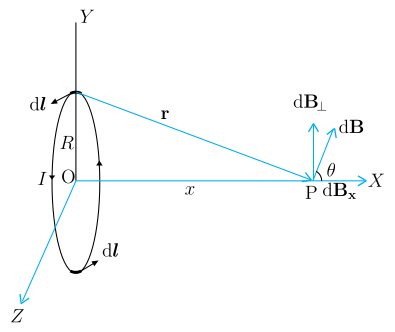
Figure — The answered alternative (field on the axis of a circular loop by Biot-Savart) needs its geometry; the catalog Applying the Biot-Savart law to every current element of the loop and integrating, the components perpendicular to the axis cancel by symmetry, leaving a net axial field.
Consider a circular loop of radius R carrying current I, lying in a plane, and let P be a point on its axis at a distance x from the centre O.
By the Biot-Savart law, a current element Idl at the top of the loop produces a field at P of magnitude:
dB=4πμ0r2Idlsin90°=4πμ0R2+x2Idl
(since dl is always perpendicular to r, the line joining the element to P, and r=R2+x2), directed perpendicular to r, in the plane containing the axis and r.
This dB can be resolved into a component dBcosθ along the axis (where cosθ=R/R2+x2) and a component dBsinθ perpendicular to the axis. By symmetry, for every element there is a diametrically opposite element whose perpendicular component exactly cancels it, while the axial components from all elements add up.
Integrating the axial component around the full loop (circumference 2πR):
…
- CBSE 2024Set ANNUAL3 marksQ.Derive an expression for magnetic field on the axis of current carrying coil of radius 'a' at a distance 'x' from the centre of coil.
›Reveal solutionSolution
Apply the Biot–Savart law to a current element, sum the axial components (the perpendicular components cancel by symmetry) around the whole loop.
Consider a circular coil of radius a carrying current I, and a point P on its axis at distance x from the centre O.
Take a small current element Idl on the loop. The distance from this element to P is
r=a2+x2
By the Biot–Savart law, the magnetic field due to this element at P has magnitude
dB=4πμ0r2Idlsin90∘=4πμ0a2+x2Idl
(since dl is tangent to the loop and r from the element to P is always perpendicular to dl), and dB is perpendicular to r, i.e. it lies in the plane containing the axis and makes an angle θ with the axis, where cosθ=rx... actually sinθ=a/r (angle between dB and the axis relates to the geometry): resolve dB into two components — …
- CBSE 2023Set 55/4/13 marksQ.Two circular loops A and B, each of radius 3 m, are placed coaxially at a distance of 4 m. They carry currents of 3 A and 2 A in opposite directions respectively. Find the net magnetic field at the centre of loop A.
›Reveal solutionSolution
The net magnetic field at the center of loop A is the vector sum of the field produced by loop A itself and the field produced by loop B. Since the currents are in opposite directions, these fields oppose each other. The net magnetic field is 125214π×10−7 T directed away from loop B.
The problem asks for the net magnetic field at the center of loop A. This net field is the vector sum of two contributions:
- The magnetic field produced by loop A at its own center.
- The magnetic field produced by loop B at the center of loop A.
Since both loops are circular and coaxial, their magnetic fields at any point on their common axis will also be directed along this axis. Therefore, we need to determine the magnitude and direction of each field component and then perform a vector sum. The key is to correctly identify the direction of each field using the right-hand thumb rule, especially considering the currents are in opposite directions.
Let's assume the common axis of the loops is the x-axis. Let the center of loop A be at x=0 and the center of loop B be at x=4 m.
-
Identify given parameters:
- Radius of each loop, R=3 m.
- Distance between loops, d=4 m. This is the distance from the center of loop B to the center of loop A.
- Current in loop A, IA=3 A.
- Current in loop B, IB=2 A.
- Currents are in opposite directions.
-
Magnetic field due to loop A at its own center (BA):
We use the formula for the magnetic field at the center of a circular current loop.
The magnetic field at the center of a circular loop of radius R carrying current I is given by:
B=2Rμ0I
Let's assume the current in loop A is counter-clockwise when viewed from a point on the positive x-axis. By the right-hand thumb rule, the magnetic field BA at the center of loop A will point along the positive x-axis (away from loop B).
Substituting the values:
BA=2×(3 m)(4π×10−7 T⋅m/A)×(3 A)
BA=612π×10−7 T
BA=2π×10−7 T (directed along the positive x-axis).
-
Magnetic field due to loop B at the center of loop A (BB):
We use the formula for the magnetic field on the axis of a circular current loop. The center of loop A is on the axis of loop B, at a distance d=4 m from the center of loop B.
The magnetic field on the axis of a circular loop of radius R carrying current I, at a distance x from its center, is given by:
B=2(R2+x2)3/2μ0IR2
Since the current in loop B is in the opposite direction to loop A, and we assumed loop A's current is counter-clockwise, loop B's current must be clockwise (when viewed from a point on the positive x-axis). By the right-hand thumb rule, the magnetic field BB produced by loop B at any point on its axis (including the center of loop A) will point along the negative x-axis (towards loop B).
Substituting the values: R=3 m, x=4 m, IB=2 A. …
- CBSE 2023Set ANNUAL3 marksQ.(a) State Biot-Savart law.(1)(b) Obtain the expression for the magnetic field on the axis of a circular current loop. (2)
›Reveal solutionSolution
The Biot–Savart law gives the magnetic field due to a small current element; integrating it around a circular loop gives the axial field B=μ0IR2/[2(R2+x2)3/2], which reduces to μ0I/2R at the centre.
- Biot–Savart law: The magnetic field dB at a point P due to a small current element Idl is: dB=4πμ0r2Idl×r^ where r is the distance from the current element to P, and r^ is the unit vector from the element to P. In magnitude, dB=4πμ0r2Idlsinθ, where θ is the angle between dl and r^.
- Field on the axis of a circular current loop: Consider a circular loop of radius R carrying current I, and a point P on its axis at a distance x from the centre O. For every current element dl on the loop, the distance to P is r=R2+x2, and dl is always perpendicular to r (so sinθ=1). Hence: dB=4πμ0R2+x2Idl …
- CBSE 2023Set ANNUAL3 marksQ.Using Biot-Savart's law, find the magnitude of magnetic field on the axis of a circular current carrying coil. OR Explain the working principle of moving coil galvanometer with a labelled diagram.
›Reveal solutionSolution
Integrating the Biot-Savart contributions of all current elements around the loop, only the axial components survive, giving B=2(R2+x2)3/2μ0IR2.
Consider a circular loop of radius R carrying current I, and a point P on its axis at distance x from the centre O. Consider a current element Idl on the loop; its distance from P is s=R2+x2, and it is always perpendicular to the line joining the element to P.
By the Biot-Savart law, the field due to this element at P has magnitude:
dB=4πμ0s2Idl=4πμ0R2+x2Idl
directed perpendicular to s, i.e. it has a component along the axis and a component perpendicular to the axis.
By symmetry, as we sum contributions from all elements around the loop, the perpendicular (radial) components cancel out in pairs from diametrically opposite elements, while the axial components all add up. The axial component of each dB is:
dBx=dBsinθ=dB⋅sR=dB⋅R2+x2R …
- CBSE 2018Set 55/13 marksQ.(a) State Biot - Savart law and express it in the vector form.(b) Using Biot - Savart law, obtain the expression for the magnetic field due to a circular coil of radius r, carrying a current I at a point on its axis distant x from the centre of the coil.
›Reveal solutionSolution
Biot–Savart: dB=4πμ0r2Idl×r^; axial field of a coil =2(r2+x2)3/2μ0Ir2.
- Statement. The magnetic field dB due to a current element Idl at a point P at position r from the element has magnitude dB=4πμ0r2Idlsinθ (θ = angle between dl and r), directed perpendicular to the plane of dl and r. In vector form: dB=4πμ0r2Idl×r^.
- Field on the axis of a circular coil. Consider a coil of radius r carrying current I; P is on the axis at distance x from the centre. Each element is at distance r2+x2 from P, and dl⊥r, so dB=4πμ0(r2+x2)Idl. …
🎓Unlock everything free for 14 days
- ✓Full step-by-step solutions
- ✓Concept-first explanations
- ✓Methods, shortcuts & mistakes
- ✓PYQ mapping + timed mock tests
Full access for 14 days. No credit card required.