Q.Write the formula of Biot-Savart law in vector form. Obtain the formula of magnetic field at any point on the axis for a current carrying circular loop using this law. Draw necessary diagram. OR Write Ampere's circuital law. A steady electric current 'I' is uniformly flowing in a long straight wire of radius 'a'. Obtain the expression of the magnetic field outside the wire at a point at distance 'r' (r > a). Draw necessary diagram.
You're viewing a preview — the full solution, concept, methods & PYQ mapping are locked.
Start your 14-day free trial to unlock the full solution →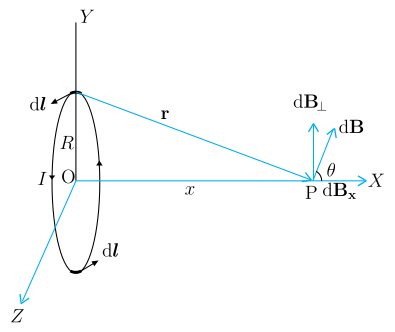
Applying the Biot-Savart law to every current element around a circular loop, and using symmetry to keep only the axial components, gives the standard on-axis field formula.
Biot-Savart law (vector form): the magnetic field dB produced at a point P by a small current element I dl (position vector r from the element to P) is:
dB = (mu0 / 4pi) * I (dl x r_hat) / r^2 = (mu0 / 4pi) * I (dl x r) / r^3
directed perpendicular to both dl and r (given by the right-hand/cross-product rule); mu0 is the permeability of free space.
Field on the axis of a circular current loop:
Consider a circular loop of radius a, carrying steady current I, lying in the y-z plane with its centre at O. Let P be a point on the axis (x-axis) at a distance x from O.
For a current element I dl at the top of the loop, the distance to P is r = sqrt(a^2 + x^2). Since dl is always perpendicular to r for points on the axis (the element is tangential to the loop, and r lies in the plane containing the axis and that element), the magnitude of dB is:
dB = (mu0 / 4*pi) * I dl / (a^2 + x^2)
This dB is perpendicular to r, and can be resolved into two components: one along the axis (dB_x) and one perpendicular to the axis (dB_perp, in the plane of the loop). By symmetry, for every current element there is a diametrically opposite element whose perpendicular component dB_perp is equal and opposite, so all perpendicular components cancel when summed around the full loop; only the axial components dB_x add up.
…
Unlock everything free for 14 days
- Full step-by-step solutions
- Concept-first explanations
- Methods, shortcuts & mistakes
- PYQ mapping + timed mock tests
Full access for 14 days. No credit card required.