Q.State the Biot-Savart law. Using this law, find an expression for the magnetic field at a point which is at a distance , on the axis of a circular current-carrying loop of radius . Also find the magnetic field if point lies at the centre of the loop. (1+3+1=5) OR An AC voltage is applied across a pure inductor of inductance . Show mathematically that the current flowing through it lags behind the applied voltage by a phase angle of . Explain the term 'inductive reactance' and show that a pure inductor acts as a conductor for DC. (3+1+1=5)
You're viewing a preview — the full solution, concept, methods & PYQ mapping are locked.
Start your 14-day free trial to unlock the full solution →The Biot-Savart law gives the field due to a current element; integrating its axial component around a circular loop gives , reducing to at the centre. For the alternative, solving for a sinusoidal applied voltage shows the inductor current lags the voltage by and offers zero opposition to DC.
Biot-Savart law
The magnetic field due to a small current element at a point P, whose position vector relative to the element is (unit vector ), is
is the permeability of free space; the direction of is perpendicular to both and (given by the right-hand rule).
Field on the axis of a circular current loop
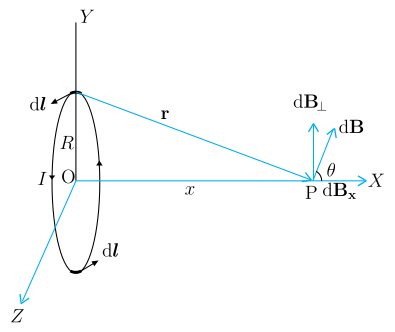
Consider a circular loop of radius , carrying current , and a point on its axis at distance from the centre . For any current element on the loop, the distance to is
and since is tangential to the loop while (from the element to ) lies in the plane containing the axis and the radius to that element, , so
By symmetry, as we sum from all elements around the loop, the components perpendicular to the axis cancel in pairs, and only the components along the axis survive. Each makes angle with the axis, where , so the axial component is .
Integrating around the full loop (circumference ):
Field at the centre of the loop
Setting :
…
Unlock everything free for 14 days
- Full step-by-step solutions
- Concept-first explanations
- Methods, shortcuts & mistakes
- PYQ mapping + timed mock tests
Full access for 14 days. No credit card required.