Physics · Ch 9 — Ray Optics and Optical Instruments
Refraction at a Spherical Surface
Refraction at a Spherical Surface
Refraction at a Spherical Surface
When light travels from one transparent medium to another across a curved spherical surface, the path of the rays bends. The geometry of this bending is governed by Snell’s law and the curvature of the surface. For a small aperture (the surface’s lateral size is small compared to other distances), we can use small-angle approximations.
Consider a spherical surface with centre of curvature and radius of curvature . An object lies on the principal axis. Rays from are incident from a medium of refractive index into another medium of refractive index . The image is formed on the principal axis.
Derivation of the Formula
-
Small-angle approximations: For small angles, the perpendicular from point on the surface to the principal axis is approximately equal to . The tangents of the relevant angles are:
-
Angle of incidence (): In triangle , the exterior angle equals the sum of the two opposite interior angles:
- Angle of refraction (): In triangle , the angle is the difference between two angles:
- Applying Snell’s law: For small angles, and . Snell’s law becomes:
- Substituting and : Substitute the expressions for and into the simplified Snell’s law:
Cancelling $MN$ (which is non-zero) gives:
Rearranging:
- Applying the Cartesian sign convention: The distances , , and are magnitudes. Using the sign convention:
- Object distance: (object is to the left of the surface) …
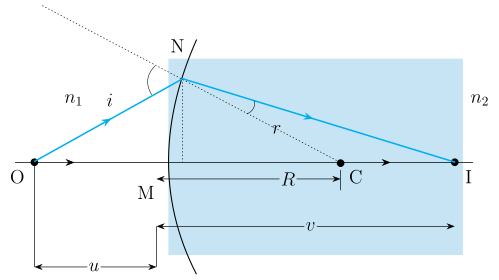
Drawn by us to help you understand the concept clearly, and verified to make sure it's accurate. For exams, practice from your textbook's own diagram.
What the Figure Shows
The figure depicts a convex spherical refracting surface — a single curved arc — that separates two transparent media. The medium to the left has refractive index (optically rarer), and the medium to the right has refractive index (optically denser, ). The principal axis is a horizontal straight line passing through the centre of curvature and the pole of the spherical surface. The radius of curvature is the distance along the axis.
A point object is placed on the principal axis in medium . One ray from travels along the axis (the axial ray) and strikes the surface normally at , continuing undeviated. Another ray from strikes the surface at point (not at the pole). At , the ray refracts and bends toward the normal (since ), and after refraction it meets the axial ray at point on the principal axis in medium . Thus is the real image of formed by the spherical surface.
Key Geometrical Elements and Labels
- : object point on the principal axis in medium .
- : image point on the principal axis in medium .
- : centre of curvature of the spherical surface, on the principal axis.
- : pole of the spherical surface (the point where the principal axis meets the surface).
- : point of incidence of the non-axial ray on the spherical surface.
- : radius of curvature, .
- , : refractive indices of the two media.
- Angles marked: , , — these are the angles that the incident ray, the radius, and the refracted ray make with the principal axis, respectively. The angle of incidence is the exterior angle of triangle , and the angle of refraction is the difference .
Physical Idea Taught
The figure illustrates how a single spherical surface can form an image by refraction. The derivation uses the small-angle approximation (aperture of the surface is small compared to distances , , ), so that the perpendicular is nearly equal to the arc length, and . By applying Snell's law () in the small-angle limit (), and expressing and in terms of the distances , , , the textbook arrives at the fundamental relation for refraction at a spherical surface.
Key Formula Derived
The final result, after applying the Cartesian sign convention, is:
where: …