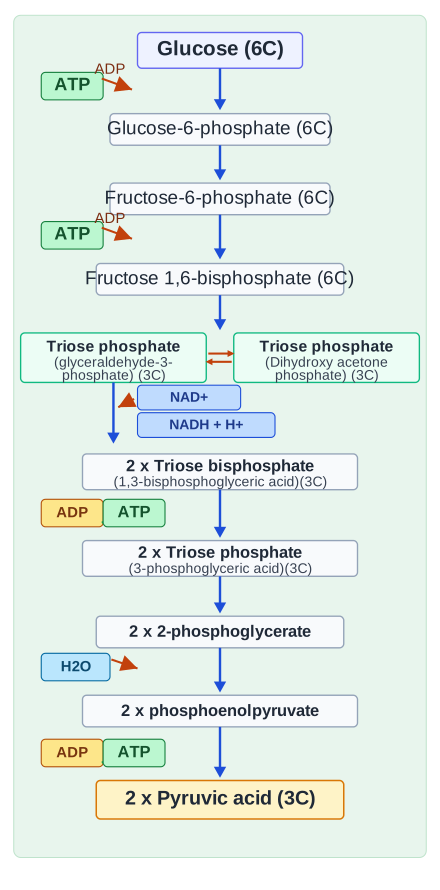
Glycolysis: The Universal Energy Starter
Imagine you eat a piece of bread. Your body breaks that starch down into glucose — a simple sugar with 6 carbon atoms. But glucose is too stable to be useful directly. Your cells need to crack it open and extract energy from it. Glycolysis is that first cracking step. It happens in the cytoplasm of every living cell, from bacteria to your own muscle cells, and it requires no oxygen.
The word itself tells you what happens: glyco = sugar, lysis = splitting. You start with one 6-carbon glucose molecule and end with two 3-carbon pyruvate molecules. Along the way, you capture a little energy and rearrange the atoms.
The Big Picture: What Goes In, What Comes Out
Glucose (6C)+2 NAD++2 ADP+2 Pi⟶2 Pyruvate (3C)+2 NADH+2 H++2 ATP
That's the net equation. But the real story is in the steps — and there are 10 of them, divided into two clear phases.
Phase 1: The Investment Phase (Steps 1–5)
You have to spend energy before you can earn it. The cell uses 2 ATP molecules to phosphorylate glucose — that is, to attach phosphate groups to it. This does two things: it makes the molecule more reactive, and it traps it inside the cell (phosphorylated glucose cannot leave the membrane).
The 6-carbon chain is then split into two 3-carbon molecules called glyceraldehyde-3-phosphate (G3P). One of the two products is actually a different molecule, but an enzyme quickly converts it into G3P as well. So after step 5, you have two identical 3-carbon molecules, each with one phosphate group attached.
No ATP has been made yet. You are 2 ATP in the hole.
Phase 2: The Payoff Phase (Steps 6–10)
Now each G3P molecule goes through a series of reactions that generate energy. The key events:
- Each G3P is oxidised — it loses electrons (and hydrogen atoms) to NAD⁺, producing NADH. This is the first energy capture.
- Substrate-level phosphorylation happens twice — phosphate groups are transferred from the sugar intermediates directly to ADP, making ATP. Each G3P produces 2 ATP, so from two G3P molecules you get 4 ATP.
- The final product is pyruvate, a 3-carbon molecule.
The Net Tally
| Item | Count |
|---|
| Glucose consumed | 1 |
| ATP used (investment) | 2 |
| ATP produced (payoff) | 4 |
| Net ATP | 2 |
| NADH produced | 2 |
| Pyruvate produced | 2 |
You end with a modest profit of 2 ATP and 2 NADH. That NADH will later be fed into the electron transport chain (if oxygen is present) to make much more ATP. But even without oxygen — in anaerobic conditions — glycolysis alone can keep a cell alive for a while, as in your muscles during a sprint. …