Question of 52
Q.Draw the ray-diagram of glycolysis. OR Write the differences between cyclic and non-cyclic photophosphorylation.
Madhya Pradesh MpbseMP Board Higher Secondary (Class 11) 2019Subjective· 5mImportance★★★★★
0% · 0/52 Questions
You're viewing a preview — the full solution, concept, methods & PYQ mapping are locked.
Start your 14-day free trial to unlock the full solution →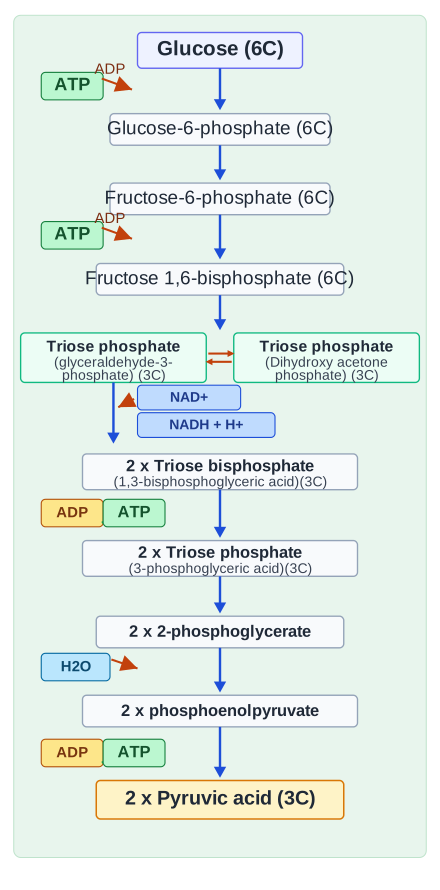
Glycolysis is a 10-step enzymatic pathway in the cytoplasm that converts one 6-carbon glucose molecule into two 3-carbon pyruvate molecules, with a net gain of 2 ATP and 2 NADH.
The glycolytic pathway (Embden-Meyerhof-Parnas pathway), occurring entirely in the cytoplasm and common to both aerobic and anaerobic respiration, proceeds through the following steps (a ray diagram listing each intermediate in sequence):
- Glucose is phosphorylated by ATP (using hexokinase) to Glucose-6-phosphate. [uses 1 ATP]
- Glucose-6-phosphate is isomerised to Fructose-6-phosphate.
- Fructose-6-phosphate is phosphorylated by ATP (using phosphofructokinase) to Fructose-1,6-bisphosphate. [uses 1 ATP]
- Fructose-1,6-bisphosphate is split by aldolase into two 3-carbon sugars: Dihydroxyacetone phosphate (DHAP) and Glyceraldehyde-3-phosphate (G3P). DHAP is converted to a second G3P, so from here every step happens twice per original glucose.
- Each G3P is oxidised and phosphorylated (using inorganic phosphate and NAD+) to 1,3-Bisphosphoglycerate, generating NADH. [produces 2 NADH total]
- Each 1,3-Bisphosphoglycerate transfers a phosphate to ADP, forming 3-Phosphoglycerate and ATP (substrate-level phosphorylation). [produces 2 ATP total]
- 3-Phosphoglycerate is converted to 2-Phosphoglycerate.
- 2-Phosphoglycerate loses water to form Phosphoenolpyruvate (PEP).
- PEP transfers its phosphate to ADP, forming Pyruvate and ATP (substrate-level phosphorylation). [produces 2 ATP total] …
Unlock everything free for 14 days
- Full step-by-step solutions
- Concept-first explanations
- Methods, shortcuts & mistakes
- PYQ mapping + timed mock tests
Full access for 14 days. No credit card required.