Q.Rotation around carbon-carbon single bond of ethane is not completely free. Justify the statement.
🔒You're viewing a preview — the full solution, concept, methods & PYQ mapping are locked.
🔒 Start your 14-day free trial to unlock the full solution →Concept understanding — Free Radical Mechanism
Free Radical Mechanism – From Intuition to Precision
Imagine you have a long chain of paperclips linked together. Now imagine someone snips one link in the middle. That single cut doesn't just break the chain — it creates two new ends, each hungry to grab onto something. That's the core idea of a free radical mechanism: a reaction that proceeds through species with an unpaired electron — a "hungry" atom or molecule that desperately wants to pair up.
The Intuition: Why Radicals Are Special
Most chemical bonds involve paired electrons — two electrons spinning in opposite directions, like a stable couple. A free radical is the chemical equivalent of a lone wolf: it has one unpaired electron, making it highly reactive. It will do almost anything to find a partner — steal an electron from a neighbour, donate its own, or break another bond to create more radicals.
This creates a chain reaction. One radical reacts, produces another radical, which reacts again, and so on — like a row of dominoes falling one after another. That's why free radical mechanisms are often called chain reactions.
The Precise Statement
A free radical mechanism is a stepwise reaction pathway involving species with unpaired electrons (free radicals). It proceeds through three distinct phases:
- Initiation – A stable molecule is broken to produce two free radicals. This usually requires energy — heat (thermolysis) or light (photolysis).
- Propagation – Radicals react with stable molecules to produce new radicals. This step repeats many times, forming the chain.
- Termination – Two radicals combine to form a stable product, ending the chain.
General pattern:
Initiation: A−Bhν or ΔA⋅+B⋅
Propagation: A⋅+C−D→A−C+D⋅
Termination: A⋅+D⋅→A−D
A Concrete Example: Chlorination of Methane
This is the classic textbook example, and it appears in almost every Indian board exam (Class 11/12, JEE, NEET).
Overall reaction:
CH4+Cl2hνCH3Cl+HCl
Step-by-step mechanism:
Initiation – Chlorine molecule absorbs UV light and splits:
Cl2hν2Cl⋅
Propagation – Two steps that repeat:
- Chlorine radical attacks methane:
Cl⋅+CH4→HCl+CH3⋅
- Methyl radical attacks another chlorine molecule:
CH3⋅+Cl2→CH3Cl+Cl⋅
Notice: the Cl⋅ consumed in step 1 is regenerated in step 2. This is the chain — one radical keeps producing another.
Termination – Any two radicals meet:
Cl⋅+Cl⋅→Cl2
CH3⋅+CH3⋅→C2H6
CH3⋅+Cl⋅→CH3Cl
A common mistake: students think termination only happens when the same radicals combine. In reality, any two radicals can terminate — including cross-combination (like CH3⋅+Cl⋅). Also, termination steps are rare because radical concentrations are very low.
Key Characteristics to Remember
- Free radicals are neutral — they have no charge, only an unpaired electron. Don't confuse them with ions.
- They are highly reactive — lifetimes are typically microseconds or less. …
Rotation around C–C Single Bond in Ethane
Concept: Conformational analysis and torsional strain
Although a σ-bond permits rotation, the energy of the ethane molecule varies with the dihedral angle between the two methyl groups. This variation arises from torsional strain (Pitzer strain).
In the eclipsed conformation, the C–H bonds on adjacent carbons are aligned, bringing electron clouds into close proximity. This electron–electron repulsion raises the potential energy by approximately 12.5kJ mol−1.
In the staggered conformation, the C–H bonds are maximally separated (dihedral angle 60°), minimising repulsion and giving the lowest energy state. …
Rotation around the C–C single bond in ethane encounters a small but measurable energy barrier (~12 kJ/mol) due to torsional strain from electron-cloud repulsion between eclipsed C–H bonds. The staggered conformation is most stable, the eclipsed least stable, making rotation hindered rather than free.
The phrase "free rotation" suggests that a carbon–carbon single bond should allow the two methyl groups in ethane to spin past one another without any energy cost, like a frictionless axle. After all, a σ-bond has cylindrical symmetry about the internuclear axis, so geometrically nothing should prevent rotation. Yet experiment tells a different story: rotation is hindered.
Why rotation is not free
When you rotate one CHX3 group relative to the other in ethane, the molecule passes through different conformations—spatial arrangements that differ only by rotation about the single bond. These conformations have different potential energies because of how the electron clouds of the C–H bonds on adjacent carbons interact.
-
Staggered conformation: The C–H bonds on one carbon are as far apart as possible from those on the other (dihedral angle 60°, 180°, 300°). The electron clouds repel each other minimally. This is the lowest-energy, most stable arrangement.
-
Eclipsed conformation: The C–H bonds on adjacent carbons line up directly (dihedral angle 0°, 120°, 240°). The electron clouds are forced close together, leading to maximum repulsion. This is the highest-energy, least stable arrangement.
The energy difference between staggered and eclipsed conformations is about 12 kJ/mol. This barrier arises from torsional strain (also called Pitzer strain)—the repulsion between bonding electron pairs when bonds are eclipsed.
A common mistake is to think the barrier comes from steric repulsion between hydrogen atoms. In ethane the hydrogens are small and far apart; the dominant effect is electron-cloud repulsion between the C–H bonds themselves.
The rotation profile
As one methyl group rotates through 360°, the potential energy oscillates:
| Dihedral angle | Conformation | Relative energy |
|---|---|---|
| 0°, 120°, 240° | Eclipsed | Maximum (~12 kJ/mol) |
| 60°, 180°, 300° | Staggered | Minimum (0 kJ/mol) |
- COMEDK 2025Set 2025-E1 markMCQQ.Identify the Alkane (molecular formula C8H18 ) which yields only a single monochloride on Chlorination in the presence of sunlight. (A) 2,2,4-Trimethylpentane (B) 2,4-Dimethylhexane (C) 2,2,3,3 - Tetramethylbutane (D) 3,4-Dimethylhexane
›Reveal solutionSolution
The key idea is that only a perfectly symmetric alkane with all hydrogen atoms equivalent will produce a single monochlorination product. The molecule that satisfies this is 2,2,3,3-tetramethylbutane, which has only one type of hydrogen.
Concept & Intuition
When an alkane is chlorinated in sunlight, a hydrogen atom is replaced by chlorine. If the alkane has several different kinds of hydrogen atoms (primary, secondary, tertiary), each distinct type can give a different monochloride isomer. The question asks for the alkane that yields only one monochloride — meaning every hydrogen atom in the molecule must be chemically equivalent. This is a symmetry problem: the more symmetric the molecule, the fewer distinct hydrogen environments.
Step-by-step reasoning
-
Identify the condition for a single monochloride
For only one monochlorination product, all hydrogen atoms in the alkane must be equivalent. That means the molecule must have a structure where every carbon atom (and its attached hydrogens) is in the same chemical environment. This typically occurs in highly symmetric molecules.
-
Examine each option for symmetry and hydrogen types
-
(A) 2,2,4-Trimethylpentane
Structure:
   CH3
   |
CH3-C-CH2-CH-CH3
   |       |
   CH3     CH3
This molecule has primary hydrogens (on CH₃ groups), secondary hydrogens (on CH₂), and a tertiary hydrogen (on the CH group). At least three different types → multiple monochlorides. ✗
-
(B) 2,4-Dimethylhexane
Structure:
CH3-CH-CH2-CH-CH2-CH3
     |         |
     CH3       CH3
Contains primary, secondary, and tertiary hydrogens. Several distinct environments → multiple products. ✗
-
(C) 2,2,3,3-Tetramethylbutane
Structure:
   CH3   CH3
   |     |
CH3-C---C-CH3
   |     |
   CH3   CH3
``` …
-
-
- COMEDK 2025Set 2025-E1 markMCQQ.The correct order of reactivity of halogens with alkanes is : (A) F2>Cl2>Br2>I2 (B) F2>Br2>Cl2>I2 (C) Cl2>F2>Br2>I2 (D) I2>Br2>Cl2>F2
›Reveal solutionSolution
Halogen reactivity toward alkanes (halogenation) follows the bond-dissociation / electronegativity trend F2>Cl2>Br2>I2 — option (A).
Reasoning.
Halogenation of an alkane is a free-radical substitution whose ease is governed by how readily the halogen abstracts hydrogen. Going down group 17 the X–X bond weakens but, more importantly, the reactivity of the halogen atom toward the C–H bond falls sharply:
- F2 reacts explosively (highly exothermic, often uncontrollable).
- Cl2 reacts readily on initiation (light/heat). …
- COMEDK 2025Set 2025-E1 markMCQQ.Which of the following is the most stable free radical? (A) (C6H5)2C˙H (B) C˙H3 (C) (CH3)3C˙ (D) CH2=C˙H
›Reveal solutionSolution
The most stable free radical is the one with the greatest delocalisation of the unpaired electron. Here, the diphenylmethyl radical (A) is stabilised by resonance with two aromatic rings, making it the most stable.
Concept and intuition
Free radicals are stabilised by anything that spreads out (delocalises) the unpaired electron. Alkyl groups stabilise radicals through hyperconjugation and inductive effects — more alkyl substituents mean greater stability (tertiary > secondary > primary > methyl). But resonance with π-systems (like benzene rings or double bonds) is far more powerful. A radical adjacent to a double bond can delocalise the electron into the π-system; a radical adjacent to an aromatic ring can delocalise into the ring’s π-cloud. Two aromatic rings give even more delocalisation than one.
Step-by-step reasoning
-
Identify the stabilising features in each radical
- (A) (C6H5)2C˙H: The unpaired electron is on a carbon directly bonded to two phenyl rings. Each ring can delocalise the electron through resonance, giving many contributing structures.
- (B) C˙H3: A methyl radical — no alkyl substituents, no π-system. Only hyperconjugation from three C–H bonds, which is very weak.
- (C) (CH3)3C˙: A tertiary butyl radical — three methyl groups donate electron density via hyperconjugation and inductive effect. This is the most stable alkyl radical, but still only σ-delocalisation.
- (D) CH2=C˙H: A vinyl radical — the unpaired electron is on an sp² carbon of a double bond. The radical is not conjugated with the π-bond (it’s orthogonal), so no resonance stabilisation. In fact, vinyl radicals are less stable than methyl radicals.
-
Compare resonance vs. hyperconjugation
Resonance delocalisation spreads the unpaired electron over several atoms, dramatically lowering energy. Hyperconjugation is a weaker effect. The diphenylmethyl radical (A) has two aromatic rings, each offering multiple resonance forms — the unpaired electron can be delocalised onto ortho and para positions of both rings. This is far more stabilising than the three alkyl groups in (C).
-
Rank the radicals by stability …
-
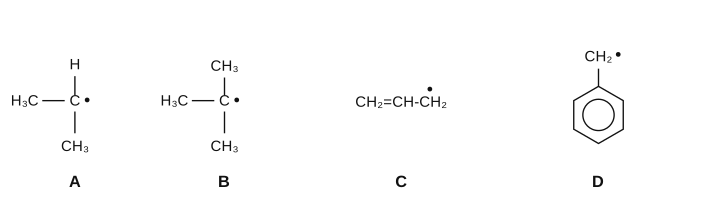
- COMEDK 2025Set 2025-M1 markMCQQ.Arrange the following free radicals in the increasing order of their stability: .tg {border-collapse:collapse;border-spacing:0;} .tg td{border-color:black;border-style:solid;border-width:1px;font-family:Arial, sans-serif;font-size:14px; overflow:hidden;padding:10px 5px;word-break:normal;} .tg th{border-color:black;border-style:solid;border-width:1px;font-family:Arial, sans-serif;font-size:14px; font-weight:normal;overflow:hidden;padding:10px 5px;word-break:normal;} .tg .tg-baqh{text-align:center;vertical-align:top} A B C D (A) A<B<D<C (B) C<D<B<A (C) C<B<D<A (D) A<B<C<D
›Reveal solutionSolution
The stability of free radicals increases with the degree of delocalisation of the unpaired electron. The order is: primary < secondary < tertiary < allyl/benzyl, but here the allyl and benzyl radicals are both resonance-stabilised, with benzyl slightly more stable due to aromatic ring conjugation. The correct order is C < B < D < A (option C).
Concept & Intuition
Free radicals are stabilised by anything that spreads out (delocalises) the unpaired electron. Alkyl groups are weakly electron-donating via hyperconjugation, so more alkyl substituents on the radical carbon mean greater stability: tertiary > secondary > primary > methyl. But resonance delocalisation into a π-system (like a double bond or an aromatic ring) is far more powerful. The allyl radical (CH₂=CH–CH₂•) and the benzyl radical (C₆H₅–CH₂•) both enjoy this stabilisation. Between them, the benzyl radical benefits from delocalisation into the aromatic ring’s π-system, which is more extensive than a single double bond, making it the most stable of the four.
Step-by-step reasoning
-
Identify each radical’s class
- A: (CH₃)₂CH• — secondary alkyl radical (two alkyl groups on the radical carbon).
- B: (CH₃)₃C• — tertiary alkyl radical (three alkyl groups).
- C: CH₂=CH–CH₂• — allyl radical (the unpaired electron is adjacent to a C=C double bond).
- D: C₆H₅–CH₂• — benzyl radical (the unpaired electron is adjacent to a benzene ring).
-
Rank alkyl radicals by hyperconjugation
More alkyl groups → more hyperconjugative structures → greater stability.
So: secondary (A) < tertiary (B).
(A primary radical would be even less stable, but none is present.)
-
Compare resonance-stabilised radicals
- The allyl radical has two equivalent resonance forms:
CH2=CH−CH˙2⟷CH˙2−CH=CH2
The unpaired electron is delocalised over three carbon atoms.- The benzyl radical has several resonance forms, including one where the unpaired electron is on the ortho or para position of the ring:
C6H5−CH˙2⟷several ring-delocalised structures
Delocalisation into an aromatic ring is more stabilising than into a simple alkene because the ring’s π-system is larger and the resulting structures retain aromaticity in the ring (the ring remains a sextet in the major contributor). Hence benzyl > allyl.4. Combine all comparisons
- Least stable: secondary alkyl (A).
- Next: tertiary alkyl (B) — more hyperconjugation than A.
- Then: allyl (C) — resonance stabilisation beats any alkyl radical.
- Most stable: benzyl (D) — even greater resonance delocalisation. So the increasing order is: A < B < C < D.
- Check the options …
-
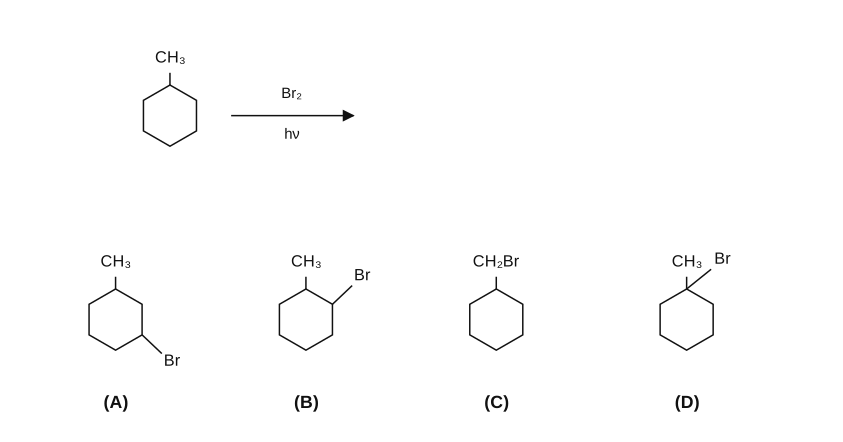
- COMEDK 2024Set 2024-A1 markMCQQ.The major product obtained in the following reaction is : (A) (B) (C) (D)
›Reveal solutionSolution
The reaction is free‑radical bromination of methylcyclohexane under light; the major product is the one where bromination occurs at the allylic‑type tertiary carbon (the ring carbon bearing the methyl group), giving a geminal dibromo‑like structure — but here the methyl group is already present, so the major product is the tertiary bromide with Br and CH₃ on the same carbon, i.e., option (D).
Concept & Intuition
When a saturated hydrocarbon is treated with Br₂ in the presence of light (hν), a free‑radical chain reaction occurs. The key selectivity in free‑radical halogenation is governed by the stability of the carbon radical intermediate: tertiary radicals are more stable than secondary, which are more stable than primary. In methylcyclohexane, the carbon that already bears the methyl group is a tertiary carbon (it is attached to three other carbons and one hydrogen). That tertiary C–H bond is the weakest and most easily broken, so the radical forms preferentially there. The bromine atom then attacks that radical, placing Br on the same carbon as the methyl group.
Step‑by‑Step Reasoning
-
Identify the substrate and reaction type
The starting material is methylcyclohexane (a saturated cyclohexane ring with one methyl substituent). The reagents are Br₂ and light (hν), which initiate a free‑radical substitution (not addition, since there are no double bonds).
-
Initiation
Light provides the energy to homolytically cleave the Br–Br bond:
Br2hν2Br∙
- Propagation – hydrogen abstraction
A bromine radical abstracts a hydrogen atom from the hydrocarbon. The rate and selectivity depend on the C–H bond strength. In methylcyclohexane, the possible hydrogens are:
- Tertiary (on the carbon that holds the CH₃): one hydrogen.
- Secondary (on the five other ring carbons): many hydrogens.
- Primary (on the methyl group itself): three hydrogens. The tertiary C–H bond is the weakest (bond dissociation energy ~91 kcal/mol vs. ~98 for secondary and ~101 for primary). Therefore, the bromine radical overwhelmingly abstracts the tertiary hydrogen:
cyclo-C6H11CH3+Br∙→cyclo-C6H10CH3∙+HBr
The radical formed is a tertiary radical, which is highly stabilized by hyperconjugation and inductive effects.
- Propagation – bromine transfer The tertiary radical then reacts with a Br₂ molecule to form the product and regenerate a bromine radical: cyclo-C6H10CH3∙+Br2→cyclo-C6H10CH3Br+Br∙ …
-
- COMEDK 2024Set 2024-M1 markMCQQ.Given below are 4 species with one odd electron on the Carbon atom. A=(CH3)3C∙C=(C6H5)2C∙HB=(C6H5)3C∙D=(CH3)2C∙H Choose the correct decreasing order of stability of the species. (A) A > B > C > D (B) B > C > A > D (C) D > A > C > B (D) A > B > D > C
›Reveal solutionSolution
The stability of carbon free radicals increases with greater delocalization of the unpaired electron, so the most stable radical has the most extensive resonance. The correct decreasing order is B > C > A > D, corresponding to option (B).
Concept & Intuition
Carbon free radicals are electron-deficient species (seven valence electrons). Their stability is governed by how well the unpaired electron can be delocalized (spread out) over adjacent atoms or π-systems. More delocalization lowers the energy of the radical. Alkyl groups stabilize radicals weakly via hyperconjugation and inductive effects, but aromatic rings (phenyl groups) provide powerful resonance stabilization by allowing the unpaired electron to spread into the π-system of the ring. Thus, the more phenyl groups attached to the radical carbon, the more stable the radical.
Step-by-step reasoning
-
Identify the radical center and substituents
- A: (CH3)3C∙ — a tertiary alkyl radical (three methyl groups).
- B: (C6H5)3C∙ — triphenylmethyl radical (three phenyl groups).
- C: (C6H5)2C∙H — diphenylmethyl radical (two phenyl groups, one H).
- D: (CH3)2C∙H — isopropyl radical (two methyl groups, one H).
-
Compare resonance stabilization
- Phenyl groups are far superior to methyl groups for delocalizing the unpaired electron. Each phenyl ring can participate in resonance, spreading the spin density over ortho and para positions.
- B has three phenyl rings → maximum delocalization → most stable.
- C has two phenyl rings → still very stable, but less than B.
- A has no phenyl rings, only methyl groups → stabilization only via hyperconjugation (9 α C–H bonds) and inductive effect.
- D has only two methyl groups and one H → hyperconjugation from 6 α C–H bonds, less than A.
-
Order by number of phenyl groups …
-
- COMEDK 2024Set 2024-M1 markMCQQ.Identify the product [D] formed when Reactant [A] (MM78 g/mol) undergoes the series of reactions shown (A) Benzoic acid (B) m-Cresol (C) p-Cresol (D) o-Cresol
![A reaction scheme on one line with a final vertical step. It reads: [A] --(MeCl, Catalyst)](/figures/comedk/2024-M-chemistry-q44.svg)
›Reveal solutionSolution
The key is to identify [A] as benzene (78 g/mol), then follow Friedel–Crafts methylation to toluene (C₇H₈), then radical chlorination at the benzylic position, and finally nucleophilic substitution/hydrolysis to give benzyl alcohol, which is not among the options — but careful: the chlorination conditions (3 moles Cl₂, 385 K) actually lead to exhaustive chlorination of the methyl group to CCl₃, and aqueous NaOH hydrolysis then yields benzoic acid. The correct product is benzoic acid, option (A).
Concept and Intuition
This problem is a classic organic synthesis puzzle where you must deduce the starting material from its molar mass, then follow each reaction step. The molar mass 78 g/mol immediately points to benzene (C₆H₆). The first step is a Friedel–Crafts alkylation with methyl chloride (MeCl) and a catalyst (typically AlCl₃), giving toluene (C₇H₈). The next step uses 3 moles of Cl₂ at 385 K — this is not a typical aromatic chlorination (which would need a Lewis acid catalyst and gives ring substitution). Instead, the high temperature and excess chlorine favor free-radical side-chain chlorination. With 3 moles of Cl₂, the methyl group is exhaustively chlorinated to a trichloromethyl group (–CCl₃). Finally, aqueous NaOH hydrolyzes the trichloromethyl group to a carboxylate, which upon acidification (implied by the workup) gives benzoic acid.
Step-by-Step Reasoning
-
Identify [A] from molar mass
The molar mass of [A] is 78 g/mol. Benzene (C₆H₆) has exactly that mass: 6×12+6×1=78. So [A] is benzene.
-
First reaction: Friedel–Crafts methylation
Benzene reacts with MeCl in the presence of a Lewis acid catalyst (e.g., AlCl₃) to give toluene (C₇H₈).
C6H6+CH3ClAlCl3C6H5CH3+HCl
The intermediate is given as C₇H₈, confirming toluene.
- Second reaction: Chlorination with 3 moles of Cl₂ at 385 K
At 385 K (≈112°C), without a Lewis acid catalyst, chlorine undergoes free-radical substitution on the side chain. The methyl group’s hydrogen atoms are progressively replaced:
- First: C6H5CH3→C6H5CH2Cl
- Second: →C6H5CHCl2
- Third: →C6H5CCl3 The reaction produces 3 moles of HCl, matching the equation. So [C] is benzotrichloride (C₆H₅CCl₃). …
-
- COMEDK 2024Set 2024-M1 markMCQQ.What is the number of mono-chloro derivatives of Ethyl cyclohexane possible? (A) 5 (B) 4 (C) 6 (D) 3
›Reveal solutionSolution
The key idea is to count all distinct carbon atoms in ethylcyclohexane that can be substituted by chlorine, considering symmetry and the fact that the ethyl group breaks the symmetry of the cyclohexane ring. The total number of mono-chloro derivatives is 5.
Concept & Intuition
A mono-chloro derivative is formed by replacing one hydrogen atom on a carbon with a chlorine atom. The number of distinct derivatives equals the number of non-equivalent carbon atoms in the molecule. Two carbons are equivalent if swapping them (by rotation or reflection) gives the same molecule. Ethylcyclohexane has a cyclohexane ring with an ethyl group attached; the ring is no longer symmetric like plain cyclohexane. We must carefully identify all unique positions.
Step-by-step reasoning
-
Draw the structure
Ethylcyclohexane: a six-carbon cyclohexane ring with a –CH₂CH₃ group attached to one ring carbon. Label the ring carbons: the carbon bearing the ethyl group is C1. Moving clockwise, the other ring carbons are C2, C3, C4, C5, C6. The ethyl group itself has two carbons: the one attached to the ring (call it Cα) and the terminal methyl carbon (Cβ).
-
Identify symmetry
The molecule has no plane of symmetry through the ring because the ethyl group is a bulky substituent. However, there is a mirror plane that passes through C1 and the opposite carbon C4, and also through the ethyl group’s C–C bond. This plane makes C2 equivalent to C6, and C3 equivalent to C5. So the ring carbons fall into four distinct sets:
- C1 (the substituted carbon)
- C2 and C6 (equivalent)
- C3 and C5 (equivalent)
- C4 (the carbon opposite C1)
-
Count distinct ring positions
From the symmetry:
- Position at C1: one distinct carbon.
- Position at C2/C6: one distinct type (two carbons, but same derivative).
- Position at C3/C5: one distinct type.
- Position at C4: one distinct carbon. That gives 4 distinct ring positions.
-
Count distinct ethyl group positions
The ethyl group has two carbons:
- Cα (the CH₂ directly attached to the ring)
- Cβ (the terminal CH₃) These are not equivalent because Cα is bonded to a ring carbon and a CH₃, while Cβ is bonded only to Cα and hydrogens. So they give two distinct mono-chloro derivatives: one where Cl is on Cα, one where Cl is on Cβ.
-
Total distinct derivatives
Ring positions: 4 distinct types. …
-
🎓Unlock everything free for 14 days
- ✓Full step-by-step solutions
- ✓Concept-first explanations
- ✓Methods, shortcuts & mistakes
- ✓PYQ mapping + timed mock tests
Full access for 14 days. No credit card required.