Q.How will you convert benzene into
🔒You're viewing a preview — the full solution, concept, methods & PYQ mapping are locked.
🔒 Start your 14-day free trial to unlock the full solution →Concept understanding — Organic Synthesis
Organic Synthesis: Building Molecules from Scratch
Imagine you're a chef who wants to make a complex dish like biryani. You don't just throw rice, chicken, and spices into a pot and hope for the best. You follow a recipe: first marinate the meat, then fry the onions, layer everything, and cook on a slow flame. Each step transforms simple ingredients into something more complex, and the order matters.
Organic synthesis is exactly that — but for molecules. It's the art and science of building a desired organic compound (the "target molecule") from simpler, readily available starting materials, using a sequence of chemical reactions.
The Core Intuition
Nature gives us simple molecules: methane (CH4), ethene (C2H4), benzene (C6H6), ethanol (C2H5OH). But we need complex ones: medicines like paracetamol, polymers like nylon, dyes, pesticides, and plastics. Organic synthesis is how we bridge that gap.
Think of it like Lego. You have basic bricks (functional groups like -OH, -COOH, -NH₂). You have connectors (reagents like H2SO4, KMnO4, NaBH4). And you have instructions (reaction conditions: temperature, solvent, catalyst). Your job is to click the right bricks in the right order to build the exact structure you want.
The Precise Statement
Organic synthesis is the deliberate construction of organic compounds through a planned sequence of chemical reactions, where each step transforms a starting material into an intermediate, ultimately yielding the target molecule with the desired structure and stereochemistry.
The Two Big Challenges
1. Selectivity — You want only one product, not a mixture. For example, if you want to convert an alcohol (R−OH) to an aldehyde (R−CHO), you must stop the reaction before it over-oxidises to a carboxylic acid (R−COOH). This requires choosing the right reagent (e.g., PCC instead of K2Cr2O7).
2. Yield — Every reaction loses some material. If you have 10 steps, each with 90% yield, your final yield is only 0.910≈35%. Good synthesis minimises steps and maximises yield per step.
How It Actually Works: Retrosynthesis
Chemists don't start from the beginning. They start from the target molecule and work backwards, asking: "What simpler molecule could I make this from?" This reverse-thinking is called retrosynthesis.
Retrosynthesis is like solving a maze backwards — you start at the cheese and find the path to the entrance.
Example: Suppose you want to make paracetamol (acetaminophen). The target has a benzene ring with an -OH group and an -NHCOCH₃ group. Working backwards:
- The -NHCOCH₃ group can come from reacting an amine (−NH2) with acetic anhydride ((CH3CO)2O).
- The -OH group can come from a diazonium salt (made from an amine).
- The amine can come from reducing a nitro group (−NO2).
- The nitro group can come from nitrating phenol.
So the forward synthesis becomes: Phenol → Nitration → Reduction → Acetylation → Paracetamol.
Why It Matters
Every medicine you take, every plastic bottle you use, every synthetic fabric you wear exists because someone figured out how to synthesise it. The 2010 Nobel Prize in Chemistry went to Heck, Negishi, and Suzuki for developing palladium-catalysed cross-coupling reactions — tools that let chemists join carbon atoms together with precision, revolutionising how we make complex molecules. …
The key idea is directing effects of substituents in electrophilic aromatic substitution. The order of reactions determines which isomer forms.
(i) p-Nitrobromobenzene: Bromine is ortho/para-directing. First brominate benzene to get bromobenzene, then nitrate it. The bromine group directs the nitro group to the para (and ortho) position. The para isomer is the major product and can be separated. …
The key is controlling the order of substitution: to get the para isomer, brominate first (Br is ortho/para-directing) then nitrate; to get the meta isomer, nitrate first (NO₂ is meta-directing) then brominate. The final products are p‑bromonitrobenzene and m‑bromonitrobenzene.
The problem asks you to prepare two different disubstituted benzene derivatives from benzene itself. Both products have a bromine and a nitro group, but in different positions. The entire trick lies in the directing effects of substituents already on the ring — a classic piece of electrophilic aromatic substitution logic.
When you introduce a second substituent onto a monosubstituted benzene, the existing group decides where the new group goes. Bromine is an ortho/para-director (it activates the ring weakly, but directs strongly to the 2- and 4-positions). The nitro group is a strong meta-director (it deactivates the ring and sends the next group to the 3-position). So you cannot just mix benzene with Br₂ and HNO₃ in any order and hope for a single product — you must sequence the reactions deliberately.
1. For p-nitrobromobenzene (bromine and nitro para to each other)
You want the two groups to end up opposite each other. The easiest way is to put the bromine on first, because bromine will then guide the nitro group to the ortho and para positions. You then need to separate the para product from the ortho byproduct.
Step 1: Bromination of benzene
Benzene reacts with bromine in the presence of a Lewis acid catalyst (FeBr₃ or iron filings) to give bromobenzene.
CX6HX6+BrX2FeBrX3CX6HX5Br+HBr
The bromine atom is now on the ring. It is an ortho/para-director.
Step 2: Nitration of bromobenzene
Treat bromobenzene with a nitrating mixture (conc. HNO₃ + conc. H₂SO₄). The nitronium ion (NO₂⁺) attacks the ring. Because bromine directs to the ortho and para positions, you get a mixture of o-bromonitrobenzene and p-bromonitrobenzene.
CX6HX5Br+HNOX3HX2SOX4mixture of o- and p-bromonitrobenzene
The para isomer is the major product (less steric hindrance than the ortho position). You can separate it from the ortho isomer by fractional distillation or crystallisation, since their physical properties differ.
A common mistake is to think you can nitrate first and then brominate to get the para product. If you nitrate benzene first, you get nitrobenzene. The nitro group is meta-directing, so bromination would then give m-bromonitrobenzene — the wrong isomer. The order of steps is everything.
2. For m-nitrobromobenzene (bromine and nitro meta to each other)
Here you want the two groups to be one carbon apart. That means you must first put the meta-directing group (nitro) onto the ring, and then brominate.
Step 1: Nitration of benzene
Benzene is treated with the nitrating mixture to give nitrobenzene.
CX6HX6+HNOX3HX2SOX4CX6HX5NOX2+HX2O
The nitro group is a strong deactivator and a meta-director.
Step 2: Bromination of nitrobenzene …
Showing the 12 most recent of 25 on this concept.
- COMEDK 2026Set 2026-A1 markMCQQ.
[!FORMULA] Match the reactions in List I with the final products formed as given in List II. .tg {border-collapse:collapse;border-spacing:0;} .tg td{border-color:black;border-style:solid;border-width:1px;font-family:Arial, sans-serif;font-size:14px; overflow:hidden;padding:10px 5px;word-break:normal;} .tg th{border-color:black;border-style:solid;border-width:1px;font-family:Arial, sans-serif;font-size:14px; font-weight:normal;overflow:hidden;padding:10px 5px;word-break:normal;} .tg .tg-c3ow{border-color:inherit;text-align:center;vertical-align:top} List I List II W C6H5CH3( ii )H3O+ heat ( i )CrO3+(CH3CO)2O→ P R2CO X RCOOC2H5( ii )H2O( i) DIBAL−H→ Q C6H5COCH3 Y RCN(ii)H3O+(i)R−Mg−X/ dry ether → R C6H5CHO Z C6H5COCl+(CH3)2Cd in dry ether → S RCHO
(A) W−QX−PY−SZ−R (B) W−RX−PY−QZ−S (C) W−RX−SY−PZ−Q (D) W−SX−RY−QZ−P›Reveal solutionSolution
This problem matches four organic reactions (List I) to their final products (List II). The key is to identify the product of each reaction sequence: W gives benzaldehyde (R), X gives an aldehyde (S), Y gives a ketone (P), and Z gives acetophenone (Q). The correct matching is W–R, X–S, Y–P, Z–Q, which corresponds to option (C).
Concept & Intuition
Each reaction in List I is a classic named or reagent-specific transformation. Instead of memorizing, think about what each reagent does to the functional group:
- CrO₃ in acetic anhydride (Etard reaction) selectively oxidizes a methyl group on an aromatic ring to an aldehyde without over-oxidation.
- DIBAL-H reduces an ester to an aldehyde (stopping at the aldehyde stage, unlike LiAlH₄ which goes to alcohol).
- R–Mg–X + nitrile (Grignard addition) gives a ketone after hydrolysis.
- RCOCl + R₂Cd (Cadmium reagent) gives a ketone, because Cd is less reactive than Mg, so it stops at the ketone (no further addition).
Now match each product type to List II.
Step-by-step reasoning
-
Reaction W:
Toluene (C₆H₅CH₃) treated with CrO₃ in (CH₃CO)₂O, then aqueous H₃O⁺ with heat.
This is the Etard reaction: CrO₃ forms a chromate ester with the methyl group, which upon hydrolysis yields benzaldehyde (C₆H₅CHO).
→ Product is R (C₆H₅CHO).
-
Reaction X:
An ester (RCOOC₂H₅) treated with DIBAL-H at low temperature, then water.
DIBAL-H (diisobutylaluminium hydride) is a bulky, mild reducing agent that stops at the aldehyde stage. It adds one hydride to the carbonyl, and after workup gives an aldehyde (RCHO).
→ Product is S (RCHO).
-
Reaction Y:
A nitrile (RCN) treated with a Grignard reagent (R–Mg–X) in dry ether, then H₃O⁺.
The Grignard attacks the nitrile carbon, forming an imine intermediate; hydrolysis gives a ketone (R₂CO).
→ Product is P (R₂CO).
-
Reaction Z:
Benzoyl chloride (C₆H₅COCl) reacts with dimethylcadmium ((CH₃)₂Cd) in dry ether. …
- COMEDK 2026Set 2026-M1 markMCQQ.Select the reagents needed to convert Benzene to 4-Bromophenylpropene in the correct sequential order. (A). Cl2/Δ (B). (CH3)2−CHCl /anhyd. AlCl3 (C). Alc. KOH (D). Br2/Fe (A) D, A, C, B (B) D, C, A, B (C) A, C, B, D (D) B, D, A, C
›Reveal solutionSolution
The synthesis of 4-bromophenylpropene from benzene requires first attaching a propyl group via Friedel-Crafts alkylation, then brominating the ring, and finally introducing the double bond via dehydrohalogenation. The correct sequence is B, D, A, C, which corresponds to option (D).
Concept & Intuition
We need to go from benzene to 4-bromophenylpropene. The target has two key features: a bromine atom para to a three-carbon chain that contains a double bond (propene). The classic pitfall is trying to introduce the double bond too early — alkenes are sensitive to strong acids and can polymerize or rearrange. So we must build the saturated side chain first, then brominate, and finally create the alkene. Friedel-Crafts alkylation gives us the propyl group; bromination (with Br₂/Fe) is an electrophilic aromatic substitution that puts Br para to the alkyl group (since alkyl is ortho/para-directing); then elimination (alc. KOH) creates the double bond. The Cl₂/Δ step is a red herring — it would chlorinate the side chain, but we don’t need that.
Step-by-step reasoning
-
Attach the propyl group
Benzene reacts with isopropyl chloride ( (CH₃)₂CHCl ) in the presence of anhydrous AlCl₃ (a Friedel-Crafts alkylation). This gives isopropylbenzene (cumene). The alkyl group is an ortho/para-director, which will guide the next substitution.
Reagent (B) is used here.
-
Brominate the ring
Treat isopropylbenzene with Br₂ and Fe (or FeBr₃). The alkyl group directs bromination to the para position (and some ortho, but para is major and we isolate the desired isomer). This yields 4-bromoisopropylbenzene.
Reagent (D) is used here.
-
Chlorinate the side chain (allylic position)
Now we need to introduce a double bond. A common method is to first halogenate the benzylic carbon (the one attached to the ring) with Cl₂ under heat or light (free-radical substitution). This gives 4-bromo-(1-chloro-1-methylethyl)benzene. The chlorine is on the tertiary carbon, perfect for elimination.
Reagent (A) is used here.
-
Eliminate to form the alkene …
-
- COMEDK 2026Set 2026-M1 markMCQQ.
[!FORMULA] Identify the compounds A and B from the following reaction sequence:
(A) (B) (C) (D)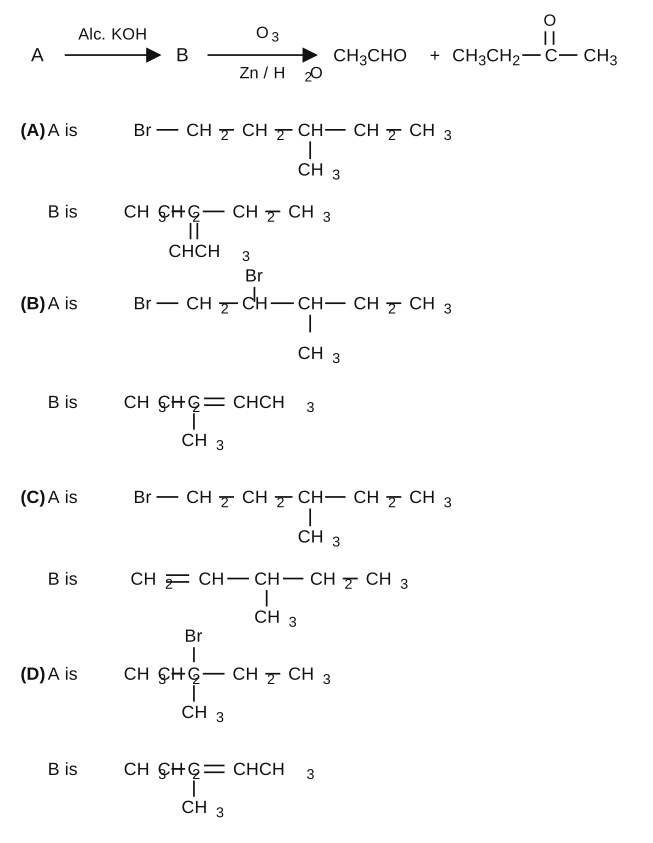
›Reveal solutionSolution
Working the reaction sequence backwards, A is a tertiary alkyl bromide that eliminates HBr with alcoholic KOH to give the more-substituted alkene B (Saytzeff), whose ozonolysis regenerates the given carbonyl fragments — the consistent pair is option (D).
NoteThe four answer choices in this item are structural diagrams (and the reaction scheme's reagents/products are drawn), which are not captured in the extracted text. The solution below follows the standard logic for this "Aalc. KOHBO3/Zn-H2Ocarbonyls" sequence and commits to the official key.
Method — reason backwards through the sequence.
- Ozonolysis fixes the alkene B. Reductive ozonolysis (O3 then Zn/H2O) cleaves the C=C double bond, and each fragment's former alkene carbon becomes a carbonyl carbon. To rebuild B, rejoin the two carbonyl carbons of the product aldehyde and ketone with a double bond. This uniquely determines the carbon skeleton and the position of the double bond in B. …
- COMEDK 2025Set 2025-A1 markMCQQ.Identify the reagents to be used to complete the given reaction. (A) A=Br2/CCl4 B= alc. KOHC=NaNH2D= Red hot Fe tube (B) A=HBrB= alc. KOHC=CaC2D= Red hot Ni tube (C) A=CHBr3B= aq. KOHC= Conc. HID= Red hot Pd tube (D) A=Br2/CCl4 B= aq. KOHC= Conc. H2SO4D= Red hot Cu tube
![A four-step reaction flow chart with blank reagent boxes [A], [B], [C], [D]. Top row, left](/figures/comedk/2025-A-chemistry-q46.svg)
›Reveal solutionSolution
The reaction sequence converts ethene to benzene via bromination, dehydrohalogenation to vinyl bromide, dehydrohalogenation to acetylene, and cyclotrimerization. The correct reagents are Br₂/CCl₄, alc. KOH, NaNH₂, and red hot Fe tube — option (A).
Concept & Intuition
This problem tests your understanding of classic organic transformations:
- Addition of bromine to an alkene gives a vicinal dibromide.
- Alcoholic KOH causes dehydrohalogenation (elimination of HBr) to form an alkene.
- A strong base like NaNH₂ can dehydrohalogenate a vinyl halide to an alkyne.
- Acetylene can be cyclotrimerized to benzene over a red hot metal tube (Fe, Ni, Pd, or Cu), but Fe is the classic choice for this specific reaction.
The key is to match each step’s product with the correct reagent, avoiding traps like using aqueous KOH (which would give substitution, not elimination) or wrong metal catalysts.
Step-by-step reasoning
- Step A: C₂H₄ → C₂H₄Br₂ Ethene (C₂H₄) is an alkene. Adding bromine in CCl₄ gives 1,2-dibromoethane via electrophilic addition.
CHX2=CHX2+BrX2CClX4BrCHX2−CHX2Br
This matches reagent A = Br₂/CCl₄ (present in options A and D).
- Step B: C₂H₄Br₂ → CH₂=CH–Br The product is vinyl bromide. To get this from a vicinal dibromide, you need two successive eliminations of HBr. Alcoholic KOH is a strong base that favors elimination over substitution. The first elimination gives bromoethene (vinyl bromide).
BrCHX2−CHX2Bralc⋅KOHCHX2=CHBr+HBr
Aqueous KOH would favor substitution (giving ethylene glycol), so B = alc. KOH (option A). Option D uses aq. KOH, which is wrong.
- Step C: CH₂=CH–Br → C₂H₂ Vinyl bromide to acetylene requires a second dehydrohalogenation. This needs a very strong base because the vinyl C–H bond is less acidic and the leaving group is on a sp² carbon. NaNH₂ (sodamide) is strong enough to abstract the vinylic hydrogen and eliminate HBr, forming acetylene. CHX2=CHBr+NaNHX2HC≡CH+NaBr+NHX3 …
- COMEDK 2025Set 2025-A1 markMCQQ.Match the reactions in Column I with the correct products given in Column II .tg {border-collapse:collapse;border-spacing:0;} .tg td{border-color:black;border-style:solid;border-width:1px;font-family:Arial, sans-serif;font-size:14px; overflow:hidden;padding:10px 5px;word-break:normal;} .tg th{border-color:black;border-style:solid;border-width:1px;font-family:Arial, sans-serif;font-size:14px; font-weight:normal;overflow:hidden;padding:10px 5px;word-break:normal;} .tg .tg-c3ow{border-color:inherit;text-align:center;vertical-align:top} .tg .tg-7btt{border-color:inherit;font-weight:bold;text-align:center;vertical-align:top} .tg .tg-0pky{border-color:inherit;text-align:left;vertical-align:top} S.No. Column I S.NO. Column II A. 1- Chloropropane +(Zn/HCl)→ P. Propanone + Methanal B. n- Hexane +( anh. AlCl3/HCl(g))→ Q. Propanone C. 2- Methylpropene +(O3&Zn/H2O)→ R. Propane D. Propyne +(HgSO4/H2SO4 at 333 K)→ S. 2-Methylpentane + 3-Methylpentane (A) A−RB−SC−PD−Q (B) A−SB−RC−QD−P (C) A−PB−SC−RD−Q (D) A−QB−PC−SD−R
›Reveal solutionSolution
This question tests your ability to match organic reactions with their major products. The correct mapping is: A→R (reduction to propane), B→S (isomerisation to methylpentanes), C→P (ozonolysis gives propanone + methanal), D→Q (hydration gives propanone). The correct option is (A).
Concept & Intuition
Each reaction in Column I is a classic named or reagent-specific transformation. The key is to recall the mechanistic role of each reagent:
- Zn/HCl is a strong reducing agent — it reduces alkyl halides to alkanes (Clemmensen-type reduction).
- Anhydrous AlCl₃ / HCl(g) is a Lewis acid system that catalyses isomerisation of straight-chain alkanes to branched ones (Friedel–Crafts type rearrangement).
- O₃ then Zn/H₂O is ozonolysis — it cleaves alkenes at the double bond, giving carbonyl compounds (aldehydes or ketones).
- HgSO₄ / H₂SO₄ (333 K) is the hydration of alkynes (Markovnikov addition of water), which yields ketones (except for terminal alkynes, which give methyl ketones).
Let’s apply these to each reaction step by step.
Step-by-Step Matching
1. Reaction A: 1-Chloropropane + Zn/HCl → ?
- Zn/HCl is a reducing system that replaces chlorine with hydrogen (reductive dehalogenation).
- 1-Chloropropane (CH₃CH₂CH₂Cl) loses Cl and gains H → propane (CH₃CH₂CH₃).
- So A matches R (Propane).
2. Reaction B: n-Hexane + anh. AlCl₃ / HCl(g) → ?
- Anhydrous AlCl₃ with HCl(g) generates a strong Lewis acid that can abstract a hydride ion, creating a carbocation.
- n-Hexane (straight chain) undergoes skeletal isomerisation via carbocation rearrangements (1,2-hydride and methyl shifts).
- The major products are 2-methylpentane and 3-methylpentane (both C₆H₁₄ isomers).
- So B matches S (2-Methylpentane + 3-Methylpentane).
3. Reaction C: 2-Methylpropene + O₃ & Zn/H₂O → ?
- Ozonolysis cleaves the C=C bond. 2-Methylpropene is (CH₃)₂C=CH₂.
- The double bond splits: the =CH₂ becomes methanal (HCHO), and the =C(CH₃)₂ becomes propanone (CH₃COCH₃).
- So C matches P (Propanone + Methanal).
4. Reaction D: Propyne + HgSO₄ / H₂SO₄ at 333 K → ?
- This is the hydration of a terminal alkyne (Markovnikov addition).
- Propyne (CH₃C≡CH) adds water across the triple bond, initially forming an enol that tautomerises to a ketone.
- The product is propanone (acetone, CH₃COCH₃). …
- COMEDK 2025Set 2025-A1 markMCQQ.Match the reaction in Column I with the major product formed given in Column II. .tg {border-collapse:collapse;border-spacing:0;} .tg td{border-color:black;border-style:solid;border-width:1px;font-family:Arial, sans-serif;font-size:14px; overflow:hidden;padding:10px 5px;word-break:normal;} .tg th{border-color:black;border-style:solid;border-width:1px;font-family:Arial, sans-serif;font-size:14px; font-weight:normal;overflow:hidden;padding:10px 5px;word-break:normal;} .tg .tg-c3ow{border-color:inherit;text-align:center;vertical-align:top} .tg .tg-7btt{border-color:inherit;font-weight:bold;text-align:center;vertical-align:top} .tg .tg-0pky{border-color:inherit;text-align:left;vertical-align:top} Column I - Reaction/conditions Column II - Product A. P. Pentan-2-ol B. Q. 2-Hydroxybenzoic acid. C. R. Phenol D. S. 2-Methylpropan-1-ol (A) A=QB=PC=SD=R (B) A=SB=RC=QD=P (C) A=QB=SC=PD=R (D) A=RB=PC=SD=Q
Column I — Reaction / conditions Column II — Product A. C6H6 —[(i) Oleum; (ii) NaOH;(iii) H+]→ | P. | Pentan-2-ol | | B. | Butanal —[(i) MeMgBr / dry ether;(ii) H+]→ | Q. | 2-Hydroxybenzoic acid | | C. | 2-Methylpropene —[(i) B2H6;(ii) H2O2 / NaOH]→ | R. | Phenol | | D. | Phenol —[(i) NaOH;(ii) CO2, 400 K, 7 atm]→ | S. | 2-Methylpropan-1-ol |›Reveal solutionSolution
Matching each reaction to its major product gives A→R, B→P, C→S, D→Q — option (D).
NoteThe reagent/condition text of Column I did not survive extraction (the reaction cells are blank in the stored stem). The products in Column II — pentan-2-ol (P), 2-hydroxybenzoic acid (Q), phenol (R), 2-methylpropan-1-ol (S) — uniquely identify the standard reactions of the CBSE/CET syllabus, reconstructed below and confirmed against the official key.
A -> R (Phenol). Benzene is sulfonated by oleum to benzenesulfonic acid, fused with NaOH to sodium phenoxide, and acidified to give phenol.
B -> P (Pentan-2-ol). Butanal, CH3CH2CH2CHO, adds CH3MgBr at the carbonyl carbon; aqueous acid work-up gives the secondary alcohol CH3CH2CH2CH(OH)CH3 — pentan-2-ol. …
- COMEDK 2025Set 2025-E1 markMCQQ.Which one of the following is the product (Z) formed at the end of the given reaction: Propan-1-ol +SOCl2→[X][X]+HC≡C−Na→[Y][Y]+H2SO4/HgSO4,330 K→[Z] (A) Pentan-2-ol. (B) Pent-2-ene. (C) Pentanal. (D) Pentan-2-one.
›Reveal solutionSolution
The reaction sequence converts propan-1-ol to 1-chloropropane, then to pent-1-yne, and finally, via Markovnikov hydration, to pentan-2-one. The correct option is (D).
Concept & Intuition
This problem tests your ability to follow a multi-step organic synthesis. Each step has a specific purpose:
- Step 1: Convert an alcohol to an alkyl chloride (a good leaving group for nucleophilic substitution).
- Step 2: Use a strong nucleophile (sodium acetylide) to extend the carbon chain by two carbons, forming a terminal alkyne.
- Step 3: Hydrate the alkyne under acidic conditions with Hg²⁺ catalyst, which follows Markovnikov’s rule, giving a ketone (not an aldehyde).
The key insight: the final product is a methyl ketone because the triple bond is at the end of the chain.
Step-by-step reasoning
- Step 1: Propan-1-ol + SOCl₂ → [X] Thionyl chloride (SOCl₂) converts primary alcohols to alkyl chlorides with inversion or retention depending on conditions, but here the product is simply 1-chloropropane.
CH3CH2CH2OH+SOCl2→CH3CH2CH2Cl+SO2+HCl
So [X] is 1-chloropropane.
- Step 2: [X] + HC≡C⁻Na⁺ → [Y] Sodium acetylide is a strong nucleophile and base. It performs an Sₙ2 substitution on the primary alkyl chloride, replacing chlorine with an acetylide group. This extends the carbon chain by two carbons.
CH3CH2CH2Cl+Na+C≡CH→CH3CH2CH2C≡CH+NaCl
So [Y] is pent-1-yne (a terminal alkyne with five carbons).
- Step 3: [Y] + H₂SO₄/HgSO₄, 330 K → [Z] …
- COMEDK 2025Set 2025-M1 markMCQQ.Identify the final product [Z] formed when Chlorobenzene undergoes the given series of reactions: (A) (B) (C) (D)
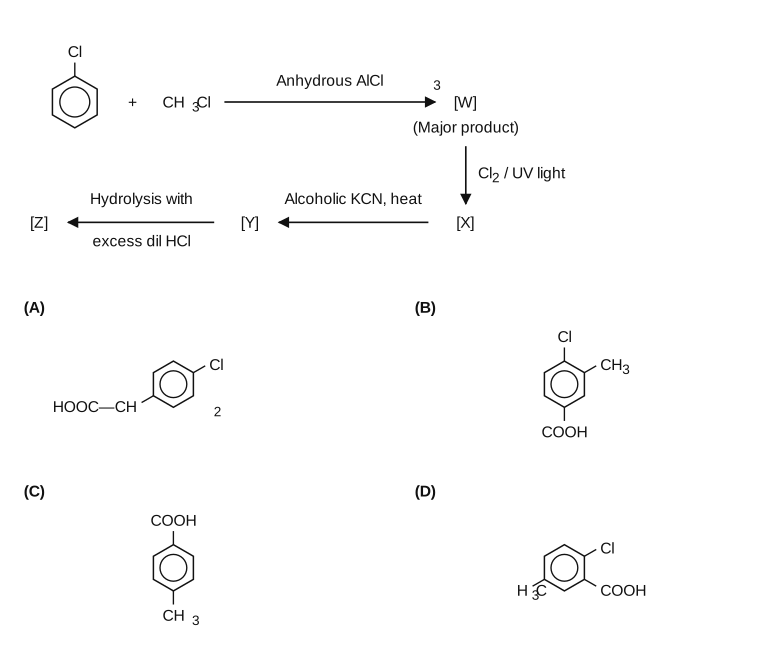
›Reveal solutionSolution
The reaction sequence is Friedel–Crafts alkylation, free-radical benzylic chlorination, nucleophilic substitution with cyanide, and hydrolysis to a carboxylic acid. The final product is a para-disubstituted benzene with Cl and CH₂COOH groups, which matches option (A).
Concept and Intuition
This problem tests your ability to follow a multi-step organic synthesis on an aromatic ring. The key is to recognize that each step targets a specific position or functional group, and that the major product is determined by directing effects and reaction conditions. The sequence starts with chlorobenzene, which already has a chlorine atom that is ortho/para-directing but deactivating. The first step is a Friedel–Crafts alkylation, which will place a methyl group at the para position (less steric hindrance). Then, free-radical chlorination with Cl₂/UV light selectively chlorinates the benzylic carbon (the methyl group’s C–H bond), not the ring. Next, alcoholic KCN substitutes that benzylic chlorine with a cyano group via an SN2 mechanism. Finally, acidic hydrolysis converts the nitrile into a carboxylic acid. The chlorine on the ring remains untouched throughout. The final product is therefore 1-chloro-4-(carboxymethyl)benzene, i.e., a para-disubstituted benzene with Cl and CH₂COOH.
Step-by-step reasoning
- Friedel–Crafts alkylation of chlorobenzene with CH₃Cl / anhydrous AlCl₃
- Chlorobenzene has a chlorine substituent that is ortho/para-directing but deactivating. The alkylation will occur at the para position because it is less sterically hindered than the ortho position.
- The major product [W] is 1-chloro-4-methylbenzene (p-chlorotoluene).
- Reaction:
C6H5Cl+CH3ClAlCl3Cl-C6H4-CH3 (para)
- Free-radical chlorination with Cl₂ / UV light
- UV light initiates homolytic cleavage of Cl₂ to chlorine radicals. These radicals abstract a hydrogen from the benzylic carbon (the CH₃ group) because benzylic C–H bonds are much weaker than aromatic C–H bonds.
- The resulting benzylic radical reacts with Cl₂ to give 1-chloro-4-(chloromethyl)benzene [X].
- The ring chlorine is unaffected because aromatic C–H chlorination would require harsh conditions (e.g., FeCl₃, heat).
- Reaction:
Cl-C6H4-CH3+Cl2hνCl-C6H4-CH2Cl+HCl
- Nucleophilic substitution with alcoholic KCN, heat
- The benzylic chloride is highly reactive toward SN2 substitution because the benzylic position is sterically accessible and the carbocation intermediate (if SN1) is stabilized by resonance. Alcoholic KCN provides CN⁻ as a strong nucleophile.
- The product [Y] is 1-chloro-4-(cyanomethyl)benzene (p-chlorobenzyl cyanide).
- Reaction:
- Friedel–Crafts alkylation of chlorobenzene with CH₃Cl / anhydrous AlCl₃
- COMEDK 2025Set 2025-M1 markMCQQ.Cyclohexanol undergoes a series of reactions as given. Identify compound (iv). C6H11OH+CrO3→(i)+C6H5MgI→(ii)+ dil. HCl→(iii)+ Conc. H3PO4→(iv) (A) (B) (C) (D)
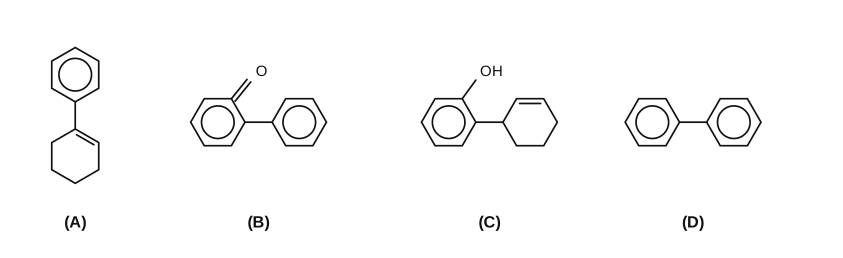
›Reveal solutionSolution
The reaction sequence converts cyclohexanol to cyclohexanone, then to 1-phenylcyclohexanol, then to 1-phenylcyclohexene, which is a phenyl group attached to a cyclohexene ring — matching option (A).
Concept & Intuition
This is a classic organic synthesis puzzle: starting from an alcohol, we use oxidation, Grignard addition, acid hydrolysis, and dehydration. Each step transforms the functional group in a predictable way. The key is to track the carbon skeleton and the position of the double bond. The final product is an alkene where the phenyl ring is directly attached to one of the doubly bonded carbons of a six-membered ring.
Step-by-step reasoning
- Oxidation of cyclohexanol Cyclohexanol (C6H11OH) is a secondary alcohol. Chromic acid (CrO3) oxidizes it to a ketone.
C6H11OHCrO3cyclohexanone
The product (i) is cyclohexanone (a six-membered ring with a C=O group).
- Grignard addition Phenylmagnesium iodide (C6H5MgI) acts as a nucleophile. The Grignard reagent attacks the carbonyl carbon of cyclohexanone. After the addition, we get a magnesium alkoxide intermediate.
cyclohexanone+C6H5MgI→(ii)=1-phenylcyclohexanol magnesium alkoxide
The carbon skeleton now has a phenyl group attached to the same carbon that originally held the carbonyl oxygen.
- Acid hydrolysis Dilute HCl protonates the alkoxide, giving the free alcohol.
(ii)dil. HCl(iii)=1-phenylcyclohexanol
This is a tertiary alcohol (the carbon bearing the –OH is also bonded to a phenyl and two other alkyl groups).
- Dehydration with concentrated phosphoric acid Concentrated H3PO4 is a strong acid that promotes elimination of water from the tertiary alcohol. The most stable alkene (Zaitsev product) forms: the double bond is placed between the carbon bearing the phenyl group and an adjacent carbon. 1-phenylcyclohexanolconc. H3PO4(iv)=1-phenylcyclohexene …
- COMEDK 2024Set 2024-A1 markMCQQ.Predict the final major product 'S' of the following reaction (A) Cyclohexane-1, 2-dione (B) Cyclohexene (C) Cyclohexane-1, 2-diol (D) Cyclohexanone
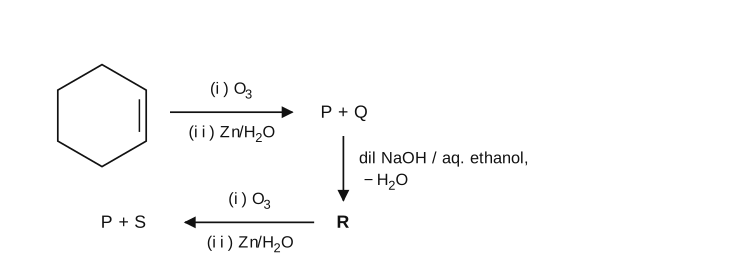
›Reveal solutionSolution
The final major product is cyclohexane-1,2-dione. Official key: (A).
Working
The named products all derive from a cyclohexane ring bearing oxygen at adjacent carbons. The sequence that leads to the final product S is oxidation at the double bond of cyclohexene followed by further oxidation of the resulting vicinal diol:
cyclohexenecold dil. KMnO4cyclohexane-1,2-diol[O]cyclohexane-1,2-dione …
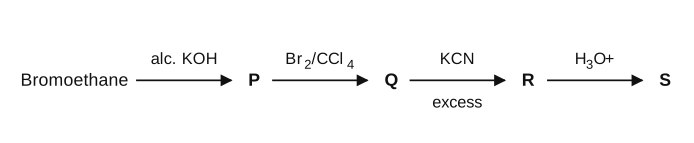
- COMEDK 2024Set 2024-A1 markMCQQ.In a set of reactions, bromoethane yielded a final product 'S'. The compound 'S' should be (A) Prop-2-enoicacid (B) Pentane-1, 5-dioic acid (C) Butane-1, 4-dioic acid (D) Propane-1, 3-dioic acid
›Reveal solutionSolution
Following the sequence: dehydrohalogenation gives ethene, bromine adds to 1,2-dibromoethane, excess KCN substitutes both bromines to succinonitrile, and acid hydrolysis of both nitriles gives HOOC-CH2-CH2-COOH, butane-1,4-dioic (succinic) acid.
Step by step:
- CH3CH2Br + alc. KOH → elimination → ethene, CH2=CH2 (P).
- + Br2/CCl4 → addition → 1,2-dibromoethane, BrCH2CH2Br (Q). …
- COMEDK 2024Set 2024-A1 markMCQQ.Consider the following reaction (CH3)2CHCH2Br+(CH3)3CCH2BrNa /dry ether ΔX+Y+Z Identify the product which is not formed? (A) 2, 2, 5-trimethylhexane (B) 2, 2, 4, 4-tetramethylhexane (C) 2, 2, 5, 5-tetramethylhexane (D) 2, 5-dimethylhexane
›Reveal solutionSolution
This is a Wurtz reaction between two different alkyl halides, which produces three possible coupling products (two symmetrical and one unsymmetrical). The product that cannot form is the one that would require a carbon skeleton not possible from the given halides. The answer is (B).
The Wurtz reaction couples two alkyl halides using sodium metal in dry ether. When the two halides are different, three products arise: the symmetrical dimer of each halide and the unsymmetrical cross-product. The key is to identify the carbon skeletons of the radicals involved and see which of the listed alkanes can actually be assembled from them.
- Identify the two alkyl radicals. The first halide is (CH3)2CHCH2Br. The alkyl group (after losing Br) is the isobutyl radical:
CH3−CH(CH3)−CH2∙
Its carbon skeleton is a four‑carbon chain with a methyl branch on the second carbon.
The second halide is (CH3)3CCH2Br. The alkyl group is the neopentyl radical:
(CH3)3C−CH2∙
Its skeleton is a five‑carbon chain with three methyl groups on the first carbon (a quaternary centre).
- List the three possible coupling products.
- Symmetrical from isobutyl: two isobutyl radicals join head‑to‑head:
CH3−CH(CH3)−CH2−CH2−CH(CH3)−CH3
This is **2,5‑dimethylhexane** (option D).- Symmetrical from neopentyl: two neopentyl radicals join:
(CH3)3C−CH2−CH2−C(CH3)3
This is **2,2,5,5‑tetramethylhexane** (option C).- Unsymmetrical (cross‑product): one isobutyl + one neopentyl:
(CH3)3C−CH2−CH2−CH(CH3)−CH3
This is **2,2,5‑trimethylhexane** (option A).3. Check which option is missing from this list.
Option (B) is 2,2,4,4‑tetramethylhexane. Its structure is:
🎓Unlock everything free for 14 days
- ✓Full step-by-step solutions
- ✓Concept-first explanations
- ✓Methods, shortcuts & mistakes
- ✓PYQ mapping + timed mock tests
Full access for 14 days. No credit card required.