Q.Match Column I with Column II for the oxidation states of the central atoms.
Column I
Column II
🔒You're viewing a preview — the full solution, concept, methods & PYQ mapping are locked.
🔒 Start your 14-day free trial to unlock the full solution →Concept understanding — Oxidation Number Calculation
Oxidation Number Calculation: From Intuition to Precision
Imagine you're watching a tug-of-war between two atoms in a molecule. Each atom has a certain "pull" on the shared electrons — chemists call this electronegativity. The oxidation number is like a scorecard that tells us: If the more electronegative atom took all the shared electrons, what charge would each atom end up with?
This isn't a real charge — it's a bookkeeping tool. Real molecules don't have these exact charges. But this imaginary scorecard helps us track where electrons go during chemical reactions, especially in redox (reduction-oxidation) processes.
The Core Idea
Oxidation number (also called oxidation state) is the hypothetical charge an atom would have if all bonds to atoms of different elements were 100% ionic — meaning the more electronegative atom keeps all the shared electrons.
For an atom bonded to another atom of the same element (like O₂ or N₂), the electrons are shared equally. So the oxidation number is zero — no one "wins" the tug-of-war.
The Rules (Your Toolkit)
These rules are applied in order — rule 1 overrides rule 2, and so on. Memorise them in this sequence:
-
Free elements (uncombined, like Fe, O₂, H₂, S₈) have oxidation number = 0.
-
Monatomic ions have oxidation number = their charge.
Example: Na⁺ = +1, Cl⁻ = −1, Mg²⁺ = +2.
-
Fluorine is always −1 in compounds (it's the most electronegative element — it always "wins").
-
Oxygen is usually −2, except:
- In peroxides (like H₂O₂) it's −1
- In OF₂ (with fluorine) it's +2 (fluorine wins)
-
Hydrogen is usually +1 when bonded to non-metals, −1 when bonded to metals (like NaH, CaH₂).
-
The sum of oxidation numbers in a neutral compound = 0.
In a polyatomic ion, the sum = the ion's charge.
Never apply rule 6 before rules 1–5. The sum rule is your check, not your starting point.
How to Calculate: A Step-by-Step Example
Let's find the oxidation number of sulphur in H₂SO₄ (sulphuric acid).
Step 1: Write the known oxidation numbers.
Hydrogen: +1 (rule 5, bonded to non-metal oxygen)
Oxygen: −2 (rule 4, not a peroxide)
Step 2: Let the unknown be x (for sulphur).
Step 3: Apply the sum rule (rule 6). The compound is neutral, so:
2(+1)+x+4(−2)=0
Step 4: Solve:
2+x−8=0
x−6=0
x=+6
Sulphur in H₂SO₄ has oxidation number +6.
Another Example: A Polyatomic Ion
Find the oxidation number of chromium in Cr₂O₇²⁻ (dichromate ion).
Oxygen: −2 (rule 4)
Let chromium = x
Sum of oxidation numbers = charge of ion (−2):
2x+7(−2)=−2
2x−14=−2
2x=12
x=+6
When you get a fractional oxidation number (like +2.5 in Fe₃O₄), it means the compound has two different oxidation states for the same element. Fe₃O₄ actually contains Fe²⁺ and Fe³⁺ in a 1:2 ratio.
Common Traps to Avoid
| Mistake | Why it's wrong |
|---------|----------------| …
The oxidation state of the central metal atom is found by balancing the total charge on the complex ion, remembering that oxygen is −2 and fluorine is −1.
Step 1: For Cr2O72−, let the oxidation state of each Cr be x. Then 2x+7(−2)=−2, giving 2x=+12, so x=+6.
Step 2: For MnO4−, let the oxidation state of Mn be x. Then x+4(−2)=−1, giving x=+7. …
Assign oxidation states by treating oxygen as −2 and fluorine as −1, then balance the total charge. Cr₂O₇²⁻ → +6, MnO₄⁻ → +7, VO₃⁻ → +5, FeF₆³⁻ → +3.
The oxidation state of a central metal atom in a complex ion is found by accounting for the known oxidation states of the ligands and ensuring the algebraic sum equals the overall charge on the species. Oxygen almost always takes −2 (except in peroxides and superoxides, which are not present here), and fluorine invariably takes −1 as the most electronegative element.
1. Dichromate ion, Cr2O72−
Let the oxidation state of each chromium atom be x. The ion contains two chromium atoms and seven oxygen atoms.
2x+7(−2)=−2
2x−14=−2
2x=+12⟹x=+6
Each chromium is in the +6 oxidation state.
2. Permanganate ion, MnO4−
Let the oxidation state of manganese be x. The ion has one manganese and four oxygen atoms.
x+4(−2)=−1
x−8=−1
x=+7
Manganese is in the +7 oxidation state.
3. Vanadate ion, VO3−
Let the oxidation state of vanadium be x. The ion contains one vanadium and three oxygen atoms.
x+3(−2)=−1
x−6=−1
x=+5
Vanadium is in the +5 oxidation state.
4. Hexafluoroferrate(III) ion, FeF63− …
- COMEDK 2026Set 2026-M1 markMCQQ.In the reaction, Cr2O72−+4H2O2+2H+→2CrO5+H2O The change in oxidation state of Cr is: (A) +6 to +3 (B) +6 to +10 (C) No change in oxidation state (D) +3 to +6
›Reveal solutionSolution
In this reaction, chromium’s oxidation state remains +6 throughout; the blue perchromic acid CrO₅ is a special case where Cr still has oxidation state +6, so the answer is “no change.”
The key concept here is oxidation state determination in unusual compounds. Many students see CrO₅ and assume oxygen is always –2, leading to a wrong oxidation state for chromium. But CrO₅ contains peroxide linkages (O–O bonds), where oxygen has oxidation state –1, not –2. Recognizing this is the entire crux of the problem.
Let’s work through it step by step.
- Find the oxidation state of Cr in the reactant Cr₂O₇²⁻ In dichromate ion, each oxygen is –2 (no peroxide bonds). Let Cr have oxidation state x.
2x+7(−2)=−2⇒2x−14=−2⇒2x=12⇒x=+6.
So Cr is +6 in the reactant.
- Now examine the product CrO₅
CrO₅ is known as perchromic acid (or chromium pentoxide). Its structure is not five separate O²⁻ ions; instead, it contains one oxo (Cr=O) and two peroxide (O–O) groups.
- In a peroxide bond, each oxygen has oxidation state –1.
- In the oxo group, oxygen is –2. So in CrO₅:
- 1 oxygen as oxo: –2
- 4 oxygens as two peroxides: each peroxide contributes –2 total (since each O is –1, two O’s give –2), so two peroxides give –4. Total oxygen contribution = –2 + (–4) = –6. Let Cr oxidation state be y. The molecule is neutral:
- COMEDK 2025Set 2025-E1 markMCQQ.The oxidation number of potassium in K2O,K2O2 and KO2 respectively are: (A) +1,+2,+4 (B) +1,+2,+1 (C) +1,+1,+1 (D) +2,+1,+1
›Reveal solutionSolution
Potassium is an alkali metal that always has an oxidation number of +1 in its compounds, regardless of whether the other element is oxygen in a peroxide or superoxide form. The correct answer is (C).
The key concept here is that alkali metals (Group 1) have a fixed oxidation number of +1 in all their compounds. This is because they readily lose their single valence electron to achieve a noble gas configuration. Oxygen, on the other hand, can have variable oxidation numbers depending on the type of compound: -2 in normal oxides, -1 in peroxides, and -1/2 in superoxides. The trick is not to let oxygen’s variability confuse you—potassium’s oxidation state is constant.
Let’s work through each compound step by step:
-
In K2O (potassium oxide):
- Potassium (K) is in Group 1, so its oxidation number is always +1.
- Let the oxidation number of oxygen be x. The compound is neutral, so: 2(+1)+x=0⟹x=−2.
- This is the normal oxide ion O2−. Potassium’s oxidation number is +1.
-
In K2O2 (potassium peroxide):
- Again, potassium is +1.
- Let oxygen’s oxidation number be y. The sum of oxidation numbers is zero: 2(+1)+2y=0⟹2y=−2⟹y=−1.
- This is the peroxide ion O22−, where each oxygen has an oxidation number of −1. Potassium remains +1.
-
In KO2 (potassium superoxide):
- Potassium is still +1. …
-
- COMEDK 2025Set 2025-M1 markMCQQ.Which one of the following options represents the decreasing order of oxidation number of the central atom in: Cr2O72−,CrO2−,MnO4−,BrO3− (A) CrO2−>BrO3−>Cr2O72−>MnO4− (B) MnO4−>CrO2−>Cr2O72−>BrO3− (C) BrO3−>CrO2−>MnO4−>Cr2O72− (D) MnO4−>Cr2O72−>BrO3−>CrO2−
›Reveal solutionSolution
The oxidation numbers are: Cr in Cr2O72− is +6, Cr in CrO2− is +3, Mn in MnO4− is +7, Br in BrO3− is +5. Decreasing order: MnO4−>Cr2O72−>BrO3−>CrO2−, which matches option (D).
The key idea is to assign oxidation numbers systematically using the rule that oxygen is almost always −2 (except in peroxides, which don’t appear here), and the overall charge of the ion equals the sum of oxidation numbers. Once we compute each central atom’s oxidation state, we simply sort them from highest to lowest.
Why this works: Oxidation number is a bookkeeping tool that tracks electron distribution in compounds and ions. For polyatomic ions, the sum of oxidation numbers equals the ion’s charge. Oxygen’s fixed −2 makes these calculations straightforward.
-
Find oxidation number of Cr in Cr2O72−
Let Cr’s oxidation number be x. There are 2 Cr atoms and 7 O atoms (each O = −2). The ion charge is −2.
Equation: 2x+7(−2)=−2
2x−14=−2⟹2x=12⟹x=+6.
So Cr here is +6.
-
Find oxidation number of Cr in CrO2−
Let Cr’s oxidation number be y. One Cr, two O atoms (each −2), charge −1.
y+2(−2)=−1⟹y−4=−1⟹y=+3.
So Cr here is +3.
-
Find oxidation number of Mn in MnO4−
Let Mn’s oxidation number be z. One Mn, four O atoms (each −2), charge −1.
z+4(−2)=−1⟹z−8=−1⟹z=+7.
So Mn is +7.
-
Find oxidation number of Br in BrO3−
Let Br’s oxidation number be w. One Br, three O atoms (each −2), charge −1.
w+3(−2)=−1⟹w−6=−1⟹w=+5.
So Br is +5. …
-
- COMEDK 2024Set 2024-M1 markMCQQ.An inorganic salt comprises of atoms of elements A,B and C. If the oxidation numbers of A, B and C are +3,+6 and −2 respectively, what is the possible formula of the compound? (A) A3(BC3)4 (B) A2(BC4)3 (C) A3(BC)2 (D) A3B6C2
›Reveal solutionSolution
The key idea is that the total oxidation number of all atoms in a neutral compound must sum to zero. By calculating the net charge for each formula option, only one yields zero — option (B).
We are given the oxidation numbers:
A = +3, B = +6, C = –2.
For a neutral compound, the sum of (oxidation number × number of atoms) over all elements must equal zero.
Let’s check each option step by step.
-
Option (A): A3(BC3)4
- This means 3 atoms of A, and 4 formula units of BC3.
- In one BC3: B = +6, each C = –2, so total for BC3 = +6+3(−2)=0.
- So the polyatomic ion BC3 is neutral.
- Then the compound is just 3 A atoms: total charge = 3×(+3)=+9.
- Not zero → not neutral.
-
Option (B): A2(BC4)3
- 2 atoms of A, and 3 formula units of BC4.
- In one BC4: B = +6, each C = –2, so total = +6+4(−2)=+6−8=−2.
- So BC4 has a charge of –2.
- Then total charge = 2(+3)+3(−2)=+6−6=0.
- This works.
-
Option (C): A3(BC)2
- 3 atoms of A, and 2 formula units of BC.
- In one BC: B = +6, C = –2, total = +6−2=+4.
- Total charge = 3(+3)+2(+4)=+9+8=+17.
- Not zero. …
-
- COMEDK 2022Set 20221 markMCQQ.The oxidation state of nickel in [Ni(CO4)] is (A) 1 (B) 2 (C) 3 (D) 0
›Reveal solutionSolution
So nickel is in the zero oxidation state (this is why Ni(CO)4 is a classic zero-valent carbonyl, formed in the Mond process).
Concept: Oxidation state in a metal carbonyl. Carbon monoxide is a NEUTRAL ligand (charge 0).
For [Ni(CO)4] (tetracarbonylnickel(0)), the complex itself is neutral:
x + 4(0) = 0 => x = 0 …
- COMEDK 2021Set 20211 markMCQQ.The oxidation number of Cr in CrO5 which has the following structure, is (A) +4 (B) +5 (C) +3 (D) +6
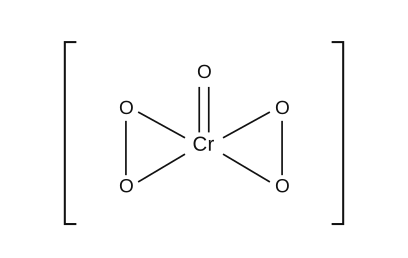
›Reveal solutionSolution
So Cr is in the +6 state (as expected, since CrO5 is made from Cr(VI) dichromate and H2O2 without any redox change at the metal).
Concept: Oxidation number with peroxo linkages.
From the figure, CrO5 (chromium peroxide, the blue species of the H2O2/dichromate test) has a butterfly structure:
- ONE terminal oxo oxygen, Cr=O -> oxidation state of that O = -2
- TWO peroxo (O-O) groups bonded side-on -> each O in a peroxide linkage has oxidation state -1, i.e. 4 oxygens at -1 …
- COMEDK 2021Set 2021-B1 markMCQQ.Arrange the following compounds in the increasing order of the Oxidation numbers of Carbons atoms present in the 4 compounds. CH3OH, CH2O, C2H6, HCOOH (A) C2H6 < CH2O < HCOOH < CH3OH (B) CH2O < C2H6 < HCOOH < CH3OH (C) CH3OH < C2H6 < CH2O < HCOOH (D) C2H6 < CH3OH < CH2O < HCOOH
›Reveal solutionSolution
Assigning oxidation states to carbon gives −3,−2,0,+2 for C2H6,CH3OH,CH2O,HCOOH, so the increasing order is C2H6<CH3OH<CH2O<HCOOH.
Counting bonds (C–H = −1 to C, C–O = +1, C=O = +2, C–C = 0):
- C2H6: each C has 3 C–H + 1 C–C =−3.
- CH3OH: 3 C–H + 1 C–O =−3+1=−2.
- CH2O: 2 C–H + 1 C=O =−2+2=0. …
- COMEDK 2021Set 2021-B1 markMCQQ.When Potassium permanganate plays the role of an oxidizing agent producing the 4 compounds listed below, what would be the number of electrons transferred in each case? Potassium manganate, Manganese dioxide, Manganese (III) oxide, Manganese sulphate. (A) 3, 5, 1, 2 (B) 3, 4, 1, 2 (C) 1, 3, 4, 5 (D) 5, 3, 4, 2
›Reveal solutionSolution
Electrons gained by Mn(+7) equal the drop in oxidation state: 1, 3, 4, 5 for manganate, MnO2, Mn2O3, MnSO4.
Oxidation state of Mn in each product (from +7):
- Potassium manganate K2MnO4: Mn = +6 ⇒ 1 e⁻
- Manganese dioxide MnO2: Mn = +4 ⇒ 3 e⁻ …
- KCET 2019Set A-11 markMCQQ.Oxidation state of copper is +1 in (A) Malachite (B) Azurite (C) Cuprite (D) Chalcopyrite
›Reveal solutionSolution
Write each ore's formula and balance the oxidation states; only Cu2O (cuprite) forces copper to be +1.
Step 1 — Write the formulae of the four copper ores.
Ore Formula Malachite CuCO3⋅Cu(OH)2 Azurite 2CuCO3⋅Cu(OH)2 Cuprite (ruby copper) Cu2O Chalcopyrite (copper pyrites) CuFeS2 Step 2 — Assign oxidation states.
Cuprite, Cu2O: oxygen is −2, and the compound is neutral, so
2x+(−2)=0⇒x=+1.
Copper is +1 (cuprous).
Malachite, CuCO3⋅Cu(OH)2: in CuCO3, the carbonate ion is CO32−, so Cu is +2; in Cu(OH)2, two OH− give Cu=+2. …
- KCET 2018Set A-11 markMCQQ.The state of hybrid orbitals of carbon in CO2, CH4 and CO32− respectively is (A) sp3, sp2 and sp (B) sp3, sp and sp2 (C) sp, sp3 and sp2 (D) sp2, sp3 and sp
›Reveal solutionSolution
The hybridisation of carbon in each species is determined by counting the number of sigma bonds and lone pairs around it. For CO2 it is sp, for CH4 it is sp3, and for CO32− it is sp2. The correct option is (C).
The key idea is that hybridisation is a local property of an atom in a molecule — it depends only on how many regions of electron density (sigma bonds + lone pairs) surround that atom. Each region corresponds to one hybrid orbital. So to find the hybridisation of carbon in each species, we simply count the number of atoms directly bonded to carbon plus any lone pairs on carbon, and then match that number to the familiar hybridisation scheme: 2 regions → sp, 3 regions → sp2, 4 regions → sp3.
Let’s apply this to each molecule in turn.
-
CO2 (carbon dioxide)
Carbon is the central atom. It forms two double bonds — one with each oxygen. Each double bond counts as one sigma bond and one pi bond. So carbon has exactly two sigma bonds and no lone pairs. That gives 2 regions of electron density.
Two regions → sp hybridisation.
TipA double bond does NOT count as two regions — it’s still just one direction in space. Only sigma bonds and lone pairs create separate hybrid orbitals.
-
CH4 (methane)
Carbon is bonded to four hydrogen atoms by four single bonds. Each single bond is one sigma bond. So carbon has four sigma bonds and no lone pairs. That’s 4 regions.
Four regions → sp3 hybridisation.
-
CO32− (carbonate ion) …
-
🎓Unlock everything free for 14 days
- ✓Full step-by-step solutions
- ✓Concept-first explanations
- ✓Methods, shortcuts & mistakes
- ✓PYQ mapping + timed mock tests
Full access for 14 days. No credit card required.