Q.Find all pairs of consecutive even positive integers, both of which are larger than 5 such that their sum is less than 23.
🔒You're viewing a preview — the full solution, concept, methods & PYQ mapping are locked.
🔒 Start your 14-day free trial to unlock the full solution →Concept understanding — Linear Inequalities
Linear Inequalities: The Intuition First
You already know what an equation is: a statement that two things are exactly equal. 2x+3=7 says "twice something plus three is exactly seven." That's a tight, precise condition — only one number (x=2) satisfies it.
Now imagine you loosen that condition. Instead of "exactly equal to 7," what if you said "less than 7"? Or "greater than or equal to 7"? That's an inequality. You're no longer looking for a single point; you're looking for a whole range of numbers.
Real life is full of inequalities: "You need at least 60% to pass" (marks≥60), "The bus can carry at most 50 people" (passengers≤50), "Profit must be more than zero" (P>0). Equations are rare; inequalities are everywhere.
The Four Symbols
There are only four inequality symbols. Memorise them once:
| Symbol | Meaning | Example | Reads as |
|---|---|---|---|
| < | less than | x<5 | x is less than 5 |
| > | greater than | x>5 | x is greater than 5 |
| ≤ | less than or equal to | x≤5 | x is at most 5 |
| ≥ | greater than or equal to | x≥5 | x is at least 5 |
The "or equal to" versions (≤, ≥) include the boundary number itself. The strict versions (<, >) do not.
Solving Linear Inequalities: Almost Like Equations
A linear inequality looks just like a linear equation, but with an inequality sign instead of an equals sign. For example:
2x+3<7
You solve it the same way you solve 2x+3=7 — with one critical difference.
The Golden Rule (and the only trap)
When you multiply or divide both sides of an inequality by a negative number, you must flip the inequality sign.
Why? Think of the number line. 3<5 is true. Multiply both sides by −1: −3<−5? No — −3 is actually greater than −5 (because −3 is to the right on the number line). So the inequality flips: −3>−5.
This is the single most common mistake students make. If you multiply or divide by a negative, flip the sign. If you multiply/divide by a positive, leave it alone.
Example: Solve 2x+3<7
Step 1: Subtract 3 from both sides (no sign change — subtracting is always safe).
2x<4
Step 2: Divide both sides by 2 (positive — no flip).
x<2
Answer: Any number less than 2 works. x=1.9, x=0, x=−100 — all satisfy the original inequality.
Example: Solve −3x+5≥11
Step 1: Subtract 5 from both sides.
−3x≥6
Step 2: Divide both sides by −3 (negative — flip the sign).
x≤−2
Answer: x must be less than or equal to −2.
Representing Solutions: The Number Line
The solution to an inequality is an interval (or union of intervals), not a single number. You can show it on a number line:
- Open circle at a number means that number is not included (< or >).
- Closed circle means it is included (≤ or ≥).
- Shade the region that satisfies the inequality.
For x<2: open circle at 2, shade everything to the left.
For x≤−2: closed circle at -2, shade everything to the left.
The Precise Definition
A linear inequality in one variable is any inequality that can be written in one of these four forms:
ax+b<0,ax+b>0,ax+b≤0,ax+b≥0 …
Concept: Linear Inequalities
Let the two consecutive even positive integers be n and n+2, where n is even.
The condition "both larger than 5" gives n>5, so n≥6 (since n is even).
The condition "sum less than 23" gives:
n+(n+2)<23
2n+2<23
2n<21
n<10.5
Since n is even, we have n≤10. …
Let the first even integer be x; the next is x+2. With x>5 and x+(x+2)<23, the valid pairs are (6,8), (8,10), and (10,12).
Setting up the conditions. Let the smaller consecutive even integer be x, so the larger is x+2. The problem requires:
- both larger than 5: since x>5 automatically makes x+2>5, the binding condition is x>5;
- their sum less than 23: x+(x+2)<23.
Solving the sum inequality.
x+(x+2)<23
2x+2<23
2x<21
x<10.5
Combining the conditions.
5<x<10.5
Since x must be an even integer, the possible values are x=6, 8, 10, giving: …
Showing the 12 most recent of 14 on this concept.
- COMEDK 2026Set 2026-A1 markMCQQ.A student needs to buy notebooks (n) for a semester. Double the number of notebooks plus 5 must strictly exceed 15 , but the number of notebooks plus 10 must be no more than 22 . What is the range of notebooks they can buy? (A) {6,7,8,9,10,11} (B) {6,7,8,9,10,11,12} (C) {5,6,7,8,9,10,11,12,13,14,15} (D) {5,6,7,8,9,10,11,12}
›Reveal solutionSolution
We solve two inequalities: 2n+5>15 and n+10≤22, then find the integer values of n that satisfy both. The result is n∈{6,7,8,9,10,11,12}, which matches option (B).
The problem gives two conditions about the number of notebooks n (which must be a whole number, since you can't buy a fraction of a notebook).
We translate each English phrase into an inequality, solve them separately, then combine the results to find the allowed integer values.
- First condition: "Double the number of notebooks plus 5 must strictly exceed 15" This means:
2n+5>15
Subtract 5 from both sides:
2n>10
Divide by 2:
n>5
So n must be greater than 5. Since n is a whole number, the smallest possible value is n=6.
- Second condition: "The number of notebooks plus 10 must be no more than 22" This means:
n+10≤22
Subtract 10:
n≤12
So n can be at most 12.
- Combine both conditions: From step 1: n>5 (so n≥6) From step 2: n≤12 Together: 6≤n≤12 …
- COMEDK 2026Set 2026-M1 markMCQQ."A storage room must be kept at a temperature (T) such that triple the temperature is at least 15∘C, but the temperature plus 8 is strictly not more than 20∘C. What is the range of safe temperatures?" (A) [5,12] (B) (5,12) (C) [5,20) (D) [5,12)
›Reveal solutionSolution
The problem gives two inequalities: 3T≥15 and T+8<20. Solving each and combining them yields 5≤T<12, which corresponds to option (D).
We need to translate the English conditions into mathematical inequalities. The phrase "triple the temperature is at least 15∘C" means 3T≥15. The phrase "the temperature plus 8 is strictly not more than 20∘C" means T+8<20 (since "strictly not more than" means less than, not less than or equal). The safe temperatures are those that satisfy both conditions simultaneously.
-
Solve the first inequality
3T≥15
Divide both sides by 3 (positive, so inequality direction stays the same):
T≥5.
So the temperature must be at least 5∘C.
-
Solve the second inequality
T+8<20
Subtract 8 from both sides:
T<12.
So the temperature must be strictly less than 12∘C.
-
Combine the two conditions
We need T≥5 and T<12.
In interval notation, this is [5,12).
The square bracket at 5 means 5 is included (since "at least" includes equality). …
-
- CA Foundation 2026Set jan-20261 markMCQQ.The solution of the inequality 35−2x≤6x−5 is (A) x≥8 (B) x≤8 (C) x≥6 (D) x≤6
›Reveal solutionSolution
Multiplying 35−2x≤6x−5 by 6 gives 40≤5x, i.e. x≥8.
Step 1 — clear denominators (LCM = 6)
6⋅35−2x≤6(6x−5) ⇒ 2(5−2x)≤x−30.
Step 2 — expand and collect
10−4x≤x−30 ⇒ 10+30≤x+4x ⇒ 40≤5x.
Step 3 — isolate x
x≥8.
Dividing by the positive 5 keeps the inequality sign unchanged. …
- CA Foundation 2026Set may-20261 markMCQQ.One experienced person does 10 units of work per day, while a fresher does 5 units of work per day. The employer wants to maintain at least 50 units of work per day. This situation can be expressed as ______ (A) 10x+5y>50 x≥0, y≤0 (B) 10x+5y≤50 x≥0, y≥0 (C) 10x+5y≥50 x≥0, y≥0 (D) 10x+5y=50 x≥0, y≤0
›Reveal solutionSolution
"At least 50" translates to ≥, and both counts of people are non-negative: 10x+5y≥50, x≥0, y≥0.
Step 1 — Define the variables
Let x= number of experienced persons and y= number of freshers.
Step 2 — Write the output
Each experienced person does 10 units and each fresher 5 units, so total daily output is 10x+5y.
Step 3 — Translate the constraints
"Maintain at least 50 units" means the output must be 50 or more:
10x+5y≥50
The number of people cannot be negative, so:
x≥0,y≥0 …
- COMEDK 2025Set 2025-E1 markMCQQ.The solution for the following system of inequalities 3x−7<5+x and 11−5x≤1 on a real number line is (A) (B) (C) (D)
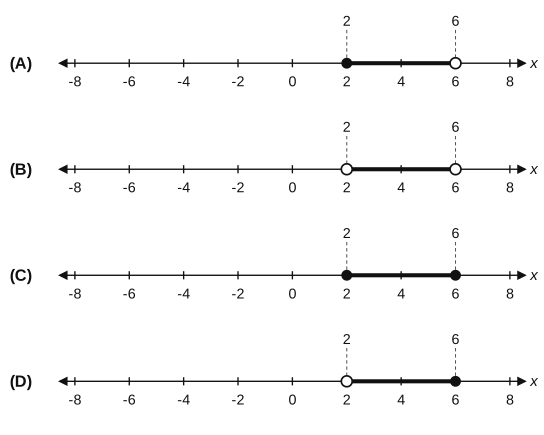
›Reveal solutionSolution
The system reduces to x<6 and x≥2, so the solution is the interval [2,6) — a closed dot at 2 and an open circle at 6. That matches option (A).
The key idea is that solving a system of inequalities means finding all real numbers that satisfy every inequality at the same time. Each inequality gives a half‑line (or ray) on the number line; the solution is the intersection of those rays. The endpoint symbols (open vs. closed) tell us whether the boundary point itself is included.
-
Solve the first inequality
3x−7<5+x
Subtract x from both sides: 2x−7<5
Add 7: 2x<12
Divide by 2: x<6
So the solution set is all numbers strictly less than 6 — an open circle at 6, shading to the left.
-
Solve the second inequality
11−5x≤1
Subtract 11: −5x≤−10
Divide by −5 (remember to reverse the inequality sign when dividing by a negative): x≥2
So the solution set is all numbers greater than or equal to 2 — a closed dot at 2, shading to the right.
-
Find the intersection
We need numbers that are both x<6 and x≥2.
On the number line, this is the interval from 2 up to (but not including) 6.
- At x=2: the second inequality includes it (≥), so we use a filled dot.
- At x=6: the first inequality excludes it (<), so we use an open circle. …
-
- COMEDK 2025Set 2025-M1 markMCQQ.The solution set of the system of inequalities 5−4x≤−7 or 5−4x≥7,x∈R is (A) (−∞,−21)∩[3,∞) (B) (−∞,−21)∪(3,∞) (C) (−∞,−21]∩(3,∞) (D) (−∞,−21]∪[3,∞)
›Reveal solutionSolution
The problem asks for the solution set of the compound inequality 5−4x≤−7 or 5−4x≥7. Solving each part separately gives x≥3 and x≤−21, and because of the “or,” we take the union of these intervals. The correct answer is (−∞,−21]∪[3,∞).
Concept & Intuition
This is a compound inequality connected by the word “or.” That means a value of x is a solution if it satisfies at least one of the two inequalities. The “or” is like a logical OR: the solution set is the union of the individual solution sets. A common mistake is to treat “or” as “and” (intersection), which would give only values that satisfy both — but here that would be impossible since the two conditions are opposites. So we solve each inequality separately, then combine them with a union.
Step-by-step solution
- Solve the first inequality:
5−4x≤−7
Subtract 5 from both sides:
−4x≤−12
Divide by −4 (remember to flip the inequality sign when dividing by a negative):
x≥3
So the solution set for this part is [3,∞).
- Solve the second inequality:
5−4x≥7
Subtract 5:
−4x≥2
Divide by −4 (flip the sign):
x≤−21
So the solution set for this part is (−∞,−21].
- Combine with “or”: …
- CA Foundation 2025Set may-20251 markMCQQ.The longest side of a triangle is 2 times the shortest side and the third side is 4 cm shorter than the longest side. If the perimeter of the triangle is at least 61 cm, find the minimum length of the shortest side. (A) 7 cm (B) 9 cm (C) 11 cm (D) 13 cm
›Reveal solutionSolution
5s−4≥61⇒s≥13, so the shortest side is at least 13 cm.
Step 1 — Express all sides via the shortest side s
- Shortest = s
- Longest = 2s
- Third = longest −4=2s−4
Step 2 — Write the perimeter inequality
'Perimeter at least 61 cm' means
s+2s+(2s−4)≥61
5s−4≥61
Step 3 — Solve the inequality
5s≥65⇒s≥13
The smallest permissible value is s=13 cm (sides then 13, 26, 22 — a valid triangle since 13+22>26).
Why the other options are wrong: (A) 7, (B) 9, (C) 11 all give a perimeter below 61 cm, violating the condition. …
- CA Foundation 2025Set sep-20251 markMCQQ.Which of the followings is a solution of the inequality 35x≤6x−5 ? (A) (−∞,−310] (B) (−∞,−310) (C) (−∞,−38] (D) (−∞,−38)
›Reveal solutionSolution
Multiply out by 6, isolate x: x≤−310, endpoint included.
Step 1 — Remove the fractions
Multiply every term of 35x≤6x−5 by 6 (positive, so the direction is unchanged):
10x≤x−30.
Step 2 — Isolate x
10x−x≤−30⇒9x≤−30⇒x≤−930=−310.
Step 3 — Write the solution set
Because the sign is ≤, −310 belongs to the set: (−∞,−310]. …
- COMEDK 2024Set 2024-A1 markMCQQ.The inequality 4x−3≥310x−1 represents which of the following interval when x∈R (A) [−4,∞) (B) [4,∞) (C) (−∞,4] (D) {4,5,6,7⋯}
›Reveal solutionSolution
The inequality simplifies to a linear inequality in x; solving it yields x≥4, which corresponds to the interval [4,∞). The correct option is (B).
We start with the inequality
4x−3≥310x−1.
The goal is to isolate x and find the set of real numbers that satisfy it. Since both sides are linear, the solution will be an interval (or possibly a single point or empty set).
Concept & Intuition:
This is a linear inequality — we treat it much like an equation, but we must be careful when multiplying or dividing by a negative number (which flips the inequality sign). Here, the denominator is positive (3), so multiplying through by 3 is safe and keeps the direction unchanged.
- Clear the fraction Multiply both sides by 3 (positive, so inequality direction stays the same):
3(4x−3)≥10x−1.
This gives
12x−9≥10x−1.
- Collect x-terms on one side Subtract 10x from both sides:
12x−10x−9≥−1⇒2x−9≥−1.
- Isolate the x-term Add 9 to both sides:
2x≥8.
- Solve for x Divide both sides by 2 (positive, so inequality direction unchanged):
x≥4.
Thus the solution set is all real numbers greater than or equal to 4, written in interval notation as [4,∞). …
- COMEDK 2024Set 2024-E1 markMCQQ.The solution set for the inequality 13x−5<15x+4<7x+12;x∈W is (A) {0} (B) {0,1} (C) {} (D) {−4,−3,−2,−1,0}
›Reveal solutionSolution
The inequality 13x−5<0 has solution x<135, and among the given choices only x=0 satisfies this, so the solution set is {0}.
Concept & Intuition
This is a simple linear inequality. The key idea: solve it exactly like a linear equation, but remember that multiplying or dividing by a negative number flips the inequality sign. Here, we only need to isolate x by adding and dividing by a positive number, so no sign reversal occurs. The solution is all real numbers less than 135. Then we check which of the given finite sets of integers are entirely contained in that interval.
Step-by-step solution
- Write the inequality
13x−5<0
- Isolate the term with x Add 5 to both sides:
13x<5
- Divide by the positive coefficient 13 Since 13 > 0, the inequality direction stays the same:
x<135
-
Interpret the solution
135≈0.3846. So the inequality holds for any real number less than about 0.3846.
-
Check each option
- (A) {0}: 0 is less than 0.3846 → works.
- (B) {0,1}: 1 is not less than 0.3846 → fails.
- (C) {}: the empty set — but 0 works, so this is false.
- (D) {−4,−3,−2,−1,0}: all these are less than 0.3846, so they all satisfy the inequality. Wait — does that mean (D) is also correct?
Watch outThe problem asks for the solution set of the inequality, not just a set that is a subset of the solution. The solution set is all real numbers x<135. Among the options, only one set equals that solution set? No — none of them are infinite. So the question likely means: "Which of these sets is exactly the set of all solutions?" But since the solution set is infinite, the only plausible interpretation is: "Which of these sets contains all numbers that satisfy the inequality?" That would be (D), but (D) misses many numbers (like 0.2).
Actually, re-reading: the problem says "The solution set for the inequality ..." and then lists finite sets. This is a common trick: they mean "which of these finite sets is the complete set of integer solutions?" But the inequality has infinitely many integer solutions (all negative integers and zero). So (D) is incomplete (it misses −5,−6,…).
The only set that is exactly the set of all solutions (if we restrict to integers) would be all integers less than 1, i.e., {…,−3,−2,−1,0}. That's infinite, not listed. So the intended reading is: "Which of these sets is a subset of the solution set?" But then (A) and (D) both are subsets. …
- COMEDK 2024Set 2024-M1 markMCQQ.
[!FORMULA] If 21(53x+4)≥31(x−6),x∈R then
(A) x∈(−∞,120) (B) x∈(−∞,120] (C) x∈(120,∞) (D) x∈[120,∞)›Reveal solutionSolution
This is a linear inequality problem. After clearing fractions and simplifying, we find that the solution set is all real numbers less than or equal to 120, which corresponds to option (B).
We are solving the inequality
21(53x+4)≥31(x−6)
for real x. The goal is to isolate x and determine the interval of values that satisfy the inequality.
Concept & Intuition
Inequalities work like equations, except when multiplying or dividing by a negative number (which flips the inequality sign). Here, all coefficients are positive, so we can safely clear fractions by multiplying by a common denominator. The result will be a simple linear inequality.
- Clear the fractions Multiply both sides by the least common multiple of 2 and 3, which is 6:
6⋅21(53x+4)≥6⋅31(x−6)
This simplifies to:
3(53x+4)≥2(x−6)
- Distribute Left side:
3⋅53x+3⋅4=59x+12
Right side:
2x−12
So we have:
59x+12≥2x−12
- Move variable terms to one side Subtract 59x from both sides:
12≥2x−59x−12
Combine the x-terms:
2x−59x=510x−59x=5x
Thus:
12≥5x−12
- Isolate the term with x Add 12 to both sides:
24≥5x
- Multiply by 5 (positive, so inequality direction stays the same):
120≥x
This is equivalent to:
x≤120
- Interpret the solution …
- CA Foundation 2024Set sep-20241 markMCQQ.A dietician recommends mixture of two kinds of foods to a person so that mixture contains at least 45 units of carbs, 25 units of protein, 15 units of fat and 15 units of fibre. The above contents of nutrients are available in the foods as below :If 'x' units of food-1 is mixed with 'y' units of food-2, how dietician recommendation can be expressed ? (A) 20x+10y≤45;5x+2y≥25;3x+4y≤15;2x+5y≥15;x≥0;y≥0 (B) 20x+10y≤25;5x+2y≥45;3x+4y≤15;2x+5y≥15;x≥0;y≥0 (C) 20x+10y≥45;5x+2y≥25;3x+4y≥15;2x+5y≥15;x≥0;y≥0 (D) 20x+10y≤45;5x+2y≤25;3x+4y≤15;2x+5y≤15;x≥0;y≥0
Carbs Protein Fat Fibre Food-1 20 5 3 2 Food-2 10 2 4 5 ›Reveal solutionSolution
"At least" ⇒ every constraint is ≥; build one inequality per nutrient from the table, plus non-negativity.
Step 1 — Interpret "at least"
The mixture must contain AT LEAST the stated units, so each nutrient total ≥ its minimum.
Step 2 — Form one constraint per nutrient
With x units of Food-1 and y units of Food-2:
Nutrient Constraint Carbs (min 45) 20x+10y≥45 Protein (min 25) 5x+2y≥25 Fat (min 15) 3x+4y≥15 Fibre (min 15) 2x+5y≥15 Step 3 — Add non-negativity
Quantities cannot be negative: x≥0, y≥0.
This is exactly option (C). …
🎓Unlock everything free for 14 days
- ✓Full step-by-step solutions
- ✓Concept-first explanations
- ✓Methods, shortcuts & mistakes
- ✓PYQ mapping + timed mock tests
Full access for 14 days. No credit card required.