Q.A box contains 10 red marbles, 20 blue marbles and 30 green marbles. 5 marbles are drawn from the box, what is the probability that
Concept understanding — Combinations Probability
Combinations Probability: Counting When Order Doesn't Matter
Imagine you are picking a team of 3 students from a class of 10. You do not care who is chosen first, second, or third — you only care which 3 students end up on the team. That is a combination: a selection where order does not matter.
If you now ask for the chance that one particular set of 3 students (say your three best friends) is the one chosen, you are doing combinations probability: probability where the favourable and total outcomes are both counted using combinations.
The Core Intuition
When every possible selection is equally likely (like drawing names from a hat), the probability of an event is the familiar ratio:
P(E)=Total number of possible selectionsNumber of favourable selections
This is the same "favourable over total" idea from basic probability — the only new part is that we count combinations, not arrangements, because order is irrelevant.
The key difference from permutations: the group {Alice, Bob, Charlie} is the same selection as {Charlie, Bob, Alice}. Swapping the order of chosen items does not create a new outcome.
The Precise Statement
Let n be the total number of distinct objects and let r be how many you choose (without replacement). The number of ways to choose r objects from n is:
(rn)=r!(n−r)!n!
read as "n choose r". If a selection of r objects is made at random and every combination is equally likely, then the probability of an event E is:
P(E)=(rn)number of combinations in E
A Worked Example
Problem: A bag has 5 red marbles and 3 blue marbles. You draw 3 marbles at random (without looking). What is the probability of getting exactly 2 red marbles?
Step 1 — Total outcomes. Choosing 3 marbles from 8:
(38)=3!5!8!=56
Step 2 — Favourable outcomes. You need exactly 2 red (from 5) and 1 blue (from 3):
(25)×(13)=10×3=30
Step 3 — Probability.
P(exactly 2 red)=5630=2815
For "exactly k of one type", multiply (ways to choose k from that type) by (ways to choose the rest from the others), then divide by the total number of combinations.
Combinations vs. Permutations
| Situation | Use |
|---|---|
| Order does not matter (team, hand of cards, lottery numbers) | Combinations |
| Order does matter (password, race positions, seating) | Permutations |
If unsure, ask: "Would swapping two selected items change the outcome?" If no, it is combinations.
Do not use plain combinations when items are chosen with replacement (like drawing a card and putting it back). Combinations assume selection without repetition; with replacement the counting changes.
The Big Picture
Combinations probability is just careful counting when order is irrelevant:
- Count the total equally likely selections using (rn).
- Count how many of those match your event.
- Divide.
Combinations Probability links the NCERT Class 11 Mathematics chapters on Permutations & Combinations and Probability, matching searches like "probability using combinations formula class 11" or "probability important questions class 11 maths". This (rn)-based approach to counting favourable outcomes is a staple technique in CBSE board and JEE Main problems.
Concept: Combinations Probability — the draw order does not matter, so count groups of 5 out of (560) total (10+20+30=60 marbles).
- All blue: choose all 5 from the 20 blue marbles:
P=(560)(520).
- At least one green: use the complement. "No green" means all 5 come from the 10+20=30 non-green marbles:
P(at least one green)=1−(560)(530).
✓Final answer- (560)(520); ;
- 1−(560)(530).
Draw 5 marbles from 60 (order irrelevant), so the total number of ways is (560). (i) All blue: (560)(520).
(ii) At least one green =1−(560)(530), using non-green =10+20=30.
The box has 10 red, 20 blue and 30 green marbles, a total of 10+20+30=60 marbles. We draw 5 of them, and the order in which they come out does not matter — that is the signal to count with combinations. Since every group of 5 marbles is equally likely,
P(event)=total number of groups of 5number of favourable groups of 5,total=(560).
(i) All five are blue
There are 20 blue marbles, and we need all 5 drawn marbles to come from them. The number of favourable groups is (520), so
P(all blue)=(560)(520).
(ii) At least one is green
"At least one green" covers many cases (exactly 1,2,3,4 or 5 green), so it is quicker to use the complement: first find the probability of drawing no green marble, then subtract from 1.
If no marble is green, all 5 come from the non-green marbles. The non-green marbles are the reds and blues: 10+20=30. The number of ways to choose 5 from these 30 is (530), so
P(no green)=(560)(530),P(at least one green)=1−(560)(530).
The non-green count is 10+20=30, not 40. Add the red and blue marbles carefully before writing the combination.
- (560)(520); ;
- 1−(560)(530).
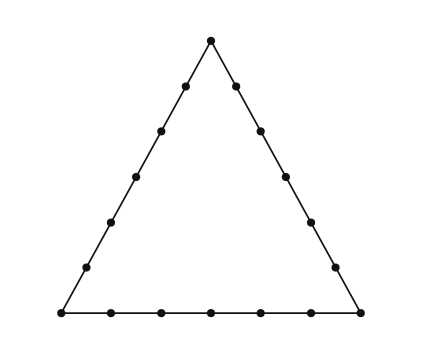
- COMEDK 2023Set 2023-E1 markMCQQ.18 Points are indicated on the perimeter of a triangle ABC as shown below. If three points are chosen then probability that it will from a triangle is (A) 21 (B) 408355 (C) 816331 (D) 816711
›Reveal solutionSolution
Triples that DO form a triangle = 816 - 105 = 711.
Concept: three chosen points form a triangle unless they are collinear; on a triangle's perimeter, collinear triples are exactly triples taken from ONE side.
Total ways to choose 3 of the 18 marked points: C(18, 3) = 816. (This 816 is exactly the denominator appearing in the options, confirming the stem's count of 18 points is the one to use, not the extra dots the printed drawing happens to show.)
The 18 points comprise the 3 vertices plus 5 more points on each of the three sides (3 + 3*5 = 18). Each side therefore carries 5 + 2 = 7 collinear points (its 5 interior points and its 2 end vertices).
Degenerate (collinear) triples = 3 * C(7, 3) = 3 * 35 = 105.
Triples that DO form a triangle = 816 - 105 = 711.
Probability = 711/816.
✓Final answerThe correct option is (D) — 816711
ANSWER: D
- COMEDK 2023Set 2023-M1 markMCQQ.In a trial, the probability of success is twice the probability of failure. In six trials, the probability of at most two failure will be (A) 729600 (B) 729500 (C) 729400 (D) 729496
›Reveal solutionSolution
With p(success)=32,p(failure)=31, the probability of at most 2 failures in 6 trials is 72964+192+240=729496.
Let failure probability =q. Given success =2q, and 2q+q=1⇒q=31,p=32. Number of failures X∼Bin(6,31). "At most two failures":
P(X≤2)=∑k=02(k6)(31)k(32)6−k.
P(0)=(32)6=72964,P(1)=6⋅31⋅(32)5=729192,P(2)=15⋅91⋅(32)4=729240.
Sum =72964+192+240=729496.
✓Final answerThe correct option is (D) — 729496
- COMEDK 2022Set 20221 markMCQQ.Three vertices are chosen randomly from the seven vertices of a regular 7-sided polygon. The probability that they form the vertices of an isosceles triangle is (A) 71 (B) 31 (C) 73 (D) 53
›Reveal solutionSolution
No triangle is counted more than once, because a triangle would be counted twice only if it were EQUILATERAL (three apexes) - and a regular 7-gon has no equilateral triangle since 7 is not divisible by 3. So the 21 are distinct.
Concept: Counting isosceles triangles in a regular polygon.
Total ways to choose 3 vertices from 7: C(7,3) = 35.
Count the isosceles triangles. Fix an APEX vertex; an isosceles triangle with that apex is obtained by picking the two other vertices symmetrically about the apex, i.e. the pair k steps clockwise and k steps anticlockwise, for k = 1, 2, 3 (k can go up to floor((7-1)/2) = 3). That gives 3 isosceles triangles per apex.
Number of isosceles triangles = 7 apexes x 3 = 21
No triangle is counted more than once, because a triangle would be counted twice only if it were EQUILATERAL (three apexes) - and a regular 7-gon has no equilateral triangle since 7 is not divisible by 3. So the 21 are distinct.
P = 21 / 35 = 3/5
✓Final answerThe correct option is (D) — 53
ANSWER: D
- KCET 2021Set A-11 markMCQQ.A student has to answer 10 questions, choosing at least 4 from each of the parts A and B. If there are 6 questions in part A and 7 in part B, then the number of ways can the student choose 10 questions is (A) 256 (B) 352 (C) 266 (D) 426
›Reveal solutionSolution
Enumerate the admissible splits between the two parts (4+6, 5+5, 6+4), count each with combinations, and add.
Step 1 — Set up the constraints.
Let a = number of questions chosen from Part A, and b = number from Part B.
- Part A contains 6 questions ⇒a≤6
- Part B contains 7 questions ⇒b≤7
- Total to answer: a+b=10
- At least 4 from each part: a≥4 and b≥4
Step 2 — Find every admissible split.
Since b=10−a, the condition b≥4 becomes 10−a≥4⇒a≤6. Combined with a≥4:
4≤a≤6.
So a∈{4,5,6}, giving exactly three cases:
Case a (from A, max 6) b=10−a (from B, max 7) Valid? 1 4 6 ✓ (6≤7) 2 5 5 ✓ 3 6 4 ✓ (Note a=3 would force b=7, but that breaks a≥4; a=7 is impossible since Part A only has 6 questions.)
Step 3 — The concept: choose, then multiply, then add.
Selecting questions is a combination (order does not matter), so each case counts as (a6)(b7) — the product rule, since the choice from A and the choice from B are independent. The three cases are mutually exclusive, so we finally add them (the addition rule).
Step 4 — Case 1: 4 from A, 6 from B.
(46)(67)=2⋅16⋅5×7=15×7=105.
Step 5 — Case 2: 5 from A, 5 from B.
(56)(57)=6×2⋅17⋅6=6×21=126.
(using (57)=(27)=21)
Step 6 — Case 3: 6 from A, 4 from B.
(66)(47)=1×3⋅2⋅17⋅6⋅5=1×35=35.
(using (47)=(37)=35)
Step 7 — Add the three mutually exclusive cases.
105+126+35=266.
Step 8 — Check the distractors.
- (D) 426 would arise from wrongly allowing extra splits.
- (B) 352 and (A) 256 are the results of miscounting one of the binomials.
Our enumeration is exhaustive and each case is checked against the sizes of the parts, so 266 stands.
✓Final answerThe correct option is (C) — 266.
ANSWER: C
- COMEDK 2021Set 2021-B1 markMCQQ.A box contains 5 white and an unknown number x of red balls. Two balls are drawn at random. If the probability that both are white is 5/14, then x = (A) 9 (B) 12 (C) 1 (D) 3
›Reveal solutionSolution
Solving the probability equation gives x=3 red balls.
Total balls =5+x. Probability both drawn are white:
P=(25+x)(25)=2(5+x)(4+x)10=(5+x)(4+x)20.
Set equal to 145:
(5+x)(4+x)=520×14=56.
Since 56=8×7=(5+3)(4+3), we get x=3.
✓Final answerThe correct option is (D) — 3
- KCET 2018Set A-11 markMCQQ.VERSION: 23-A 59. A bag contains 17 tickets numbered from 1 to 17. A ticket is drawn at random, then another ticket is drawn without replacing the first one. The probability that both the tickets may show even numbers is (A) 347 (B) 178 (C) 167 (D) 177
›Reveal solutionSolution
We need the probability of drawing two even-numbered tickets without replacement from numbers 1–17. There are 8 even numbers, so the probability is 178×167=347.
The key idea here is conditional probability without replacement. When the first ticket is not returned, the second draw's probability depends on what happened in the first draw. This is a classic "drawing without replacement" problem — the sample space shrinks after each draw.
Let's break it down.
-
Identify the total and favorable outcomes.
Tickets are numbered 1 to 17. The even numbers in this range are:
2,4,6,8,10,12,14,16 — that's 8 even numbers.
The total number of tickets is 17.
-
Probability that the first ticket is even.
Since all tickets are equally likely,
P(first even)=total ticketsnumber of even tickets=178.
- Probability that the second ticket is even, given the first was even.
After drawing one even ticket, it is not replaced. So:
- Remaining tickets: 17−1=16
- Remaining even tickets: 8−1=7 Hence,
P(second even∣first even)=167.
- Multiply the probabilities. For both events to happen in sequence, we multiply:
P(both even)=178×167=27256.
- Simplify the fraction. Divide numerator and denominator by 8:
27256=347.
Watch outA common mistake is to treat this as with replacement and write 178×178=28964, which is not even among the options. Always check whether the draw is with or without replacement.
TipYou can also think of this as: number of ways to choose 2 even tickets from 8 divided by number of ways to choose any 2 tickets from 17. That gives (217)(28)=13628=347 — same result, faster if you're comfortable with combinations.
✓Final answerThe probability is 347, which corresponds to option (A).
-
🎓Unlock everything free for 14 days
- ✓Full step-by-step solutions
- ✓Concept-first explanations
- ✓Methods, shortcuts & mistakes
- ✓PYQ mapping + timed mock tests
Full access for 14 days. No credit card required.