Q.Three equal masses of kg each are fixed at the vertices of an equilateral triangle .
Take (see Fig. 7.5).
You're viewing a preview — the full solution, concept, methods & PYQ mapping are locked.
Start your 14-day free trial to unlock the full solution →The net gravitational force on a mass at the centroid of an equilateral triangle with equal masses at the vertices is zero due to symmetry. When the mass at one vertex is doubled, the symmetry breaks and the net force points toward that vertex, with magnitude .
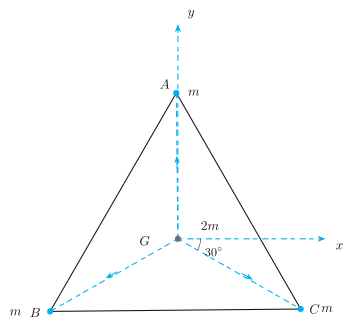
The figure shows an equilateral triangle ABC with a mass placed at each vertex. A fourth mass, , sits at the centroid G of the triangle. The centroid is the point where the three medians (lines from each vertex to the midpoint of the opposite side) intersect. In the diagram, these medians are drawn as dashed lines from G to A, B, and C.
A coordinate system is set up with its origin at G. The x-axis runs horizontally to the right through G, and the y-axis runs vertically upward through vertex A. The angle between the positive x-axis and the line GC is marked as . This angle is a direct geometric consequence of the equilateral triangle's symmetry: each median makes a angle with the side it meets, and the centroid divides each median in a 2:1 ratio.
The physical idea this figure teaches is the superposition of gravitational forces. You have three identical masses at the vertices and a different mass at the centre. The question the textbook asks is: what is the net gravitational force on the mass at G due to the three masses at A, B, and C?
Because the triangle is equilateral and the masses at the vertices are equal, the three forces on have the same magnitude. Their directions, however, are along the three medians — from G toward each vertex. The symmetry of the figure is the key: the three force vectors are spaced apart. When you add three vectors of equal magnitude that are apart, they cancel exactly. The net force on the mass at the centroid is therefore zero.
For any symmetric arrangement of equal masses at the vertices of an equilateral triangle, the net gravitational force on a mass placed at the centroid is zero. This is a direct consequence of vector addition and symmetry — no calculation is needed once you see the spacing.
The textbook develops the formula for the gravitational force between any two point masses. For the mass at vertex A and the mass at G, the magnitude of the force is:
where is the universal gravitational constant, is the mass at each vertex, and is the distance from G to any vertex (the same for all three vertices in an equilateral triangle). The direction of this force is along the line from G to A.
The same magnitude applies for the forces from B and C. The vector sum of these three forces is:
The angle marked in the figure is used when you want to resolve these forces into x- and y-components to verify the cancellation algebraically. For example, the force from C makes an angle of below the positive x-axis, so its x-component is and its y-component is . Adding all three components gives zero in both directions.
To verify the cancellation quickly: place the three force vectors tip-to-tail. Because they are equal in magnitude and separated by , they form a closed equilateral triangle of vectors — the resultant is zero. This geometric method is often faster than resolving components.
Why the centroid is special
The centroid of an equilateral triangle is equidistant from all three vertices, and the lines joining it to the vertices make angles with each other. When the three vertex masses are equal, the three gravitational force vectors on a mass at the centroid are equal in magnitude and spaced evenly ( apart) in direction — by the principle of superposition, their vector sum is zero (three equal-magnitude vectors at intervals always cancel).
Gravitational force between two point masses:
(a) Equal masses at all three vertices …
Unlock everything free for 14 days
- Full step-by-step solutions
- Concept-first explanations
- Methods, shortcuts & mistakes
- PYQ mapping + timed mock tests
Full access for 14 days. No credit card required.