Q.A body weighs 63 N on the surface of the earth. What is the gravitational force on it due to the earth at a height equal to half the radius of the earth?
🔒You're viewing a preview — the full solution, concept, methods & PYQ mapping are locked.
🔒 Start your 14-day free trial to unlock the full solution →Concept understanding — Variation Of Gravity
Variation of Gravity: Why Your Weight Changes Even When You Don't
Imagine you step on a weighing scale at sea level in Mumbai, then carry that same scale to the top of Mount Everest. The scale would show a smaller number — you'd weigh less. But you haven't lost any mass. What changed?
The force pulling you down — gravity — is not constant everywhere on Earth. It varies. That's what we mean by variation of gravity.
The Core Idea
Gravity is the force with which the Earth pulls objects toward its centre. The strength of this pull depends on two things: the mass of the Earth and your distance from its centre. Since the Earth is not a perfect sphere and it spins, that distance and the effective pull change from place to place.
The acceleration due to gravity, denoted by g, is approximately 9.8m/s2 at sea level. But that's an average. The actual value can be slightly higher or lower depending on where you are.
Why Does Gravity Vary? Three Main Reasons
1. Altitude (Height Above Sea Level)
This is the most intuitive one. As you go higher, you move farther from the Earth's centre. Gravity follows an inverse-square law: double the distance, and the force becomes one-fourth.
The formula for g at a height h above the Earth's surface (where R is Earth's radius, about 6400 km) is:
gh=(R+h)2GM
For small heights compared to R, we can approximate:
gh≈g(1−R2h)
This means for every kilometre you go up, g decreases by roughly 0.003m/s2. That's why at the top of a tall mountain, you weigh about 0.5% less than at sea level.
2. Depth (Going Underground)
What happens if you go down a mine or into the Earth's crust? Intuition might say gravity increases because you're closer to the centre. But the opposite happens.
Inside the Earth, the mass above you pulls upward, partially cancelling the pull from below. For a uniform Earth, only the mass inside the sphere of radius r (your distance from the centre) contributes to gravity at that point.
gd=r2GM′
Where M′ is the mass of the sphere of radius r. If Earth had uniform density ρ, then M′=34πr3ρ, giving:
gd=34πGρr
This means gravity decreases linearly as you go deeper. At the centre of the Earth, g=0 — you'd be weightless, pulled equally in all directions.
This linear decrease assumes uniform density. The real Earth has a dense iron core, so the actual variation is more complicated — gravity actually increases slightly as you go down through the crust before eventually decreasing.
3. Rotation of the Earth (Latitude Effect)
The Earth spins once every 24 hours. This rotation creates a centrifugal force that acts outward, away from the axis of rotation. This force effectively reduces the weight you feel.
The effect is strongest at the equator (where the rotational speed is highest, about 1670 km/h) and zero at the poles (where you're on the axis of rotation).
The effective g at latitude ϕ is:
geff=g−ω2Rcos2ϕ
Where ω is Earth's angular speed (7.3×10⁻⁵rad/s) and R is Earth's radius.
At the equator (ϕ=0∘), the reduction is about 0.034m/s2 — roughly 0.35% of g.
| Location | Approximate g (m/s²) | Why? |
|----------|------------------------|------|
| Equator (sea level) | 9.78 | Fastest rotation + bulging equator |
| 45° latitude | 9.81 | Intermediate |
| North Pole | 9.83 | No rotation effect + closer to centre |
4. Shape of the Earth (Oblateness)
The Earth is not a perfect sphere. Because of its rotation, it bulges at the equator and flattens at the poles. The equatorial radius is about 21 km larger than the polar radius.
This means:
- At the poles, you're closer to the Earth's centre → stronger gravity
- At the equator, you're farther from the centre → weaker gravity …
The key idea here is the Variation of Gravity with Height. The gravitational force exerted by the Earth on a body decreases as its distance from the Earth's center increases.
- The weight of the body on the Earth's surface is given by Ws=mg, where g is the acceleration due to gravity on the surface. We are given Ws=63 N.
- The acceleration due to gravity at a height h above the Earth's surface, gh, is related to g by the formula:
gh=g(R+hR)2
where R is the radius of the Earth.
- We are given that the height h is half the radius of the Earth, so h=R/2. Substituting this into the formula for gh: gh=g(R+R/2R)2=g(3R/2R)2=g(32)2=94g …
The gravitational force (weight) decreases with increasing height from the Earth's surface. At a height equal to half the Earth's radius, the gravitational force on the body will be 28 N.
Understanding Gravitational Force and its Variation with Height
The weight of a body is the gravitational force exerted on it by the Earth. This force is given by W=mg, where m is the mass of the body and g is the acceleration due to gravity at that location.
The acceleration due to gravity, g, is not constant. It depends on the distance from the center of the Earth. According to Newton's Law of Universal Gravitation, the force between two masses is inversely proportional to the square of the distance between their centers. This means that as a body moves further away from the Earth's surface, its distance from the Earth's center increases, and thus the gravitational force, and consequently the acceleration due to gravity, decreases.
At the Earth's surface, the acceleration due to gravity is gs. At a height h above the Earth's surface, the distance from the center of the Earth becomes R+h, where R is the radius of the Earth. The acceleration due to gravity at this height, gh, is given by the formula:
gh=gs(R+hR)2
Where:
- gh is the acceleration due to gravity at height h.
- gs is the acceleration due to gravity at the Earth's surface.
- R is the radius of the Earth.
- h is the height above the Earth's surface.
This formula is exact and should be used when the height h is comparable to the Earth's radius R. There is an approximation gh≈gs(1−2h/R) which is valid only for h≪R. Since the problem specifies h=R/2, which is not much smaller than R, we must use the exact formula.
Now, let's apply this understanding to solve the problem.
Step-by-Step Solution
-
Identify the initial condition:
The body weighs 63 N on the surface of the Earth. This means the gravitational force on the body at the surface is Ws=63 N.
We know that weight is W=mg. So, Ws=mgs=63 N. Here, m is the mass of the body, which remains constant regardless of its location, and gs is the acceleration due to gravity at the Earth's surface.
-
Identify the target condition:
We need to find the gravitational force (weight) on the body at a height h equal to half the radius of the Earth.
So, h=2R.
Let the gravitational force at this height be Wh. We can write Wh=mgh, where gh is the acceleration due to gravity at height h.
-
Apply the formula for gh:
Using the formula for acceleration due to gravity at height h:
gh=gs(R+hR)2
-
Substitute the given height into the formula:
We are given h=2R. Substitute this into the equation for gh: …
Step 1: Weight on the surface Ws=mg=63 N.
Step 2: Use the height-variation formula gh=g(R+hR)2. With h=R/2: R+hR=3R/2R=32. …
Showing the 12 most recent of 17 on this concept.
- KCET 2026Set C21 markMCQQ.Imagine a new planet having the same density as that of the earth, but it is two times bigger than the earth in size. If the acceleration due to gravity on the surface of the new planet is g' and that on the surface of the earth is g, then (A) g′=4g (B) g′=8g (C) g′=2g (D) g′=4g
›Reveal solutionSolution
Express surface gravity in terms of density and radius: g=GM/R2 with M=34πR3ρ gives g=34πGρR, i.e. g∝ρR.
Step 1 — Derive g in terms of density and radius
g=R2GM=R2G(34πR3ρ)=34πGρR
Step 2 — Apply the given conditions …
- KCET 2026Set C21 markMCQQ.Suppose the acceleration due to gravity at the earth's surface is g m/s2 and at the surface of moon it is g' m/s2. An M kg passenger goes from the earth to the moon in a spaceship moving with a constant velocity (Neglect all other objects in the sky). Which curve best represents the weight (net gravitational force) as a function of time? [FIGURE: A graph of weight (y-axis, marked Mg at top and Mg' lower down) versus time t (x-axis, up to t_s), showing four labelled curves A, B, C, D all starting at Mg; curves A and B decline toward the right without reaching zero; curve C dips to near zero at a point between O and t_s then rises back up to a value near Mg' at t_s; curve D dips lowest (to zero) between O and t_s and then rises back up, ending at Mg' at t_s.] (A) A (B) B (C) C (D) D
›Reveal solutionSolution
The net gravitational force (weight) on the passenger is the vector sum of Earth's pull (toward Earth, dominant near t=0) and the Moon's pull (toward the Moon, dominant near ts); between them lies a neutral point where these two pulls exactly cancel.
Step 1 — Write the net force as a function of position
At a distance r from Earth along a line of length D to the Moon, the net gravitational force on the passenger of mass M is
Fnet=r2GMeM (toward Earth)−(D−r)2GMmoonM (toward Moon)
At t=0 (near Earth), Fnet≈Mg, matching every curve's starting point.
Step 2 — Locate the neutral point
As r increases, Earth's pull weakens as 1/r2 while the Moon's pull strengthens as 1/(D−r)2. Since Mmoon≪Me, this neutral point (where the two forces are exactly equal and opposite, giving Fnet=0) lies quite close to the Moon, but it is reached well before ts.
Step 3 — Behaviour after the neutral point …
- KCET 2025Set D-41 markMCQQ.The total energy of a satellite in a circular orbit at a distance (R+h) from the centre of the Earth varies as [R is the radius of the Earth and h is the height of the orbit from Earth’s surface] (A) −(R+h)1 (B) −(R+h)21 (C) +(R+h)21 (D) +(R+h)1
›Reveal solutionSolution
The total energy of a satellite in a circular orbit is the sum of its kinetic and potential energies, which together give a dependence of −(R+h)1, so the correct option is (A).
The key idea is that for any satellite in a stable circular orbit, the gravitational force provides the necessary centripetal acceleration. This links the orbital speed directly to the orbital radius, and from there the total mechanical energy (kinetic + potential) simplifies to a neat expression.
Let’s build this from the ground up.
- Gravitational potential energy For a satellite of mass m at a distance r=R+h from the Earth’s centre, the gravitational potential energy is
U=−rGMm
where M is the Earth’s mass. This is always negative because gravity is attractive — zero only at infinite separation.
- Kinetic energy from orbital motion In a circular orbit, the centripetal force is supplied entirely by gravity:
r2GMm=rmv2
Cancel m and multiply through by r:
v2=rGM
So the kinetic energy is
K=21mv2=21m⋅rGM=2rGMm
- Total mechanical energy Add potential and kinetic:
E=K+U=2rGMm−rGMm=−2rGMm
This is the famous result: for a circular orbit, the total energy is exactly half the potential energy (and negative). …
- KCET 2025Set D-41 markMCQQ.Which of the following statements is incorrect with reference of ‘Nuclear force’? (A) Nuclear force becomes attractive for nucleon distances larger than 0.8fm (B) Nuclear force becomes repulsive for nucleon distances less than 0.8fm (C) Nuclear force is always attractive (D) Potential energy is minimum, if the separation between the nucleons is 0.8fm
›Reveal solutionSolution
Read the nucleon–nucleon potential-energy curve: it has a minimum at r0≈0.8fm, so the force is attractive outside that distance and repulsive inside it — hence "always attractive" is the false statement.
Step 1 — The shape of the nuclear potential.
The potential energy U(r) of two nucleons falls steeply from large positive values at very small r, passes through a minimum at r0≈0.8fm, and then rises towards zero as r grows, becoming negligible beyond a few femtometres.
Step 2 — Force from the potential.
The force is the negative gradient of the potential:
F(r)=−drdU
- For r>0.8fm: U is increasing with r, so dU/dr>0 and F<0 — the force pulls the nucleons together, i.e. attractive. This is what binds the nucleus.
- For r<0.8fm: U is decreasing with r, so dU/dr<0 and F>0 — the force pushes the nucleons apart, i.e. repulsive. This short-range repulsive "hard core" is why nuclear matter has a nearly constant density and does not collapse.
- At r=0.8fm: dU/dr=0, so F=0 — the equilibrium separation, where U is minimum.
Step 3 — Test each option. …
- COMEDK 2025Set 2025-A1 markMCQQ.If the radius of earth were to shrink by two percent, its mass remaining the same, the acceleration due to gravity on the earth's surface would (A) Decrease by 4% (B) Increase by 1% (C) Increase by 4% (D) Increase by 2%
›Reveal solutionSolution
The acceleration due to gravity on Earth’s surface depends inversely on the square of the radius. If the radius shrinks by 2% (mass constant), gravity increases by about 4%. The correct option is (C).
Concept & Intuition
The acceleration due to gravity at the surface of a planet is given by
g=R2GM,
where G is the gravitational constant, M is the planet’s mass, and R is its radius.
If the mass stays the same but the radius decreases, the surface gets closer to the center of mass. Since gravity follows an inverse-square law, a small reduction in radius causes a larger relative increase in g. A 2% decrease in R means the new radius is 0.98R, so g becomes (0.98R)2GM=0.9604R2GM≈1.041g. That’s roughly a 4% increase.
TipFor small changes, we can use the approximation:
If R changes by a small fraction x (here x=−0.02), then g changes by approximately −2x. Since x is negative, −2x is positive, giving about a 4% increase. This avoids squaring decimals.
Now let’s work it through step by step.
- Write the formula for g
g=R2GM.
Here G and M are constants, so g is inversely proportional to R2.
- Express the new radius A 2% shrinkage means the new radius R′ is
R′=R−0.02R=0.98R.
- Find the new acceleration g′
g′=(R′)2GM=(0.98R)2GM=0.9604R2GM.
Since R2GM=g, we have
- COMEDK 2025Set 2025-M1 markMCQQ.The radius of earth is R and acceleration due to gravity on its surface is g. The height at which the acceleration due to gravity becomes 8g is: (A) 2R (B) (22−1)R (C) 2R (D) 22R
›Reveal solutionSolution
The acceleration due to gravity decreases with height according to an inverse-square law. At height h, gh=g(R+h)2R2. Setting gh=g/8 gives h=(8−1)R=(22−1)R, so the correct option is (B).
The key idea is that gravity follows an inverse-square law with distance from the Earth’s center. On the surface, distance is R; at height h, distance is R+h. The acceleration drops as the square of the distance increases. So to get g/8, the distance must be multiplied by 8=22. That directly gives the height.
Let’s work it through:
- Write the formula for gravity at height h The acceleration due to gravity at a distance r from Earth’s center is
g(r)=r2GM
On the surface, r=R and g(R)=g=R2GM.
At height h above the surface, r=R+h, so
gh=(R+h)2GM=g⋅(R+h)2R2.
- Set the condition We want gh=8g. Substitute:
g⋅(R+h)2R2=8g.
Cancel g (non-zero):
(R+h)2R2=81.
- Solve for R+h Take reciprocals:
R2(R+h)2=8⇒(RR+h)2=8.
Take the positive square root (distance is positive):
RR+h=8=22.
So
- COMEDK 2024Set 2024-A1 markMCQQ.A planet has double the mass of the earth and double the radius. The gravitational potential at the surface of the Earth is V and the magnitude of the gravitational field strength is g. The gravitational potential and gravitational field strength on the surface of the planet are .tg {border-collapse:collapse;border-spacing:0;} .tg td{border-color:black;border-style:solid;border-width:1px;font-family:Arial, sans-serif;font-size:14px; overflow:hidden;padding:10px 5px;word-break:normal;} .tg th{border-color:black;border-style:solid;border-width:1px;font-family:Arial, sans-serif;font-size:14px; font-weight:normal;overflow:hidden;padding:10px 5px;word-break:normal;} .tg .tg-baqh{text-align:center;vertical-align:top} .tg .tg-amwm{font-weight:bold;text-align:center;vertical-align:top} Potential Field A V 4g B 2V 2g C V 2g D 2V 4g (A) C (B) D (C) A (D) B
›Reveal solutionSolution
Doubling both mass and radius leaves the surface potential unchanged (V) and halves the field strength (g/2) — that is table row C, i.e. option (A).
Earth: potential V=−RGM, field magnitude g=R2GM.
Planet: M′=2M, R′=2R.
Potential:
V′=−R′GM′=−2RG(2M)=−RGM=V.
Field strength:
g′=R′2GM′=(2R)2G(2M)=4R22GM=2g. …
- COMEDK 2024Set 2024-E1 markMCQQ.The acceleration due to gravity at pole and equator can be related as (A) ge=gp<g (B) ge=gp=g (C) ge<gp (D) ge>gp
›Reveal solutionSolution
The acceleration due to gravity is slightly less at the equator than at the poles because of Earth’s rotation and its equatorial bulge. Thus ge<gp, making option (C) correct.
Why this is the right approach
The value of g (acceleration due to gravity) is not constant over Earth’s surface. Two main effects cause it to vary:
- Earth’s rotation – At the equator, part of the gravitational force is “used up” to keep objects moving in a circle (centripetal force), so the measured weight is slightly less.
- Earth’s shape – Earth is an oblate spheroid: the equatorial radius is larger than the polar radius. Since g∝1/R2, gravity is weaker at the equator.
Both effects work in the same direction: they reduce g at the equator relative to the poles.
Step-by-step reasoning
- Recall the formula for apparent gravity The effective acceleration due to gravity at a latitude ϕ is
geff=g0−ω2Rcos2ϕ
where g0 is the gravity if Earth were non-rotating, ω is Earth’s angular speed, and R is the local radius. At the pole (ϕ=90∘), cosϕ=0, so
gp=g0
At the equator (ϕ=0∘), cosϕ=1, so
ge=g0−ω2R
Since ω2R>0, we get ge<gp.
- Consider the shape effect Earth’s equatorial radius is about 21 km larger than the polar radius. Using the inverse-square law:
g∝R21
A larger R at the equator means a smaller g. This reinforces the inequality ge<gp. …
- KCET 2023Set A-31 markMCQQ.A closed water tank has cross-sectional area A. It has a small hole at a depth h from the free surface of water. The radius of the hole is r so that r≪πA. If P0 is the pressure inside the tank above water level, and Pa is the atmospheric pressure, the rate of flow of the water coming out of the hole is [ρ is the density of water] (A) πr22gh+ρ2(P0−Pa) (B) πr22gH (C) πr2gh+ρ2(P0−Pa) (D) πr22gh
›Reveal solutionSolution
The key idea is to apply Bernoulli’s equation between the free surface and the hole, accounting for the excess pressure P0 above the water. The efflux speed is v=2gh+ρ2(P0−Pa), and the flow rate is area times speed, giving option (A).
The problem is a classic extension of Torricelli’s theorem. When the tank is open to the atmosphere, the efflux speed is simply 2gh. Here, the tank is closed and the air above the water is at a pressure P0 that may differ from atmospheric pressure Pa outside the hole. That pressure difference adds an extra term to the kinetic energy of the emerging water.
The condition r≪A/π means the hole area is tiny compared to the tank’s cross-section, so the water level falls very slowly. This lets us treat the flow as steady and the speed of the free surface as negligible.
-
Choose two points for Bernoulli’s equation.
Point 1: at the free surface inside the tank, where pressure is P0, speed is nearly 0, and height is taken as 0 (reference level).
Point 2: just outside the hole, where pressure is Pa (atmospheric), speed is v (what we want), and height is −h (since the hole is h below the surface).
-
Write Bernoulli’s equation for an ideal, incompressible fluid:
P0+21ρ(0)2+ρg(0)=Pa+21ρv2+ρg(−h)
This simplifies to:
P0=Pa+21ρv2−ρgh
- Solve for v:
21ρv2=P0−Pa+ρgh
v2=ρ2(P0−Pa)+2gh
v=2gh+ρ2(P0−Pa) …
-
- COMEDK 2023Set 2023-E1 markMCQQ.The acceleration due to gravity at a height of 7 km above the earth is the same as at a depth d below the surface of the earth. Then d is (A) 7 km (B) 2 km (C) 3.5 km (D) 14 km
›Reveal solutionSolution
Since g falls twice as fast with height as with depth (gh=g(1−2h/R) vs gd=g(1−d/R)), equal values require d=2h=14 km.
At height h (with h≪R): gh=g(1−R2h).
At depth d: gd=g(1−Rd). …
- COMEDK 2023Set 2023-M1 markMCQQ.Starting from the centre of the earth having radius R, the variation of g (acceleration due to gravity) is shown by (A) (B) (C) (D)
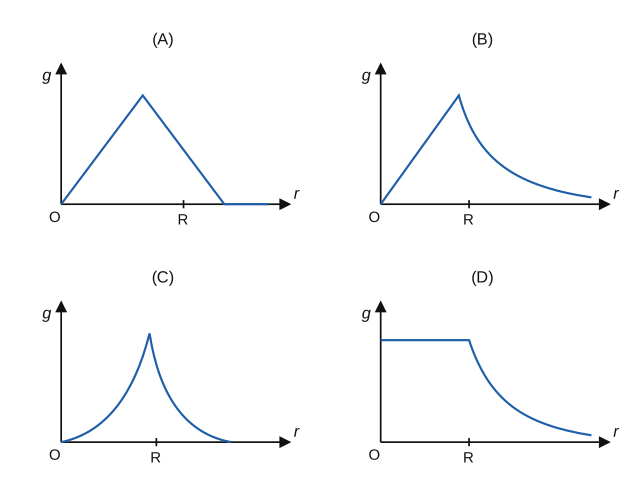
›Reveal solutionSolution
The acceleration due to gravity inside a uniform sphere increases linearly with distance from the centre, then outside it falls off as 1/r2. The correct graph is a straight-line rise from zero at the centre to a maximum at the surface, followed by a curved decay — this matches option (B).
The key concept is Newton’s shell theorem and how gravity behaves inside and outside a uniform sphere.
- Inside a uniform sphere (r<R), only the mass inside radius r contributes to gravity; that mass is proportional to r3, so g∝r.
- Outside (r>R), the entire mass acts as if concentrated at the centre, so g∝1/r2.
Thus the graph must show a linear increase from g=0 at the centre to a maximum at the surface, then a smooth, concave-up decay (not a straight line) for r>R. Let’s check each option.
- Inside the Earth (0≤r≤R) For a uniform sphere of radius R and mass M, the mass enclosed at radius r is
Menc=R3Mr3.
By Newton’s law,
g(r)=r2GMenc=R3GMr.
So g is directly proportional to r — a straight line from the origin. This eliminates option (C) (curved rise) and option (D) (starts at maximum, no rise).
- At the surface (r=R)
g(R)=R2GM,
the familiar surface gravity. The graph must peak exactly at r=R.
- Outside the Earth (r>R) The entire mass M acts at the centre, so g(r)=r2GM. …
- COMEDK 2023Set 2023-M1 markMCQQ.The height vertically above the earth's surface at which the acceleration due to gravity becomes 1% of its value at the surface is (A) 8R (B) 9R (C) 10R (D) 20R
›Reveal solutionSolution
Setting g(R/(R+h))2=0.01g gives R/(R+h)=0.1, hence R+h=10R and h=9R.
Above the surface,
g′=g(R+hR)2.
We need g′=0.01g: …
🎓Unlock everything free for 14 days
- ✓Full step-by-step solutions
- ✓Concept-first explanations
- ✓Methods, shortcuts & mistakes
- ✓PYQ mapping + timed mock tests
Full access for 14 days. No credit card required.