Q.Four strings pull on a single point P, which stays at rest (equilibrium). Taking the upward vertical as reference: one string pulls with a force of 2 N directed up and to the left, at 45∘ from the upward vertical; a second string pulls with 1 N directed up and to the right, at 45∘ from the upward vertical; a third string pulls with an unknown force F1 directed horizontally to the right (it makes 45∘ with the 1 N force); and a fourth string pulls with an unknown force F2 directed vertically downward (at 90∘ from F1). Find the forces F1 and F2.
🔒You're viewing a preview — the full solution, concept, methods & PYQ mapping are locked.
🔒 Start your 14-day free trial to unlock the full solution →Concept understanding — Static Equilibrium
Static Equilibrium: The Art of Staying Put
Imagine a book lying flat on a table. It doesn't move. A lamp hanging from the ceiling — still. A bridge holding up cars — motionless. What do all these have in common? They are in static equilibrium.
The word "static" means unchanging or stationary. "Equilibrium" comes from Latin aequilibrium — "equal balance." Put them together: a state where an object is completely at rest, with no tendency to start moving or rotating.
But here's the key insight: being at rest doesn't mean nothing is happening. Forces are still acting on that book — gravity pulls it down, the table pushes it up. The lamp feels tension from the ceiling pulling up and gravity pulling down. These forces are cancelling each other out perfectly.
Static equilibrium is dynamic balance — forces are present, but their net effect is zero. The object "chooses" to stay still because all pushes and pulls are perfectly matched.
The Two Conditions for Static Equilibrium
For an object to be truly static (not moving or rotating), two separate things must be true simultaneously.
Condition 1: No Net Force (Translational Equilibrium)
The sum of all forces acting on the object must be zero. In vector form:
∑F=0
This means:
- All upward forces equal all downward forces
- All leftward forces equal all rightward forces
- All forward forces equal all backward forces
If you break it into components (the standard exam approach):
∑Fx=0,∑Fy=0,∑Fz=0
Why this alone isn't enough: Imagine pushing a door at its handle — it rotates open. The forces might balance (you push, the hinges push back), but the door still moves. That's why we need the second condition.
Condition 2: No Net Torque (Rotational Equilibrium)
The sum of all torques (twisting effects) about any point must be zero:
∑τ=0
Torque depends on three things: the force applied, the distance from the pivot point, and the angle at which you push. For a force F applied at distance r from the pivot, at angle θ:
τ=rFsinθ
A common mistake: thinking torque only matters if the object is actually rotating. Torque can be present even when nothing moves — it's just balanced by other torques. A seesaw with two kids of equal weight at equal distances is a perfect example.
Putting It All Together
For an object to be in static equilibrium:
∑F=0and∑τ=0
Both conditions must hold simultaneously. If either fails, the object will either accelerate (move in a straight line) or start rotating (or both).
A Simple Example: The Book on the Table
Consider a 2 kg book on a horizontal table. Gravity pulls down with force Fg=mg=2×9.8=19.6 N.
The table pushes up with a normal force N=19.6 N.
Check condition 1: ∑Fy=N−Fg=19.6−19.6=0 ✓ …
Since P is in equilibrium, the horizontal components of all forces sum to zero (giving F1) and the vertical components sum to zero (giving F2). …
With P at rest, the vector sum of the four pulls is zero. Resolving into horizontal and vertical axes turns this into two simple equations, giving F1=1/2≈0.71 N and F2=3/2≈2.12 N.
Concept
For a point in equilibrium, ∑Fx=0 and ∑Fy=0. Take right as +x and up as +y. The 2 N pull acts at 135∘ (up-left, 45∘ from vertical), the 1 N pull at 45∘ (up-right), F1 along +x, and F2 along −y. Note cos45∘=sin45∘=21.
Horizontal balance (∑Fx=0)
The 2 N force has a leftward component 2cos45∘; the 1 N force has a rightward component 1cos45∘; F1 is fully rightward:
F1+1cos45∘−2cos45∘=0⇒F1=(2−1)cos45∘=21≈0.71 N. …
Concept: Resolving Concurrent Forces at Equilibrium
At equilibrium, ΣFx=0 and ΣFy=0 independently — resolve every force into horizontal and vertical components and balance each axis.
Step 1: Set up the axes and each force's components
Take right as +x, up as +y. The 2 N force (up-left, 45∘ from vertical) has components (−2cos45∘,+2sin45∘). The 1 N force (up-right, 45∘ from vertical) has components (+1cos45∘,+1sin45∘). F1 acts along +x; F2 acts along −y.
Step 2: Apply horizontal equilibrium to find F1
F1+1cos45∘−2cos45∘=0⟹F1=(2−1)cos45∘=21≈0.71 N
Step 3: Apply vertical equilibrium to find F2 …
- KCET 2026Set C21 markMCQQ.A mass M is hung with a light inextensible string as shown in figure. Find the tension of the horizontal string.
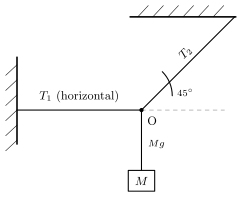 (A) 2 Mg
(B) 3 Mg
(C) Mg
(D) 3 Mg
(A) 2 Mg
(B) 3 Mg
(C) Mg
(D) 3 Mg›Reveal solutionSolution
Apply the equilibrium condition ∑F=0 at the junction point O where the horizontal string, the 45∘ string, and the hanging mass all meet.
Step 1 — Set up the forces at the junction O
As shown in the figure, three forces act at the junction O: the tension T1 in the horizontal string (pulling toward the wall), the tension T2 in the string inclined at 45∘ to the horizontal (pulling toward the ceiling attachment), and the weight Mg of the hanging mass (pulling vertically downward). Resolving T2 into components gives a horizontal part T2cos45∘ and a vertical part T2sin45∘.
Step 2 — Apply equilibrium along each axis
Since O is in equilibrium (the system is static), the net force in both the vertical and horizontal directions must be zero. …
- COMEDK 2025Set 2025-E1 markMCQQ.A bob of a simple pendulum has a mass of 4 g and a charge of 20μC. If it is at rest in a uniform horizontal electric field of intensity 1000Vm−1, the angle that the pendulum makes with the vertical at equilibrium is: (A) tan−121 (B) 60∘ (C) 30∘ (D) tan−12
›Reveal solutionSolution
The pendulum is in equilibrium under gravity and the horizontal electric force; the angle is given by tanθ=mgqE, which evaluates to tanθ=21, so the correct option is (A).
We have a simple pendulum bob with mass m=4 g=4×10⁻³ kg and charge q=20 μC=20×10−6 C. It is placed in a uniform horizontal electric field E=1000 V/m. At equilibrium, the bob is stationary, so the net force on it must be zero. The forces acting are:
- Weight mg vertically downward.
- Electric force qE horizontally (direction depends on sign of charge; we take it as horizontal).
- Tension T along the string.
At equilibrium, the bob hangs at some angle θ from the vertical. The tension must balance both the weight and the electric force. This is a classic case of equilibrium under two perpendicular forces: the vertical component of tension balances weight, and the horizontal component balances the electric force.
-
Resolve forces.
Let θ be the angle the string makes with the vertical. Then:
- Vertical: Tcosθ=mg
- Horizontal: Tsinθ=qE
-
Divide the two equations to eliminate T:
TcosθTsinθ=mgqE⇒tanθ=mgqE
- Plug in the numbers (use SI units):
qE=(20×10−6)(1000)=20×10−3=0.02 N
mg=(4×10⁻³)(9.8)=0.0392 N
So
tanθ=0.03920.02≈0.5102 …
- COMEDK 2024Set 2024-A1 markMCQQ.A tiny ball of mass m and charge q is suspended from the fixed support using an insulating string of length 1 m. The horizontal uniform electric field E is switched on. The angle made by the string with vertical when the ball is in equilibrium is 45∘. The magnitude of uniform electric field is (A) E=qmgNC−1 (B) E=q2mgNC−1 (C) E=2qmgNC−1 (D) E=0NC−1
›Reveal solutionSolution
The ball hangs at 45° when the electric force equals the weight, so qE=mg, giving E=mg/q. The correct option is (A).
The key concept here is equilibrium of forces in two dimensions. When the electric field is switched on, the charged ball experiences a horizontal electric force qE and a downward gravitational force mg. The string tension adjusts so that the net force is zero. At equilibrium, the string makes a 45° angle with the vertical, which tells us the horizontal and vertical force components are equal in magnitude.
-
Draw the free-body diagram.
The ball has three forces:
- Weight mg (downward)
- Electric force qE (horizontal, direction of the field)
- Tension T along the string (at 45° to the vertical)
-
Resolve tension into components.
Since the string makes 45° with the vertical, the horizontal component is Tsin45∘ and the vertical component is Tcos45∘. Because sin45∘=cos45∘=21, both components have magnitude T/2.
-
Apply equilibrium conditions.
- Vertical equilibrium: Tcos45∘=mg⇒2T=mg
- Horizontal equilibrium: Tsin45∘=qE⇒2T=qE
-
Equate the two expressions. …
-
- COMEDK 2024Set 2024-M1 markMCQQ.A stone of mass 2 kg is hung from the ceiling of the room using two strings. If the strings make an angle 60∘ and 30∘ respectively with the horizontal surface of the roof then the tension on the longer string is : g=10 ms−2 (A) 23 N (B) 103 N (C) 10 N (D) 3 N
›Reveal solutionSolution
The two strings are perpendicular; equilibrium gives the longer (flatter, 30∘) string a tension of 10 N.
Weight of the stone: W=mg=2×10=20 N.
Let T1 be the tension in the string at 60∘ and T2 the tension in the string at 30∘ (angles from the horizontal). The 30∘ string is the longer one.
Horizontal balance:
T1cos60∘=T2cos30∘ ⇒ T1=3T2.
Vertical balance:
T1sin60∘+T2sin30∘=20 …
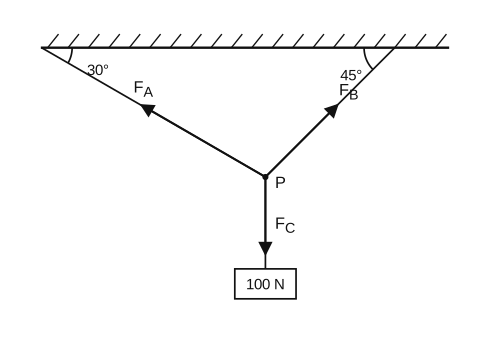
- COMEDK 2023Set 2023-E1 markMCQQ.FA,FB and FC are three forces acting at point P as shown in figure. The whole system is in equilibrium state. The magnitude of FA is (A) 100 N (B) 83.3 N (C) 73.3 N (D) 89.6 N
›Reveal solutionSolution
Resolving the equilibrium of the three concurrent forces gives FA(1.366)=100, so FA≈73.3 N.
Three forces are concurrent at P: FA along the left string (30∘ above horizontal, pulling up-left), FB along the right string (45∘ above horizontal, pulling up-right), and the weight FC=100 N downward.
Horizontal equilibrium (the two string tensions balance):
FAcos30∘=FBcos45∘
FB=FAcos45∘cos30∘=FA0.7070.866=1.2247FA …
- KCET 2022Set B-31 markMCQQ.An electric dipole with dipole moment 4×10⁻⁹ Cm is aligned at 30∘ with the direction of a uniform electric field of magnitude 5×10⁴ NC−1, the magnitude of the torque acting on the dipole is (A) 10−5 Nm (B) 10×10−3 Nm (C) 10−4 Nm (D) 3×10⁻⁴ Nm
›Reveal solutionSolution
Apply τ=p×E, whose magnitude is τ=pEsinθ with θ=30∘.
Step 1 — Why a dipole feels a torque but no net force.
In a uniform field, the +q end feels qE one way and the −q end feels qE the opposite way. The two forces are equal and opposite, so the net force is zero — but because they act along different lines, they form a couple that twists the dipole. The couple's moment is the torque:
τ=p×E⟹τ=pEsinθ
where θ is the angle between the dipole moment p and the field E. Physically, this torque acts to align p with E — which is why τ=0 at θ=0∘ (aligned, stable) and is maximum at θ=90∘.
Step 2 — List the data.
p=4×10⁻⁹ Cm,E=5×10⁴ NC−1,θ=30∘
Step 3 — Substitute.
τ=pEsinθ=(4×10⁻⁹)(5×10⁴)sin30∘
First the product pE:
pE=(4)(5)×10−9+4=20×10−5=2×10⁻⁴
Now the trigonometric factor, sin30∘=21:
τ=2×10−4×21
τ=1×10⁻⁴ Nm
Step 4 — Check the distractors. …
- KCET 2022Set B-31 markMCQQ.A metallic rod of mass unit length 0.5 kgm−1 is lying horizontally on a smooth inclined plane which makes an angle of 30∘ with the horizontal. A magnetic field of strength 0.25 T is acting on it in the vertical direction. When a current ‘T’ is flowing through it, the rod is not allowed to slide down. The quantity of current required to keep the rod stationary is (A) 14.76 A (B) 11.32 A (C) 7.14 A (D) 5.98 A
›Reveal solutionSolution
The magnetic force BIL on the current-carrying rod is horizontal (since B is vertical and the rod is horizontal); balance its component along the frictionless incline against the component of gravity, which gives I=λgtanθ/B.
Step 1 — Get the direction of the magnetic force.
The force on a current-carrying rod is
F=IL×B
Here L is horizontal (the rod lies horizontally across the incline) and B is vertical. A cross product of a horizontal vector with a vertical vector is horizontal, and perpendicular to the rod.
Since they are mutually perpendicular, the magnitude is simply
F=BIL
acting horizontally, pushing the rod into the incline.
Step 2 — Resolve along the incline (the plane is smooth ⇒ no friction).
Take axes along and perpendicular to the incline surface, θ=30∘:
- Component of weight down the incline: mgsinθ
- Component of the horizontal magnetic force up the incline: BILcosθ
(The horizontal force makes angle θ with the incline surface, so its along-incline component carries cosθ — this is the step most students get wrong by writing sinθ.)
Step 3 — Equilibrium condition.
BILcosθ=mgsinθ …
- COMEDK 2021Set 2021-B1 markMCQQ.A mass of 5 kg suspended from the end of a string is pulled through an angle of 600 to the vertical. The tension in the string is ( g=10m/s2) (A) 3100 (B) 350 (C) 100 (D) 503
›Reveal solutionSolution
With the string at 60∘ to vertical and a horizontal applied force, vertical equilibrium gives Tcos60∘=mg, so T=100 N.
The mass is held in equilibrium at 60∘ from the vertical by a horizontal force. Resolving:
Vertical: Tcosθ=mg. …
- KCET 2018Set A-11 markMCQQ.A man weighing 60kg is in a lift moving down with an acceleration of 1.8ms−2. The force exerted by the floor on him is (A) 588N (B) 480N (C) Zero (D) 696N
›Reveal solutionSolution
The apparent weight of a person in an accelerating lift is found by applying Newton’s second law in the vertical direction. For downward acceleration, the normal force is less than the true weight. The force exerted by the floor on the man is 480 N.
The concept: apparent weight in an accelerating lift
When you stand in a lift, the floor pushes up on you with a normal force N. That’s the force you feel as your weight. If the lift is stationary or moving at constant speed, N equals your true weight mg. But if the lift accelerates, the net force on you must equal ma (Newton’s second law). The direction of acceleration decides whether N is larger or smaller than mg.
Here the lift is moving down with acceleration a=1.8 m/s2. That means the net acceleration of the man is also 1.8 m/s2 downward. So the net force on him is ma downward. The two vertical forces acting on him are:
- his weight mg (downward)
- the normal force N from the floor (upward)
Since the net force is downward, the downward force (weight) must be larger than the upward force (normal). So N<mg.
Step-by-step solution
1. Choose a sign convention.
Let downward be positive. Then:
- Weight mg is positive.
- Normal force N is negative (it points upward).
- Acceleration a is positive (downward).
2. Write Newton’s second law.
The net force in the downward direction is:
mg−N=ma
3. Solve for N.
Rearrange:
N=mg−ma=m(g−a)
4. Plug in the numbers. …
🎓Unlock everything free for 14 days
- ✓Full step-by-step solutions
- ✓Concept-first explanations
- ✓Methods, shortcuts & mistakes
- ✓PYQ mapping + timed mock tests
Full access for 14 days. No credit card required.