Q.Two vectors u and v are drawn in the XY-plane. Both lie to the right of the Y-axis, so both have positive x-components. u is directed upward and to the right (it points above the horizontal, so its y-component is positive), while v is directed downward and to the right (it slopes below the horizontal, so its y-component is negative). If u=ai^+bj^ and v=pi^+qj^, which of the following is correct?
Concept understanding — Vector Component Extraction
Vector Component Extraction: The Intuition
Imagine pushing a heavy box across the floor at an angle — not straight forward, but slightly downward. Some of your effort moves the box forward, and some presses it into the floor. The force you apply is a single vector, but its effect splits into two independent directions: horizontal and vertical.
That splitting is vector component extraction. Any vector can be seen as the sum of two (or three) simpler vectors pointing along chosen reference directions — usually the coordinate axes. Each of those simpler vectors is a component.
"Component" means "a part of a whole." In vectors, the components are the parts that add up to give the original vector.
The Precise Statement
Given a vector v in a plane, and perpendicular axes x and y, the components of v are its projections onto those axes:
v=vxi^+vyj^
where i^ and j^ are unit vectors along the x and y axes, and vx, vy are scalar components (numbers, possibly negative).
If v makes an angle θ from the positive x-axis, then:
vx=∣v∣cosθandvy=∣v∣sinθ
Component along an axis=(magnitude of vector)×cos(angle between vector and that axis)
Why This Works: The Geometry
Draw a vector from the origin. Drop a perpendicular from its tip to the x-axis — that gives vx. Drop another to the y-axis — that gives vy. The original vector is the diagonal of the rectangle formed by vx and vy. This is the Pythagorean theorem in reverse: if you know the hypotenuse and one angle, trigonometry gives you the legs.
A Concrete Example
A force of 10 N acts at 30∘ above the horizontal.
- Fx=10cos30∘=10×23=53≈8.66 N
- Fy=10sin30∘=10×21=5 N
So the force vector is 8.66i^+5j^ N.
A common mistake: using sin for the horizontal component and cos for the vertical. Check: if the angle is measured from the x-axis, the side adjacent to it is along x — that's cos; the opposite side is along y — that's sin.
Why This Matters
Component extraction is the single most useful operation in vector physics. It lets you add vectors by adding their components (much easier than geometry), apply Newton's laws separately in each direction, and analyze 2D motion (projectiles, inclined planes). Without components you'd draw parallelograms every time; with them, it's just arithmetic.
The deeper reason it works: every vector is a sum of perpendicular pieces, and those pieces are independent — changing one doesn't affect the other. That independence lets you treat the x- and y-directions as separate problems, then combine the results.
Vector component extraction is the art of breaking a single vector into its perpendicular parts, so you can work with each separately.
Resolving a vector into its perpendicular components is taught in the CBSE Class 11 Physics and Mathematics vector chapters and revisited in Class 12 Vector Algebra, making "vector components formula with examples" one of the most searched topics across both subjects. This same component method is essential for solving projectile motion and inclined-plane problems in JEE Main and NEET Physics.
u points up-and-right, so both its components are positive (a>0,b>0). v points down-and-right, so its x-component is positive but its y-component is negative (p>0,q<0).
A component is positive when the vector points along the + axis. u (up-right) gives a>0,b>0; v (down-right) gives p>0,q<0.
Option (B) — a, p and b are positive while q is negative.
Read each vector's direction: rightward gives a positive i^-component, upward a positive j^-component. u points up-and-to-the-right, so a>0 and b>0; v points down-and-to-the-right, so p>0 and q<0. Hence option (B).
Concept
For a vector A=Axi^+Ayj^, the sign of each component is fixed by direction: Ax>0 if it points toward +x (right), Ax<0 if toward −x (left); Ay>0 if it points toward +y (up), Ay<0 if down.
Steps
- Vector u: it lies in the first quadrant, pointing up and to the right. Rightward ⇒a>0; upward ⇒b>0.
- Vector v: it points to the right but slopes downward (below the horizontal). Rightward ⇒p>0; downward ⇒q<0.
- Collecting: a>0, b>0, p>0, q<0.
Why the others fail
- (A) claims b<0, but u points upward, so b>0. Wrong.
- (C) claims p<0, but v points to the right, so p>0. Wrong.
- (D) claims all positive, but v points downward, so q<0. Wrong.
Option (B): a, p and b are positive while q is negative.
Concept: Instantiate Concrete Numbers That Match the Picture, Then Just Read Off the Signs
Method: Pick an Explicit Numeric Vector for u and v (Not Abstract Quadrant/Sign Reasoning)
Both existing solutions reason abstractly about which quadrant each vector points into and what sign that implies for each component. This method instead writes down one concrete, fully numeric pair of vectors that matches the pictorial description exactly, computes their components directly, and checks each answer option by substitution — turning an abstract sign argument into simple arithmetic.
Step 1 — Build a concrete u matching "up and to the right"
Any vector with both components positive points up-and-to-the-right. Pick a simple example:
u=3i^+4j^⟹a=3, b=4
Both are chosen positive, exactly matching "lies to the right of the Y-axis" (x-component positive) and "directed upward" (y-component positive).
Step 2 — Build a concrete v matching "down and to the right"
v=3i^−4j^⟹p=3, q=−4
The x-component is positive (still to the right of the Y-axis), but the y-component is negative (sloping below the horizontal, downward).
Step 3 — Read off the actual signs
a=3>0,b=4>0,p=3>0,q=−4<0
Step 4 — Test every option by direct substitution
- (a) claims a,p>0 and b,q<0: but b=4>0 here, contradicting the claim — fails.
- (b) claims a,p,b>0 and q<0: matches exactly (3>0,3>0,4>0,−4<0) — holds.
- (c) claims a,q,b>0 and p<0: but p=3>0 here, contradicting the claim — fails.
- (d) claims all four positive: but q=−4<0 here, contradicting the claim — fails.
Why using concrete numbers instead of abstract reasoning is a genuine cross-check
The abstract argument ("up-right means both components positive") and this numeric instantiation reach the same conclusion, but the numeric version leaves no room for a sign-convention slip: once real numbers are written down, checking each option is pure substitution, not a second round of directional reasoning that could itself go wrong. Since u,v were only required to match the two given directions (not any specific magnitude), any other numeric choice with the same signs — e.g. u=1i^+2j^, v=5i^−1j^ — would confirm the identical conclusion.
Final Answer
With u=3i^+4j^ (up-right) and v=3i^−4j^ (down-right): a,b,p>0 and q<0, matching option (b) exactly — a,p,b positive, q negative.
- COMEDK 2026Set 2026-M1 markMCQQ.Forces A and B act at a point. The sum of their magnitudes is 50 N and the magnitude of their resultant is 20 N . If the resultant is at 90∘ with the smaller force, the magnitudes of A and B , in N are (A) 28 N,20 N (B) 40 N,8 N (C) 29 N,21 N (D) 35 N,13 N
›Reveal solutionSolution
Using the parallelogram law with the condition that the resultant is perpendicular to the smaller force gives A2−B2=R2. With A+B=50 and R=20, we get A−B=8, so A=29 N and B=21 N. The correct option is (C).
Concept and Intuition
When two forces act at a point, their resultant's magnitude and direction are given by the parallelogram law. Here, we know the resultant is perpendicular to the smaller force. That means the smaller force has no component along the resultant's direction — it is entirely "sideways" to the resultant. This geometric condition gives a clean relationship between the two forces and the resultant, which, together with the sum of their magnitudes, lets us solve for each.
Step-by-step solution
- Set up variables and given conditions Let the two forces be A and B, with A>B (so B is the smaller force). Given:
A+B=50(1)
Resultant magnitude R=20 N.
The resultant is at 90∘ to the smaller force B.
- Apply the parallelogram law For two forces A and B with an angle θ between them, the resultant magnitude is:
R2=A2+B2+2ABcosθ
Also, the angle α that the resultant makes with force B satisfies:
tanα=B+AcosθAsinθ
Here, α=90∘ (resultant perpendicular to B), so tan90∘ is undefined, meaning the denominator must be zero:
B+Acosθ=0⇒cosθ=−AB
- Substitute cosθ into the resultant equation From R2=A2+B2+2ABcosθ, replace cosθ:
202=A2+B2+2AB(−AB)
Simplify:
400=A2+B2−2B2=A2−B2
So:
A2−B2=400(2)
- Solve the system of equations From (1): A=50−B. Substitute into (2):
(50−B)2−B2=400
Expand:
2500−100B+B2−B2=400
2500−100B=400
100B=2100⇒B=21
Then A=50−21=29.
- Check the "smaller force" condition We assumed B is the smaller force, but here B=21 and A=29 — that's fine, B<A. However, does the resultant being perpendicular to the smaller force hold? Yes, because we used that condition. But wait — let's verify the resultant magnitude:
A2−B2=292−212=841−441=400✓
So R=400=20 N. This matches option (C): 29 N, 21 N.
Watch outBut check the options carefully! Option (C) is 29 N and 21 N. However, we must ensure the resultant is perpendicular to the smaller force. Here smaller is 21 N, and the resultant is perpendicular to it — that works. But is there another possibility? Let's re-examine: we assumed B is smaller, but what if we had swapped labels? If we instead let the smaller force be A (so A<B), then the equation becomes A+Acosθ=0 leading to a different pair. Let's test that case quickly.
- Test the alternative labeling Suppose the smaller force is A (so A<B). Then resultant is perpendicular to A, giving:
A+Bcosθ=0⇒cosθ=−BA
Then:
R2=A2+B2+2AB(−BA)=A2+B2−2A2=B2−A2
So B2−A2=400. With A+B=50, solve:
(50−A)2−A2=400⇒2500−100A=400⇒A=21,B=29
This gives the same numbers but swapped — so the pair is 29 and 21, with the smaller being 21. So the forces are 29 N and 21 N.
TipThe key insight: the condition "resultant perpendicular to the smaller force" forces the difference of squares to equal R2. Combined with the sum, you get a simple linear equation.
✓Final answerThe correct option is (C).
ANSWER: C
- KCET 2024Set D-21 markMCQQ.A ceiling fan is rotating around a fixed axle as shown. The direction of angular velocity along.
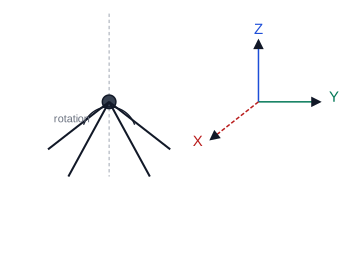 (A) X
(B) Y
(C) Z
(D) −Z
(A) X
(B) Y
(C) Z
(D) −Z›Reveal solutionSolution
ω lies along the rotation axis (the vertical axle, ±Z); apply the right-hand rule to the sense drawn in the figure — the near edge moves −Y, which forces ω along −Z.
Step 1 — The concept: angular velocity is an axial vector.
Unlike a linear velocity, ω does not point along the direction anything is moving. It points along the axis of rotation, and its sense is given by the right-hand rule: curl the fingers of the right hand in the sense of the rotation, and the extended thumb gives the direction of ω. Its magnitude is ω=dθ/dt.
Step 2 — Fix the axis.
The fan hangs from a vertical down-rod and spins about that rod. The dashed axle is vertical, and in the given frame Z points straight up. So ω must be along +Z or −Z — the horizontal directions X and Y are impossible, immediately eliminating options (A) and (B). The only question left is the sign.
Step 3 — Read the sense of rotation from the figure.
The frame drawn is right-handed: Z up, Y to the right, X out of the page towards the viewer. The rotation arrow is an ellipse round the axle whose near (front, +X side) arc runs from right to LEFT, while the far arc runs left to right.
So a blade tip that is momentarily nearest the viewer (position r along +X^) has velocity v pointing in the −Y^ direction.
Step 4 — Apply v=ω×r to pin the sign.
Write ω=ωzZ^ and take the blade tip at r=rX^:
v=ωzZ^×rX^=ωzr(Z^×X^)=ωzrY^.
But the figure says this point moves along −Y^, i.e. v=−∣v∣Y^. Matching:
ωzr=−∣v∣⟹ωz<0.
Therefore
ω=ωzZ^withωz<0⟹ω points along −Z.
Step 5 — Cross-check with the bare right-hand rule.
Hold your right hand above the fan and curl the fingers so the near side sweeps right-to-left (that is, the fan turns clockwise as seen from below/from the viewer's side, i.e. anticlockwise seen from above? — do not guess by eye, just curl): with the fingers following near-right→near-left→far-left→far-right, the thumb points down the axle, i.e. towards −Z. Consistent with Step 4.
✓Final answerThe correct option is (D) −Z — the angular velocity lies along the vertical axle, and the right-hand rule applied to the drawn sense of rotation makes it point vertically downwards.
ANSWER: D
- COMEDK 2023Set 2023-M1 markMCQQ.The sides of a parallelogram are represented by vectors p=5i^−4j^+3k^ and q=3i^+2j^−k^. Then, the area of the parallelogram is (A) 684 sq units (B) 72 sq units (C) 171 sq units (D) 72 sq units
›Reveal solutionSolution
The area of a parallelogram with adjacent sides p,q is ∣p×q∣=684 sq units.
With p=5i^−4j^+3k^ and q=3i^+2j^−k^:
p×q=i^53j^−42k^3−1
i^:(−4)(−1)−(3)(2)=4−6=−2
j^:−[(5)(−1)−(3)(3)]=−[−5−9]=14
k^:(5)(2)−(−4)(3)=10+12=22
So p×q=(−2,14,22) and
∣p×q∣=(−2)2+142+222=4+196+484=684.
✓Final answerThe correct option is (A) — 684 sq units
- COMEDK 2022Set 20221 markMCQQ.The resultant of two forces acting at an angle of 120∘ is 10 kg-W and is perpendicular to one of the forces. That force is (A) 310 kg-W (B) 10 kg-W (C) 203 kg-W (D) 103 kg-W
›Reveal solutionSolution
The force to which the resultant is perpendicular is therefore 10/sqrt(3) kg-wt (the other force is Q = 20/sqrt(3)).
Concept: resolve the two forces; the resultant is perpendicular to one of them, so the component of the resultant along that force is zero.
Let P lie along the x-axis and Q make 120 degrees with it.
Q components: (-Q/2, +Q sqrt(3)/2)
Resultant components: (P - Q/2, Q sqrt(3)/2)
Resultant perpendicular to P => x-component = 0:
P - Q/2 = 0 -> Q = 2P
Magnitude of the resultant:
R = Q sqrt(3)/2 = (2P) sqrt(3)/2 = P sqrt(3) = 10
P = 10/sqrt(3) kg-wt
The force to which the resultant is perpendicular is therefore 10/sqrt(3) kg-wt (the other force is Q = 20/sqrt(3)).
✓Final answerThe correct option is (A) — 310 kg-W
ANSWER: A
- COMEDK 2021Set 20211 markMCQQ.The vector that must be added to i−3j+2k and 3i+6j−7k so resultant vector is a unit vector along the X-axis is (A) −3i−3j+5k (B) −4i+2j+5k (C) 3i+4j+5k (D) Null vector
›Reveal solutionSolution
Check: (4i + 3j - 5k) + (-3i - 3j + 5k) = i, which is indeed the unit vector along X.
Concept: Vector addition; a unit vector along the X-axis is i.
First add the two given vectors:
(i - 3j + 2k) + (3i + 6j - 7k) = (1+3)i + (-3+6)j + (2-7)k = 4i + 3j - 5k
Let the required vector be v. Then
(4i + 3j - 5k) + v = i
v = i - (4i + 3j - 5k) = (1 - 4)i + (0 - 3)j + (0 + 5)k
v = -3i - 3j + 5k
Check: (4i + 3j - 5k) + (-3i - 3j + 5k) = i, which is indeed the unit vector along X.
✓Final answerThe correct option is (A) — −3i−3j+5k
ANSWER: A
- COMEDK 2021Set 2021-B1 markMCQQ.Given A=^−3^+2k^. If the vector B is added to vector A, then we get a unit vector along the X-axis. The vector B is (A) 3^−2k^ (B) −3^+2k^ (C) 2^+3^−2k^ (D) ^−3^
›Reveal solutionSolution
B=^−A=3^−2k^.
A unit vector along the X-axis is ^=(1,0,0). We require
A+B=^.
Therefore
B=^−A=^−(^−3^+2k^)=(1−1)^+3^−2k^=3^−2k^.
✓Final answerThe correct option is (A) — 3^−2k^
🎓Unlock everything free for 14 days
- ✓Full step-by-step solutions
- ✓Concept-first explanations
- ✓Methods, shortcuts & mistakes
- ✓PYQ mapping + timed mock tests
Full access for 14 days. No credit card required.