Imagine pushing a heavy box across the floor at an angle — not straight forward, but slightly downward. Some of your effort moves the box forward, and some presses it into the floor. The force you apply is a single vector, but its effect splits into two independent directions: horizontal and vertical.
That splitting is vector component extraction. Any vector can be seen as the sum of two (or three) simpler vectors pointing along chosen reference directions — usually the coordinate axes. Each of those simpler vectors is a component.
Note
"Component" means "a part of a whole." In vectors, the components are the parts that add up to give the original vector.
The Precise Statement
Given a vector v in a plane, and perpendicular axes x and y, the components of v are its projections onto those axes:
v=vxi^+vyj^
where i^ and j^ are unit vectors along the x and y axes, and vx, vy are scalar components (numbers, possibly negative).
If v makes an angle θ from the positive x-axis, then:
vx=∣v∣cosθandvy=∣v∣sinθ
Component along an axis=(magnitude of vector)×cos(angle between vector and that axis)
Why This Works: The Geometry
Draw a vector from the origin. Drop a perpendicular from its tip to the x-axis — that gives vx. Drop another to the y-axis — that gives vy. The original vector is the diagonal of the rectangle formed by vx and vy. This is the Pythagorean theorem in reverse: if you know the hypotenuse and one angle, trigonometry gives you the legs.
A Concrete Example
A force of 10 N acts at 30∘ above the horizontal.
Fx=10cos30∘=10×23=53≈8.66 N
Fy=10sin30∘=10×21=5 N
So the force vector is 8.66i^+5j^ N.
Watch out
A common mistake: using sin for the horizontal component and cos for the vertical. Check: if the angle is measured from the x-axis, the side adjacent to it is along x — that's cos; the opposite side is along y — that's sin.
The component of a vector r along the X-axis is given by the projection formula:
rx=∣r∣cosθ
where θ is the angle between r and the positive X-axis.
Since the magnitude ∣r∣ is fixed, maximizing rx requires maximizing cosθ. The cosine function achieves its maximum value of 1 when θ=0°, meaning the vector points directly along the positive X-axis. …
The component of a vector along an axis is maximized when the vector points directly along that axis. The answer is (B).
When we project a vector onto an axis, we are asking: how much of this vector "lives" in that direction? Mathematically, if r makes an angle θ with the X-axis and has magnitude r, its X-component is rx=rcosθ.
The cosine function tells us everything. It reaches its maximum value of 1 when θ=0°, meaning the vector points directly along the positive X-axis. At any other angle, cosθ<1, so the component shrinks.
Let me walk through each option to see this clearly:
Option (A): r along positive Y-axis
Here θ=90°, so rx=rcos(90°)=r⋅0=0. The component vanishes entirely because the vector is perpendicular to the X-axis.
Option (B): r along positive X-axis
Now θ=0°, giving rx=rcos(0°)=r⋅1=r. The entire magnitude of the vector contributes to the X-component. This is the maximum possible value.
Option (C): r at 45° to the X-axis
We get rx=rcos(45°)=r⋅21=2r≈0.707r. This is less than the full magnitude r.
Option (D): r along negative Y-axis
This means θ=270° (or −90°), so rx=rcos(270°)=r⋅0=0. Again, perpendicular means zero component. …
Concept: Optimizing a Trigonometric Function Instead of Comparing Four Cases
Method: Calculus Extremum Test on f(θ)=rcosθ (Never Evaluate the Four Given Options)
Rather than substituting each of the four listed directions into rx=rcosθ and comparing the four resulting numbers, this method treats rx as a function of the free angle θ and finds where that function is maximized using ordinary single-variable calculus -- the four options are then read off as special cases of a single continuous curve, not four separate calculations.
Steps
Write the X-component as an explicit function of the angle. For a vector of fixed magnitude r making angle θ with the X-axis:
f(θ)=rx(θ)=rcosθ,θ∈[0∘,360∘)
Differentiate and locate critical points.
f′(θ)=−rsinθ
Setting f′(θ)=0 (with r=0) gives sinθ=0, i.e. θ=0∘ or θ=180∘ -- these are the only two candidates for an extremum on the whole circle, without ever mentioning 90∘ or 45∘.
Classify each critical point with the second-derivative test.
f′′(θ)=−rcosθ
At θ=0∘: f′′(0∘)=−r<0 (since r>0) ⇒local maximum.
At θ=180∘: f′′(180∘)=+r>0⇒local minimum.
Evaluate the function at the maximum.
f(0∘)=rcos0∘=r
This is the single largest value rx can ever take, for any direction of r -- it is a global maximum since it's the only local max and f is bounded by ±r. …
Same / Similar Concept — real previous-year questions on the same or a closely similar concept, not this exact question.
COMEDK 2026Set 2026-M1 markMCQ
Q.Forces A and B act at a point. The sum of their magnitudes is 50 N and the magnitude of their resultant is 20 N . If the resultant is at 90∘ with the smaller force, the magnitudes of A and B , in N are
(A) 28N,20N
(B) 40N,8N
(C) 29N,21N
(D) 35N,13N
›Reveal solutionSolution
Using the parallelogram law with the condition that the resultant is perpendicular to the smaller force gives A2−B2=R2. With A+B=50 and R=20, we get A−B=8, so A=29N and B=21N. The correct option is (C).
Concept and Intuition
When two forces act at a point, their resultant's magnitude and direction are given by the parallelogram law. Here, we know the resultant is perpendicular to the smaller force. That means the smaller force has no component along the resultant's direction — it is entirely "sideways" to the resultant. This geometric condition gives a clean relationship between the two forces and the resultant, which, together with the sum of their magnitudes, lets us solve for each.
Step-by-step solution
Set up variables and given conditions
Let the two forces be A and B, with A>B (so B is the smaller force).
Given:
A+B=50(1)
Resultant magnitude R=20 N.
The resultant is at 90∘ to the smaller force B.
Apply the parallelogram law
For two forces A and B with an angle θ between them, the resultant magnitude is:
R2=A2+B2+2ABcosθ
Also, the angle α that the resultant makes with force B satisfies:
tanα=B+AcosθAsinθ
Here, α=90∘ (resultant perpendicular to B), so tan90∘ is undefined, meaning the denominator must be zero:
B+Acosθ=0⇒cosθ=−AB
Substitute cosθ into the resultant equation
From R2=A2+B2+2ABcosθ, replace cosθ:
202=A2+B2+2AB(−AB)
Simplify:
400=A2+B2−2B2=A2−B2
So:
A2−B2=400(2)
Solve the system of equations
From (1): A=50−B. Substitute into (2):
(50−B)2−B2=400
Expand:
2500−100B+B2−B2=400
2500−100B=400
100B=2100⇒B=21
Then A=50−21=29.
Check the "smaller force" condition
We assumed B is the smaller force, but here B=21 and A=29 — that's fine, B<A. However, does the resultant being perpendicular to the smaller force hold? Yes, because we used that condition. But wait — let's verify the resultant magnitude:
A2−B2=292−212=841−441=400✓
So R=400=20 N. This matches option (C): 29 N, 21 N. …
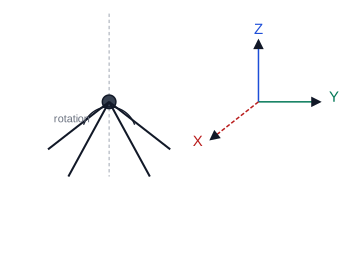
Q.A ceiling fan is rotating around a fixed axle as shown. The direction of angular velocity along.
(A) X
(B) Y
(C) Z
(D) −Z
›Reveal solutionSolution
ω lies along the rotation axis (the vertical axle, ±Z); apply the right-hand rule to the sense drawn in the figure — the near edge moves −Y, which forces ω along −Z.
Step 1 — The concept: angular velocity is an axial vector.
Unlike a linear velocity, ω does not point along the direction anything is moving. It points along the axis of rotation, and its sense is given by the right-hand rule: curl the fingers of the right hand in the sense of the rotation, and the extended thumb gives the direction of ω. Its magnitude is ω=dθ/dt.
Step 2 — Fix the axis.
The fan hangs from a vertical down-rod and spins about that rod. The dashed axle is vertical, and in the given frame Z points straight up. So ω must be along +Z or −Z — the horizontal directions X and Y are impossible, immediately eliminating options (A) and (B). The only question left is the sign.
Step 3 — Read the sense of rotation from the figure.
The frame drawn is right-handed: Z up, Y to the right, X out of the page towards the viewer. The rotation arrow is an ellipse round the axle whose near (front, +X side) arc runs from right to LEFT, while the far arc runs left to right.
So a blade tip that is momentarily nearest the viewer (position r along +X^) has velocity v pointing in the −Y^ direction.
Step 4 — Apply v=ω×r to pin the sign.
Write ω=ωzZ^ and take the blade tip at r=rX^:
v=ωzZ^×rX^=ωzr(Z^×X^)=ωzrY^.
But the figure says this point moves along −Y^, i.e. v=−∣v∣Y^. Matching:
Q.The sides of a parallelogram are represented by vectors p=5i^−4j^+3k^ and q=3i^+2j^−k^. Then, the area of the parallelogram is
(A) 684 sq units
(B) 72 sq units
(C) 171 sq units
(D) 72 sq units
›Reveal solutionSolution
The area of a parallelogram with adjacent sides p,q is ∣p×q∣=684 sq units.
Q.The resultant of two forces acting at an angle of 120∘ is 10 kg-W and is perpendicular to one of the forces. That force is
(A) 310 kg-W
(B) 10 kg-W
(C) 203 kg-W
(D) 103 kg-W
›Reveal solutionSolution
The force to which the resultant is perpendicular is therefore 10/sqrt(3) kg-wt (the other force is Q = 20/sqrt(3)).
Concept: resolve the two forces; the resultant is perpendicular to one of them, so the component of the resultant along that force is zero.
Let P lie along the x-axis and Q make 120 degrees with it.
Q.The vector that must be added to i−3j+2k and 3i+6j−7k so resultant vector is a unit vector along the X-axis is
(A) −3i−3j+5k
(B) −4i+2j+5k
(C) 3i+4j+5k
(D) Null vector
›Reveal solutionSolution
Check: (4i + 3j - 5k) + (-3i - 3j + 5k) = i, which is indeed the unit vector along X.
Concept: Vector addition; a unit vector along the X-axis is i.
Q.Given A=^−3^+2k^. If the vector B is added to vector A, then we get a unit vector along the X-axis. The vector B is
(A) 3^−2k^
(B) −3^+2k^
(C) 2^+3^−2k^
(D) ^−3^
›Reveal solutionSolution
B=^−A=3^−2k^.
A unit vector along the X-axis is ^=(1,0,0). We require
 (A) X
(B) Y
(C) Z
(D)
(A) X
(B) Y
(C) Z
(D)