Q.The radius of a metal sphere at room temperature is , and the coefficient of linear expansion of the metal is . The sphere is heated a little by a temperature so that its new temperature is . The increase in the volume of the sphere is approximately
You're viewing a preview — the full solution, concept, methods & PYQ mapping are locked.
Start your 14-day free trial to unlock the full solution →When a metal sphere is heated, its radius expands linearly. This linear expansion leads to a cubic expansion in its volume. Using the binomial approximation for small temperature changes, the increase in volume is approximately .
When a material is heated, its constituent atoms or molecules vibrate with greater amplitude. This increased vibration leads to an increase in the average distance between them, causing the material to expand. This phenomenon is known as thermal expansion.
For a solid, this expansion can be observed in its length, area, or volume. We define the coefficient of linear expansion, , as the fractional change in length per unit change in temperature. That is, if an object of initial length undergoes a temperature change , its new length is given by .
Similarly, the coefficient of volume expansion, , is the fractional change in volume per unit change in temperature. If an object of initial volume undergoes a temperature change , its new volume is given by . The increase in volume is then .
For isotropic materials (materials that expand equally in all directions), there is a direct relationship between the coefficient of linear expansion () and the coefficient of volume expansion (). If each dimension of an object expands linearly, then its volume expands cubically.
Consider a cube of side length . Its initial volume is . If its temperature increases by , its new side length becomes . The new volume is then:
.
Since , we have .
Since is typically a very small quantity (e.g., ), we can use the binomial approximation for small . In this case, and .
So, .
Substituting this back into the expression for :
.
Comparing this with the general volume expansion formula , we can see that for isotropic materials, the coefficient of volume expansion is approximately three times the coefficient of linear expansion:
.
Now we can apply this concept to the metal sphere.
- Initial Volume of the Sphere: The initial volume of the sphere at room temperature with radius is given by the formula:
- Volume Expansion Formula: The increase in volume due to a temperature change is given by:
where $V$ is the initial volume and $\gamma$ is the coefficient of volume expansion.
3. Relating Volume and Linear Expansion Coefficients: …
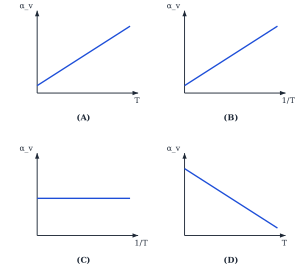 (A)
(B)
(C)
(D)
(A)
(B)
(C)
(D)Unlock everything free for 14 days
- Full step-by-step solutions
- Concept-first explanations
- Methods, shortcuts & mistakes
- PYQ mapping + timed mock tests
Full access for 14 days. No credit card required.