Q.A uniform metallic rod rotates about its perpendicular bisector with constant angular speed. If it is heated uniformly to raise its temperature slightly
Concept understanding — Rotational Dynamics
Rotational Dynamics: The Physics of Spinning Things
Imagine you're trying to open a heavy door. You push near the hinge — it barely moves. Push near the handle — it swings open easily. Same force, different result. That's the first clue: rotation isn't just about how much you push, but where and in what direction.
Now think about a spinning bicycle wheel. Why is it so hard to tilt it sideways when it's spinning fast? And why does a figure skater spin faster when she pulls her arms in? These are the questions rotational dynamics answers.
The Core Idea
Rotational dynamics is the study of why things rotate and how their rotation changes. It's the spinning-world equivalent of Newton's laws for straight-line motion.
In linear motion, you have:
- Force (F) causes acceleration (a)
- Mass (m) resists acceleration
In rotational motion, you have:
- Torque (τ) causes angular acceleration (α)
- Moment of inertia (I) resists angular acceleration
The master equation is:
τnet=Iα
This is the rotational version of F=ma. Every term has a direct parallel.
Breaking It Down
Torque — The Rotational "Push"
Torque isn't just force — it's force multiplied by the distance from the pivot point (the lever arm). That's why the door handle works better than the hinge.
τ=rFsinθ
Where r is the distance from the axis, F is the force, and θ is the angle between them. Maximum torque happens when you push perpendicular to the lever arm (θ=90∘).
Think of torque as "twisting effectiveness." A wrench works because the handle gives you a long lever arm. A short wrench needs more force to do the same job.
Moment of Inertia — The Rotational "Mass"
Mass resists linear acceleration. Moment of inertia resists angular acceleration. But unlike mass, moment of inertia depends on how the mass is distributed relative to the axis of rotation.
For a point mass m at distance r from the axis:
I=mr2
For extended objects, you sum (or integrate) over all mass elements:
I=∑miri2
| Object | Axis | Moment of Inertia |
|--------|------|-------------------|
| Thin hoop | Through center, perpendicular to plane | MR2 |
| Solid disk | Through center, perpendicular to plane | 21MR2 |
| Solid sphere | Through center | 52MR2 |
| Thin rod | Through center, perpendicular to rod | 121ML2 |
Notice: a hoop has more moment of inertia than a disk of the same mass and radius because its mass is farther from the axis. That's why a hoop is harder to start spinning.
Angular Acceleration — How Fast Rotation Changes
Just as acceleration is the rate of change of velocity, angular acceleration α is the rate of change of angular velocity ω:
α=dtdω
And angular velocity is the rate of change of angular displacement θ:
ω=dtdθ
The Complete Picture: Rotational Analogues
| Linear Quantity | Rotational Analogue |
|---|---|
| Displacement x | Angular displacement θ |
| Velocity v | Angular velocity ω |
| Acceleration a | Angular acceleration α |
| Mass m | Moment of inertia I |
| Force F | Torque τ |
| Newton's 2nd law: F=ma | τ=Iα |
| Kinetic energy: 21mv2 | 21Iω2 |
| Momentum: p=mv | Angular momentum: L=Iω |
The Key Insight: Conservation of Angular Momentum
This is where rotational dynamics gets beautiful. Just as linear momentum is conserved when no external force acts, angular momentum is conserved when no external torque acts:
L=Iω=constant
That's why the figure skater spins faster when she pulls her arms in. Her moment of inertia I decreases, so her angular velocity ω must increase to keep L constant. No external torque — just redistribution of mass.
A common mistake: thinking that angular momentum is always conserved. It's conserved only when the net external torque is zero. If you apply a torque (like friction on a spinning wheel), angular momentum changes.
Putting It All Together
When you encounter a rotational dynamics problem:
- Identify the axis of rotation — everything depends on this
- Find the net torque — sum all torques (with sign conventions)
- Determine the moment of inertia — use the right formula for the shape and axis
- Apply τnet=Iα — this gives you angular acceleration
- Use kinematic equations (if needed) — they're the same as linear ones, just with θ, ω, α
The beauty of rotational dynamics is that once you understand the parallels, you already know most of the physics. The hard part is just the geometry — figuring out lever arms and mass distributions.
If you landed here looking for "Rotational Dynamics formula" or "Rotational Dynamics numericals class 11", it helps to know that Rotational Dynamics is a core, NCERT-aligned topic from the System of Particles and Rotational Motion portion of the Class 11 Physics curriculum, and it is tested regularly in CBSE board exams as well as in JEE Main and NEET. Revisiting the NCERT Physics textbook exercises for this chapter alongside the walkthrough above is a solid way to convert this into exam-ready practice.
Concept: Rotational Dynamics — conservation of angular momentum when no external torque acts.
Reasoning:
- The rod rotates freely about its perpendicular bisector with constant angular speed. No external torque acts on the system, so angular momentum L=Iω is conserved.
- On uniform heating, the rod expands. Its moment of inertia about the perpendicular bisector increases because mass moves farther from the axis: I∝(length)2 for a rod.
- Since L is constant, an increase in I forces a decrease in ω (angular speed).
Option (D) is wrong — speed does not increase because moment of inertia increases; it decreases.
The correct option is (B): its speed of rotation decreases.
Heating the rod increases its length, which increases its moment of inertia. Since no external torque acts, angular momentum is conserved, so angular speed must decrease.
The Concept: Rotational Dynamics and Thermal Expansion
When a body rotates freely with no external torque, its angular momentum L=Iω stays constant. Here I is the moment of inertia and ω the angular speed. If the body’s shape changes — as it does when heated — I changes, and ω must adjust to keep L unchanged.
The rod is uniform and rotates about its perpendicular bisector. Heating it uniformly causes linear expansion: every dimension increases slightly. For a rod, the length L increases, and since the mass stays the same, the moment of inertia changes.
Step-by-Step Reasoning
- Moment of inertia of a rod about its perpendicular bisector For a uniform rod of mass M and length ℓ, rotating about an axis through its centre and perpendicular to its length, the moment of inertia is
I=121Mℓ2.
This is a standard result — the mass is distributed symmetrically, and the factor 121 comes from integrating r2dm.
- Effect of heating on length When the temperature rises by ΔT, the rod expands linearly:
ℓ′=ℓ(1+αΔT),
where α is the coefficient of linear expansion. Since ΔT is small, αΔT≪1.
- New moment of inertia The mass M does not change. The new moment of inertia is
I′=121M(ℓ′)2=121Mℓ2(1+αΔT)2.
Expanding to first order (since αΔT is tiny):
I′≈I(1+2αΔT).
So I′>I — the moment of inertia increases.
- Conservation of angular momentum No external torque acts on the rod (it rotates freely, and heating does not apply a torque). Therefore
Iω=I′ω′.
Substituting I′=I(1+2αΔT) gives
ω′=1+2αΔTω≈ω(1−2αΔT).
Since 2αΔT>0, we have ω′<ω — the angular speed decreases.
A common mistake is to think that because the rod expands outward, its speed increases (like a spinning skater pulling arms in). But here the mass moves away from the axis, increasing I, which slows the rotation — the opposite of the skater effect.
- Checking the options
- (A) says speed increases — wrong.
- (B) says speed decreases — correct.
- (C) says speed remains same — wrong.
- (D) says speed increases because moment of inertia increases — the reason is backwards; increasing I decreases speed.
You can remember this as: heating → expansion → larger I → slower spin (for a free body). The skater’s trick works only when I decreases.
The correct option is (B): its speed of rotation decreases.
Skip computing how much I changes and reason purely from conservation: with no external torque, L=Iω is fixed. Heating a solid rod can only push mass farther from the rotation axis (thermal expansion never shrinks it), so I can only increase, never decrease or stay put. Since ω=L/I with L constant, a larger I can only pull ω down — this rules out (A), (C), and (D) without any calculation, leaving (B) as the sole option consistent with angular-momentum conservation. It's the mirror image of a figure skater pulling their arms out to slow a spin.
- COMEDK 2026Set 2026-M1 markMCQQ.Four masses each 2 kg are placed at the corners A, B, C, D of a mass less square frame. 40 kg mass is at the centre O of a square frame of side 0.2 m . It is to be rotated about an axis passing through the centre O and perpendicular to the plane of the frame. Calculate the torque in N−m required to produce an angular acceleration of 2πrads−2. (A) 25π (B) 12.5π (C) 12.52π (D) 252π
›Reveal solutionSolution
The torque required is the product of the moment of inertia of the four corner masses plus the central mass about the given axis and the angular acceleration. The result is 252πN⋅m, which corresponds to option (D).
Concept and intuition
Torque τ is the rotational analogue of force: τ=Iα, where I is the moment of inertia about the rotation axis and α is the angular acceleration. Here the axis passes through the centre O and is perpendicular to the square frame. The frame itself is massless, so only the five point masses contribute to I. For a point mass m at distance r from the axis, I=mr2. The four corner masses are all at the same distance from O (half the diagonal of the square), and the central mass is exactly on the axis, so its distance is zero. Summing these contributions gives the total I; multiplying by α yields the required torque.
Step-by-step solution
- Find the distance from centre O to a corner. The square has side a=0.2 m. The distance from the centre to any corner is half the diagonal:
r=2a2=20.22=0.12 m.
- Moment of inertia of the four corner masses. Each corner mass is m=2 kg. For one corner:
Icorner=mr2=2×(0.12)2=2×(0.01×2)=2×0.02=0.04 kg⋅m2.
Four such masses:
Icorners=4×0.04=0.16 kg⋅m2.
- Moment of inertia of the central mass. The central mass (40 kg) lies exactly on the axis, so its distance from the axis is 0. Hence:
Icentre=40×02=0.
- Total moment of inertia.
I=Icorners+Icentre=0.16 kg⋅m2.
- Given angular acceleration.
α=2π rad/s2.
- Compute the torque.
τ=Iα=0.16×2π=0.08π N⋅m.
Express as a fraction: 0.08=1008=252. Thus:
τ=252π N⋅m.
TipA common mistake is to include the central mass’s contribution as if it were off-axis. Since it lies on the rotation axis, its moment of inertia is zero — it contributes nothing to the rotational inertia.
✓Final answerThe correct option is (D).
ANSWER: D
- KCET 2025Set D-41 markMCQQ.Two fly wheels are connected by a non-slipping belt as shown in the figure, I1=4kgm2, r1=20cm, I2=20kgm2 and r2=30cm. A torque of 10Nm is applied on the smaller wheel. Then match the entries of column I with appropriate entries of column II. I Quantities(a) Angular acceleration of smaller wheel(b) Torque on the larger wheel(c) Angular acceleration of larger wheel II Their numerical Values (in SI units)(i) 35(ii) 100/3(iii) 5/2 (A) a - ii, b - iii, c - i (B) a - iii, b - i, c - ii (C) a - ii, b - i, c - iii (D) a - iii, b - ii, c - i
›Reveal solutionSolution
Get α1 from τ=Iα, transfer it through the belt using the equal-rim-acceleration condition α1r1=α2r2, then get the large wheel's torque from τ2=I2α2.
Data. I1=4 kgm2, r1=0.20 m, I2=20 kgm2, r2=0.30 m, τ1=10 Nm.
Step 1 — (a) Angular acceleration of the smaller wheel.
Rotational form of Newton's second law:
α1=I1τ1=410=25 rads−2
So (a) → (iii).
Step 2 — Belt constraint.
A non-slipping belt has the same linear (tangential) speed, hence the same tangential acceleration, at both rims:
a=α1r1=α2r2
a=25×0.20=0.5 ms−2
Step 3 — (c) Angular acceleration of the larger wheel.
α2=r2a=0.300.5=35 rads−2
So (c) → (i).
Step 4 — (b) Torque on the larger wheel.
τ2=I2α2=20×35=3100 Nm
So (b) → (ii).
Step 5 — Assemble the match. a - iii, b - ii, c - i.
✓Final answerThe correct option is (D) — a - iii, b - ii, c - i.
ANSWER: D
- COMEDK 2025Set 2025-M1 markMCQQ.A force of −Fi^ acts at the origin of the coordinate system. The torque about the point (0,1,−1) is: (A) F(^+k^) (B) −F(^+k) (C) F(i^+k) (D) −F(^+^)
›Reveal solutionSolution
With r drawn from P=(0,1,−1) to the origin, r=(0,−1,1) and τ=r×F=(0,−1,1)×(−F,0,0)=−F(^+k^) — option (B).
Concept
Torque about a chosen point is τ=r×F, where r points from that point to the point of application of the force. Here the force acts at the origin, so r runs from the reference point P to the origin.
Solution
- Position vector:
r=(0,0,0)−(0,1,−1)=(0,−1,1).
- Cross product with F=(−F,0,0):
τ=^0−F^−10k^10.
- Components:
τx=(−1)(0)−(1)(0)=0,τy=(1)(−F)−(0)(0)=−F,τz=(0)(0)−(−1)(−F)=−F.
- Assemble:
τ=0^−F^−Fk^=−F(^+k^).
Watch outWatch the order r×F and the signs; mishandling ^×^=−k^ flips the answer to the wrong option.
✓Final answerThe torque is τ=−F(^+k^), so the correct option is (B).
ANSWER: B
- COMEDK 2024Set 2024-A1 markMCQQ.An object of mass 1 kg is allowed to hang tangentially from the rim of the wheel of radius R. When released from the rest, the block falls vertically through 4 m height in 2 seconds. The moment of inertia is 1 kg m2. The radius of the wheel R is (A) 0.025 m (B) 1 m (C) 0.25 m (D) 0.5 m
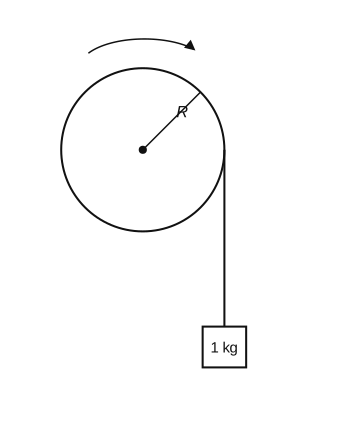
›Reveal solutionSolution
The block's fall gives a=2 m/s2. Combining Newton's law for the block with τ=Iα for the wheel yields R=0.5 m — option (D).
The string wound on the rim links the block's linear acceleration to the wheel's angular acceleration by a=αR; the tension supplies the only torque.
- Linear acceleration from the fall (s=21at2):
a=t22s=222×4=2 m/s2.
- Newton's law for the hanging block (taking g=10 m/s2):
mg−T=ma⇒T=m(g−a)=1×(10−2)=8 N.
- Rotational law for the wheel, with α=a/R and torque TR:
TR=Iα=IRa⇒TR2=Ia.
- Solve for R:
R2=TIa=81×2=0.25⇒R=0.5 m.
Energy check: mgh=21mv2+21Iω2 with v=at=4 m/s gives 40=8+21(16/R2), so R=0.5 m.
✓Final answerRadius R=0.5 m — option (D).
- COMEDK 2024Set 2024-M1 markMCQQ.A body of mass 5 kg at rest is rotated for 25 s with a constant moment of force 10 Nm. Find the work done if the moment of inertia of the body is 5 kg m2. (A) 625 J (B) 125 J (C) 6250 J (D) 1250 J
›Reveal solutionSolution
The work done equals the change in rotational kinetic energy. Using torque, time, and moment of inertia, we find the final angular velocity and then the work: 6250 J, which corresponds to option (C).
The key idea is that work done by a constant torque equals the change in rotational kinetic energy. Since the body starts from rest, the work done is simply the final rotational kinetic energy:
W=21Iω2
We know the moment of inertia I=5 kgm2 and the torque τ=10 Nm applied for t=25 s. To find ω, we use the rotational analogue of Newton’s second law:
τ=Iα
where α is the angular acceleration. Once we have α, we can find ω from ω=αt (starting from rest). Then plug into the work formula.
- Find angular acceleration From τ=Iα:
α=Iτ=510=2 rad/s2
- Find final angular velocity Since the body starts from rest (ω0=0) and accelerates uniformly:
ω=αt=2×25=50 rad/s
- Compute work done Work = change in rotational kinetic energy:
W=21Iω2=21×5×(50)2=21×5×2500=212500=6250 J
TipNotice that we never needed the mass (5 kg) directly — it’s already accounted for in the moment of inertia. A common mistake is to try using linear formulas; always check whether the problem gives rotational quantities.
Watch outA classic pitfall: forgetting that the body starts from rest and using ω2=ω02+2αθ without first finding θ. Here, the direct method using ω=αt is simpler and avoids extra steps.
✓Final answerThe correct option is (C).
ANSWER: C
- KCET 2023Set A-31 markMCQQ.Seven identical discs are arranged in a planar pattern, so as to touch each other as shown in the figure. Each disc has mass ′m′ radius R. What is the moment of inertia of system of six discs about an axis passing through the centre of central disc and normal to plane of all discs ?
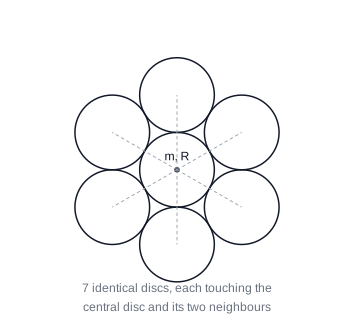 (A) 100mR2
(B) 552mR2
(C) 852mR2
(D) 27mR2
(A) 100mR2
(B) 552mR2
(C) 852mR2
(D) 27mR2›Reveal solutionSolution
The full 7-disc system's moment of inertia adds the central disc's own spin to the six outer discs' parallel-axis contributions, giving 255mR2.
Step 1 — Central disc's own moment of inertia.
The central disc's axis passes through its own center, so it simply spins about itself: Icentral=21mR2.
Step 2 — Each outer disc, by the parallel-axis theorem.
Every outer disc touches the central disc, so its center sits 2R from the axis:
Iouter=21mR2+m(2R)2=21mR2+4mR2=29mR2
Step 3 — Sum all six outer discs plus the central disc.
Itotal=21mR2+6×29mR2=21mR2+27mR2=255mR2
The alternate reading (option D, 27mR2): if the question means only the SIX OUTER discs (excluding the central disc's own spin), the answer is just 6×29mR2=27mR2 — this is exactly the genuine ambiguity KEA's own final key resolved by crediting both.
✓Final answer255mR2 (full 7-disc system) — option (B).
NoteThe exam board's own final key credited BOTH (B) and (D) for this question. KEA's official 2023 Physics answer key (dated 09-JUN-23) marks this question with a multi-answer code, because the stem itself is genuinely ambiguous — "moment of inertia of system of six discs" can reasonably mean either the whole 7-disc arrangement (55mR²/2) or just the six outer discs (27mR²). Rather than pick one, KEA accepted both as correct. This is a real board declaration, not a platform correction — we're showing you both derivations so you understand why.
- COMEDK 2023Set 2023-E1 markMCQQ.A wheel is free to rotate about a horizontal axis through O. A force of 200 N is applied at a point P2 cm from the center O. OP makes an angle of 55∘ with x axis and the force is in the plane of the wheel making an angle of 25∘ with the horizontal axis. What is the torque? (A) 4 N m (B) 3.2 N m (C) 2 N m (D) 3.4 N m
›Reveal solutionSolution
The angle between the position vector and force is 30∘, giving τ=rFsin30∘=2 N m.
Torque about O is τ=rFsinθ, where θ is the angle between OP and F.
- OP is at 55∘ to the x-axis.
- F is at 25∘ to the horizontal (x-axis).
- Angle between them: θ=55∘−25∘=30∘.
With r=2 cm=0.02 m and F=200 N:
τ=rFsinθ=0.02×200×sin30∘=0.02×200×0.5=2 N m
✓Final answerThe correct option is (C) — 2 N m
- COMEDK 2021Set 20211 markMCQQ.Newton's second law of rotational motion of a system particles having angular momentum L is given by (A) dtdp=τext (B) dtdL=τint (C) dtdL=τext (D) dtdL=τint+τext
›Reveal solutionSolution
(dp/dt = F_ext is the translational law, not the rotational one.)
Concept: rotational analogue of Newton's second law for a system of particles.
For a system, the internal torques cancel in pairs (Newton's third law, forces along the line joining the particles), so only the EXTERNAL torque changes the total angular momentum:
dL/dt = tau_ext.
(dp/dt = F_ext is the translational law, not the rotational one.)
✓Final answerThe correct option is (C) — dtdL=τext
ANSWER: C
- COMEDK 2021Set 2021-B1 markMCQQ.A ring starts from rest and acquires an angular speed of 20 rad/s in 4 seconds. The mass of the ring is 250 g and its radius is 20 cm, the torque of the ring is (A) 0.5 Nm (B) 0.025 Nm (C) 0.25 Nm (D) 0.05 Nm
›Reveal solutionSolution
With α=5 rad/s2 and ring moment of inertia I=mr2=0.01 kg⋅m2, the torque is τ=Iα=0.05 Nm.
Angular acceleration:
α=tω−ω0=420−0=5 rad/s2.
Moment of inertia of a ring about its axis:
I=mr2=0.250×(0.20)2=0.250×0.04=0.01 kg⋅m2.
Torque:
τ=Iα=0.01×5=0.05 Nm.
✓Final answerThe correct option is (D) — 0.05 Nm
- KCET 2020Set A-11 markMCQQ.A wheel starting from rest gains an angular velocity of 10 rad/s after uniformly accelerated for 5 sec. The total angle through which it has turned is (A) 25 rad (B) 100 rad (C) 25π rad (D) 50π rad about a vertical axis
›Reveal solutionSolution
The wheel undergoes uniform angular acceleration from rest. Using the kinematic equation for angular displacement under constant acceleration, the total angle turned is 25 rad.
The problem gives you a wheel starting from rest, reaching 10 rad/s in 5 seconds under uniform angular acceleration. The key is to recognise that this is the rotational analogue of linear motion with constant acceleration. The same kinematic equations apply, just with angular variables: θ for displacement, ω for velocity, α for acceleration, and t for time.
Since the acceleration is uniform, the average angular velocity is simply the arithmetic mean of the initial and final velocities. For motion from rest, that average is half the final velocity. The total angle turned is then average angular velocity multiplied by time — a clean, intuitive shortcut.
Let’s work through it step by step.
-
Identify the known quantities.
Initial angular velocity: ω0=0 (starts from rest).
Final angular velocity: ω=10 rad/s.
Time interval: t=5 s.
Acceleration is uniform (constant α).
-
Find the angular acceleration.
Using the definition α=tω−ω0:
α=510−0=2 rad/s2.
- Use the angular displacement equation for constant acceleration. The standard kinematic equation is:
θ=ω0t+21αt2.
Substitute ω0=0, α=2, t=5:
θ=0+21×2×(5)2=1×25=25 rad.
TipYou can also get the answer without finding α explicitly. For constant acceleration from rest, the average angular velocity is ωˉ=20+ω=2ω. Then θ=ωˉt=210×5=25 rad. This is faster and avoids extra calculation.
- Check the options. The result is 25 rad, which matches option (A). Options (C) and (D) involve π, which would appear only if the motion were circular with a given radius or if the answer were in revolutions — but here the angular velocity is given directly in rad/s, so the angle is in radians, no π factor.
Watch outA common mistake is to use θ=ωt with the final velocity (10 rad/s) instead of the average. That gives 10×5=50 rad, which is not among the options but might tempt you to pick (D) if you misread it as 50π. Always remember: for uniformly accelerated motion from rest, the average velocity is half the final velocity.
✓Final answerThe total angle turned is 25 rad, which corresponds to option (A).
-
- KCET 2018Set A-11 markMCQQ.Moment of inertia of a body about two perpendicular axes X and Y in the plane of lamina are 20kgm2 and 25kgm2 respectively. Its moment of inertia about an axis perpendicular to the plane of the lamina and passing through the point of intersection of X and Y axes is (A) 5kgm2 (B) 45kgm2 (C) 12.5kgm2 (D) 500kgm2
›Reveal solutionSolution
Apply the perpendicular axis theorem, Iz=Ix+Iy, valid for a planar lamina.
Step 1 — Identify the applicable theorem.
The body is a lamina (a plane body), the two given axes X and Y lie in its plane and are mutually perpendicular, and the required axis is perpendicular to the plane through their point of intersection. These are exactly the conditions of the perpendicular axis theorem:
Iz=Ix+Iy
Step 2 — Why the theorem is true.
For a particle of mass mi at (xi,yi) in the plane, its distance from the Z-axis is ri with ri2=xi2+yi2. Hence
Iz=∑miri2=∑mi(xi2+yi2)=∑miyi2+∑mixi2=Ix+Iy
(The distance of a point from the X-axis is ∣yi∣ and from the Y-axis is ∣xi∣.) Note it works only because zi=0 for every particle — i.e. only for a lamina.
Step 3 — Substitute.
Iz=20+25=45 kgm2
Common mistakes: subtracting (25−20=5, option A) — that is not what the theorem says; averaging (12.5, option C); or multiplying (500, option D). The theorem is a plain sum, and a sum is also physically sensible since moments of inertia are positive additive quantities.
✓Final answerThe correct option is (B) — 45 kgm2.
ANSWER: B
🎓Unlock everything free for 14 days
- ✓Full step-by-step solutions
- ✓Concept-first explanations
- ✓Methods, shortcuts & mistakes
- ✓PYQ mapping + timed mock tests
Full access for 14 days. No credit card required.