Q.One mole of a perfect gas is enclosed in a vertical cylinder of unit cross-sectional area fitted with a piston. A spring of spring constant k and unstretched (natural) length L connects the piston to the bottom of the cylinder, and the atmosphere above the piston exerts pressure Pa. Initially the spring is unstretched and the gas is in equilibrium. A certain amount of heat Q is then supplied to the gas, and its volume increases from Vo to V (the piston rises).
🔒You're viewing a preview — the full solution, concept, methods & PYQ mapping are locked.
🔒 Start your 14-day free trial to unlock the full solution →Concept understanding — First Law of Thermodynamics
First Law of Thermodynamics
The Intuition: Energy is a Bank Account
Imagine you have a bank account. You can deposit money into it, withdraw money from it, or leave it untouched. The total amount of money in your account changes only when money goes in or comes out. You cannot create money from nothing, and money does not vanish into thin air.
Energy works exactly the same way. In any physical or chemical process, energy is never created and never destroyed. It only moves from one place to another, or changes from one form into another. This is the deepest idea behind the First Law.
Now, in thermodynamics, we focus on a specific "bank account": the internal energy of a system. Internal energy (U) is the total energy stored inside a substance — the kinetic energy of its molecules jiggling around, plus the potential energy stored in the bonds between them.
If you want to change how much energy is stored inside a system, you have exactly two ways to do it:
- Heat (Q) — energy that flows because of a temperature difference. Like putting a cold pan on a hot stove.
- Work (W) — energy transferred by a force moving something. Like pushing a piston to compress a gas.
That's it. No third option. Every change in internal energy comes from either heat or work.
The Precise Statement
ΔU=Q−W
Where:
- ΔU = change in internal energy of the system
- Q = heat added to the system (positive if heat flows in)
- W = work done by the system (positive if the system does work on surroundings)
This sign convention is the standard one used in Indian exams (JEE, NEET, etc.). Heat added to the system is positive. Work done by the system is positive.
Some textbooks use Q=ΔU+W or ΔU=Q+W with a different sign for work. Always check which convention your exam follows. The one above (ΔU=Q−W) is the most common in Indian syllabi.
What This Equation Really Says
Think of it as a balance sheet:
- If you add heat (Q>0), internal energy tends to increase.
- If the system does work (W>0), internal energy tends to decrease (because energy leaves the system to do the work).
- The net change is simply: what came in minus what went out.
If ΔU=0, the system has returned to its original internal energy — but that does not mean nothing happened. Heat could have come in, and exactly the same amount of energy could have left as work. The energy just passed through.
| Process | Q | W | ΔU |
|---------|-----|-----|------------|
| Gas expands, no heat exchange | 0 | + (does work) | Negative |
| Gas compressed, no heat exchange | 0 | – (work done on it) | Positive |
| Gas heated at constant volume | + | 0 | Positive |
| Gas cooled at constant volume | – | 0 | Negative |
A Concrete Example
Take a gas trapped in a cylinder with a movable piston. You place the cylinder on a hot plate.
- Heat Q=+100 J flows into the gas.
- The gas expands, pushing the piston upward, doing work W=+40 J on the surroundings.
What happens to the internal energy?
ΔU=100−40=+60 J …
Initially the spring exerts no force, so the gas pressure balances the atmosphere: Pi=Pa. After heating, the piston rises by V−Vo (unit area), so the spring adds a force k(V−Vo): Pf=Pa+k(V−Vo). The first law then gives Q=ΔU+Pa(V−Vo)+21k(V−Vo)2. …
With the spring initially relaxed, force balance on the piston gives Pi=Pa. Raising the piston by a height equal to V−Vo (unit cross-section) stretches the spring by that amount, so the gas must additionally support the spring force k(V−Vo): Pf=Pa+k(V−Vo). The heat supplied equals the internal-energy rise plus the work done against the atmosphere and the work stored in the spring.
(a) Initial pressure
The cross-sectional area is 1. Initially the spring is unstretched, so it exerts no force. Force balance on the piston (gas pressure up, atmosphere down):
Pi⋅1=Pa⋅1 ⇒ Pi=Pa.
(b) Final pressure
When the volume grows from Vo to V, with unit area the piston rises by a distance x=V−Vo. The spring, now stretched by x, pulls the piston down with force kx=k(V−Vo). Force balance now:
Pf⋅1=Pa⋅1+k(V−Vo) ⇒ Pf=Pa+k(V−Vo).
(c) First-law relation
The work done by the gas has two parts: pushing the piston against the constant atmospheric pressure, and stretching the spring: …
Since pressure is linear in volume here, work is just a trapezoid area — no integration required. Because the spring force grows linearly with piston displacement, P(V)=Pa+k(V−Vo) is a straight line on the P-V diagram between (Vo,Pa) and (V,Pf). The work done by the gas is then simply the average pressure times the volume change: $W=\left(\dfrac{P_i+P_f}{2}\right)(V-V_o)=\left(P_a+\dfrac{k(V-V_o)}{2}\right)(V-V_o)=P_a …
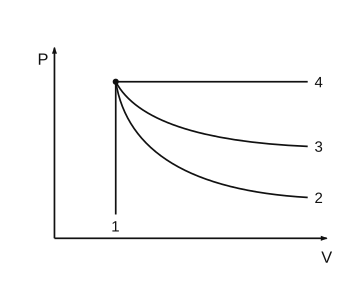
- COMEDK 2026Set 2026-A1 markMCQQ.Following graph shows four different processes, adiabatic, isothermal, isobaric and isochoric for an ideal gas, from the same initial state. Study the graph carefully and state which of the following statements is correct? (A) Process 2 is isobaric (B) Process 3 isochoric (C) Process 1 is isochoric (D) Process 4 is adiabatic
›Reveal solutionSolution
The key is to match each process on the P–V diagram to its thermodynamic name by recalling the shape of each curve: isochoric (vertical), isobaric (horizontal), isothermal (hyperbolic, gentle slope), adiabatic (steeper than isothermal). From the same initial state, process 1 is vertical → isochoric, process 4 is horizontal → isobaric, process 3 is the gentler curve → isothermal, process 2 is the steeper curve → adiabatic. Thus the correct statement is that process 1 is isochoric.
Concept & Intuition
For an ideal gas, each thermodynamic process has a distinct signature on a P–V diagram:
- Isochoric (constant volume): vertical line (V fixed, P changes).
- Isobaric (constant pressure): horizontal line (P fixed, V changes).
- Isothermal (constant temperature): a hyperbola PV=constant; it curves gently downward.
- Adiabatic (no heat exchange): a steeper curve than the isothermal, given by PVγ=constant with γ>1.
All four processes start from the same point, so we compare their shapes from that common origin.
Step-by-step reasoning
-
Identify process 1 – It is a straight vertical line downward from the initial point. Volume does not change, pressure decreases. This is exactly an isochoric process. So statement (C) “Process 1 is isochoric” is true.
-
Identify process 4 – It is a straight horizontal line to the right from the initial point. Pressure remains constant, volume increases. This is an isobaric process. Statement (A) says process 2 is isobaric — that is false; process 4 is isobaric. …
- KCET 2025Set D-41 markMCQQ.A gas is taken from state A to state B along two different paths 1 and 2. The heat absorbed and work done by the system along these two paths are Q1 and Q2 and W1 and W2 respectively. Then (A) W1=W2 (B) Q1−W1=Q2−W2 (C) Q1+W1=Q2+W2 (D) Q1=Q2
›Reveal solutionSolution
Heat and work are path functions, but their difference Q−W=ΔU is a state function — and since both paths link the same states A and B, that difference must be identical.
Step 1 — The concept: state functions vs. path functions
This question is a pure test of one idea.
-
State function — its value depends only on the state of the system (its P, V, T), not on how the system got there. Internal energy U, pressure, volume, temperature and entropy are all state functions. For a state function, Δ between two fixed states is path-independent.
-
Path function — its value depends on the route taken. Heat Q and work W are the two great examples. This is why we do not speak of "the heat of a system" — heat is energy in transit, and how much of it flows depends on which path you follow.
Step 2 — Apply the First Law of Thermodynamics
The first law is the statement of energy conservation:
ΔU=Q−W
(with the standard sign convention: Q = heat absorbed by the system, W = work done by the system — exactly as the question defines them).
The deep content of the first law is precisely this: although Q and W are each path-dependent, their difference Q−W is not. That combination always equals ΔU, a state function.
Step 3 — Both paths connect the same two states
Path 1 and Path 2 both run from state A to state B. Therefore:
ΔU1=UB−UAandΔU2=UB−UA
The right-hand sides are identical — they depend only on the endpoints. Hence
ΔU1=ΔU2
Step 4 — Translate back into Q and W
Substituting the first law into both sides:
Q1−W1=ΔU1=ΔU2=Q2−W2
Q1−W1=Q2−W2
This is option (B).
Step 5 — Why the other options fail …
-
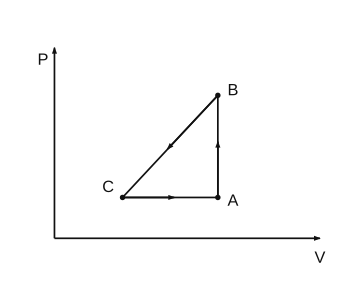
- COMEDK 2025Set 2025-M1 markMCQQ.A sample of an ideal gas is taken through the cyclic process ABCA as shown in figure below. It absorbs 60 J of heat during the part AB and rejects 80 J of heat during CA . There is no heat exchanged during the process BC.A work of 40 J is done on the gas during the part BC . If the internal energy of the gas at A is 1450 J , then the work done by the gas during the part CA is: (A) 10J (B) 20J (C) 40J (D) 30J
›Reveal solutionSolution
The key idea is to apply the first law of thermodynamics to each leg of the cycle and use the fact that the net change in internal energy over a complete cycle is zero. The work done by the gas during CA is found to be 20 J, so the correct option is (B).
The problem gives us a cyclic process on a P-V diagram, with heat and work data for each segment. The central concept is the first law of thermodynamics:
ΔU=Q−W
where ΔU is the change in internal energy, Q is the heat added to the system, and W is the work done by the system. (Be careful: some textbooks define W as work done on the system; here we use the sign convention that W positive means work done by the gas.)
Because the process is a cycle, the gas returns to its initial state, so the total change in internal energy over the whole cycle is zero:
ΔUcycle=0
We are given:
- QAB=+60J (heat absorbed)
- QCA=−80J (heat rejected, so negative)
- QBC=0 (no heat exchange)
- Work done on the gas during BC is 40 J, so work done by the gas during BC is WBC=−40J
- Internal energy at A: UA=1450J
We need WCA, the work done by the gas during CA.
Step-by-step reasoning
- Apply the first law to the whole cycle Since ΔUcycle=0, the net heat added equals the net work done by the gas:
QAB+QBC+QCA=WAB+WBC+WCA
Substitute known values:
60+0+(−80)=WAB+(−40)+WCA
−20=WAB+WCA−40
WAB+WCA=20(Equation 1)
- Determine WAB Segment AB is vertical on the P-V diagram: volume is constant. When volume doesn’t change, no work is done by or on the gas:
WAB=0
(This is a classic point: isochoric processes have zero work.)
- Find WCA from Equation 1 Substitute WAB=0: 0+WCA=20⇒WCA=20J …
- KCET 2024Set D-21 markMCQQ.A solid cube of mass m at a temperature θ0, is heated at a constant rate. It becomes liquid at temperature θ1 and vapour at temperature θ2. Let s1 and s2 be specific heats in its solid and liquid states respectively. If Lf and Lv are latent heats of fusion and vaporisation respectively, then the minimum heat energy supplied to the cube until it vaporises is (A) ms1(θ1−θ0)+ms2(θ2−θ1) (B) mLf+ms2(θ2−θ1)+mLv (C) ms1(θ1−θ0)+mLf+ms2(θ2−θ1)+mLv (D) ms1(θ1−θ0)+mLf+ms2(θ2−θ0)+mLv
›Reveal solutionSolution
The total heat required is the sum of the sensible heat to raise the solid from θ0 to θ1, the latent heat of fusion, the sensible heat to raise the liquid from θ1 to θ2, and the latent heat of vaporisation — which matches option (C).
The problem is about tracking the heat energy absorbed by a substance as it undergoes phase changes. A solid cube is heated at a constant rate, meaning we supply energy steadily. The cube starts as a solid at temperature θ0, melts into a liquid at θ1, and then vaporises into a gas at θ2. The question asks for the minimum heat energy needed to reach the point where it has just fully vaporised — that is, to turn the entire cube into vapour at θ2.
The key concept is that heat energy goes into two kinds of processes: sensible heat (which raises temperature, using specific heat capacity) and latent heat (which changes phase at constant temperature). You cannot skip a phase; the substance must absorb the latent heat for melting and for vaporisation, and it must be heated through each phase's temperature range.
Let’s walk through the journey of the cube, stage by stage.
- Heating the solid from θ0 to θ1 The cube is solid throughout this interval. The specific heat of the solid is s1, so the heat required is mass times specific heat times the temperature rise:
Q1=ms1(θ1−θ0)
- Melting at θ1 At the melting point, the temperature stays constant while the solid turns into liquid. The heat absorbed is the latent heat of fusion Lf for the entire mass:
Q2=mLf
- Heating the liquid from θ1 to θ2 Now the substance is liquid. Its specific heat is s2, so the heat needed is:
Q3=ms2(θ2−θ1)
- Vaporising at θ2 At the boiling point, the liquid turns into vapour at constant temperature. The heat absorbed is the latent heat of vaporisation Lv: Q4=mLv …
- COMEDK 2023Set 2023-E1 markMCQQ.If the ratio of specific heat of a gas at constant pressure to that at constant volume is γ, the change in internal energy of a mass of a gas when the volume changes from V to 3 V at constant pressure is (A) (γ−1)R (B) 2PV (C) γ2PV (D) (γ−1)2PV
›Reveal solutionSolution
(Option (B), 2PV, is the WORK done, not the change in internal energy.)
Concept: for an ideal gas, dU = n Cv dT, and Cv = R/(gamma - 1). At constant pressure, P dV = n R dT.
Isobaric expansion from V to 3V at pressure P:
n R (T2 - T1) = P (3V - V) = 2 P V.
Change in internal energy: …
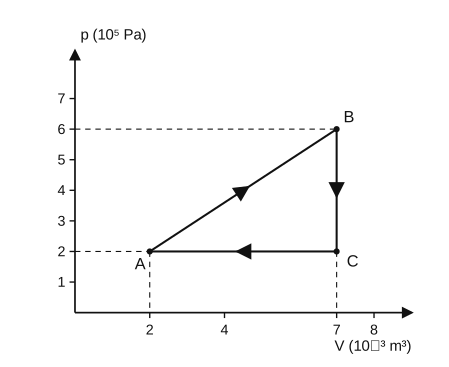
- COMEDK 2023Set 2023-M1 markMCQQ.A gas is taken through the cycle A→B→C→A, as shown in figure. What is the net work done by the gas? (A) 2000 J (B) 1000 J (C) Zero (D) −2000 J
›Reveal solutionSolution
The enclosed triangle has base ΔV=5×10⁻³m3 and height Δp=4×10⁵Pa; its area is 1000 J, and the clockwise sense makes the work positive.
Vertices: A(V=2,p=2), B(V=7,p=6), C(V=7,p=2) (in units 10−3m3 and 105Pa).
Net work done by the gas in a cyclic process equals the area enclosed. The triangle has a right angle at C:
- base ΔV=(7−2)×10−3=5×10⁻³m3
- height Δp=(6−2)×105=4×10⁵Pa …
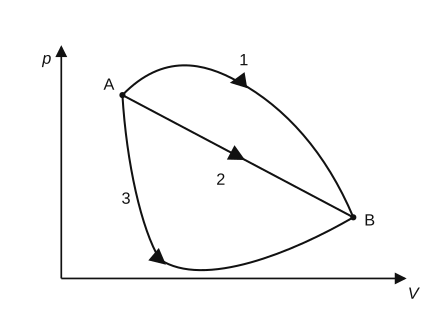
- COMEDK 2023Set 2023-M1 markMCQQ.An ideal gas goes from state A to state B via three different processes as indicated in the p-V diagram. If Q1,Q2 and Q3 indicate the heat absorbed by the three processes and ΔU1,ΔU2 and ΔU3 indicate the change in internal energy along the three processes respectively, then (A) Q1>Q2>Q3 and ΔU1=ΔU2=ΔU3 (B) Q3>Q2>Q1 and ΔU1=ΔU2=ΔU3 (C) Q1=Q2=Q3 and ΔU1>ΔU2>ΔU3 (D) Q3>Q2>Q1 and ΔU1>ΔU2>ΔU3
›Reveal solutionSolution
For an ideal gas, internal energy change depends only on temperature change, so all three processes have the same ΔU. The heat absorbed Q equals ΔU+W, and work W is the area under the p-V curve. Path 1 has the largest area, path 3 the smallest, so Q1>Q2>Q3.
The key idea here is the First Law of Thermodynamics:
Q=ΔU+W
where Q is heat added to the system, ΔU is the change in internal energy, and W is the work done by the system. For an ideal gas, internal energy depends only on temperature (not on how you get there). Since all three processes start at the same state A and end at the same state B, the temperature change ΔT is identical for all three. Hence ΔU1=ΔU2=ΔU3.
Now, the work done by the gas during a process is the area under the p-V curve (with volume increasing, so work is positive). The more the curve bulges upward, the larger the area. Path 1 arches highest, path 2 is a straight line, and path 3 sags lowest. Therefore:
W1>W2>W3
Since ΔU is the same for all, the heat Q=ΔU+W follows the same order:
Q1>Q2>Q3
Let’s walk through it step by step.
-
Recognize that internal energy change is path-independent for an ideal gas.
The internal energy of an ideal gas depends solely on its temperature: U=nCVT. States A and B have fixed temperatures TA and TB, so ΔU=nCV(TB−TA) is the same no matter which path connects them. Thus ΔU1=ΔU2=ΔU3.
-
Understand work as area under the p-V curve. …
-
- COMEDK 2023Set 2023-M1 markMCQQ.If 150 J of heat is added to a system and the work done by the system is 110 J, then change in internal energy will be (A) 40 J (B) 110 J (C) 150 J (D) 260 J
›Reveal solutionSolution
By the first law of thermodynamics, ΔU=Q−W=150−110=40J.
Heat added to the system Q=+150J; work done by the system W=+110J. The first law of thermodynamics gives …
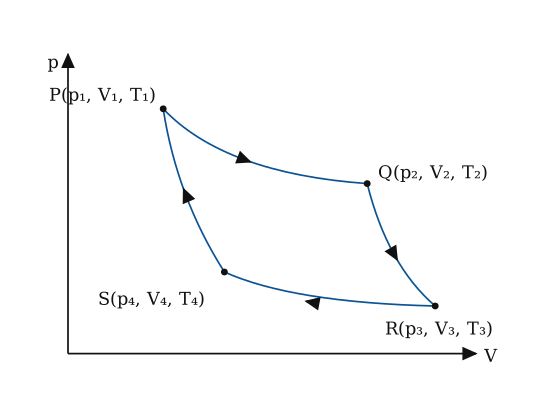
- COMEDK 2021Set 20211 markMCQQ.Carnot cycle of an engine is given below Total work done by the gas in one cycle is (A) μRT2logV1V2−μRT1logV4V3 (B) μRT1logV1V2−μRT2logV4V3 (C) μRT1logV1V2+μRT2logV4V3 (D) Zero
›Reveal solutionSolution
It is NOT zero (the enclosed area of the loop is the net work).
Concept: work in a Carnot cycle. Only the two ISOTHERMAL legs do net work overall (the work in the two adiabatic legs is equal and opposite for a Carnot cycle and cancels).
From the p-V diagram, the cycle runs P -> Q -> R -> S -> P (clockwise):
- P -> Q: isothermal EXPANSION at the higher temperature T1, from V1 to V2: W1 = mu R T1 ln(V2/V1) (positive)
- Q -> R: adiabatic expansion, W2
- R -> S: isothermal COMPRESSION at the lower temperature T2, from V3 to V4: W3 = mu R T2 ln(V4/V3) = - mu R T2 ln(V3/V4) (negative) …
- COMEDK 2021Set 2021-B1 markMCQQ.The first law of thermodynamics is restatement of (A) Law of conservation of momentum (B) Law of conservation of mass (C) Law of conservation of energy (D) Newton's law of cooling
›Reveal solutionSolution
The first law is energy conservation for thermodynamic systems.
The first law states ΔU=Q−W: the heat added to a system equals the increase in its internal energy plus the work it does. This is simply the law of conservation of e …
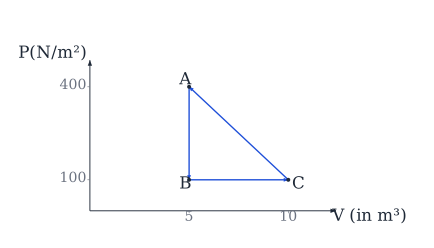
- KCET 2019Set A-11 markMCQQ.A thermodynamic system undergoes a cyclic process ABC as shown in the diagram. The work done by the system per cycle is
 (A) 750 J
(B) -1250 J
(C) -750 J
(D) 1250 J
(A) 750 J
(B) -1250 J
(C) -750 J
(D) 1250 J›Reveal solutionSolution
Work per cycle = ± area enclosed on the P−V diagram; the area of this right triangle is 750 J and the sense of traversal is anticlockwise, so W=−750 J.
1. Read the three vertices off the diagram.
A=(5 m3, 400 N/m2),B=(5 m3, 100 N/m2),C=(10 m3, 100 N/m2)
The path printed is A→B→C→A: straight down, then right, then diagonally back up-left.
2. Compute the work leg by leg using W=∫PdV.
Leg A→B (isochoric, V=5 fixed):
dV=0⟹WAB=0
Leg B→C (isobaric at P=100, expansion from 5 to 10 m³):
WBC=PΔV=100×(10−5)=+500 J
(positive — the gas expands and does work on the surroundings)
Leg C→A (straight line, compression from V=10 back to V=5): the work is the area under that straight line, i.e. the mean pressure times ΔV:
Pˉ=2100+400=250 N/m2,WCA=PˉΔV=250×(5−10)=−1250 J
(negative — the gas is compressed, work is done on it)
3. Add them.
Wcycle=WAB+WBC+WCA=0+500−1250=−750 J
4. Cross-check with the area rule. The enclosed figure is a right triangle with base ΔV=10−5=5 m3 and height ΔP=400−100=300 N/m2:
Area=21×5×300=750 J …
🎓Unlock everything free for 14 days
- ✓Full step-by-step solutions
- ✓Concept-first explanations
- ✓Methods, shortcuts & mistakes
- ✓PYQ mapping + timed mock tests
Full access for 14 days. No credit card required.