Q.What amount of heat must be supplied to 2.0×10⁻² kg of nitrogen (at room temperature) to raise its temperature by 45∘C at constant pressure? (Molecular mass of N2=28; R=8.3 J mol−1 K−1.)
Concept understanding — Heat Capacity at Constant Pressure
Heat Capacity at Constant Pressure — From Intuition to Precision
Imagine you have a pot of water on a stove. You turn the burner on, and the water gets hotter. How much heat does it take to raise its temperature by, say, 10°C? That depends on two things: how much water you have, and whether the pot is open to the air or sealed tight.
If the pot is open (constant pressure — the air above it is always at atmospheric pressure), the water can expand as it heats. Some of the energy you supply goes into pushing the atmosphere aside — doing work against the outside air. So you need to put in more heat than if the pot were sealed (constant volume), where no expansion work is possible.
That extra heat is the key idea behind heat capacity at constant pressure, denoted Cp.
The Intuition First
Heat capacity tells you: "How much heat must I add to raise the temperature of this substance by 1°C (or 1 K)?"
- At constant volume (Cv): All the heat goes into increasing the internal energy (the kinetic and potential energy of the molecules). No work is done because the volume doesn't change.
- At constant pressure (Cp): Some heat goes into internal energy, but some also goes into the work of expansion against the constant external pressure. So Cp is always larger than Cv for gases (and for most solids/liquids, the difference is tiny because they barely expand).
For an ideal gas, the difference is exactly Cp−Cv=nR, where n is the number of moles and R is the universal gas constant. This is a direct consequence of the first law of thermodynamics.
The Precise Statement
Heat capacity at constant pressure is defined as the amount of heat required to raise the temperature of a substance by 1 K (or 1°C) while keeping the pressure constant.
Mathematically:
Cp=(dTδQ)p
The subscript p means "at constant pressure." The δQ (not dQ) reminds us that heat is a path-dependent quantity, not a state function.
But we can rewrite this in terms of a state function — enthalpy (H). At constant pressure, the heat added equals the change in enthalpy:
δQp=dH
Therefore:
Cp=(∂T∂H)p
This is the working definition you'll use in problems: Cp is the partial derivative of enthalpy with respect to temperature at constant pressure.
Molar vs. Specific Heat Capacity
You'll encounter two common forms:
- Molar heat capacity at constant pressure (Cp,m): heat capacity per mole (units: J mol⁻¹ K⁻¹)
- Specific heat capacity at constant pressure (cp): heat capacity per unit mass (units: J kg⁻¹ K⁻¹)
The total heat capacity of a sample is:
Cp=n⋅Cp,m=m⋅cp
Why It Matters
In most chemical reactions and physical processes, the system is open to the atmosphere — constant pressure. So Cp is the relevant quantity for:
- Calculating enthalpy changes (ΔH=nCp,mΔT)
- Designing calorimeters (like coffee-cup calorimeters that operate at constant pressure)
- Understanding why gases heat up when compressed (and cool when expanded)
Do not confuse Cp with Cv. For gases, the difference is significant. For solids and liquids, the difference is often negligible (typically less than 1%), so many textbooks treat them as approximately equal for condensed phases.
A Quick Example
How much heat is needed to raise the temperature of 2 moles of an ideal gas from 300 K to 400 K at constant pressure? (Given Cp,m=29.1 J mol−1K−1)
Qp=nCp,mΔT=(2)(29.1)(100)=5820 J
If the same gas were heated at constant volume, you'd need less heat — about 5820−nRΔT=5820−(2)(8.314)(100)=4157 J — because no expansion work is done.
Final takeaway: Cp is the heat capacity you measure when the system is free to expand against a constant external pressure. It's always larger than Cv for gases, and the difference comes from the work of expansion.
Students searching for "Heat Capacity at Constant Pressure: Definition, Formula & Real-World Examples" or "Heat Capacity at Constant Pressure 11 physics" will find this explanation directly aligned with the Class 11 Physics curriculum prescribed under NCERT/CBSE. It is also a recurring theme in JEE Main, NEET and state engineering/medical entrance exams, so working through it carefully pays off well beyond board exams.
Concept: Heat capacity at constant pressure for an ideal gas.
For a diatomic gas like nitrogen at room temperature, the molar heat capacity at constant pressure is Cp=27R. The heat required is given by:
Q=nCpΔT
where n is the number of moles.
Step 1: Calculate the number of moles.
n=Mm=28×10−3 kg mol−12.0×10⁻² kg=2820=0.714 mol
Step 2: Substitute into the heat equation with ΔT=45 K (since a change in Celsius equals a change in Kelvin).
Q=0.714×27×8.3×45
Q=0.714×3.5×8.3×45=933 J
The heat required is 933 J or approximately 0.93 kJ.
For an ideal gas at constant pressure, heat supplied is Q=nCpΔT. Using Cp=27R for diatomic nitrogen, the heat required is 933J.
When we heat a gas at constant pressure, it not only gains internal energy but also does work by expanding against the external pressure. This is why the heat capacity at constant pressure, Cp, is always larger than at constant volume, Cv. For an ideal gas, the relationship is Cp=Cv+R.
Nitrogen is a diatomic molecule. At room temperature, it has three translational and two rotational degrees of freedom (vibrational modes are not excited). By the equipartition theorem, each degree of freedom contributes 21R per mole to the molar heat capacity at constant volume:
Cv=25R
Therefore, the molar heat capacity at constant pressure is:
Cp=Cv+R=25R+R=27R
Cp=27R=27×8.3=29.05J mol−1K−1
Now let's calculate the heat required step by step:
-
Find the number of moles of nitrogen.
Given mass m=2.0×10⁻²kg=20g and molecular mass M=28g mol−1:
n=Mm=2820=75mol
-
Identify the temperature change.
The temperature rise is ΔT=45∘C=45K (since a change in Celsius equals a change in Kelvin).
-
Apply the heat capacity formula at constant pressure.
The heat supplied at constant pressure is:
Q=nCpΔT
Substituting the values:
Q=75×27×8.3×45
-
Simplify the calculation.
Notice that 75×27=25:
Q=25×8.3×45=2.5×8.3×45
Q=2.5×373.5=933.75J
A common mistake is to use Cv instead of Cp when the problem specifies constant pressure. Always check whether the process is isobaric (constant P) or isochoric (constant V).
The amount of heat that must be supplied is 933J (or 934J if rounded).
A quick cross-check: nitrogen's tabulated specific heat at constant pressure is about cp≈1.04 J g−1K−1, so Q=mcpΔT=20 g×1.04×45≈936 J — matching the kinetic-theory answer to within rounding. This is a useful shortcut whenever you have a handy tabulated specific heat: it lets you skip converting mass to moles and multiplying by Cp=27R entirely, and it's also a good way to sanity-check that the molar route was set up correctly.
- COMEDK 2026Set 2026-M1 markMCQQ.An ideal gas has molar specific heat 25R at constant pressure. If 1662 J of heat brings about 50 K temperature change, the number of moles of gas is (A) 2.6 (B) 1.6 (C) 2 (D) 0.6
›Reveal solutionSolution
Using Q=nCpΔT at constant pressure with Cp=25R gives n≈1.6 moles.
Applying the first law at constant pressure
Heat supplied at constant pressure:
Q=nCpΔT
Given Cp=25R, Q=1662J and ΔT=50K, with R=8.314J mol−1K−1:
Cp=25×8.314=20.785J mol−1K−1
Solving for the number of moles:
n=CpΔTQ=20.785×501662=1039.251662≈1.6
✓Final answerThe gas contains n≈1.6 moles — option (B).
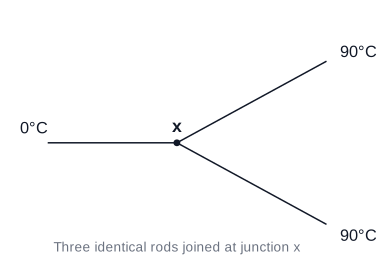
- KCET 2025Set D-41 markMCQQ.Three metal rods of the same material and identical in all respects are joined as shown in the figure. The temperatures at the ends of these rods are maintained as indicated. Assuming no heat energy loss occurs through the curved surfaces of the rods, the temperature at the junction x is
 (A) 60∘C
(B) 30∘C
(C) 20∘C
(D) 45∘C
(A) 60∘C
(B) 30∘C
(C) 20∘C
(D) 45∘C›Reveal solutionSolution
Apply the steady-state junction rule — heat in = heat out — using dtdQ=LkAΔT; with three identical rods the geometry factor cancels and 2(90−x)=x gives x=60∘C.
Step 1 — The set-up (from the figure)
Three identical rods meet at a common junction x:
- One rod runs to an end held at 0∘C (the cold sink).
- Two rods run to ends held at 90∘C (the hot sources).
The rods are of the same material and identical in all respects, so each has the same thermal conductivity k, the same cross-sectional area A and the same length L. No heat escapes through the curved surfaces, so all the heat that arrives at the junction must leave through the rods.
Step 2 — The concept: steady-state conduction
The rate of heat conduction along a rod (Fourier's law) is
dtdQ=LkA(Thot−Tcold)
Define the thermal conductance C=LkA, which is identical for all three rods. Then simply
dtdQ=CΔT
In the steady state the junction's temperature is no longer changing, which means it is storing no heat. Therefore
(heat flowing IN per second)=(heat flowing OUT per second)
This is the thermal analogue of Kirchhoff's junction rule for currents.
Step 3 — Write the heat currents
The junction is at temperature x, with 0<x<90 (it must lie between the extremes).
Heat IN — along the two rods from the 90∘C ends (heat flows hot → cold, so into the junction):
(dtdQ)in=2×C(90−x)
Heat OUT — along the one rod to the 0∘C end:
(dtdQ)out=C(x−0)=Cx
Step 4 — Equate and solve
2C(90−x)=Cx
The conductance C=kA/L is the same on both sides, so it cancels entirely — which is why we never needed the values of k, A or L:
2(90−x)=x
180−2x=x
180=3x
x=60∘C
Step 5 — Why 60 °C and not the naïve 45 °C
The tempting wrong answer is 45∘C — the plain average of 0 and 90. That would be right if one rod came from the hot end and one went to the cold end (a symmetric arrangement).
But here two rods feed heat in and only one carries it away. The junction is fed twice as strongly as it is drained, so it must settle closer to the hot end than to the cold one. Indeed 60∘C is two-thirds of the way from 0 to 90 — exactly the weighted average:
x=∑Ci∑CiTi=3CC(0)+C(90)+C(90)=3180=60∘C ✓
Verify the balance: in-flow =2C(90−60)=60C; out-flow =C(60)=60C. Equal ✓
✓Final answerThe correct option is (A) — 60∘C.
ANSWER: A
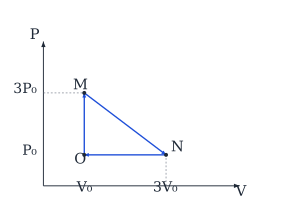
- KCET 2024Set D-21 markMCQQ.One mole of an ideal monoatomic gas is taken round the cyclic process MNOM. The work done by the gas is
 (A) 4.5P0V0
(B) 4P0V0
(C) 9P0V0
(D) 2P0V0
(A) 4.5P0V0
(B) 4P0V0
(C) 9P0V0
(D) 2P0V0›Reveal solutionSolution
Net work in a cycle = area enclosed on the P–V diagram (positive for a clockwise loop); the loop is a right triangle of legs 2V0 and 2P0, so W=21(2V0)(2P0)=2P0V0.
Step 1 — The concept.
Work done by a gas is W=∫PdV, which is the area under the path on a P–V diagram. Around a closed cycle the areas under the outgoing and returning legs partially cancel, leaving
Wnet=∮PdV=±(area enclosed by the loop),
positive if the cycle runs clockwise (the gas expands at high pressure and is compressed at low pressure — a net output, as in an engine) and negative if anticlockwise. Note also that for a full cycle ΔU=0 (internal energy is a state function), so by the first law Q=W — but we do not need that here.
Step 2 — Read the vertices.
M=(V0, 3P0),N=(3V0, P0),O=(V0, P0).
The three legs are: M→N a straight sloping line, N→O horizontal at P=P0 (compression), O→M vertical at V=V0 (isochoric pressure rise).
Step 3 — Compute the enclosed area.
The triangle is right-angled at O:
- horizontal leg ON=3V0−V0=2V0,
- vertical leg OM=3P0−P0=2P0.
Area=21×base×height=21(2V0)(2P0)=2P0V0.
Step 4 — Fix the sign from the sense of traversal.
Apply the shoelace formula to M(1,3)→N(3,1)→O(1,1) (in units of V0 and P0):
∑=xM(yN−yO)+xN(yO−yM)+xO(yM−yN)=1(1−1)+3(1−3)+1(3−1)=−6+2=−4.
A negative shoelace sum means the vertices are listed clockwise, and ∣−4∣/2=2 ⇒ area =2P0V0. Clockwise ⇒ the gas does positive net work.
(Physically: on M→N the gas expands from V0 to 3V0 at relatively high pressures — large positive work; on N→O it is compressed back at the lowest pressure P0 — a smaller negative work; on O→M the volume is constant so W=0. The expansion wins, hence net positive work.)
Step 5 — Cross-check leg by leg.
- WMN = area of the trapezium under the straight line from V0 to 3V0 =21(3P0+P0)(3V0−V0)=21(4P0)(2V0)=4P0V0.
- WNO=P0(V0−3V0)=−2P0V0 (compression at constant P0).
- WOM=0 (isochoric, dV=0).
Wnet=4P0V0−2P0V0+0=2P0V0✓
(The "monoatomic, one mole" data are not needed for the work — they would matter only for Q or ΔU on individual legs.)
✓Final answerThe correct option is (D) 2P0V0.
ANSWER: D
- KCET 2020Set A-11 markMCQQ.A certain amount of heat energy is supplied to a monoatomic ideal gas which expands at constant pressure. What fraction of the heat energy is converted into work? (A) 1 (B) 32 (C) 52 (D) 75
›Reveal solutionSolution
For a monoatomic ideal gas expanding at constant pressure, the fraction of supplied heat converted into work is 52, which corresponds to option (C).
The key here is to connect the heat supplied at constant pressure to the two places it can go: increasing the internal energy of the gas, and doing work on the surroundings. The fraction that becomes work is simply the work done divided by the heat supplied. Since the process is at constant pressure, both the work and the heat have straightforward expressions in terms of the temperature change, and the ratio depends only on the gas's specific heat capacities — which for a monoatomic gas are fixed numbers.
Let’s walk through it step by step.
- Identify the relevant thermodynamic quantities. For a monoatomic ideal gas, the molar specific heat at constant volume is CV=23R, and at constant pressure it is CP=CV+R=25R. When heat Q is supplied at constant pressure to n moles, causing a temperature rise ΔT, we have:
Q=nCPΔT=n(25R)ΔT.
- Find the work done during the expansion. At constant pressure P, the work done by the gas is W=PΔV. Using the ideal gas law PV=nRT, a change in volume at constant pressure gives PΔV=nRΔT. So:
W=nRΔT.
- Compute the fraction of heat converted to work. The fraction is W/Q:
QW=n⋅25RΔTnRΔT=251=52.
Watch outA common mistake is to use CV instead of CP for the heat supplied, because the gas does expand. But the problem explicitly says "at constant pressure" — so the heat is nCPΔT, not nCVΔT. Using CV would give 32, which is option (B) — a tempting distractor.
TipNotice that the fraction W/Q for constant pressure is always R/CP. For any ideal gas, CP=CV+R, so the fraction is R/(CV+R). For a monoatomic gas, CV=23R, giving 52. For a diatomic gas (without vibration), CV=25R, so the fraction would be 72 — a different number entirely.
✓Final answerThe correct option is (C) 52.
- KCET 2019Set A-11 markMCQQ.One mole of O2 gas is heated at constant pressure starting at 27°C. How much energy must be added to the gas as heat to double its volume? (A) Zero (B) 450 R (C) 750 R (D) 1050 R
›Reveal solutionSolution
For an ideal diatomic gas heated at constant pressure, the heat required to double the volume is Q=nCpΔT. With n=1, Cp=27R, and ΔT=300K (since V∝T at constant P), we get Q=1050R. The correct option is (D).
The key here is to recognise that the gas is oxygen (O2), which is diatomic. At constant pressure, the heat added equals the change in enthalpy: Q=nCpΔT. And because pressure is constant, volume is directly proportional to absolute temperature (Charles’s law). So doubling the volume means doubling the absolute temperature.
Let’s walk through it step by step.
-
Identify the gas and its degrees of freedom.
Oxygen (O2) is a diatomic molecule. At moderate temperatures (like 27∘C), it has 5 degrees of freedom: 3 translational and 2 rotational. Vibrational modes are not excited at this temperature.
For a diatomic ideal gas:
- Cv=25R
- Cp=Cv+R=27R
-
Convert the initial temperature to Kelvin.
T1=27∘C=300K
Always use absolute temperature in gas law calculations.
-
Relate volume change to temperature change at constant pressure.
For an ideal gas at constant pressure: V∝T (Charles’s law).
So if volume doubles: V1V2=2⟹T1T2=2
Therefore T2=2×300=600K, and ΔT=300K.
-
Heat added at constant pressure.
The heat required is Q=nCpΔT.
Here n=1 mole, Cp=27R, ΔT=300K.
So:
Q=1⋅27R⋅300=27×300R=7×150R=1050R
Watch outA common mistake is to use Cv instead of Cp for constant-pressure heating. At constant pressure, the gas does work on the surroundings as it expands, so more heat is needed than just to raise the internal energy. That extra heat is accounted for by Cp, which is larger than Cv by R.
TipFor any ideal gas, the ratio Cp/Cv=γ. For diatomic gases like O2, γ=7/5=1.4. Knowing γ can help you quickly find Cp if you remember Cv=25R for diatomic gases.
✓Final answerThe correct option is (D), 1050R.
-
🎓Unlock everything free for 14 days
- ✓Full step-by-step solutions
- ✓Concept-first explanations
- ✓Methods, shortcuts & mistakes
- ✓PYQ mapping + timed mock tests
Full access for 14 days. No credit card required.