Q.Calculate the power of a crane in watts, which lifts a mass of 100 kg to a height of 10 m in 20s.
🔒You're viewing a preview — the full solution, concept, methods & PYQ mapping are locked.
🔒 Start your 14-day free trial to unlock the full solution →Concept understanding — Power Against Gravity
Power Against Gravity: The Intuition
Imagine you're lifting a bucket of water from a well. The bucket is heavy — gravity is pulling it down with a force equal to its weight. To lift it, you must apply an upward force that exactly cancels gravity. If you lift it slowly, you feel the strain for a long time. If you yank it up quickly, you feel a burst of effort, but it's over fast.
That "burst of effort per unit time" is what we call power. When you're working against a constant force like gravity, power tells you how fast you're doing that work.
Power is not the force itself, nor the work alone — it's the rate at which work is done. Lifting the same bucket to the same height requires the same total work, regardless of speed. But doing it faster requires more power.
The Precise Statement
When an object moves vertically against gravity (upward), the force you must supply is at least equal to the object's weight:
F=mg
where m is mass and g is acceleration due to gravity (9.8 m/s2 on Earth).
The work done to lift it through a height h is:
W=F⋅h=mgh
Now, power P is work per unit time. If you lift it in time t:
P=tW=tmgh
But th is just the upward speed v (assuming constant speed). So we get the compact form:
P=mg⋅v
This is power against gravity — the rate at which you must supply energy to lift a mass m at constant speed v against the pull of gravity.
What This Really Means
- It's a minimum. If you accelerate the object upward, you need even more force (Newton's second law), and hence more power. The formula P=mgv assumes you're lifting at steady speed — no acceleration.
- Direction matters. If the object moves downward at constant speed, gravity does the work, and you (or a brake) must absorb power. The formula still gives the magnitude, but the sign flips.
- It's independent of path. Only the vertical speed matters. Whether you lift straight up or along a ramp, the power against gravity depends only on the vertical component of velocity.
For a quick calculation: lifting a 10 kg mass at 0.5 m/s requires P=10×9.8×0.5≈49 watts. That's about the power of a dim incandescent bulb — and you'd feel it after a minute.
Common Mistake to Avoid …
Concept: Power = Work done per unit time, where the work is done lifting the mass against gravity.
Step 1: Work done against gravity (using g=9.8m/s2, the standard NCERT value):
W=mgh=100×9.8×10=9800 J
Step 2: Power is work per unit time: …
Power is the rate of doing work. Lifting m=100kg through h=10m needs work W=mgh, done in t=20s, so P=tmgh=490W.
Concept: power as work per unit time
The crane raises the load against gravity, increasing its gravitational potential energy by mgh. Power is the rate at which this work is done.
P=tW=tmgh
Step-by-step solution
1. Work done against gravity.
W=mgh=100×9.8×10=9800J
2. Power.
P=tW=209800=490W …
Concept: Power as the Rate of Doing Work
Power delivered by a machine equals the work it does divided by the time taken:
P=tW
Here the crane does work against gravity to lift the mass.
Step 1: Identify the work done
The crane lifts a mass m=100 kg through a height h=10 m against gravity. The work done equals the gain in gravitational potential energy:
W=mgh
Step 2: Substitute values
Using g=9.8 m/s2 (the standard NCERT value): …
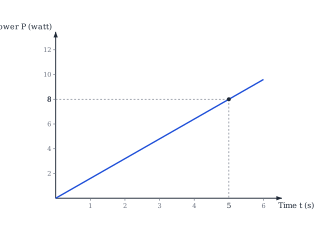
- KCET 2024Set D-21 markMCQQ.A particle of mass 500 g is at rest. It is free to move along a straight line. The power delivered to the particle varies with time according to the following graph: The momentum of the particle at t=5 s is
 (A) 22 Ns
(B) 52 Ns
(C) 5 Ns
(D) 5.5 Ns
(A) 22 Ns
(B) 52 Ns
(C) 5 Ns
(D) 5.5 Ns›Reveal solutionSolution
Power is the rate of doing work, so the area under the P–t graph is the kinetic energy gained; convert that energy to momentum with p=2mK.
1. Link power to energy
By definition,
P=dtdW⟹W=∫0tPdt=area under the P–t graph
2. Work–energy theorem
The particle starts from rest (Ki=0) and moves along a straight line, so all the work delivered goes into kinetic energy:
W=ΔK=Kf−0=Kf
3. Read the graph
The graph is a straight line through the origin, i.e. P=kt, rising to P=10 W at t=5 s (so k=2 Ws−1). The area under it up to t=5 s is a triangle:
W=21×base×height=21×5 s×10 W=25 J
(Equivalently ∫052tdt=t205=25 J.)
4. Kinetic energy → momentum
For a particle of mass m,
K=2mp2⟹p=2mK …
- COMEDK 2024Set 2024-E1 markMCQQ.When water falls from a height of 80 m at the rate of 20 kg s−1 to operate a turbine the losses due to frictional force are 20% of input energy. How much power is generated by the turbine? (A) 12.8 KW (B) 62.5 KW (C) 25.6 KW (D) 21.6 KW
›Reveal solutionSolution
The turbine’s output power is the gravitational potential energy per second of the falling water, reduced by 20% frictional losses. The result is 12.8 kW, which corresponds to option (A).
The core idea here is simple: water falling from a height loses gravitational potential energy, which is converted into kinetic energy and then into mechanical work by the turbine. But not all of that energy is usable — friction in the water flow and the turbine mechanism wastes a fixed percentage. So we calculate the input power (the rate at which potential energy is delivered) and then subtract the losses.
Why this approach works:
Power is energy per second. The water’s mass flow rate (kg/s) and the height (m) give us the rate of potential energy change: Pinput=m˙gh. Then we apply the efficiency (or loss factor) to find the actual electrical/mechanical power output.
-
Identify the given data
- Height: h=80m
- Mass flow rate: m˙=20kg/s
- Gravitational acceleration: g=9.8m/s2 (standard value)
- Frictional loss: 20% of input energy → usable energy = 80% of input.
-
Calculate the input power (rate of potential energy)
The potential energy of a mass m at height h is mgh. Per second, this becomes:
Pinput=m˙gh=20×9.8×80
First, 20×9.8=196. Then 196×80=15680W.
So Pinput=15680W=15.68kW.
- Account for the frictional losses Losses are 20%, so the turbine receives only 80% of the input power: Poutput=0.80×15.68kW=12.544kW …
-
🎓Unlock everything free for 14 days
- ✓Full step-by-step solutions
- ✓Concept-first explanations
- ✓Methods, shortcuts & mistakes
- ✓PYQ mapping + timed mock tests
Full access for 14 days. No credit card required.