Q.The average work done by a human heart while it beats once is 0.5 J. Calculate the power used by heart if it beats 72 times in a minute.
🔒You're viewing a preview — the full solution, concept, methods & PYQ mapping are locked.
🔒 Start your 14-day free trial to unlock the full solution →Concept understanding — Power Time Relation
Power and Time: The Intuition
Think about lifting a heavy box. If you lift it slowly, you feel tired but you manage. If you lift it fast — the same box to the same height — you feel a much greater strain. The work done (force × distance) is identical in both cases. So why does the fast lift feel harder?
The answer is power. Power tells you not just how much work is done, but how quickly it is done. The fast lift requires more power because the same work is compressed into a shorter time.
Everyday language often confuses power with energy. A "powerful" car isn't one that uses more fuel (energy) — it's one that can accelerate faster or climb a hill at higher speed, meaning it delivers energy more quickly.
The Precise Statement
Power is defined as the rate at which work is done (or energy is transferred). Mathematically:
P=tW
where:
- P = power (watts, W)
- W = work done (joules, J)
- t = time taken (seconds, s)
This is the power-time relation in its simplest form: power is work divided by time.
P=tW
If you rearrange it, you get two other useful forms:
W=P×tandt=PW
These tell you:
- To do a fixed amount of work, using more power means less time.
- To run a device for a fixed time, more power means more work (and more energy consumed).
A Concrete Example
Suppose you need to lift a 10 kg mass to a height of 2 metres. The work done against gravity is:
W=mgh=10×9.8×2=196 J
Now consider two cases:
| Case | Time taken | Power required |
|---|---|---|
| Slow lift | 4 seconds | P=4196=49 W |
| Fast lift | 1 second | P=1196=196 W |
The fast lift requires four times the power — that's why it feels much harder, even though the work is the same.
A common mistake is to think power and work are the same thing. They are not. Work is the total energy transferred; power is the rate of that transfer. A 100 W bulb uses 100 J of energy every second, but if you leave it on for an hour, the total work (energy used) is 100×3600=360,000 J.
Why This Matters for Exams
The power-time relation appears in two main forms in problems:
- Direct calculation: Given work and time, find power (or any missing variable). …
The key idea is that power is the rate of doing work, and the period is the time for one beat.
Step 1 — Find the time for one beat.
If the heart beats 72 times in 60 seconds, the time for one beat (the period T) is
T=7260=65 s.
Step 2 — Relate work per beat to power.
Power is work done per unit time:
P=TW. …
Power is the rate of doing work. By finding the total work done in one minute and dividing by 60 seconds, we get the heart's power as 0.6 W.
Concept First: Frequency and Period
When a process repeats — like a heartbeat — we talk about its frequency (how many times it happens per second) and its period (the time for one cycle). Power, being work per unit time, connects naturally to these ideas.
If you know the work done in one beat and how many beats occur in a given time, you don't need to time a single beat. You just find the total work over a convenient interval and divide by that interval. That's the cleanest route here.
Step-by-step solution
- Find the total work done in one minute. The heart does 0.5 J of work each time it beats. In one minute, it beats 72 times. Total work = work per beat × number of beats
Wtotal=0.5×72=36 J
- Convert the time interval to seconds. Power is measured in watts (J/s), so time must be in seconds.
t=1 minute=60 s
- Apply the definition of power. Power = work done ÷ time taken …
Concept: Power from Repeated Work Events
When work is done repeatedly (once per cycle), total power equals total work over an interval divided by that interval — you don't need the duration of a single cycle if you know how many cycles occur in a known time.
Step 1: Find the total work done in one minute
Each beat does W1=0.5 J of work; there are 72 beats in 60 s:
Wtotal=0.5×72=36 J …
- KCET 2025Set D-41 markMCQQ.A body of mass 0.25 kg travels along a straight line from x=0 to x=2 m with a speed u=kx3/2 where k=2 SI units. The work done by the net during this displacement is (A) 8 J (B) 16 J (C) 32 J (D) 4 J
›Reveal solutionSolution
Use the work–energy theorem: the work done by the net force is exactly the change in kinetic energy, so we only need the speed at the two endpoints — no force law required.
Step 1 — Choose the right principle
The question asks for the work done by the net force. The work–energy theorem states
Wnet=ΔK=21mvf2−21mvi2
This is the natural tool here: we are handed the speed as a function of position, which is precisely what we need for the endpoints. (You could find F=ma=mvdxdv and integrate ∫Fdx, but that is the same theorem done the long way.)
Step 2 — Write down the speed law
u(x)=kx3/2,k=2 (SI units)
Squaring is more convenient than working with the speed itself, because kinetic energy needs u2:
u2(x)=k2x3=(2)2x3=4x3
Step 3 — Evaluate at the two endpoints
At the initial point xi=0:
ui2=4(0)3=0⇒ui=0
At the final point xf=2 m:
uf2=4(2)3=4×8=32 m2s−2 …
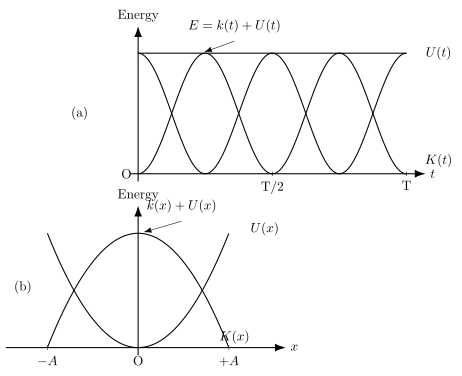
- KCET 2025Set D-41 markMCQQ.The variations of kinetic energy K(x), potential energy U(x) and total energy as a function of displacement of a particle in SHM is as shown in the figure. The value of ∣x0∣ is
 (A) 2A
(B) 2A
(C) 2A
(D) 2A
(A) 2A
(B) 2A
(C) 2A
(D) 2A›Reveal solutionSolution
The graphs cross where K=U, and since K+U=E that means each equals half the total energy — solving 21kx02=21(21kA2) gives ∣x0∣=A/2.
Step 1 — Read the graph
The figure shows three curves against displacement x:
- U(x) — an upward parabola, minimum (zero) at x=0, maximum at x=±A.
- K(x) — a downward parabola, maximum at x=0, zero at x=±A.
- E — a horizontal line (total energy is constant, as it must be for a conservative system).
The point ±x0 marked on the axis is where the two parabolas intersect. At an intersection the two functions are equal:
K(x0)=U(x0)
This is the entire physical content of the question.
Step 2 — The SHM energy expressions
For a particle of amplitude A executing SHM under a restoring force F=−kx:
Potential energy (elastic PE stored at displacement x):
U(x)=21kx2
Total energy (constant — evaluate it at x=A, the extreme position, where the particle is momentarily at rest so K=0 and all the energy is potential):
E=U(A)=21kA2
Kinetic energy (from conservation of mechanical energy):
K(x)=E−U(x)=21kA2−21kx2=21k(A2−x2)
These are exactly the two parabolas drawn.
Step 3 — Impose the crossing condition
Set K(x0)=U(x0):
21k(A2−x02)=21kx02
Cancel the common factor 21k (non-zero):
A2−x02=x02
A2=2x02
x02=2A2
Taking the square root and keeping the magnitude:
∣x0∣=2A≈0.707A
Step 4 — The equivalent (and quicker) route
Because K+U=E always, the condition K=U means each is exactly half the total energy:
U(x0)=2E …
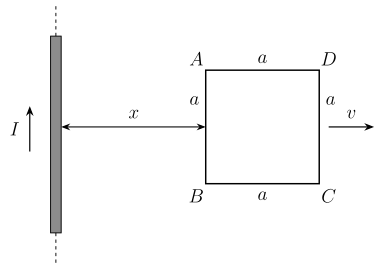
- KCET 2024Set D-21 markMCQQ.A square loop of side length 'a' is moving away from an infinitely long current carrying conductor at a constant speed 'v' as shown. Let 'x' be the instantaneous distance between the long conductor and side AB. The mutual inductance (M) of the square loop - long conductor pair changes with time (t) according to which of the following graphs?
 (A) [FIGURE]
(B) [FIGURE]
(C) [FIGURE]
(D) [FIGURE]
(A) [FIGURE]
(B) [FIGURE]
(C) [FIGURE]
(D) [FIGURE]›Reveal solutionSolution
Derive M(x)=2πμ0alnxx+a, put x=x0+vt: M decays monotonically towards zero, so the graph is a decaying, concave-up curve.
Step 1 — Flux through the loop from the wire's field.
The wire's field at perpendicular distance r is B=2πrμ0I. It is not uniform across the loop, so integrate: take a strip of width dr and length a at distance r,
ϕ=∫xx+a2πrμ0I(adr)=2πμ0Ia[lnr]xx+a=2πμ0Ialn(xx+a).
Step 2 — Extract the mutual inductance.
By definition ϕ=MI, so
M(x)=2πμ0aln(xx+a)=2πμ0aln(1+xa)
M depends only on the geometry — as it must.
Step 3 — Introduce the motion.
The loop moves away at constant speed, so x=x0+vt (increases linearly with t). Substituting,
M(t)=2πμ0aln(1+x0+vta).
Step 4 — Read off the shape of the graph.
- As t increases, x0+vta decreases, so M decreases monotonically. …
- KCET 2024Set D-21 markMCQQ.In alpha particle scattering experiment, if v is the initial velocity of the particle, then the distance of closest approach is d. If the velocity is doubled, then the distance of closest approach becomes (A) 4d (B) 2d (C) 2d (D) 4d
›Reveal solutionSolution
Energy conservation gives d∝1/v2; doubling v therefore quarters d.
Step 1 — What "distance of closest approach" means
In Rutherford's experiment, an α-particle (charge +2e) fired head-on at a nucleus (charge +Ze) is repelled by the Coulomb force. It decelerates, and at the point of closest approach it is momentarily at rest — all of its kinetic energy has been converted into electrostatic potential energy.
Step 2 — Apply conservation of energy
At launch (far away, PE ≈0): energy =21mv2.
At closest approach (distance d, KE =0): energy =4πε01d(2e)(Ze).
Equating:
21mv2=4πε01⋅d2Ze2
Step 3 — Solve for d
d=4πε01⋅mv24Ze2
Everything on the right except v is fixed by the projectile and the target, so
d∝v21
The why is worth stating: the particle must "buy" its penetration with kinetic energy, and kinetic energy scales as v2 — so it is v2, not v, that sets how deep it gets.
Step 4 — Scale the velocity
Let the new velocity be v′=2v and the new distance d′. Using the proportionality: …
- COMEDK 2024Set 2024-M1 markMCQQ.The power of a gun which fires 120 bullet per minute with a velocity 120 ms−1 is : (given the mass of each bullet is 100 g) (A) 86400 W (B) 14.4 kW (C) 1.44 kW (D) 1220 W
›Reveal solutionSolution
The power is the total kinetic energy delivered per second. With 120 bullets per minute (2 per second), each of mass 0.1 kg and speed 120 m/s, the power is 1440 W = 1.44 kW, so the correct option is (C).
Concept & Intuition
Power is the rate of doing work or transferring energy. Here, the gun does work by giving each bullet kinetic energy. The key is to find the total kinetic energy imparted to all bullets in one second, because “power” means energy per unit time. We don’t need force or acceleration — just the energy of the bullets leaving the gun.
Step-by-step solution
- Find the number of bullets fired per second. The gun fires 120 bullets per minute.
Bullets per second=60120=2 bullets/s.
-
Convert mass to kilograms.
Each bullet has mass 100 g=0.1 kg.
(Always use SI units: kg, m, s.)
-
Kinetic energy of one bullet.
KEone=21mv2=21×0.1×(120)2.
Compute:
1202=14400, so
KEone=0.05×14400=720 J.
- Total kinetic energy per second (power). Since 2 bullets are fired each second,
Power=2×720=1440 W.
Convert to kilowatts: 1440 W=1.44 kW.
- Match with options. …
- KCET 2023Set A-31 markMCQQ.Pressure of ideal gas at constant volume is proportional to (A) average potential energy of the molecules (B) total energy of the gas (C) average kinetic energy of the molecules (D) force between the molecules
›Reveal solutionSolution
Kinetic theory: PV=32NEˉk, so at fixed V, P∝Eˉk.
Step 1 — The kinetic-theory expression for pressure.
Pressure arises from molecular collisions with the walls. Kinetic theory gives
P=31VmNv2=32VN(21mv2)=32VNEˉk,
where Eˉk=21mv2 is the average kinetic energy per molecule.
Step 2 — Impose constant volume.
With N and V fixed, the prefactor 3V2N is a constant, so
P∝Eˉk.
(Equivalently, Eˉk=23kBT and P∝T at constant V — Gay-Lussac's law. The two statements are the same physics.)
Step 3 — Why the others fail.
- (A) Average potential energy — in an ideal gas the molecules are assumed to have no intermolecular potential energy, so this is identically zero and cannot determine P. …
- KCET 2023Set A-31 markMCQQ.A wire of resistance R is connected across a cell of emf ε and internal resistance r. The current through the circuit is I. In time t, the work done by the battery to establish the current I is (A) Rε2t (B) IRt (C) I2Rt (D) εIt
›Reveal solutionSolution
Work done by a source of emf = emf × charge driven =ε⋅(It).
Step 1 — What emf means.
The emf ε of a cell is defined as the work done per unit charge by the source in driving charge around the circuit:
ε=qW.
Step 2 — The charge delivered in time t.
A steady current I transports
q=It
of charge through the circuit in time t.
Step 3 — The total work done by the battery.
W=εq=εIt.
Equivalently, the power delivered by the source is P=εI, so W=Pt=εIt.
Step 4 — Where that energy goes (why the other options are wrong).
Using ε=I(R+r):
W=εIt=I2Rt+I2rt. …
- KCET 2021Set B-21 markMCQQ.Consider an electrical conductor connected across a potential difference V. Let Δq be a small charge moving through it in time Δt. If I is the electric current through it, (I) the kinetic energy of the charge increases by IVΔt. (II) the electric potential energy of the charge decreases by IVΔt. (III) the thermal energy of the conductor increases by IVΔt. Then the correct statement/s is/are (A) (I) (B) (I), (II) (C) (I) and (III) (D) (II), (III)
›Reveal solutionSolution
The power delivered by the battery is P=IV, and this energy is dissipated as heat in the conductor — not stored as kinetic energy of the charge carriers. Only statements (II) and (III) are correct, so the answer is option (D).
When a charge Δq moves through a potential difference V, the work done by the electric field is ΔW=VΔq. Since current I=Δq/Δt, we have ΔW=IVΔt. This is the energy supplied by the battery.
The key question is: where does this energy go? In a normal conductor (like a metal wire), the charge carriers (electrons) do not accelerate indefinitely. They collide repeatedly with the lattice ions, transferring their gained kinetic energy to the lattice as heat. So the energy does not stay as kinetic energy of the charges — it becomes thermal energy of the conductor.
Let’s examine each statement carefully.
-
Statement (I): "the kinetic energy of the charge increases by IVΔt."
If the charges kept gaining kinetic energy, they would accelerate without limit. In a steady current, the drift velocity is constant — the energy gained from the field is lost in collisions. So the kinetic energy of the charge carriers does not increase by IVΔt. This statement is false.
-
Statement (II): "the electric potential energy of the charge decreases by IVΔt."
As a charge moves from higher to lower potential, its electric potential energy decreases by exactly VΔq=IVΔt. This is the very definition of potential difference. This statement is true.
-
Statement (III): "the thermal energy of the conductor increases by IVΔt." …
-
- KCET 2020Set A-11 markMCQQ.The period of revolution of an electron revolving in nth orbit of H-atom is proportional to (A) n2 (B) n1 (C) n3 (D) Independent of n
›Reveal solutionSolution
The period of revolution of an electron in the nth orbit of a hydrogen atom is proportional to n3, based on Bohr's model combining the radius and velocity scaling laws.
The key idea comes from Bohr's model of the hydrogen atom. In this model, the electron moves in circular orbits around the nucleus under the influence of the Coulomb force. The period of revolution is simply the time taken to complete one full circle: T=v2πr, where r is the radius of the orbit and v is the orbital speed. To find how T depends on the principal quantum number n, we need to know how both r and v scale with n.
From Bohr's postulates, two results are central:
- The radius of the nth orbit is proportional to n2: rn∝n2.
- The velocity of the electron in the nth orbit is inversely proportional to n: vn∝n1.
These come from quantising angular momentum (mvr=2πnh) and equating the Coulomb force to the centripetal force. Let's combine them step by step.
- Write the expression for the period. The time for one revolution is the circumference divided by speed:
Tn=vn2πrn.
- Substitute the proportionalities. Since rn∝n2 and vn∝n1, we get:
Tn∝1/nn2=n2×n=n3.
- Check the constants. If you want the exact expression, it is: Tn=me44ε02h3n3, …
- KCET 2019Set A-11 markMCQQ.A particle of mass m and charge q is placed at rest in uniform electric field E and then released. The kinetic energy attained by the particle after moving a distance y is (A) qEy2 (B) qE2y (C) qEy (D) q2Ey
›Reveal solutionSolution
Constant force qE over a displacement y does work qEy, and by the work–energy theorem that work is entirely converted into kinetic energy because the particle started at rest.
Step 1 — The force on the charge.
In a uniform field E, a charge q experiences
F=qE,
which is constant in magnitude and direction. Released from rest, the particle accelerates along E (for q>0), so its displacement y is parallel to the force.
Step 2 — Work done by that force.
For a constant force parallel to the displacement,
W=F⋅y=qEycos0∘=qEy.
Step 3 — Work–energy theorem.
Wnet=ΔK=Kf−Ki.
The particle is released from rest, so Ki=0, and the electric force is the only force doing work. Hence
Kf=qEy.
Step 4 — Cross-check with kinematics.
a=mqE,v2=u2+2ay=0+2(mqE)y=m2qEy, …
- KCET 2018Set A-11 markMCQQ.A mass of 1 kg carrying a charge of 2 C is accelerated through a potential of 1 V. The velocity acquired by it is (A) 2 ms−1 (B) 2 ms−1 (C) 21 ms−1 (D) 21 ms−1
›Reveal solutionSolution
Work–energy theorem: the electrical work qV done on the charge appears entirely as kinetic energy 21mv2.
Step 1 — The physics.
When a charge q is accelerated through a potential difference V, the electric field does work
W=qV
on it. If the charge starts from rest and no other force acts, the work–energy theorem says all of this work becomes kinetic energy:
qV=21mv2
Step 2 — Solve for v.
v=m2qV
Step 3 — Substitute the given values (m=1 kg, q=2 C, V=1 V; all already in SI units, so no conversion is needed):
v=1 kg2×(2 C)×(1 V)=4=2 ms−1 …
- KCET 2018Set A-11 markMCQQ.The half-life of tritium is 12.5 years. What mass of tritium of initial mass 64 mg will remain undecayed after 50 years? (A) 32 mg (B) 8 mg (C) 16 mg (D) 4 mg
›Reveal solutionSolution
Count how many half-lives fit into 50 years (50/12.5=4), then halve the mass four times: 64→32→16→8→4 mg.
Step 1 — The half-life law.
Radioactive decay is exponential, N=N0e−λt, which is most conveniently written in terms of the half-life t1/2:
N=N0(21)n,n=t1/2t
where n is the number of half-lives elapsed. (Mass is proportional to the number of undecayed nuclei, so the same formula applies to the mass.)
Step 2 — Number of half-lives.
n=12.5 years50 years=4
Step 3 — Remaining mass.
m=64 mg×(21)4=1664=4 mg
Tracing it half-life by half-life makes it transparent: …
🎓Unlock everything free for 14 days
- ✓Full step-by-step solutions
- ✓Concept-first explanations
- ✓Methods, shortcuts & mistakes
- ✓PYQ mapping + timed mock tests
Full access for 14 days. No credit card required.