Biology · Ch 10 — Biotechnology and Its Applications
Biotechnological Applications in Agriculture
Biotechnological Applications in Agriculture
Biotechnological applications in agriculture aim to solve a fundamental problem: how to increase food production to feed a growing population. The textbook presents three broad options that have been considered for this purpose. The first is agro-chemical based agriculture, which relies heavily on fertilisers and pesticides. The second is organic agriculture, which uses natural inputs and biological cycles. The third, and the focus of this section, is genetically engineered crop-based agriculture — the use of biotechnology to create crops with desirable traits.
Although the earlier Green Revolution nearly tripled the food supply, it still has not been enough to keep pace with a growing population. Much of that increase came not from better varieties alone, but from heavier use of agrochemicals and improved farm-management practices. For farmers in the developing world, agrochemicals are often too expensive, and simply breeding existing varieties further cannot push yields much higher using conventional methods. This is the gap that biotechnology — tissue culture first, and genetic engineering after it — was developed to fill.
Tissue Culture and Micropropagation
Because traditional breeding could not keep up with demand, scientists developed tissue culture: the ability to regenerate a whole plant from an explant, any small part of a plant that is grown in a test tube under sterile conditions in a special nutrient medium. This ability of a single cell or explant to regenerate a complete plant is called totipotency.
For this to work, the nutrient medium has to supply everything the explant would normally get from the rest of the plant — a carbon source such as sucrose, inorganic salts, vitamins, amino acids, and growth regulators such as auxins and cytokinins, which trigger cell division and differentiation.
Using this technique, thousands of genetically identical plants — called somaclones — can be grown from a single parent plant in a very short time, a process known as micropropagation. Commercially important food plants such as tomato, banana, and apple are produced this way on a large scale today.
One particularly valuable use of tissue culture is recovering healthy, virus-free plants from plants that are already infected. Even when the rest of a plant's tissue carries a viral infection, its growing tips — the apical and axillary meristems — are usually still virus-free. By removing just the meristem and growing it in vitro, scientists can regenerate a plant free of the original infection. This has been done successfully with banana, sugarcane, and potato.
Tissue culture also enables an unusual kind of hybridisation. Scientists can digest away a plant cell's wall to isolate a naked protoplast, then fuse protoplasts taken from two different plant varieties — each carrying a desirable trait — into a single hybrid protoplast. Grown further, this hybrid protoplast develops into what is called a somatic hybrid, through a process called somatic hybridisation. A well-known example is the fusion of tomato and potato protoplasts to produce the "pomato" — though in practice this particular hybrid never combined the desired traits of both parents well enough to be commercially useful.
Genetic modification takes this idea further still: plants, bacteria, fungi, and animals whose genes have been deliberately altered by such manipulation are called Genetically Modified Organisms (GMOs).
The central goal of agricultural biotechnology is to produce crops that are more productive and more resilient. This is achieved by introducing specific genes into crop plants, giving them new characteristics that are difficult or impossible to obtain through traditional breeding.
Two major applications of biotechnology in agriculture are:
- Production of pest-resistant plants: This reduces the need for chemical pesticides, lowering costs and environmental damage.
- Production of plants with enhanced tolerance to abiotic stresses: These include tolerance to drought, salinity, heat, and cold, allowing crops to be grown in harsher conditions.
The most successful and widely adopted example of pest-resistant crops is the development of Bt cotton. Bt cotton is a genetically modified (GM) plant that carries a gene from the bacterium Bacillus thuringiensis. This bacterium produces a protein toxin that is lethal to certain insect pests, particularly the cotton bollworm. The gene responsible for this toxin is isolated from the bacterium and inserted into the cotton plant's genome. Once inside the plant, the gene is expressed, meaning the plant itself now produces the insecticidal protein. When a pest feeds on the Bt cotton plant, it ingests the toxin and dies, providing built-in protection.
The Bt toxin protein is produced in an inactive form (a protoxin) inside the bacterium. It becomes active only in the alkaline gut of the insect, where it is cleaved by specific enzymes to become toxic. The activated toxin then binds to the surface of the insect's midgut cells and creates pores in the cell membrane, causing the cells to swell and burst (lyse) — which kills the insect. This is why the toxin does not harm the plant itself or mammals, whose digestive systems are acidic rather than alkaline.
This toxin gene is named cry, and it exists in several versions. For example, the proteins encoded by the genes cryIAc and cryIIAb control the cotton bollworm, while cryIAb controls the corn borer. Which version is used depends on the crop and the specific pest being targeted, since most Bt toxins are insect-group specific.
Another important application is the development of plants with improved nutritional quality. A landmark example is the creation of golden rice, a genetically modified rice variety. Ordinary rice lacks sufficient beta-carotene, which the human body converts into vitamin A. Vitamin A deficiency is a major cause of blindness and disease in many developing countries where rice is a staple food. The book identifies it simply as vitamin-A-enriched rice, without detailing the specific genes used — a good example of something worth researching further yourself. The goal of golden rice is to provide a dietary source of vitamin A to populations that rely heavily on rice.
The benefits of genetically modified crops are numerous and significant. They include:
- Increased tolerance to abiotic stresses: Crops can be engineered to withstand drought, salinity, and extreme temperatures.
- Reduced reliance on chemical pesticides: Pest-resistant crops like Bt cotton drastically cut the need for spraying, which is better for the environment and farmer health.
- Reduction in post-harvest losses: Some GM crops are engineered for longer shelf life or resistance to spoilage.
- Increased efficiency of mineral usage: Plants can be made to use nutrients like nitrogen more efficiently, reducing the need for fertilisers.
- Enhanced nutritional value: As seen with golden rice, crops can be fortified with essential vitamins and minerals.
Beyond food crops, genetic modification has also been used to create tailor-made plants that supply industries with alternative resources — such as starches, biofuels, and pharmaceutical compounds.
Pest-resistant GM crops like Bt cotton reduce how much chemical pesticide farmers need to spray. This not only lowers production costs for farmers but also reduces the environmental and health hazards associated with pesticide application.
Pest-Resistant Plants Using RNA Interference (RNAi) …
Drawn by us to help you understand the concept clearly, and verified to make sure it's accurate. For exams, practice from your textbook's own diagram.
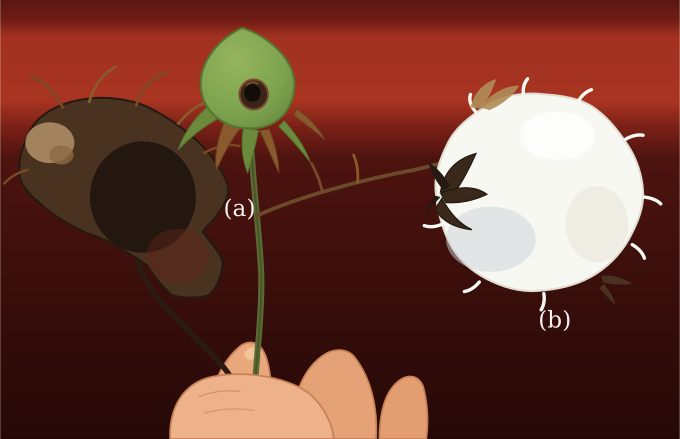
Figure 10.1 is a simple two-panel comparison, labelled (a) and (b). There are no arrows, labels beyond the panel letters, or any other markings. Each panel shows a single cotton boll — the fruit of the cotton plant that contains the fibres.
Panel (a) shows a destroyed cotton boll. The boll is visibly damaged: it is partially eaten, discoloured, and the white cotton fibre inside is spoiled, matted, or missing in places. This damage is the direct result of bollworm larvae feeding on the boll from the inside. The boll has not opened properly; instead, it looks rotten or hollowed out.
Panel (b) shows a fully mature, healthy cotton boll. This boll has burst open naturally, exposing a clean, fluffy mass of white cotton fibre. The boll wall is intact and the fibre is undamaged — exactly what a farmer wants to harvest. …
Drawn by us to help you understand the concept clearly, and verified to make sure it's accurate. For exams, practice from your textbook's own diagram.
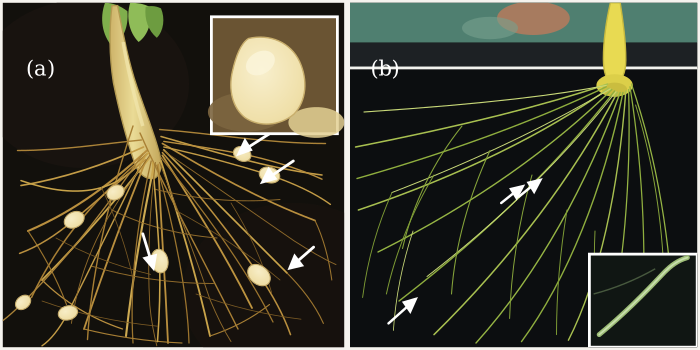
Figure 10.2 shows two side-by-side photographs of tobacco root systems, labelled (a) and (b). Both panels are taken five days after the roots were deliberately infected with the root-knot nematode Meloidogyne incognita.
Panel (a) is the control plant — an ordinary, non-transgenic tobacco plant. Its roots are heavily infested. The nematode has invaded the root tissue and triggered the formation of characteristic galls or knots: swollen, lumpy outgrowths that are visible all along the root system. These galls are the classic symptom of nematode infection, and they disrupt the root's ability to absorb water and nutrients, stunting the plant.
Panel (b) is a transgenic tobacco plant that has been engineered to produce double-stranded RNA (dsRNA) corresponding to a specific nematode gene. The dsRNA triggers RNA interference (RNAi) inside the nematode's cells: it silences the target mRNA, preventing the parasite from producing a protein essential for its survival. As a result, the nematode cannot establish itself or cause disease. The transgenic roots in panel (b) appear healthy, with no galls or knots — they look essentially like uninfected roots, despite the deliberate exposure to nematodes. …