Q.Bt cotton is not:
Concept understanding — Bt Toxin Inactivity
Let’s start with something you already know. Imagine you eat a piece of stale, spoiled food. Your stomach immediately feels uneasy — maybe you get cramps or nausea. Your body is reacting to something harmful that entered it. Now, what if that harmful thing was a tiny crystal that only dissolves and becomes active in your stomach’s specific acidic environment? That’s the basic idea behind Bt toxin inactivity.
The everyday intuition
Think of a medicine capsule that has a special coating. That coating is designed to survive the acid in your stomach and only dissolve in your intestines, where the medicine is needed. If the coating dissolved too early, the medicine would be destroyed before it could work. If it never dissolved, the medicine would pass right through you, useless.
Bt toxin works on a similar principle — but in reverse. The toxin is produced by a bacterium called Bacillus thuringiensis (Bt). This bacterium makes a protein crystal that is harmless to most organisms, including humans, because it is produced in an inactive form. It only becomes dangerous when it reaches the very specific environment of an insect’s midgut.
The precise meaning
Bt toxin inactivity means that the toxin protein is initially non-toxic. It is a protoxin — a precursor that needs to be activated inside the body of a target insect. The activation happens only when the protoxin is eaten by a susceptible insect larva. Inside the insect’s midgut, which has a high pH (alkaline conditions) and specific digestive enzymes, the inactive crystal dissolves and gets chopped into a smaller, active toxin molecule.
That active toxin then binds to the insect’s gut wall, creating pores that cause the gut to leak. The insect stops feeding and eventually dies. But for any other animal — including humans, cattle, birds, or fish — the toxin remains inactive because their digestive systems lack the right alkaline pH and the specific enzymes needed to activate it.
This is why Bt toxin is considered safe for humans and non-target animals. The toxin is not poisonous by itself; it is the insect’s own digestive chemistry that turns it into a poison. If you ate the Bt crystal, it would pass through your body unchanged, like an undigested seed.
Why it matters
This concept is the foundation of Bt crops — genetically modified plants like Bt cotton, Bt corn, and Bt brinjal. Scientists take the gene that codes for this inactive toxin from the bacterium and insert it into the plant’s DNA. The plant then produces the inactive toxin in its tissues. When a pest insect chews on the plant, it ingests the inactive toxin, which becomes active only inside that insect.
The key advantage is target specificity. The toxin does not harm beneficial insects like bees, ladybugs, or earthworms, because their gut conditions are different. It also does not harm humans or livestock. This reduces the need for chemical insecticides, which are broad-spectrum poisons that kill many organisms, including helpful ones.
What the NCERT textbook says
The NCERT Class 12 Biology textbook (Chapter 12: Biotechnology and its Applications) explains this clearly:
“The Bt toxin protein exists as inactive protoxins but once an insect ingests the inactive toxin, it is converted into an active form of toxin due to the alkaline pH of the gut which solubilises the crystals.”
It also emphasises that the toxin is harmless to humans because:
- The human gut has an acidic pH, not alkaline.
- Humans lack the specific protease enzymes that clip the protoxin into its active form.
A few key points to remember
- Inactive form = safe for most organisms.
- Activation requires alkaline pH + specific insect gut enzymes.
- Result = the toxin is a stomach poison only for certain insect larvae.
- Application = Bt crops produce this inactive toxin, so pests die when they eat the plant, but humans and other animals are not affected.
Bt toxin is not a chemical poison. It is a protein that is harmless until it meets the right biological conditions. This is why Bt crops are considered an environmentally safer alternative to chemical pesticides — they target only the pest, not the ecosystem.
So, when you hear “Bt toxin inactivity,” think of a locked box that only opens with a very specific key — a key that only certain insects carry. For everyone else, the box stays locked, and the contents remain harmless.
Bt toxin inactivity is a key detail within the NCERT Class 12 Biology chapter on Biotechnology and its Applications, commonly searched as "Bt toxin mechanism class 12 biology" or "Bt cotton important questions." Because Bt crops are one of the most exam-favoured applications of genetic engineering, this concept shows up reliably in CBSE boards and NEET biology papers.
The bacterium Bacillus thuringiensis produces proteins that are toxic to certain insects. These toxins are initially present as inactive protoxins, or crystal proteins, within the bacterial cells. The toxin remains inactive in the bacterium itself because it is in a crystalline form and the cellular environment, particularly the pH, does not facilitate its activation.
When an insect ingests these inactive crystal proteins, the alkaline pH of its gut solubilizes the crystals. This solubilized protoxin is then cleaved by specific proteases present in the insect gut, converting it into its active form. The activated toxin binds to the surface of the midgut epithelial cells, creating pores that cause the cells to swell and lyse, ultimately leading to the death of the insect. This mechanism ensures the toxin is specific to insects with an alkaline gut and is harmless to humans and other animals with acidic digestive systems.
Bt cotton is a genetically modified plant that has been engineered to express this bacterial gene, making it inherently resistant to specific insect pests like bollworms. However, this biological resistance is targeted against certain insects and does not provide resistance to all chemical pesticides.
The statement that is NOT true of Bt cotton is (D) Resistant to all pesticides — its resistance is specific to certain insect pests, not to pesticides/herbicides/fungicides in general.
Bt cotton is genetically engineered to be resistant to specific insect pests, but this resistance does not extend to all types of pesticides, which include herbicides, fungicides, and other insecticides.
Bt cotton represents a significant advancement in agricultural biotechnology, primarily known for its inherent resistance to certain insect pests. This resistance stems from the plant's genetic modification, where it incorporates and expresses a gene from the bacterium Bacillus thuringiensis (Bt). This bacterium naturally produces protein crystals that contain a potent insecticidal protein.
The remarkable aspect of this Bt toxin is its specificity and mechanism of action. In its natural state within the bacterium, the toxin exists as an inactive protoxin. This inactive form is harmless to the bacterium itself and, crucially, to most other organisms, including humans and beneficial insects.
The term "protoxin" indicates that it's a precursor molecule that requires activation to become toxic. This is a common biological strategy to control the activity of potent substances.
When an insect, such as the cotton bollworm, ingests the Bt toxin crystals along with the plant material, the unique conditions within its digestive system come into play. The insect's gut environment is characterized by an alkaline pH. This alkaline condition is critical because it solubilizes the inactive protoxin crystals, releasing the active toxin.
Once activated, this toxin binds specifically to receptors on the surface of the midgut epithelial cells of the insect. This binding is highly selective, which is why the toxin affects only certain insect groups. Upon binding, the toxin creates pores in the cell membrane of these midgut cells. These pores disrupt the osmotic balance, leading to the swelling and eventual lysis (bursting) of the cells. The destruction of the midgut cells paralyzes the insect's digestive system, causing it to stop feeding and ultimately leading to its death.
The specificity of Bt toxin is due to two main factors: the alkaline pH required for activation, which is found only in the guts of susceptible insects, and the presence of specific binding receptors on the midgut cells of these target insects.
Now, let's consider the options provided in the question:
- (A) A GM plant: Bt cotton is indeed a Genetically Modified (GM) plant. Its genome has been altered by introducing a foreign gene (from Bacillus thuringiensis) to confer a new trait.
- (B) Insect resistant: Yes, Bt cotton is insect resistant. It is specifically engineered to resist certain lepidopteran pests like the cotton bollworms, which are a major threat to cotton crops.
- (C) A bacterial gene expressing system: This is also true. Bt cotton plants have been genetically engineered to express the cry gene from Bacillus thuringiensis, meaning they produce the bacterial toxin themselves.
- (D) Resistant to all pesticides: This statement is incorrect. "Pesticides" is a broad category that includes insecticides (to kill insects), herbicides (to kill weeds), fungicides (to kill fungi), and other chemicals used to control pests. Bt cotton's genetic modification provides resistance only to specific insect pests by producing its own insecticide (the Bt toxin). It does not confer resistance to herbicides, fungicides, or other types of insecticides that target different pests or operate through different biochemical pathways. For instance, Bt cotton would still require herbicides to control weeds or fungicides to combat fungal diseases.
Bt cotton is not resistant to all pesticides because its genetic modification provides specific resistance only to certain insect pests by producing the Bt toxin, and this resistance does not extend to other categories of pesticides like herbicides or fungicides.
Method — test each option against what Bt cotton actually does
- (a) It IS a GM plant → true, so not the answer to "is not".
- (b) It IS insect-resistant → true, not the answer.
- (c) It IS a bacterial-gene-expressing system (carries the Bacillus thuringiensis cry gene) → true, not the answer.
- (d) "Resistant to all pesticides" → FALSE: its resistance is narrowly specific to certain insects, not chemical pesticides/herbicides/fungicides in general → this is the one that is NOT true → (d).
- KCET 2025Set C-41 markMCQQ.Some strains of Bacillus thuringiensis produce proteins that kill insects. Which one of the following is not killed by proteins of Bacillus thuringiensis? (A) Armyworm (B) Cotton bollworm (C) Tapeworm (D) Tobacco budworm
›Reveal solutionSolution
Bt Cry proteins are insect-specific — they need an alkaline insect midgut and a specific midgut receptor — so the non-insect of the four, the tapeworm, is not killed.
Step 1 — How the Bt toxin actually works (this is the whole question).
Bacillus thuringiensis forms protein crystals containing the Cry protein, which exists as an inactive protoxin. When an insect eats it:
- The insect's midgut is alkaline (pH>9.5), which solubilises the crystal.
- The protoxin is then converted into the active toxin.
- The active toxin binds to specific receptors on the midgut epithelium, punching pores in the cells, which swell, lyse and kill the insect.
Every one of these three steps is insect-specific. That is exactly why the toxin is safe for humans and other animals — our stomachs are acidic, so the crystal is never solubilised, and we lack the midgut receptor.
Step 2 — Classify the four organisms.
Option Organism Phylum (A) Armyworm Spodoptera — a lepidopteran caterpillar Arthropoda (insect) ✓ killed (B) Cotton bollworm Helicoverpa armigera — a lepidopteran Arthropoda (insect) ✓ killed (this is what Bt-cotton targets, via cryIAc) (C) Tapeworm Taenia — a flatworm/helminth Platyhelminthes — NOT an insect ✗ (D) Tobacco budworm Heliothis — a lepidopteran Arthropoda (insect) ✓ killed (also cryIAc) Step 3 — Conclude.
The armyworm, cotton bollworm and tobacco budworm are all lepidopteran insects, and NCERT names them explicitly as targets of the cryIAc/cryIIAb genes. The tapeworm is an endoparasitic flatworm: it lives in the host's intestine, has no alkaline insect midgut and no Cry receptor, so the Bt protein has no effect on it.
✓Final answerThe correct option is (C) — Tapeworm.
ANSWER: C
- KCET 2025Set C-41 markMCQQ.Which among the three layers of blood vessel wall – Tunica intima, Tunica media and Tunica Externa is comparatively thin in the veins? (A) Tunica intima (B) Tunica externa (C) Both tunica media and tunica externa (D) Tunica media
›Reveal solutionSolution
The middle layer (tunica media) is the muscular/elastic one that resists pressure; since venous pressure is low, it is the layer that is comparatively thin in veins.
Step 1 — The three layers of a blood-vessel wall
Both arteries and veins are built of the same three coats, from inside out:
Layer Composition Function Tunica intima inner endothelium (single layer of squamous cells) smooth, friction-free lining Tunica media smooth muscle + elastic fibres withstands pressure; regulates lumen diameter (vasoconstriction/dilation) Tunica externa (adventitia) fibrous connective tissue with collagen anchoring, structural support Step 2 — Apply the pressure argument
Arteries receive blood ejected from the ventricles under high, pulsatile pressure. To absorb and smooth that surge, they need a thick, muscular, elastic tunica media.
Veins collect blood from capillaries and return it to the heart at low pressure (venous return relies on skeletal-muscle pumping, respiratory pump and valves, not on wall recoil). With no high pressure to contain, the muscular/elastic layer is not needed in bulk — so in veins the tunica media is comparatively thin. This is exactly why a vein has a larger lumen and collapses when empty, whereas an artery holds its shape.
Step 3 — Check the distractors
- (A) Tunica intima — it is a single endothelial layer in both vessel types, so it is not the layer that differs.
- (B) Tunica externa — in veins this fibrous coat is relatively well developed (proportionally it is the largest layer of a vein), not thin.
- (C) Both media and externa — only the media is the thinned layer, so this over-reaches.
- (D) Tunica media — correct. ✓
✓Final answerThe correct option is (D) — Tunica media.
ANSWER: D
- KCET 2024Set B-41 markMCQQ.The functional unit of contraction is a (A) Portion of myofibril between two successive Z-lines (B) Portion of myofibril between two successive M-lines (C) Centre of the H-zone (D) Centre of the I-band
›Reveal solutionSolution
The contractile unit of a muscle is the sarcomere, defined as the stretch of a myofibril lying between two consecutive Z-lines.
Step 1 — Recall the architecture of a myofibril
Each muscle fibre contains many myofibrils. A myofibril shows alternating light and dark bands:
- I-band (light) — contains only thin (actin) filaments; it is bisected by the Z-line.
- A-band (dark) — contains the thick (myosin) filaments; its centre carries the lighter H-zone, bisected by the M-line.
Step 2 — Define the functional (contractile) unit
The sarcomere is the portion of the myofibril between two successive Z-lines. It contains one full A-band flanked by two half I-bands. This is the smallest repeating assembly that contains everything needed to contract: anchored thin filaments (Z-line), overlapping thick filaments (A-band) and the cross-bridge machinery.
Step 3 — Why the sliding-filament model makes the Z-line the boundary
During contraction, myosin heads form cross-bridges and pull the actin filaments towards the centre of the A-band. The thin filaments are attached to the Z-lines, so the Z-lines are dragged inward:
Sarcomere length↓,I-band↓,H-zone↓,A-band=constant
Because the shortening is measured between the Z-lines, that span is by definition the functional unit.
Step 4 — Eliminate the other options
- (B) Between two M-lines — an M-line sits at the centre of each A-band; the span between two M-lines is a sarcomere-length region but it is not the standard definition, and it is not anchored to actin, so it is not the unit that shortens by anchor displacement.
- (C) Centre of the H-zone — this is merely the location of the M-line, a single plane, not a unit.
- (D) Centre of the I-band — this is where the Z-line lies; it is a boundary, not a unit.
✓Final answerThe correct option is (A) Portion of myofibril between two successive Z-lines — this is the sarcomere, the functional unit of contraction.
ANSWER: A
- KCET 2024Set B-41 markMCQQ.The Government of India legalised MTP with some strict regulations in the year (A) 1951 (B) 1961 (C) 1971 (D) 2001
›Reveal solutionSolution
The Government of India legalised MTP — with strict conditions — in 1971.
Step 1 — What MTP is
MTP = Medical Termination of Pregnancy, the intentional/voluntary termination of a pregnancy before full term. It is not a contraceptive method — it is a remedial measure.
Step 2 — The legislation
The Government of India legalised MTP in 1971, but attached strict regulations to it. The reason was twofold:
- A very large number of unsafe, illegal abortions were being performed, endangering women's lives; and
- The procedure was liable to misuse — most notoriously for illegal female foeticide after sex determination of the foetus.
Step 3 — The conditions attached
- MTP is considered relatively safe up to 12 weeks (first trimester); terminations after 12 weeks up to 20 weeks are much riskier and require stricter clearance (in the NCERT text, the approval of two doctors).
- MTPs are legally allowed on grounds such as risk to the mother's life/health, contraceptive failure, foetal abnormality, or pregnancy from rape.
- A large fraction of MTPs are performed illegally by unqualified quacks, which remains a major health hazard — hence the emphasis on the regulated nature of the law.
Step 4 — Eliminate the other options
(A) 1951 and (B) 1961 predate the Act; (D) 2001 is far too late (by then the MTP Act had already been in force for three decades; 2001 is closer to the era of the PNDT amendments against sex determination).
✓Final answerThe correct option is (C) 1971 — the year the Government of India legalised MTP with strict regulations.
ANSWER: C
- KCET 2024Set B-41 markMCQQ.Which of these enzymes is required to cleave a plasmid ? (A) Ligase (B) Endonuclease (C) Exonuclease (D) Polymerase
›Reveal solutionSolution
Cutting a circular plasmid open requires an internal cut, which by definition is made by an endonuclease (a restriction enzyme), not by ligase, exonuclease or polymerase.
Step 1 — Classify the four enzymes by what they physically do to DNA.
- Nucleases cut phosphodiester bonds. They come in two kinds:
- Exonucleases remove nucleotides from the ends of the DNA.
- Endonucleases make cuts at specific positions within the DNA.
- Ligases join two DNA fragments by sealing the phosphodiester backbone.
- Polymerases synthesise new DNA on a template.
Step 2 — Ask what "cleave a plasmid" requires.
A plasmid is a small, circular, extra-chromosomal DNA molecule. A circle has no free ends. Therefore:
- An exonuclease literally cannot start on an intact circular plasmid — there is no terminus to attack. ✗ (C)
- To linearise/open the plasmid so that a foreign gene can be inserted, the cut must be made inside the molecule → an endonuclease. ✓ (B)
Step 3 — The specific enzyme used in practice.
In rDNA technology the enzyme used is a restriction endonuclease. Each such enzyme:
- inspects the DNA and binds at a specific palindromic nucleotide sequence (e.g. EcoRI: 5′-GAATTC-3′/3′-CTTAAG-5′),
- cuts each strand a little away from the centre, between the same two bases on both strands,
- leaves single-stranded overhangs — sticky ends.
Because the same enzyme cuts both the plasmid vector and the source DNA, both fragments carry complementary sticky ends that base-pair with each other — after which DNA ligase seals them (which is why (A) is the next step, not this one).
Step 4 — Eliminate the remainder.
- (A) Ligase — joins, does not cut; it acts after the endonuclease. ✗
- (C) Exonuclease — removes nucleotides from ends; cannot open a circle. ✗
- (D) Polymerase — synthesises DNA; no cleaving activity. ✗
✓Final answerThe correct option is (B) — Endonuclease.
ANSWER: B
- Nucleases cut phosphodiester bonds. They come in two kinds:
- KCET 2024Set B-41 markMCQQ.Which among the following is used to treat Emphysema ? (A) Human Hormone-α-Antitrypsin (B) Human-α-Interferon (C) Human protein-α-Antitrypsin (D) Human-α-Lactalbumin
›Reveal solutionSolution
Emphysema is treated with α-1 antitrypsin, and the option must also classify it correctly — it is a protein, not a hormone.
Step 1 — Identify the molecule that treats emphysema.
Among the products obtainable by genetic engineering, the textbook list of human proteins reads: insulin (diabetes), α-1 antitrypsin (emphysema), factor VIII (haemophilia), α-interferon (viral infections/cancer) and α-lactalbumin (a milk protein). The molecule paired with emphysema is unambiguously α-1 antitrypsin. That leaves options (A) and (C) — both name antitrypsin — and the question then turns on how it is described.
Step 2 — The biology of why it works.
Emphysema is the progressive destruction of the alveolar walls of the lung. The enzyme neutrophil elastase digests elastin in lung tissue; α-1 antitrypsin is a protease inhibitor — a plasma protein — that neutralises this elastase and thereby protects the alveoli. A hereditary deficiency of α-1 antitrypsin leaves the elastase unopposed, the alveolar walls are destroyed, and emphysema results. Administering the (recombinant/purified) protein restores the missing inhibitor. Note that it works by inhibiting an enzyme, which is exactly what a protease-inhibitor protein does — it does not act on a receptor as a signalling molecule, so it cannot be a hormone.
Step 3 — Distinguish (A) from (C) — the actual discriminator.
- (A) "Human Hormone-α-Antitrypsin" — the molecule is correct, but its classification is wrong. A hormone is a chemical messenger secreted by an endocrine gland into the blood to act on a distant target. α-1 antitrypsin is a protease inhibitor protein, not a signalling hormone. ✗
- (C) "Human protein-α-Antitrypsin" — correct molecule and correct classification: it is a human protein. ✓
Step 4 — Eliminate the rest.
- (B) Human-α-Interferon — used against viral infections and cancers, not emphysema. ✗
- (D) Human-α-Lactalbumin — a milk protein (transgenic cow Rosie produced human-protein-enriched milk containing human α-lactalbumin); it is a nutritional protein, no role in emphysema. ✗
✓Final answerThe correct option is (C) — Human protein-α-Antitrypsin.
ANSWER: C
- KCET 2023Set B-41 markMCQQ.Eukaryotic genes are monocistronic but they are split genes because (A) Introns are interrupted with Mutons. (B) they contain Exons only. (C) they contain Introns only. (D) Exons are interrupted by Introns.
›Reveal solutionSolution
"Split gene" = the exons (expressed, coding) are broken up by introns (intervening, non-coding), which are spliced out of the hnRNA.
Step 1 — Define the two terms
- Exon — the expressed sequence; it appears in the mature mRNA and is translated.
- Intron — the intervening sequence; it is transcribed but removed during splicing and never appears in mature mRNA.
Step 2 — What "monocistronic but split" means
- Monocistronic → one eukaryotic mRNA codes for one polypeptide (unlike prokaryotic polycistronic mRNA, e.g. the lac operon, which codes for several).
- Split → the coding information of that one gene is not in one continuous block; it is interrupted.
Step 3 — The processing that follows
DNAtranscriptionhnRNA (exons + introns)splicingmRNA (exons only)
The hnRNA additionally receives capping (methyl guanosine triphosphate at the 5′ end) and tailing (poly-A at the 3′ end) before it is exported for translation.
Step 4 — Eliminate the other options
- (A) "Introns are interrupted with Mutons" — a muton is the smallest unit of DNA that can undergo mutation; it has nothing to do with gene architecture. Nonsense distractor.
- (B) "they contain Exons only" — if a gene had only exons it would be continuous, not split. This describes a prokaryotic gene.
- (C) "they contain Introns only" — impossible; a gene with no exons would encode no protein.
✓Final answerThe correct option is (D) Exons are interrupted by Introns — which is exactly why eukaryotic genes are called split genes.
ANSWER: D
- KCET 2021Set C-31 markMCQQ.The concept of “Contagium vivum fluidum” was given by (A) D.J. Ivanowsky (B) W.M. Stanley (C) M.W. Beijerinck (D) R.H. Whittaker
›Reveal solutionSolution
The term Contagium vivum fluidum ("contagious living fluid") was coined by M.W. Beijerinck in 1898 for the agent of tobacco mosaic disease.
Step 1 — The historical sequence of virus discovery
The discovery of viruses came from work on tobacco mosaic disease, and each worker in the options contributed a different step:
Scientist Year Contribution D.J. Ivanowsky 1892 Showed the causal agent of tobacco mosaic disease passes through bacteria-proof filters; he thought it was a very small bacterium. M.W. Beijerinck 1898 Demonstrated that the sap of infected plants could infect healthy plants, and named the infectious fluid Contagium vivum fluidum — a contagious living fluid. W.M. Stanley 1935 Crystallised the virus, showing it is largely made of proteins — proof it is not an ordinary cellular organism. R.H. Whittaker 1969 Not a virologist at all — he proposed the five-kingdom classification. Step 2 — Match the term to the worker
The question asks specifically who gave the concept of Contagium vivum fluidum. That Latin phrase is Beijerinck's coinage. It captured the crucial idea that the agent was living (it multiplied inside the host) yet behaved like a fluid (it was not retained by a filter, so it was not a visible cellular organism).
Step 3 — Eliminate
- (A) Ivanowsky — filterability, but no such term.
- (B) Stanley — crystallisation, 37 years later.
- (D) Whittaker — five-kingdom classification, irrelevant here.
✓Final answerThe correct option is (C) — M.W. Beijerinck.
ANSWER: C
- KCET 2021Set C-31 markMCQQ.Which among the following plants is a source of drug which is native to America? (A) Papaver somniferum (B) Erythroxylum coca (C) Cannabis sativa (D) Atropa bellodona
›Reveal solutionSolution
The drug cocaine is obtained from Erythroxylum coca, a plant native to South America. The correct option is (B).
The question asks for a plant that is both a source of a drug and native to America. The key is to connect each plant to its geographical origin and the drug it yields. Many medicinal and psychoactive plants have been spread globally by humans, but their native ranges are specific. America here refers to the Americas (North and South America).
Let’s examine each option:
-
Papaver somniferum (opium poppy) – This is the source of morphine, codeine, and heroin. It is native to the eastern Mediterranean region and western Asia, not America. It was introduced elsewhere later.
-
Erythroxylum coca – This shrub is the source of cocaine. It is native to the eastern slopes of the Andes in South America (Peru, Bolivia, Colombia). Indigenous peoples have used its leaves for centuries. This matches the requirement perfectly.
-
Cannabis sativa – Source of marijuana (THC) and hemp fiber. Its native range is debated but is generally considered to be Central Asia or the Indian subcontinent. It is not native to the Americas.
-
Atropa belladonna (deadly nightshade) – Source of atropine and other tropane alkaloids. It is native to Europe, North Africa, and western Asia. Not native to America.
Watch outA common mistake is to think that because a plant is widely cultivated or naturalized in the Americas today, it must be native. Papaver somniferum and Cannabis sativa are grown in many parts of the world, including the Americas, but their original home is elsewhere. Only Erythroxylum coca is truly indigenous to the Americas.
TipFor exam questions on the origin of drug plants, remember the key pairings: Coca → South America, Opium poppy → Mediterranean/Asia, Cannabis → Central Asia, Belladonna → Europe. This is a standard fact in biology and pharmacognosy.
✓Final answerThe correct option is (B) Erythroxylum coca.
-
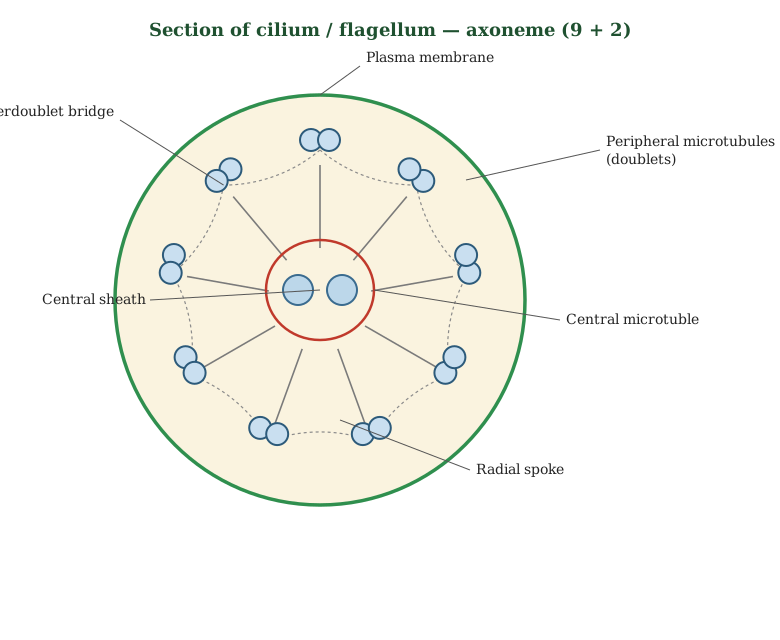
- KCET 2020Set A-11 markMCQQ.In the below diagram, identify the part which connects the peripheral microtubules to the central sheath.:
 (A) Plasma membrane
(B) Interdoublet bridge
(C) Central microtubule
(D) Radial spoke
(A) Plasma membrane
(B) Interdoublet bridge
(C) Central microtubule
(D) Radial spoke›Reveal solutionSolution
In the 9+2 axoneme, the link that runs inward from a peripheral doublet to the central sheath is the radial spoke; the interdoublet bridge runs sideways between adjacent doublets.
Step 1 — Read the parts of the axoneme.
A cilium/flagellum is a
9 + 2array enclosed by the plasma membrane:- 9 peripheral doublets — pairs of microtubules arranged in a ring.
- 2 central microtubules — the central pair, wrapped in a proteinaceous central sheath.
Step 2 — Distinguish the two kinds of cross-link (this is the whole question).
Link Runs from → to Function Interdoublet (nexin) bridge one peripheral doublet → the adjacent peripheral doublet holds the ring of nine together; converts dynein sliding into bending Radial spoke a peripheral doublet → the central sheath couples the outer ring to the central pair; regulates the beat The question asks specifically for the part that connects the peripheral microtubules to the central sheath — that is the radial spoke, and the figure labels exactly those inward-radiating lines as "Radial spoke".
Step 3 — Eliminate the others.
- (A) Plasma membrane — the outer boundary; it connects nothing internally.
- (B) Interdoublet bridge — connects doublet to doublet, i.e. peripheral to peripheral. This is the trap option.
- (C) Central microtubule — it is one of the things being connected, not the connector.
✓Final answerThe correct option is (D) Radial spoke — the spokes radiate from each peripheral doublet inward to the central sheath.
ANSWER: D
- KCET 2019Set A-11 markMCQQ.Which of these is not an advantages in Genetically modified crops? (A) Reduces the reliance on chemical pesticides. (B) Increases the post harvest losses (C) Increases efficiency of mineral usage in plants. (D) Enhances the nutritional value of food.
›Reveal solutionSolution
The question asks which option is not an advantage of genetically modified (GM) crops. The correct answer is (B) Increases the post harvest losses, because GM crops are designed to reduce such losses, not increase them.
The key here is to understand what "advantage" means in the context of genetically modified crops. An advantage is a benefit — something that improves farming, the environment, or human well-being. The question tests whether you can spot the one statement that describes a disadvantage or a false claim.
Let’s examine each option carefully.
-
Option (A): Reduces the reliance on chemical pesticides.
This is a well-known advantage. Many GM crops are engineered to be pest-resistant (e.g., Bt cotton produces a protein toxic to certain insects). This means farmers need to spray fewer chemical pesticides, which saves money and reduces environmental harm. So this is an advantage.
-
Option (B): Increases the post harvest losses.
"Post harvest losses" refer to the spoilage or damage of crops after they are harvested — during storage, transport, or handling. GM crops are often modified to have longer shelf life, resist bruising, or tolerate better storage conditions (e.g., Flavr Savr tomato). So they decrease post harvest losses, not increase them. This statement is the opposite of an advantage — it is a disadvantage. Therefore, this is the correct answer.
-
Option (C): Increases efficiency of mineral usage in plants.
Some GM crops are designed to use minerals (like nitrogen or phosphorus) more efficiently. This means they can grow well even in poorer soils, reducing the need for fertilizers. That is clearly an advantage — it lowers costs and environmental pollution.
-
Option (D): Enhances the nutritional value of food.
This is a classic advantage. For example, "Golden Rice" is genetically modified to produce beta-carotene (a source of vitamin A), helping to prevent blindness in malnourished populations. So this is an advantage.
Watch outA common mistake is to misread "increases" as a neutral word. Remember: "post harvest losses" are bad — increasing them is harmful, not beneficial. Always check whether the statement describes a positive or negative effect.
TipIn multiple-choice questions about advantages/disadvantages, first identify what each option actually does. If it sounds like a problem (e.g., "increases losses"), it is likely the odd one out.
✓Final answerThe correct option is (B).
-
- KCET 2018Set A-11 markMCQQ.During replication of retrovirus (A) Viral protein is introduced in the host cell. (B) Viral RNA is introduced into the host cell. (C) Viral DNA is introduced into the host cell. (D) Transcriptase enzyme is introduced into the host cell.
›Reveal solutionSolution
Retroviruses carry an RNA genome; the RNA enters the host and is reverse-transcribed into DNA inside the cell.
Step 1 — What defines a retrovirus.
A retrovirus is an RNA virus that reverses the usual flow of information: instead of DNA → RNA, it goes RNA → DNA, using the enzyme reverse transcriptase. HIV is the standard example.
Step 2 — The replication cycle (as in NCERT).
- The virus attaches to a host cell (in HIV, a helper T-lymphocyte / macrophage) and its envelope fuses with the cell membrane.
- The viral RNA genome enters the host cell. ← this is the step the question asks about
- Inside the cell, reverse transcriptase copies the viral RNA into complementary DNA (cDNA).
- That viral DNA is integrated into the host cell's DNA (as a provirus).
- The infected cell then transcribes and translates viral genes, producing new virus particles.
Step 3 — Eliminate the distractors.
- (A) Viral protein: capsid/envelope proteins are not what is delivered as the genome.
- (C) Viral DNA: the virus does not carry DNA — DNA is made inside the host from the RNA. This is the commonest error.
- (D) The reverse transcriptase enzyme is packaged within the virion along with the RNA; it is not what is "introduced" as the genetic material, and the option's loose phrasing ("transcriptase") does not describe the defining event.
Conclusion. What enters the host cell during retroviral replication is the viral RNA.
✓Final answerThe correct option is (B) — Viral RNA is introduced into the host cell.
ANSWER: B
🎓Unlock everything free for 14 days
- ✓Full step-by-step solutions
- ✓Concept-first explanations
- ✓Methods, shortcuts & mistakes
- ✓PYQ mapping + timed mock tests
Full access for 14 days. No credit card required.