Q.Refer to the given diagram and answer the questions that follow :
You're viewing a preview — the full solution, concept, methods & PYQ mapping are locked.
Start your 14-day free trial to unlock the full solution →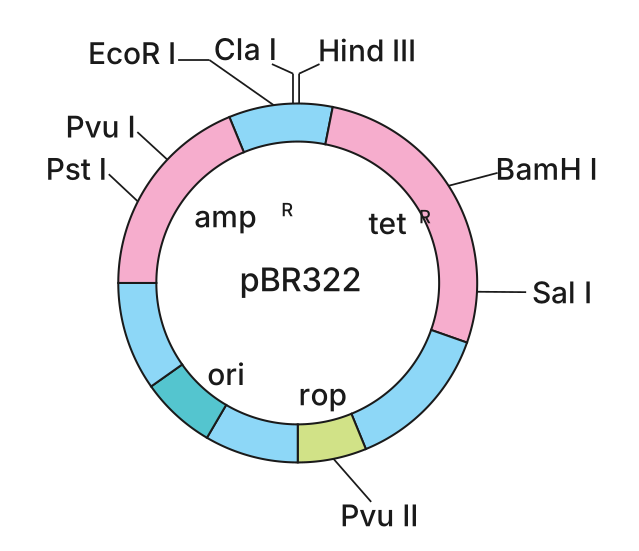
The diagram is the cloning vector pBR322: insertional inactivation uses restriction sites within a resistance gene (e.g. BamHI/SalI in tetR, PstI/PvuI in ampR); a single cloning site per enzyme is needed to linearise the vector cleanly; rop controls plasmid replication; and ori controls the copy number.
The given diagram is the widely-used E. coli cloning vector pBR322, which carries two antibiotic-resistance (selectable marker) genes — ampicillin resistance (ampR) and tetracycline resistance (tetR) — an origin of replication (ori), the rop gene, and several unique restriction sites.
a) Enzymes for insertional inactivation of selectable marker genes (2 marks):
"Insertional inactivation" means inserting foreign DNA into a restriction site that lies within an antibiotic-resistance gene, which destroys (inactivates) that gene and lets us select recombinants.
- Within the tetracycline-resistance (tetR) gene: recognition sites of BamHI and SalI (also HindIII). Inserting foreign DNA at BamHI or SalI inactivates tetracycline resistance, so recombinants become sensitive to tetracycline.
- Within the ampicillin-resistance (ampR) gene: recognition sites of PstI and PvuI (and ScaI). Insertion here inactivates ampicillin resistance.
b) Why the vector should have only one cloning (recognition) site for a given restriction enzyme (1 mark):
So that the restriction enzyme cuts the vector at a single point, producing a single linearised molecule with defined ends into which the foreign DNA can be ligated. If there were more than one site for the same enzyme, the enzyme would cut the vector into several fragments, complicating gene cloning and preventing formation of a single stable recombinant DNA molecule.
c) Significance of rop (1 mark):
rop codes for the proteins involved in the replication of the plasmid — i.e. it regulates plasmid replication (and thus helps control copy number). …
Unlock everything free for 14 days
- Full step-by-step solutions
- Concept-first explanations
- Methods, shortcuts & mistakes
- PYQ mapping + timed mock tests
Full access for 14 days. No credit card required.