Q.Sketch and label Miller's Experiment.
🔒You're viewing a preview — the full solution, concept, methods & PYQ mapping are locked.
🔒 Start your 14-day free trial to unlock the full solution →Concept understanding — Fossil Evidence Evolution
Imagine you find an old photograph of your great-grandparent. You can see what they looked like, what clothes they wore, how they stood. Now imagine a whole stack of such photographs, each one a little older, stretching back a hundred years. You could watch how hairstyles changed, how glasses got smaller, how people got taller. That stack of photographs is a record of change over time.
Fossil evidence works exactly like that, but on a scale of millions of years. A fossil is any preserved trace of a once-living organism — a bone, a tooth, a shell, an imprint of a leaf, or even a footprint. When scientists dig into the earth, they find these fossils arranged in layers of rock. The deeper you go, the older the fossil. This layered arrangement is called the fossil record.
The key idea is simple: the fossil record shows that life on Earth has changed over time. It is not a random collection of old bones. It is a historical document. You can see, for example, that in very old rocks, you find only simple, single-celled life. In slightly younger rocks, you find more complex creatures like fish. Then amphibians appear. Then reptiles. Then mammals. And finally, in the most recent layers, you find humans.
This sequence is not a guess. It is a physical, observable pattern found all over the world. If you dig in India, in South America, or in Europe, the same general order holds: simpler life forms appear in older rocks, and more complex ones appear in newer rocks. This is what the NCERT textbook calls the order of appearance of different forms of life.
Fossils are not just bones. They can be footprints, burrows, or even droppings (coprolites). Anything that gives a clue about an ancient organism counts as a fossil.
Why does this matter for evolution? Because evolution is, at its heart, the idea that species change over time and that all life shares common ancestors. The fossil record provides the most direct, physical proof of this change. It shows transitional forms — fossils that have features of two different groups, bridging the gap between them. The most famous example is Archaeopteryx, a fossil that has both dinosaur-like teeth and a long bony tail, and bird-like feathers and wings. It is a snapshot of the transition from reptiles to birds.
Here is what the fossil record tells us, in plain terms:
- Life was not always as it is today. The animals and plants you see now are not the same ones that existed millions of years ago.
- Older life forms are simpler. The earliest fossils are of bacteria and algae. Complex animals like mammals appear much later. …
In 1953 Stanley Miller (with Harold Urey) recreated the presumed conditions of the primitive Earth's atmosphere in a closed apparatus, passing electric sparks through a reducing gas mixture, and obtained simple organic molecules including amino acids — supporting chemical evolution. …
Stanley Miller (1953) sealed a mixture of CH₄, NH₃, H₂ and water vapour in a closed apparatus, passed electric discharge through it (simulating lightning over the primitive reducing atmosphere), and obtained amino acids and other simple organic molecules — evidence for the theory of chemical evolution (Oparin–Haldane).
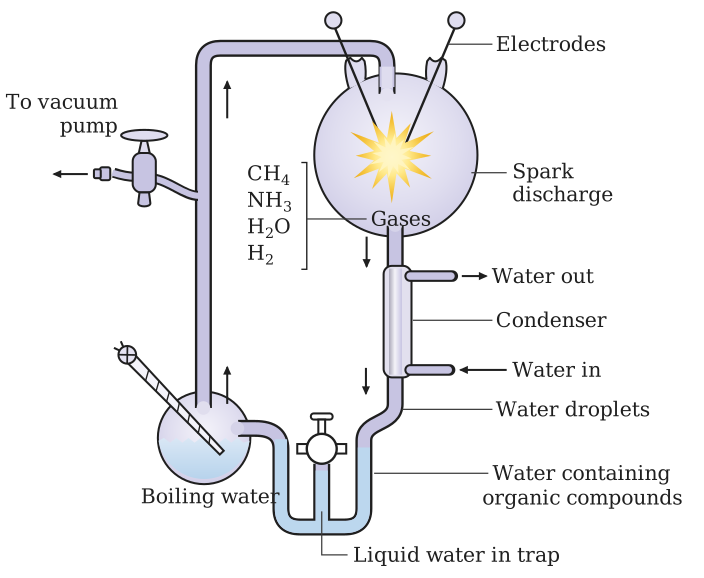
Concept. The Oparin–Haldane hypothesis proposed that life arose from non-living organic molecules formed on the early Earth under a reducing atmosphere with energy from lightning, UV and heat. Miller and Urey tested this experimentally.
Labelled parts of the apparatus (what to draw):
- Large flask — holds the 'primitive atmosphere' gas mixture: CH₄ (methane), NH₃ (ammonia), H₂ (hydrogen) and water vapour.
- Electrodes + spark source — two tungsten electrodes inside the large flask, producing an electric discharge at 800 °C to mimic lightning.
- Small flask with boiling water — represents the primitive 'ocean'; heating sends water vapour up to the large flask.
- Condenser (cooling jacket) — cools the reacted gases so they condense into liquid. …
Showing the 12 most recent of 20 on this concept.
- CBSE 2026Set V11 markMCQQ.Correct sequence of evolution of animal groups according to geological time scale is(a) Amphibians - Fishes - Reptiles - Mammals(b) Mammals - Fishes - Reptiles - Amphibians(c) Reptiles - Amphibians - Fishes - Mammals(d) Fishes - Amphibians - Reptiles - Mammals
›Reveal solutionSolution
Vertebrates appeared in the order fishes → amphibians → reptiles → mammals.
According to the geological time scale, jawed fishes appeared first, then amphibians (first to invade land), followed by reptiles (which dominated the Mesozoic), and finally mammals. T …
- CBSE 2026Set A1 markMCQQ.Fossils are found in which type of rocks?(a) Sedimentary rock(b) Metamorphic rock(c) Igneous rock(d) All of these
›Reveal solutionSolution
Fossils form in sedimentary rock because sediment buries and preserves remains layer by layer.
Sedimentary rocks are formed by the gradual deposition and compaction of sediments. Dead organisms and their hard parts get buried in these layers and are preserved as fossils over time; deeper layers are older, allowing relative dating. Igneous and met …
- CBSE 2026Set ZOOLOGY1 markMCQQ.What is the study of fossils called?(a) Organic evolution(b) Ornithology(c) Palaeontology(d) Herpetology
›Reveal solutionSolution
The scientific study of fossils is called Palaeontology.
Fossils are the preserved remains, impressions, or traces of organisms that lived in the geological past, usually found embedded in sedimentary rock layers. The scientific study of these fossils - their formation, age, and distribution in rock strata - is called Palaeontology. Fossil evidence (such as the age of rocks determined by radioactive dating, and the sequence in which simple to complex forms appear in successive strata) is one of the stronges …
- CBSE 2026Set ANNUAL1 markMCQQ.Probably how many million years ago evolution of jawless fish occurred in geological periods?(a) 500(b) 350(c) 320(d) 200
›Reveal solutionSolution
In the fossil evolutionary timeline, jawless (agnathan) fish appear roughly 350 million years ago, before jawed fish and amphibians evolved from fish stock.
The fossil record used to trace vertebrate evolution places simple jawless fish forms at around 350 million years ago; from fish with strong, stout fins, amphibians evolved (able to live on both land and water), and from early reptiles the other …
- CBSE 2025Set F1 markMCQQ.Which of the following is a living fossil?(a) Amphioxus(b) Varanus(c) Lamprey(d) Latimeria
›Reveal solutionSolution
Latimeria (coelacanth) is a living fossil.
A living fossil is a present-day organism that closely resembles ancient fossil forms and has changed little over long periods. Latimeria, the coelacanth, is a lobe-finned fish believed to be a connecting link between fishes and amphibians; it was thought to be extinct for millions of years until a living specimen was …
- CBSE 2025Set ANNUAL1 markMCQQ.Ginkgo biloba is known as a living fossil as it has changed very little over time. It is resistant to disease and pests, is tolerant of a wide range of environmental conditions and is the last standing member of its botanical family. It is the example of which of the following phenomena ?(a) Speciation(b) Fossilization(c) Adaptive radiation(d) Survival of the fittest
›Reveal solutionSolution
Traits like disease/pest resistance and environmental tolerance let Ginkgo persist while related lineages went extinct — the hallmark of survival of the fittest.
Ginkgo biloba is called a 'living fossil' because it closely resembles fossil forms from millions of years ago and is the only living member of its entire botanical family (Ginkgoaceae) — all its close relatives are extinct. The traits described (resistance to disease and pests, tolerance of a wide range of environmental conditions) are exactly the kind of favourable heritable traits that natural selection acts on: individuals/lineages carrying such traits are better able to survive changing conditions over long evolutionary time scales, while less well-adapted related lineages die out. This differs fr …
- CBSE 2025Set ZOOLOGY1 markMCQQ.Who proposed Recapitulation Theory?(i) von Baer(ii) Darwin(iii) Haeckel(iv) Aristotle
›Reveal solutionSolution
Ernst Haeckel proposed the Recapitulation (Biogenetic) Theory stating that ontogeny recapitulates phylogeny.
The Recapitulation Theory, also called the Biogenetic Law, states that the embryonic development (ontogeny) of an individual repeats or recapitulates the evolutionary history (phylogeny) of its race. It was proposed by the German biologist Ernst Haeckel, supported by the resemblance among vertebrate e …
- CBSE 2025Set ZOOLOGY1 markMCQQ.Which one of the following is not correctly matched?(i) Mesozoic Era — Age of mammals(ii) Palaeontology — Archaeopteryx(iii) Mutation Theory — Hugo de Vries(iv) Origin of Species — Charles Darwin
›Reveal solutionSolution
The Mesozoic Era is the Age of Reptiles, so pairing it with 'Age of mammals' is incorrect; the other three pairs are correct.
Checking each pair:
- (i) Mesozoic Era — Age of mammals → WRONG. The Mesozoic Era is the Age of Reptiles (dinosaurs dominated). The Age of Mammals is the Cenozoic Era.
- (ii) Palaeontology — Archaeopteryx → correct (Archaeopteryx, a fossil connecting-link between reptiles and birds, is studied in palaeontology, the study of fossils). …
- CBSE 2024Set E1 markMCQQ.Paleontological evidence is based on the study of(a) embryological development(b) comparative anatomy(c) fossils(d) divergent evolution
›Reveal solutionSolution
Paleontology is the study of fossils, so paleontological evidence for evolution comes from fossils.
Fossils are the preserved remains or impressions of past organisms found in sedimentary rock layers. Their study (paleontology) shows the sequence in which different life forms appeared, the geological ages of rocks in which they occur, and provides direct evidence of evolution and the existence of extinct forms and transitional ( …
- CBSE 2024Set ANNUAL1 markMCQQ.Archaeopteryx is the missing link between(a) man and apes(b) birds and mammals(c) amphibians and reptiles(d) reptiles and birds
›Reveal solutionSolution
Archaeopteryx, with both reptilian and avian characteristics, is a classic example of a transitional fossil linking reptiles and birds.
Archaeopteryx is an extinct, fossil organism that displays a mixture of reptilian features (such as teeth in the jaws, clawed fingers, and a long bony tail) and avian (bird-like) features (such as feathers and wings), making it a key piece of fossil evidence for the evolutionary connection b …
- CBSE 2023Set ANNUAL1 markMCQQ.In which era did the first mammal appear?(a) Permian(b) Triassic(c) Tertiary(d) none of these
›Reveal solutionSolution
The first mammals appeared in the Triassic period.
On the geological time scale, the earliest small, shrew-like mammals evolved from mammal-like reptiles (therapsids) near the end of the Triassic period, roughly 200 million years ago, during the time dinosaurs were beginning to dominate. Mammals remained small and diversified greatly on …
- CBSE 2022Set ANNUAL1 markMCQQ.By which method is the age of human evolution measured?(a) by ultraviolet radiation(b) by carbon dating(c) by chemical reaction(d) by radioactive dating
›Reveal solutionSolution
Human-evolution fossil ages are measured by carbon (C-14) dating, so the answer is (B).
The age of fossils is estimated by radiometric methods that use the constant decay rate of radioactive isotopes. For relatively recent organic remains — such as those in the timeline of human evolution — carbon dating, based on the decay of radioactive carbon-14 (half-life about 5730 years), is the standard technique.
…
🎓Unlock everything free for 14 days
- ✓Full step-by-step solutions
- ✓Concept-first explanations
- ✓Methods, shortcuts & mistakes
- ✓PYQ mapping + timed mock tests
Full access for 14 days. No credit card required.