Q.Refer to the schematic representation of DNA fingerprinting thoroughly and answer the given questions :
🔒You're viewing a preview — the full solution, concept, methods & PYQ mapping are locked.
🔒 Start your 14-day free trial to unlock the full solution →Concept understanding — DNA Fingerprinting
DNA Fingerprinting: A Beginner's Guide
Imagine you have a unique signature — not your name, not your face, but something written in every cell of your body. That is your DNA. And just like a fingerprint on your fingertip, this DNA signature is different for every person (except identical twins). DNA fingerprinting is the technique that reads that signature.
The Everyday Intuition
Think of a barcode on a product. Every product has a unique pattern of black lines. A scanner reads that pattern to identify exactly which product it is. Your DNA works the same way — it is a long, coiled molecule inside your cells, and certain regions of it have repeating patterns that vary from person to person. DNA fingerprinting scans those repeating patterns and creates a "barcode" unique to you.
What the NCERT Textbook Says
The NCERT Class 12 Biology textbook defines DNA fingerprinting as a technique used to identify the differences in the DNA sequences of individuals. It focuses on Variable Number Tandem Repeats (VNTRs) — short, repeating sequences of DNA that are scattered throughout our genome. The number of repeats at a particular location varies greatly between people. Two unrelated individuals are extremely unlikely to have the same number of repeats at the same locations.
DNA fingerprinting does not read your entire DNA sequence. It only looks at a few specific spots where the repeats vary a lot between people. This makes it fast and practical.
How It Works (Simplified)
The process has a few key steps, but you don't need to memorise every chemical name. Focus on the logic:
- Extract DNA from a sample — blood, hair, saliva, or even a tiny skin cell.
- Cut the DNA at specific points using special enzymes (called restriction enzymes). This chops the long DNA into fragments of different lengths.
- Separate the fragments by size using a technique called gel electrophoresis. Smaller fragments move faster through a gel, so they end up farther from the starting point.
- Transfer the fragments onto a nylon membrane (Southern blotting).
- Probe the membrane with a radioactive or fluorescent probe that sticks only to the VNTR regions. This reveals a pattern of bands — like a barcode.
- Compare the patterns between samples.
Why It Matters
DNA fingerprinting is not just a lab curiosity. It has real-world applications that you will encounter in exams and in life:
- Forensic science: Matching crime scene evidence (blood, hair, semen) to a suspect. This is what you see in crime shows — but it is real.
- Paternity testing: A child's DNA fingerprint is a mix of the mother's and father's. By comparing bands, you can determine biological parenthood with near-certainty.
- Identifying victims: After disasters (earthquakes, plane crashes), DNA fingerprinting helps identify bodies when other methods fail.
- Studying evolution: Comparing DNA fingerprints of different species reveals how closely related they are.
DNA fingerprinting is not the same as DNA sequencing. Sequencing reads the entire order of bases (A, T, G, C). Fingerprinting only looks at the pattern of fragment lengths. It is faster and cheaper, but gives less detailed information.
A Common Misunderstanding …
In DNA fingerprinting the number of short tandem repeats (STRs) at a locus is read as repeat-boxes on each chromosome, and after amplification these appear as size-separated bands on a gel; matching band patterns is how a crime-scene sample is traced to a person. The counts below are read off the given schematic. …
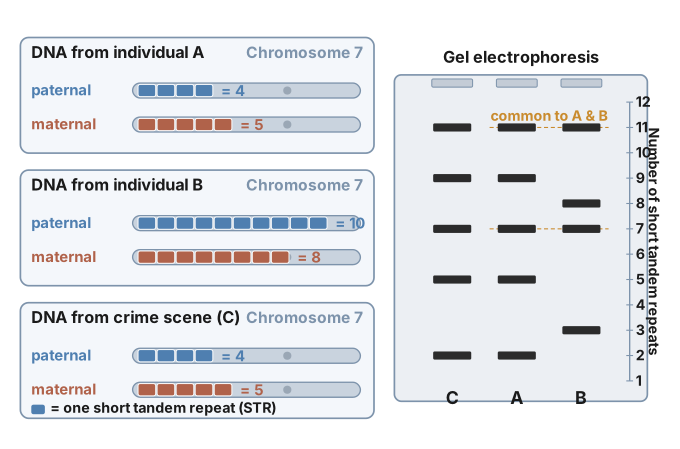
STRs are counted as the shaded repeat-boxes on each chromosome and, after PCR amplification, as bands separated by size on the gel (band height on the 1–12 scale = number of repeats). Reading the schematic: individual A's Chromosome 7 carries about 4 (paternal) and 5 (maternal) repeats and individual B about 10 and 8; on the gel A gives ~5 bands and B ~4, sharing ~2 bands; the crime-scene lane C matches individual A.
a) STRs on Chromosome 7. The number of STRs is the number of shaded repeat-boxes on each homologue. Best reading of the Chromosome-7 pair – Individual A: paternal ≈ 4 repeats, maternal ≈ 5 repeats. Individual B: paternal ≈ 10 repeats, maternal ≈ 8 repeats. (These are read from the shaded boxes on a low-resolution scan; individual B's bars are longer/more heavily shaded than individual A's, so B carries more repeats at this locus.)
b) STRs separated on the gel. Each amplified STR fragment runs as one band, its position on the 1–12 scale giving its repeat number. Counting the bands: individual A (lane A) ≈ 5 bands, individual B (lane B) ≈ 4 bands – i.e. that many distinct STR fragments are resolved for each person. …
Showing the 12 most recent of 18 on this concept.
- CBSE 2026Set 57/2/11 markMCQQ.To separate repetitive DNA from bulk genomic DNA, which of the following method is used ? (A) Elution (B) Southern Blotting (C) Polymerase Chain Reaction (D) Density Gradient Centrifugation
›Reveal solutionSolution
Density gradient centrifugation is the method used to separate repetitive DNA from bulk genomic DNA based on differences in buoyant density.
To understand why density gradient centrifugation is the correct choice, we need to step back and think about what repetitive DNA actually is and how it differs from the rest of the genome. In eukaryotic cells, a large portion of the DNA consists of sequences that are repeated many times — these are called repetitive DNA. They can be highly repetitive (like satellite DNA) or moderately repetitive. The rest is unique or "bulk" genomic DNA, which contains most of the genes.
The key physical property that distinguishes repetitive DNA from bulk DNA is its base composition. Repetitive sequences, especially satellite DNA, often have a different ratio of guanine-cytosine (GC) to adenine-thymine (AT) pairs compared to the rest of the genome. This difference in base composition leads to a difference in buoyant density — GC-rich DNA is denser than AT-rich DNA.
Now, density gradient centrifugation exploits exactly this property. In this technique, genomic DNA is placed in a solution of a dense substance like cesium chloride (CsCl) and spun at very high speeds in an ultracentrifuge. Over time, the CsCl forms a gradient of increasing density from top to bottom. The DNA molecules migrate to the position in the gradient where their own density matches that of the CsCl solution. Because repetitive DNA has a different density from bulk DNA, it forms a separate band — often called a "satellite band" — distinct from the main band of bulk DNA. This is why such repetitive DNA is also called satellite DNA.
NoteThe term "satellite DNA" comes directly from this technique — the extra band appears as a "satellite" next to the main DNA band in the centrifuge tube.
Let us briefly examine why the other options are not suitable for this purpose:
- Elution is a general term for washing or extracting a substance from a solid support, often used in chromatography. It does not separate DNA based on density or sequence repetition. …
- CBSE 2026Set 57/2/11 markMCQQ.Which of the following is used to visualize DNA bands under UV light after gel electrophoresis ? (A) Acetocarmine (B) Safranine (C) Ethidium Bromide (D) Potassium Iodide
›Reveal solutionSolution
Ethidium bromide is the fluorescent dye used to visualize DNA bands under UV light after gel electrophoresis, as it intercalates between DNA base pairs and fluoresces orange when exposed to ultraviolet radiation.
DNA fingerprinting and recombinant DNA technology rely on a fundamental technique called gel electrophoresis to separate DNA fragments by size. The process itself is elegant: DNA molecules, being negatively charged because of their phosphate backbone, migrate through an agarose gel matrix when an electric field is applied. Smaller fragments move faster and travel farther than larger ones, creating a pattern of separated bands along the gel.
But here's the challenge — DNA is invisible to the naked eye. Even after successful separation, you're staring at a clear gel with nothing to see. The fragments are there, sorted by size, but completely transparent. This is where visualization becomes critical.
Ethidium bromide solves this problem through a clever chemical property. It's a planar molecule that slips between the stacked base pairs of the DNA double helix, a process called intercalation. Once nestled between those bases, ethidium bromide undergoes a dramatic change when exposed to ultraviolet light: it fluoresces bright orange. The more DNA present in a band, the more ethidium bromide molecules bind, and the brighter that band glows under UV illumination.
The standard protocol involves either mixing ethidium bromide into the agarose gel before it sets, or soaking the gel in an ethidium bromide solution after electrophoresis is complete. When you place the gel on a UV transilluminator, the DNA bands light up as glowing orange stripes against a dark background, allowing you to photograph and analyze the banding pattern. …
- CBSE 2026Set 57/3/11 markMCQQ.Assertion (A) : Repetitive sequences are stretches of DNA sequences that are thought to have no direct coding functions. Reason (R) : They shed light on chromosome structure, dynamics and evolution.
›Reveal solutionSolution
Repetitive DNA sequences do not code for proteins, but they are far from useless — they provide crucial insights into how chromosomes are organised, how they behave during cell division, and how genomes evolve over time.
The assertion in this question touches on a fascinating and often misunderstood part of our genome. When we think of DNA, we usually picture genes — those stretches that carry instructions for making proteins. But a very large portion of the DNA in any eukaryotic cell, including our own, does not code for any protein at all. Among this non-coding DNA, a significant chunk consists of repetitive sequences.
These are exactly what they sound like: short stretches of nucleotides (the building blocks of DNA) that are repeated over and over again, sometimes hundreds or thousands of times. The NCERT textbook explains that these sequences do not have any direct, known coding function — meaning they are not transcribed into messenger RNA and then translated into a protein. So the assertion (A) is perfectly correct.
But here is where it gets interesting. Just because these sequences don't code for proteins does not mean they are "junk" or useless. The reason (R) points to their real importance: they shed light on chromosome structure, dynamics, and evolution.
Think of repetitive sequences as the "scaffolding" or "packaging" of the genome. They are found in large concentrations at certain key regions of chromosomes — for example, at the centromeres (the pinched-in middle part of a chromosome that helps in its movement during cell division) and at the telomeres (the protective caps at the ends of chromosomes). Without these repetitive sequences, chromosomes would be unstable, would not segregate properly during cell division, and would fray at the ends.
NoteThe NCERT textbook specifically mentions that repetitive sequences are used in DNA fingerprinting. Because the number of repeats varies greatly between individuals, these sequences act like a genetic barcode — unique to each person.
The reason (R) is therefore also correct. By studying how these repetitive sequences are arranged, how many copies exist, and how they change over time, scientists can understand:
- How chromosomes fold and pack inside the nucleus
- How chromosomes pair up and exchange segments during meiosis
- How genomes have expanded or contracted over evolutionary time …
- CBSE 2026Set ANNUAL1 markMCQQ.The technique of DNA fingerprinting is based on the principle of(a) Similarities in DNA sequences(b) Differences in DNA sequences(c) Polymorphism in DNA sequences(d) Differences in proteins
›Reveal solutionSolution
DNA fingerprinting detects differences (polymorphisms) in repetitive DNA sequences that are unique to each individual, allowing identification.
DNA fingerprinting, developed by Alec Jeffreys, is based on polymorphism — variability — in DNA sequences, specifically in repetitive DNA regions such as satellite DNA (VNTRs, variable number of tandem repeats). These repeat sequences vary hugely in copy number between individuals (except identical twins), even though the surrounding gene sequences may be very similar. A probe complementary to these hypervariable regions, combined with techniques like Southern hybridisation and gel electrophoresis, reveals a pattern of bands uniqu …
- CBSE 2026Set ANNUAL1 markQ.Give the name of key factor in DNA profiling.
›Reveal solutionSolution
VNTRs (variable-number tandem-repeat sequences) are the polymorphic DNA regions that give each person a unique DNA fingerprint.
DNA profiling (DNA fingerprinting), developed by Alec Jeffreys, is based on the analysis of highly polymorphic (variable) repetitive DNA sequences called VNTRs (Variable Number of Tandem Repeats), also known as minisatellite DNA. These sequences consist of a short core nucleotide sequence repeated a variable number of times in tandem at specific loci, and the number of repeats differs greatly from person to person (except identical twins). Because this variability is inherited and highly individual-specific, comparing the pattern of VNTR-containing restriction fragments (obtained via restriction digestion, gel electrophoresis, Southern blotting and hybridization with a labelled probe) between individuals generates a distinctive banding …
- CBSE 2024Set D1 markQ.Fill in the blank: DNA finger printing involves identifying differences in some specific regions in DNA sequence called as ______.
›Reveal solutionSolution
DNA fingerprinting identifies differences between individuals based on the variable number of repeats of specific short DNA sequences, called VNTRs (Variable Number of Tandem Repeats) or satellite DNA.
Besides the coding, single-copy genes, the genome contains large stretches of repetitive DNA in which a short sequence is repeated many times, forming satellite DNA. These repetitive sequences can be separated from the bulk of genomic DNA as distinct peaks (satellite peaks) during density-gradient centrifugation, and are further classified as satellite, minisatellite, and microsatellite DNA based on base-pair length and number of repetitions.
…
- CBSE 2024Set ANNUAL1 markMCQQ.The technique of DNA fingerprinting was initially developed by(a) G. J. Mendel(b) Alec Jeffreys(c) Francois Jacob(d) Jacques Monod
›Reveal solutionSolution
DNA fingerprinting, which identifies differences in repetitive (satellite) DNA sequences between individuals, was developed by the British geneticist Alec Jeffreys.
DNA fingerprinting exploits variable number tandem repeats (VNTRs) in satellite DNA, which differ in copy number from person to person (except identical twins), to generate an individual-specific DNA profile. It was developed by Alec Jeffreys in 1984 and, in India, further refined for forensic use by Dr. Lalji Singh's group at the CCMB, Hyderaba …
- CBSE 2023Set 57/1/11 markMCQQ.Study the DNA profiles obtained as a result of DNA fingerprinting of a child 'X' and three individuals 1, 2 and 3. Which one of the following options shows the possible parents of the child 'X' ?(a) 1 and 2(b) 2 and 3(c) 1 and 3(d) Only individual 3
›Reveal solutionSolution
DNA fingerprinting works because a child inherits exactly half their DNA bands from each biological parent. Reading the real gel image, the correct parent pair is whichever two individuals' bands together account for every one of child X's bands.
DNA fingerprinting works on a simple principle: every person's DNA profile is a unique combination of bands, and a child receives exactly 50% of these bands from the mother and 50% from the father. Every single band visible in a child's lane must therefore be traceable to either one parent or the other.
The key insight: if you line up the child's bands against potential parents, the true biological parents will together account for all of the child's bands, with no band left unexplained. A band in the child that appears in neither of two proposed parents rules out that pairing immediately.
Here is how to work through it systematically, using the real gel image:
- Identify every band in child X's profile. Note the position of each band in the child's lane — these are the markers the child must have inherited from someone.
- Check each band against individual 1. For every band in X, see whether it also appears in individual 1's lane.
- Check the remaining bands against individual 2. Take the bands in X that did not match individual 1, and see whether individual 2's lane accounts for them. If so, (1, 2) could be the parent pair.
- Repeat for the pairing (2, 3) and then (1, 3) — for each, check whether the two lanes together explain every band in X. …
- CBSE 2023Set 57/3/11 markMCQQ.DNA profiles of the child and three individuals 1, 2 and 3 who claim to be the parents of the child are given below. Select the option that shows the correct actual parent/parents of the child. [Figure: DNA profile gel showing bands for Child X, Individual 1, Individual 2, Individual 3](a) Individual 1 and 3(b) Individual 1 and 2(c) Individual 2 and 3(d) Individual 1 is the only parent of the child amongst 1, 2 and 3
›Reveal solutionSolution
A child inherits exactly one allele per locus from each biological parent, so every band in the child's DNA profile must match a band in one parent or the other. Find which pair of individuals' combined bands account for all of the child's bands — that pair are the true parents.
Why DNA profiling reveals parentage
DNA profiling (typically using STR markers — short tandem repeats) produces a banding pattern where each band represents an allele at a particular genetic locus. Because we inherit one chromosome from each parent, every band in a child's profile must come from either the mother or the father.
The logic is simple: scan each band in the child's lane. If a band appears in the child, at least one parent must also show that band. If a supposed parent pair leaves some of the child's bands unaccounted for by either individual, they cannot be the biological parents. The true parents, together, will account for every single band in the child.
Step-by-step matching method
- List the child's bands. Note every visible band in Child X's lane (count from top to bottom, or note their positions).
- Check Individual 1. Which of the child's bands appear in Individual 1? Mark those as "explained by 1."
- Check Individual 2. Which of the child's bands appear in Individual 2? Mark those as "explained by 2."
- Check Individual 3. Which of the child's bands appear in Individual 3? Mark those as "explained by 3."
- Test each pair against the four options:
- (a) 1 and 3 — do their combined bands cover every band in the child, with none left over?
- (b) 1 and 2 — same test.
- (c) 2 and 3 — same test.
- (d) 1 alone — can Individual 1 account for every band by themself? (Only plausible if the child were a clone/parthenogenetic offspring — biologically implausible in normal human reproduction.)
- Eliminate mismatches. Any combination that leaves even one child band unaccounted for is ruled out. Any combination that requires a band not present in either proposed parent is also ruled out.
TipIn a typical gel, look for unique bands in the child — bands that appear in only one of the three individuals. Those unique bands immediately tell you that individual must be a parent. …
- CBSE 2023Set ANNUAL1 markMCQQ.Satellite DNA is a useful tool of(a) sex determination(b) organ culture(c) forensic science(d) tissue culture
›Reveal solutionSolution
Satellite DNA underlies DNA fingerprinting, used in forensic science.
Satellite DNA is made up of short base sequences repeated many times (repetitive DNA), including minisatellites and microsatellites (VNTRs). The number of repeats varies greatly from person to person, so the pattern is essentially individual-specific (except identical twins). This polymorphism is exploited in …
- CBSE 2022Set HE2201 markMCQQ.Choose the correct answer: The first scientist who developed DNA fingerprint -(a) Wilkins(b) Eyan Willmoott(c) Alex Jeffrey(d) Kary Mullis
›Reveal solutionSolution
Alec Jeffreys developed DNA fingerprinting in 1984 by exploiting highly variable repetitive DNA regions unique to each individual.
In 1984, British geneticist Sir Alec Jeffreys at the University of Leicester developed the technique of DNA fingerprinting, which detects variation (polymorphism) in the number of repetitive DNA sequences (VNTRs/minisatellites) that differ between individuals but are inherited from parents, allowing identification of a person and establishment of parentage. This forms the basis of DNA profiling used today in forensic science, paternity testing, and identi …
- CBSE 2022Set ANNUAL1 markQ.If an inheritable mutation is observed in population at high frequency, it is called DNA ______.
›Reveal solutionSolution
An inheritable mutation present at high frequency in a population is called DNA polymorphism.
When a variation (mutation) at a DNA locus is inherited and is found in a population with a frequency greater than 0.01 (1%), it is called DNA polymorphism. Such variations, especially in non-coding regions, arise and accumula …
🎓Unlock everything free for 14 days
- ✓Full step-by-step solutions
- ✓Concept-first explanations
- ✓Methods, shortcuts & mistakes
- ✓PYQ mapping + timed mock tests
Full access for 14 days. No credit card required.