Q.Define and design a test-cross.
You're viewing a preview — the full solution, concept, methods & PYQ mapping are locked.
Start your 14-day free trial to unlock the full solution →A test cross is a genetic experiment designed to determine the genotype of an individual exhibiting a dominant phenotype by crossing it with a homozygous recessive individual.
Gregor Mendel's pioneering work with pea plants laid the foundation for our understanding of inheritance. He observed that certain traits, like tallness in pea plants, were dominant, meaning they would express themselves even if only one copy of the responsible genetic factor (allele) was present. Other traits, like dwarfness, were recessive, appearing only when two copies of the recessive allele were present. This distinction between observable characteristics (phenotype) and the underlying genetic makeup (genotype) is crucial.
For instance, a pea plant that is tall could have one of two possible genotypes: it could be homozygous dominant (carrying two alleles for tallness) or heterozygous (carrying one allele for tallness and one for dwarfness). Both genotypes result in the same tall phenotype because tallness is dominant over dwarfness. However, knowing the exact genotype is often vital for genetic studies, breeding programs, or understanding inheritance patterns. Since we cannot determine the genotype simply by looking at the plant, a specific genetic cross is needed, and this is precisely where the test cross comes into play.
A test cross is defined as a cross between an individual with an unknown genotype (but expressing a dominant phenotype) and a homozygous recessive individual for the same trait. The primary purpose of this cross is to ascertain whether the unknown individual is homozygous dominant or heterozygous.
The individual chosen for the cross must always be homozygous recessive because this genotype can only contribute recessive alleles to the offspring, allowing the alleles from the unknown parent to be fully expressed and observed in the next generation.
To design a test cross, consider an example using pea plant height:
- Identify the unknown individual: We have a tall pea plant, but we don't know if its genotype is homozygous dominant (let's denote it as TT) or heterozygous (Tt).
- Select the test parent: We must cross this unknown tall plant with a dwarf pea plant. A dwarf pea plant has only one possible genotype: homozygous recessive (tt). This is our test parent.
- Perform the cross and observe offspring: The offspring resulting from this cross (the F1 generation) will reveal the genotype of the unknown tall parent.
There are two possible outcomes for the offspring, depending on the genotype of the unknown tall parent:
- Scenario 1: If the unknown tall plant is homozygous dominant (TT).
- When a homozygous dominant tall plant (TT) is crossed with a homozygous recessive dwarf plant (tt), all the offspring will inherit one 'T' allele from the tall parent and one 't' allele from the dwarf parent.
- Consequently, all offspring will have the genotype Tt, and since 'T' (tallness) is dominant, all the offspring will be tall. …
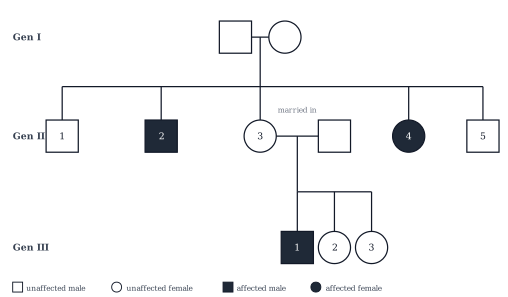 (A) Autosomal recessive
(B) Sex-linked document
(C) Sex-linked recessive
(D) Autosomal dominant
(A) Autosomal recessive
(B) Sex-linked document
(C) Sex-linked recessive
(D) Autosomal dominantUnlock everything free for 14 days
- Full step-by-step solutions
- Concept-first explanations
- Methods, shortcuts & mistakes
- PYQ mapping + timed mock tests
Full access for 14 days. No credit card required.