Q.Give the major products that are formed by heating each of the following ethers with HI.
🔒You're viewing a preview — the full solution, concept, methods & PYQ mapping are locked.
🔒 Start your 14-day free trial to unlock the full solution →Concept understanding — Williamson Ether Synthesis
Williamson Ether Synthesis: From Intuition to Mechanism
Imagine you want to build a simple bridge between two carbon chains — an oxygen atom linking them together. That bridge is an ether (R−O−R′). The Williamson ether synthesis is the most reliable way to build that bridge in a lab.
The Core Idea
You have two pieces: an alkoxide ion (RO−) and an alkyl halide (R′X). The alkoxide is a strong nucleophile — it loves positive charge. The alkyl halide has a carbon attached to a halogen (like Cl, Br, I) that is slightly positive because the halogen pulls electrons away.
When you mix them, the alkoxide attacks that slightly positive carbon, kicks out the halide ion, and forms a new C−O bond. The result? An ether.
R−O−+R′−X⟶R−O−R′+X−
That's the entire reaction in one line. But the devil is in the details — especially which alkyl halide you choose.
The Mechanism (SN2)
This is a classic SN2 reaction — one step, no intermediates. The alkoxide approaches the carbon from the opposite side of the halogen. As the C−O bond forms, the C−X bond breaks. The halide leaves as a stable anion.
Because it's SN2, the reaction is sensitive to steric hindrance. The carbon being attacked must be accessible.
If the alkyl halide is tertiary (3°), the reaction will not work via SN2. The bulky carbon blocks the backside attack. Instead, the alkoxide will act as a base and cause elimination (forming an alkene). You'll get no ether.
The Practical Rule
| Alkyl halide | Works? | Why |
|---|---|---|
| Methyl (CH3X) | Yes | Least hindered, fastest SN2 |
| Primary (1°) | Yes | Clean SN2 |
| Secondary (2°) | Sometimes | Works if not too bulky; elimination competes |
| Tertiary (3°) | No | Elimination dominates |
| Aryl (e.g., bromobenzene) | No | SN2 impossible on sp2 carbon |
To make an ether like R−O−R′, always use the less hindered alkyl halide and the more hindered alkoxide. For example, to make CH3CH2−O−CH(CH3)2, use CH3CH2O− (primary alkoxide) + (CH3)2CHBr (secondary halide) — not the other way around.
How to Choose the Alkoxide
You can't just buy alkoxide ions in a bottle. You make them by reacting an alcohol with a strong base like sodium hydride (NaH) or sodium metal.
ROH+NaH⟶RO−Na++H2
The alkoxide is then used immediately with the alkyl halide.
A Common Exam Trap …
Why this formula?
Williamson Ether Synthesis: Why the Key Principles Hold
The Williamson Ether Synthesis is a classic method to prepare ethers. The core reaction is:
R-O−+R’-X→R-O-R’+X−
Where:
- R-O− is an alkoxide ion (strong nucleophile)
- R’-X is an alkyl halide (electrophile)
- X− is a halide ion (leaving group)
Let's break down why this works — the reasoning behind the key principles.
1. Why an Alkoxide (Not an Alcohol) is Needed
The Problem with Alcohols
Alcohols (R-OH) are weak nucleophiles. The oxygen has a partial negative charge, but the O–H bond is strong. If you mix an alcohol with an alkyl halide, the reaction is extremely slow or doesn't happen at all.
The Solution: Deprotonation
By treating the alcohol with a strong base (like NaH, Na, or KOH), you remove the proton:
R-OH+NaH→R-O−Na++H2
The alkoxide ion (R-O−) has a full negative charge on oxygen. This makes it:
- A much stronger nucleophile (higher electron density)
- More reactive toward the electrophilic carbon in the alkyl halide
Key takeaway: The alkoxide's full negative charge is what drives the reaction — it's not just about having oxygen, but about having a charged, electron-rich oxygen.
2. Why the Alkyl Halide Must Be Primary (or Methyl)
The Mechanism: SN2 is the Only Path
The Williamson synthesis proceeds exclusively via an SN2 mechanism (bimolecular nucleophilic substitution). This means:
- The nucleophile attacks the carbon from the backside
- The leaving group departs from the opposite side
- The reaction is concerted (one step, no intermediates)
Why Primary Halides Work Best
In SN2 reactions, the rate depends on steric hindrance:
| Alkyl Halide Type | Steric Hindrance | SN2 Reactivity |
|---|---|---|
| Methyl (CH3X) | Minimal | Very fast |
| Primary (RCH2X) | Low | Fast |
| Secondary (R2CHX) | Moderate | Slow |
| Tertiary (R3CX) | High | Does not occur |
Why Tertiary Halides Fail
With a tertiary halide, the bulky alkyl groups block the backside attack. Instead, the alkoxide (a strong base) will eliminate a proton from the halide, forming an alkene:
R-O−+R’3C-X→R-OH+alkene+X−
This is an E2 elimination — not the desired ether formation.
Key takeaway: The Williamson synthesis works only when the alkyl halide is primary or methyl because SN2 requires an unhindered backside.
3. Why the Leaving Group Must Be Good
The Role of the Halide
The halide (X−) must be a good leaving group — meaning it can stabilize the negative charge after departure.
| Halide | Leaving Group Ability | Reason |
|---|---|---|
| I− | Excellent | Large, polarizable, weak base |
| Br− | Good | Moderate size, weak base |
| Cl− | Fair | Smaller, stronger base |
| F− | Poor | Small, strong base, holds tightly |
Why Fluoride Fails
Fluoride is a strong base and a poor leaving group. The C–F bond is very strong, and F− does not depart easily. So alkyl fluorides are unreactive in Williamson synthesis.
Key takeaway: The leaving group must be weakly basic and polarizable — iodide and bromide are ideal.
--- …
The key idea is that HI cleaves ethers: when both alkyl groups are primary/methyl, I− attacks the less hindered carbon (SN2); a tertiary or benzylic side instead forms a stable carbocation (SN1) and takes the iodine directly, while the oxygen leaves with the other side as the alcohol.
(i) CH3−CH2−CH(CH3)−CH2−O−CH2−CH3
The less hindered side is the ethyl group (−CH2CH3). SN2 attack by IX− gives ethyl iodide and 2-methylbutan-1-ol. The alcohol does not react further (primary alcohol).
(ii) CH3−CH2−CH2−O−C(CH3)2−CH2CH3
The carbon on the right of the oxygen is tertiary, so cleavage follows SN1: the tertiary carbocation forms and captures I−, giving 2-iodo-2-methylbutane, while the oxygen leaves with the propyl group as propan-1-ol. Being primary, propan-1-ol reacts only sluggishly with HI and is isolated as the alcohol.
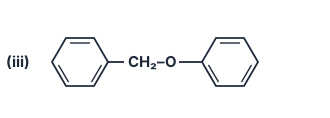
(iii) C6H5−CH2−O−C6H5 …
The key idea is that under acidic cleavage with HI, the C–O bond breaks at the less substituted carbon (via SN2) when possible, but for tertiary/benzylic groups the more substituted carbon gets the iodine (via SN1). A tertiary or benzylic alcohol byproduct reacts readily with further HI to give a second alkyl iodide, but a primary alcohol byproduct reacts much more slowly and is normally isolated as the alcohol itself.
Concept & Intuition
Heating an ether with concentrated HI is the classic acidic cleavage reaction. The mechanism is a two-step nucleophilic substitution: first the ether oxygen is protonated by HI, making it a good leaving group (as a neutral alcohol molecule). Then the iodide ion (I−) attacks one of the carbon atoms adjacent to the oxygen.
The critical decision is which C–O bond breaks. This depends entirely on the structure of the alkyl groups attached to the oxygen.
- If both groups are primary or methyl, the reaction follows SN2: the iodide attacks the less hindered (less substituted) carbon.
- If one group is tertiary, benzylic, or allylic, that carbon can form a relatively stable carbocation, so the reaction follows SN1: the C–O bond breaks to give that carbocation, which is then trapped by iodide. In this case, the more substituted (or resonance-stabilised) carbon gets the iodine.
Common Mistake
Students often assume the larger alkyl group always gets the iodine. That is wrong — it is the less substituted carbon in SN2 and the more substituted carbon in SN1. Always check the substitution pattern first.
(i) CH3−CH2−CH(CH3)−CH2−O−CH2−CH3
Step 1: Identify the alkyl groups.
The ether is:
Left side: CH3−CH2−CH(CH3)−CH2− — this is a primary carbon (the carbon directly attached to oxygen is a CH2 group, even though the chain has a branch further away).
Right side: CH3−CH2− — this is also primary (ethyl group).
Step 2: Decide the mechanism.
Both groups are primary. No tertiary, benzylic, or allylic carbons. So the reaction proceeds via SN2.
Step 3: Which bond breaks?
In SN2, the iodide attacks the less hindered primary carbon. The right-side ethyl carbon is less hindered than the left-side carbon (which has a branched chain nearby), so the iodide attacks the ethyl carbon, breaking the CH3CH2–O bond.
Step 4: Write the products.
The oxygen stays with the more substituted fragment (the branched chain) as an alcohol, and the ethyl group leaves as ethyl iodide.
CH3CH2CH(CH3)CH2–O–CH2CH3+HI→CH3CH2CH(CH3)CH2OH+CH3CH2I
The resulting alcohol, 2-methylbutan-1-ol, is primary — primary alcohols react only slowly with HI (the substitution is comparatively sluggish), so under the conditions that cleave the ether it is normally isolated as the free alcohol rather than being converted on to a second iodide.
Final products:
CH3CH2CH(CH3)CH2OH (2-methylbutan-1-ol) and CH3CH2I (iodoethane).
Shortcut
For ethers with two primary groups, the smaller alkyl group becomes the iodide; the larger (or more branched) alkyl group stays as the alcohol. Here ethyl is smaller than the C5 branched chain.
(ii) CH3−CH2−CH2−O−C(CH3)2−CH2CH3
Step 1: Identify the alkyl groups.
Left side: CH3CH2CH2− — this is a primary carbon (propyl).
Right side: –C(CH3)2–CH2CH3 — the carbon directly attached to oxygen is a tertiary carbon (it has three other carbon substituents: two methyls and one ethyl).
Step 2: Decide the mechanism.
One group is tertiary. The tertiary carbon can form a stable tertiary carbocation. So the reaction follows SN1: the C–O bond breaks to give the tertiary carbocation, which is then attacked by iodide.
Step 3: Which bond breaks?
The bond that breaks is the one that gives the more stable carbocation — the tertiary carbon–oxygen bond. So the oxygen stays with the primary propyl group (as an alcohol), and the tertiary group becomes the iodide.
Step 4: Write the products.
First cleavage:
CH3CH2CH2–O–C(CH3)2CH2CH3+HI→CH3CH2CH2OH+(CH3)2C(I)CH2CH3
The resulting propan-1-ol is primary — like 2-methylbutan-1-ol in part (i), it reacts only sluggishly with HI under these conditions, so it is isolated as the free alcohol rather than being converted on to a second iodide.
Final products:
CH3CH2CH2OH (propan-1-ol) and (CH3)2C(I)CH2CH3 (2-iodo-2-methylbutane). …
Method: Acid-Catalyzed Cleavage of Ethers (via SN1 / SN2 Mechanism)
This is not Williamson Ether Synthesis — it is the reverse reaction: ether cleavage using HI (a strong acid). The method is based on protonation of the ether oxygen, followed by nucleophilic attack by IX−.
General Principle
- Step 1: Ether oxygen is protonated by HI, making it a good leaving group (as ROH or ROHX2X+).
- Step 2: IX− (a strong nucleophile) attacks the less hindered carbon (SN2) or the carbon that can form a stable carbocation (SN1).
- Step 3: The products are alkyl iodides and alcohols (which may further react with excess HI to give more alkyl iodide).
(i) CH3−CH2−CH(CH3)−CH2−O−CH2−CH3
Name of ether: 1-ethoxy-2-methylbutane (unsymmetrical)
Step-by-step reasoning:
- Protonate the oxygen → R−OX+(H)−RX′
- Two possible cleavage sites:
- Path A (SN2 at less hindered carbon): IX− attacks the ethyl group (−CHX2CHX3) — primary carbon → gives CHX3CHX2I (ethyl iodide) and CHX3CHX2CH(CHX3)CHX2OH (2-methylbutan-1-ol)
- Path B (SN2 at more hindered carbon): IX− attacks the 2-methylbutyl group — also a primary carbon, but crowded by the adjacent branch → slower, less favored
- The alcohol formed can react with excess HI to give the corresponding alkyl iodide.
Major products:
- CH3CH2I (ethyl iodide)
- CH3CH2CH(CH3)CH2OH (2-methylbutan-1-ol) (with excess HI, this alcohol converts to CHX3CHX2CH(CHX3)CHX2I)
(ii) CH3−CH2−CH2−O−C(CH3)2−CH2CH3
Name of ether: 2-methyl-2-propoxybutane (unsymmetrical, one side tertiary)
Step-by-step reasoning:
- Protonate oxygen.
- Two possible cleavages:
- Path A (SN1 at tertiary carbon): The −C(CHX3)X2CHX2CHX3 group can form a tertiary carbocation (very stable) → IX− attacks → (CHX3)X2C(I)CHX2CHX3 (2-iodo-2-methylbutane) and CHX3CHX2CHX2OH (propan-1-ol)
- Path B (SN2 at primary carbon): IX− attacks the propyl group → CHX3CHX2CHX2I (1-iodopropane) and (CHX3)X2C(OH)CHX2CHX3 (2-methylbutan-2-ol) — but tertiary alcohol is less stable under acidic conditions
- SN1 path dominates because tertiary carbocation is highly stabilized.
Major products:
- (CH3)2C(I)CH2CH3 (2-iodo-2-methylbutane)
- CH3CH2CH2OH (propan-1-ol) (with excess HI, propan-1-ol → CHX3CHX2CHX2I)
(iii) C6H5−CH2−O−C6H5 …
Here are the common mistakes students make in acidic cleavage of ethers with HI problems and how to avoid each.
Mistake 1: Forgetting the Mechanism (SN1 vs SN2)
Students often guess the products without checking whether an alkyl group can form a stable carbocation.
- The rule: HI cleaves ethers via SN2 on the less hindered carbon unless a stable carbocation (3° or benzylic) can form — then it switches to SN1, and the carbocation side takes the iodine while the oxygen leaves with the other side as the alcohol.
- How to avoid: Always check the substitution pattern of each carbon attached to oxygen. If one side is 3° or benzylic, that side becomes the alkyl iodide (via its carbocation), not the alcohol.
Example (ii):
CH3−CH2−CH2−O−C(CH3)2−CH2CH3
- Left side: 1° — the oxygen stays here → propan-1-ol
- Right side: 3° (SN1) → carbocation → captured by I− Correct: (CH3)2C(I)CH2CH3 + CH3CH2CH2OH Common wrong answer: CH3CH2CH2I + (CH3)2C(OH)CH2CH3 (the split reversed).
Mistake 2: Ignoring the Less Hindered Side for SN2
Even when both sides are primary, students sometimes pick the wrong carbon for iodide attack.
- The rule: In SN2, the iodide ion attacks the less sterically hindered carbon — that carbon gets the iodine; the bulkier fragment keeps the oxygen as the alcohol.
- How to avoid: Draw the ether and compare the two carbons bonded to oxygen. The smaller/less crowded one becomes the alkyl iodide.
Example (i):
CH3−CH2−CH(CH3)−CH2−O−CH2−CH3
- Left side: 1° carbon, but crowded by the adjacent branch
- Right side: 1° ethyl carbon — less hindered → gets the iodine Correct: CH3CH2I + CH3CH2CH(CH3)CH2OH (2-methylbutan-1-ol) Common wrong answer: CH3CH2CH(CH3)CH2I + CH3CH2OH (the split reversed).
Mistake 3: Forgetting the Phenol Exception with Aryl Ethers
Students treat aryl groups like alkyl groups and apply SN2 directly.
- The rule: Aryl–O bonds are very strong (partial double-bond character). HI cannot break the C–O bond on the aromatic ring. Only the alkyl/benzylic side is cleaved.
- How to avoid: If one side is aryl (C6H5–), that bond never breaks — the ring keeps the oxygen and ends up as phenol.
Example (iii):
C6H5−CH2−O−C6H5
- Left side: benzylic (stable carbocation → SN1) → benzyl iodide
- Right side: aryl (does not break) → phenol Correct: C6H5CH2I + C6H5OH Common wrong answer: C6H5I + C6H5CH2OH (impossible — the aryl–O bond is not cleaved).
Mistake 4: Missing Carbocation Rearrangement in the SN1 path
When a carbocation forms, students sometimes forget it can rearrange (hydride or alkyl shift) to a more stable one.
- The rule: If the carbocation can rearrange to a more stable one (e.g., 2° → 3°), the alkyl iodide comes from the rearranged carbocation — rearrangement changes the iodide product, because the carbocation is what the iodide attacks.
- How to avoid: Draw the carbocation formed after C–O cleavage and check for a 1,2-hydride or alkyl shift before writing the iodide.
Example (ii) revisited:
The 3° carbocation (CH3)2C+CH2CH3 is already the most stable — no rearrangement needed. But if the ether had a 2° group that could become 3° via a shift, many students miss that.
--- …
- COMEDK 2026Set 2026-M1 markMCQQ.Which one of the following statements is wrong? (A) Anisole reacts with Ethanoyl chloride / anhydrous AlCl3 in CS2 to form 4-Methoxyacetophenone in larger amount (B) Isopropyl methyl ether reacts with Conc. HI to produce isopropyl alcohol and methyl iodide by SN2 mechanism (C) Tert. butyl methyl ether reacts with Conc. HI on heating to form 2-lodo-2-methylpropane and Methanol by SN1 mechanism (D) Anisole is prepared by reaction between Bromobenzene and Sodium methoxide
›Reveal solutionSolution
A, B and C are correct; D is wrong — anisole cannot be prepared from bromobenzene + sodium methoxide because the aryl C–Br does not undergo the Williamson SN2; anisole is made from sodium phenoxide and methyl iodide.
(A) Correct. Anisole undergoes Friedel–Crafts acylation with CH3COCl/anhyd. AlCl3; −OCH3 is o/p-directing, giving mainly the para product 4-methoxyacetophenone. ✓
(B) Correct. Isopropyl methyl ether (CH3)2CH-O-CH3 with conc. HI: I− attacks the less hindered carbon (the methyl) by SN2, giving CH3I + isopropyl alcohol. ✓
(C) Correct. tert-Butyl methyl ether: the tert-butyl group forms a stable 3° carbocation, so cleavage is SN1 — I− goes to the tert-butyl group giving 2-iodo-2-methylpropane (tert-butyl iodide) + methanol. ✓ …
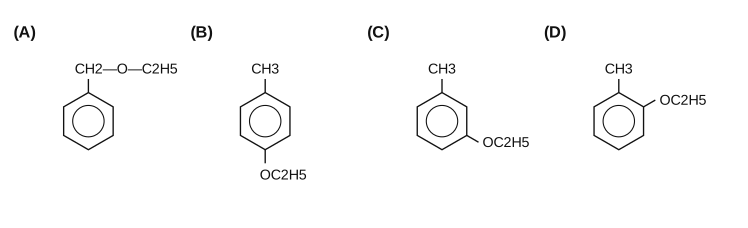
- COMEDK 2025Set 2025-A1 markMCQQ.Toluene when reacted with Cl2 gas at 385 K forms a product X which undergoes further reaction with Sodium ethoxide to yield product Y . The structure of Y is ___________ . (A) (B) (C) (D)
›Reveal solutionSolution
Toluene undergoes free-radical chlorination at the benzylic position (385 K) to give benzyl chloride, which then reacts with sodium ethoxide via an SN2 mechanism to form benzyl ethyl ether — the product is a benzene ring with a –CH₂–O–C₂H₅ side chain, matching option (A).
The key to this problem is recognising that the reaction conditions (385 K, Cl₂ gas) favour free-radical substitution at the benzylic position, not electrophilic aromatic substitution. Chlorine gas at high temperature or in the presence of light abstracts a hydrogen from the methyl group of toluene, producing benzyl chloride. Then, sodium ethoxide (a strong nucleophile and a strong base) displaces the chlorine via an SN2 reaction, giving an ether. The product is therefore a benzyl ethyl ether — a benzene ring with a –CH₂–O–C₂H₅ substituent.
- Identify the first reaction (chlorination) Toluene (C₆H₅–CH₃) reacts with Cl₂ at 385 K. This temperature is high enough to promote homolytic cleavage of Cl₂ into chlorine radicals. The benzylic C–H bond is weak (due to resonance stabilisation of the benzylic radical), so the radical chain reaction selectively replaces one hydrogen on the methyl group:
C6H5–CH3+Cl2385KC6H5–CH2Cl+HCl
The product X is benzyl chloride.
- Identify the second reaction (nucleophilic substitution) Sodium ethoxide (Na⁺ –OCH₂CH₃) is a strong nucleophile. Benzyl chloride has a primary carbon (the –CH₂Cl) that is also benzylic, making it highly reactive toward SN2 displacement. The ethoxide ion attacks the carbon, pushing out chloride:
C6H5–CH2Cl+NaOCH2CH3⟶C6H5–CH2–O–CH2CH3+NaCl
The product Y is benzyl ethyl ether.
- Match the structure to the options
- Option (A): a benzene ring with a –CH₂–O–C₂H₅ side chain — exactly benzyl ethyl ether. …
- COMEDK 2025Set 2025-M1 markMCQQ.Benzene diazonium chloride when warmed with water gives a compound, whose Sodium salt when reacted with Allyl bromide gives compound [X]. Identify [X]. (A) C6H5−CH−(CH3)2 (B) C6H5−O−CH2−CH=CH2 (C) C6H5−O−CH2−CH2−CH3 (D) C6H5−CH2−CH2−CH3
›Reveal solutionSolution
Benzene diazonium chloride hydrolyses to phenol; the sodium salt of phenol undergoes an S_N2 reaction with allyl bromide to give phenyl allyl ether. The correct product is C6H5−O−CH2−CH=CH2, option (B).
Concept & Intuition
This problem tests two classic organic reactions in sequence:
- Diazonium salt hydrolysis – a way to replace an amino group (via diazotization) with a hydroxyl group.
- Williamson ether synthesis – the reaction of an alkoxide (or phenoxide) with a primary alkyl halide to form an ether.
The key is to track the functional group transformations step by step, paying attention to the fact that allyl bromide is a primary halide with a double bond that remains untouched during the S_N2 reaction.
Step-by-step reasoning
- Starting material: Benzene diazonium chloride Benzene diazonium chloride (C6H5N2+Cl−) is formed by diazotizing aniline. When warmed with water, it undergoes hydrolysis (a type of substitution where N2 is replaced by OH).
C6H5N2+Cl−+H2OΔC6H5OH+N2+HCl
The product is phenol.
- Formation of the sodium salt of phenol Phenol is weakly acidic. Treating it with a base (like NaOH) gives sodium phenoxide:
C6H5OH+NaOH→C6H5O−Na++H2O
This phenoxide ion is a strong nucleophile.
- Reaction with allyl bromide Allyl bromide (CH2=CH−CH2Br) is a primary alkyl halide. The phenoxide ion attacks the electrophilic carbon (the one bonded to Br) in an S_N2 reaction.
C6H5O−+Br−CH2−CH=CH2→C6H5−O−CH2−CH=CH2+Br−
The product is phenyl allyl ether (allyl phenyl ether). The double bond remains intact because S_N2 does not affect π-bonds. …
- COMEDK 2024Set 2024-A1 markMCQQ.Which of the following compound cannot be prepared by Williamson's synthesis? (A) C6H5OCH2CH3 (B) (C2H5)2O (C) (CH3)3COC(CH3)3 (D) (CH3)3COCH2CH3
›Reveal solutionSolution
Williamson’s synthesis requires an alkoxide (or phenoxide) and a primary alkyl halide to avoid elimination; tertiary halides give elimination instead of ether. The compound that cannot be made is the one that would require a tertiary alkyl halide — that is, di‑tert‑butyl ether, option (C).
Concept & Intuition
Williamson’s synthesis is the classic way to make ethers: an alkoxide ion (strong nucleophile/base) attacks an alkyl halide in an Sₙ2 reaction. The catch: Sₙ2 works best on primary (or methyl) halides; secondary works poorly; tertiary halides almost always undergo E2 elimination instead, because the bulky base prefers to pull a proton rather than attack the crowded carbon. So if the ether you want would have to come from a tertiary alkyl halide, Williamson’s synthesis fails. The trick is to check which alkyl group in the ether would come from the halide — and whether that halide is primary, secondary, or tertiary.
Step‑by‑step reasoning
-
Identify the two halves of each ether
Williamson’s synthesis couples an alkoxide (R–O⁻) with an alkyl halide (R′–X). The ether is R–O–R′. We can choose which half is the alkoxide and which is the halide — but the halide must be one that can undergo Sₙ2.
-
Examine option (A): C₆H₅OCH₂CH₃
- Phenoxide (C₆H₅O⁻) + ethyl halide (CH₃CH₂–X) works perfectly: ethyl halide is primary, so Sₙ2 is fast and no elimination.
- Alternatively, ethoxide + phenyl halide would fail (aryl halides don’t do Sₙ2), but we can always choose the better route. So (A) is easily prepared.
-
Examine option (B): (C₂H₅)₂O
- Ethoxide (CH₃CH₂O⁻) + ethyl halide (CH₃CH₂–X) — both primary. Classic, clean Sₙ2. (B) is easily prepared.
-
Examine option (C): (CH₃)₃COC(CH₃)₃
- This is di‑tert‑butyl ether. To make it, we would need tert‑butoxide [(CH₃)₃CO⁻] + tert‑butyl halide [(CH₃)₃C–X].
- The halide is tertiary: Sₙ2 is impossible (steric hindrance), and E2 elimination dominates, giving isobutene. …
-
- COMEDK 2024Set 2024-E1 markMCQQ.Identify the end-product [D] formed when solution salicylate undergoes the following series of reactions (A) (B) (C) (D)
![Stem scheme: the starting material [A] is drawn as a benzene ring bearing an -OH group on](/figures/comedk/2024-E-chemistry-q5.svg)
›Reveal solutionSolution
The key is to recognise that sodium salicylate undergoes decarboxylation under the first set of conditions to give phenol, which is then deprotonated to sodium phenoxide; the final step is an O-allylation (Williamson ether synthesis), not a C-allylation, so the product is phenyl allyl ether — matching option (D).
The problem asks you to trace the transformation of sodium salicylate through a sequence of reactions. The trick lies in understanding what each reagent does and, crucially, where the allyl group ends up — on oxygen or on the ring. Many students instinctively assume allyl bromide will attack the ring (Friedel–Crafts style), but here the conditions favour a simple ether formation.
-
Start with sodium salicylate [A]
This is the sodium salt of salicylic acid: a benzene ring with an –OH group and a –COONa group in ortho positions. The –COONa is a carboxylate salt.
-
First reaction: (i) NaOH/CaO/Heat, then (ii) HCl(aq)
The mixture of NaOH and CaO (soda lime) with heat is the classic decarboxylation condition. The carboxylate group (–COONa) is lost as CO₂, and the ring gains a hydrogen in its place.
After heating, the product is phenol (C₆H₅OH). The subsequent treatment with aqueous HCl simply neutralises any remaining base and ensures the product is the free phenol.
So [B] is phenol.
-
Second reaction: (i) NaOH(aq)
Phenol is weakly acidic (pKa ≈ 10). Aqueous NaOH deprotonates it to form sodium phenoxide (C₆H₅O⁻ Na⁺).
This step is important because the phenoxide ion is a much better nucleophile than neutral phenol.
So the intermediate after this step is sodium phenoxide — but the scheme labels it again as [B] (the printed label says (B) on the second arrow). That means the intermediate before the final step is sodium phenoxide.
-
Third reaction: Allyl bromide
Allyl bromide (CH₂=CH–CH₂Br) is an alkyl halide. Sodium phenoxide is a strong nucleophile. The reaction that follows is a Williamson ether synthesis: the phenoxide oxygen attacks the electrophilic carbon of allyl bromide (the CH₂Br carbon), displacing bromide.
This gives phenyl allyl ether: C₆H₅–O–CH₂–CH=CH₂.
The allyl group is attached to oxygen, not directly to the ring. No sodium remains in the final organic product because NaBr is formed as a byproduct.
-
Check the options …
-
- COMEDK 2024Set 2024-E1 markMCQQ.Two statements, Assertion and Reason are given below. Choose the correct option. Assertion: n-propyl tert-butyl ether can be readily prepared in the laboratory by Williamson's synthesis. Reason: The reaction occurs by SN1 attack of Primary alkoxide on Tert-alkyl halide to give good yield of the product, n-propyl tert-butyl ether. (A) Assertion is incorrect bur reason is correct. (B) Both Assertion and Reason are correct and Reason is the correct explanation for Assertion. (C) Assertion is correct but Reason is incorrect. (D) Both Assertion and Reason are correct but Reason is not the correct explanation for Assertion.
›Reveal solutionSolution
[!TLDR]
The ether can be prepared by Williamson synthesis (Assertion correct), but the mechanism stated in the Reason (SN1 of a primary alkoxide on a tertiary halide) is wrong, so the answer is (C).
Concept
Williamson ether synthesis (CBSE/NCERT Class 12 Alcohols, Phenols and Ethers) is an SN2 reaction of an alkoxide on an alkyl halide. It works best when the halide is primary; with tertiary halides the alkoxide acts as a base and elimination (E2) dominates.
Solution
To make n-propyl tert-butyl ether, the correct pairing is tert-butoxide ((CH3)3CO−) + n-propyl bromide (primary halide), an SN2 reaction that gives a good yield. So the Assertion is correct. …
- KCET 2023Set D-21 markMCQQ.Which of the following is an organometallic compound? (A) CH3COONa (B) CH3CH2MgBr (C) (CH3COO)2Ca (D) CH3ONa
›Reveal solutionSolution
Look for a direct metal–carbon bond — only the Grignard reagent has one; the rest are metal carboxylates / alkoxides, bonded through oxygen.
Step 1 — The definition
An organometallic compound is one that contains at least one direct bond between a carbon atom of an organic group and a metal atom (C−M). A compound merely containing both a metal and carbon is not enough — the bond itself must be C–M.
Step 2 — Examine each option
(A) CH3COONa (sodium acetate): the sodium ion is associated with the carboxylate oxygen — CH3COO− Na+. The linkage is Na−O. Not organometallic.
(B) CH3CH2MgBr (ethylmagnesium bromide): ✓
This is a Grignard reagent. The ethyl group is bonded directly to magnesium:
CH3CH2−Mg−Br
The C−Mg bond is strongly polarised Cδ−−Mgδ+ (carbon is far more electronegative than Mg), which is precisely why the carbon behaves as a carbanion/nucleophile and attacks carbonyl groups. This is the organometallic compound. …
- KCET 2020Set A-11 markMCQQ.Which of the following is NOT a pair of functional isomers ? (A) CH3COOH and HCOOCH3 (B) C2H5OC2H5 and C3H7OCH3 (C) CH3CH2OH and CH3OCH3 (D) CH3CH2NO2 and H2NCH2COOH
›Reveal solutionSolution
Check each pair for (i) the same molecular formula and (ii) different functional groups; pair (B) shares the formula but both members are ethers, so it is metamerism, not functional isomerism.
Step 1 — The concept: what makes a pair "functional isomers".
Two compounds are functional isomers if they:
- have the SAME molecular formula, and
- possess DIFFERENT functional groups.
Both conditions must hold. If the formulas match but the functional group is the same, the relationship is something else — metamerism (different alkyl groups either side of the same functional group) or chain isomerism, not functional isomerism. That distinction is precisely what this question tests.
Step 2 — Option (A): CH3COOH and HCOOCH3.
- CH3COOH (ethanoic acid): C2H4O2 — functional group = carboxylic acid (−COOH)
- HCOOCH3 (methyl methanoate): C2H4O2 — functional group = ester (−COO−)
Same formula ✓, different functional groups ✓ → IS a functional isomer pair (the classic acid–ester pair).
Step 3 — Option (B): C2H5OC2H5 and C3H7OCH3. ← the answer
- C2H5OC2H5 (diethyl ether): C4H10O — functional group = ether (−O−)
- C3H7OCH3 (methyl propyl ether): C4H10O — functional group = ether (−O−)
Same formula ✓ — but both are ETHERS, i.e. the same functional group ✗.
They differ only in how the 4 carbons are distributed on either side of the oxygen (2+2 versus 3+1). That is the textbook definition of METAMERISM, not functional isomerism.
→ NOT a pair of functional isomers. This is what the question asks for.
Step 4 — Option (C): CH3CH2OH and CH3OCH3.
- CH3CH2OH (ethanol): C2H6O — functional group = alcohol (−OH)
- CH3OCH3 (dimethyl ether): C2H6O — functional group = ether (−O−)
Same formula ✓, different functional groups ✓ → IS a functional isomer pair (the textbook alcohol–ether example). …
- KCET 2020Set A-11 markMCQQ.In the reaction :
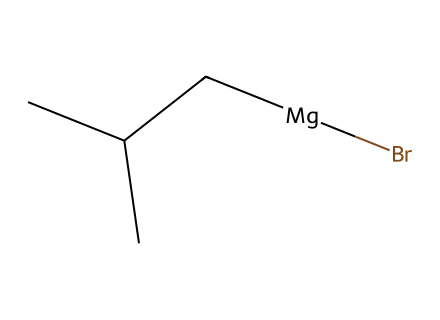 + CH3NH2Dry etherX
The number of possible isomers for the organic compound X is
(A) 2
(B) 4
(C) 5
(D) 3
+ CH3NH2Dry etherX
The number of possible isomers for the organic compound X is
(A) 2
(B) 4
(C) 5
(D) 3›Reveal solutionSolution
The Grignard is protonated by the acidic N–H of CH3NH2, giving the alkane C4H10 — and C4H10 has just two isomers.
Step 1 — Identify the Grignard reagent from the figure.
The skeletal group drawn before MgBr is an isobutyl group, (CH3)2CH−CH2−. So the reagent is
(CH3)2CH−CH2−MgBr(isobutylmagnesium bromide, a C4 Grignard).
Step 2 — What Grignards do with active hydrogen.
In R−MgBr the carbon is strongly carbanionic (Rδ−–Mgδ+), so R− is an extremely strong base. Any compound with an active (acidic) hydrogen — H2O, ROH, RNH2, RCOOH, RC≡CH — instantly protonates it:
R−MgX+H−Z⟶R−H+Mg(Z)X
Methylamine, CH3NH2, has N–H bonds (active hydrogen). So the Grignard is destroyed, not added to.
Step 3 — Write the reaction.
(CH3)2CHCH2−MgBr+CH3NH2dry etherX(CH3)2CH−CH3+CH3NH−MgBr
The organic compound X = 2-methylpropane (isobutane), molecular formula C4H10.
(Note: the alkyl group simply picks up the proton — the carbon skeleton is unchanged, so X keeps all four carbons.)
Step 4 — Count the isomers of X's molecular formula, C4H10. …
- KCET 2018Set A-11 markMCQQ.VERSION: 12-A 28. Which of the following will be the most stable diazonium salt (R N2+ X−)? (A) CH3 N2+ X− (B) C6H5 N2+ X− (C) CH3CH2 N2+ X− (D) C6H5CH2 N2+ X−
›Reveal solutionSolution
Diazonium stability comes from resonance delocalisation of the −N2+ charge into an aromatic ring directly attached to it — only C6H5N2+ has that.
Step 1 — Why diazonium ions are unstable in general.
N2 is an outstanding leaving group (an extremely stable neutral molecule), so any R−N2+ is under constant pressure to expel N2 and leave a carbocation R+. Anything that stabilises the diazonium ion itself (rather than the departing carbocation) increases its stability.
Step 2 — The aryl case (B).
In benzenediazonium ion the −N2+ is attached directly to the sp2 ring carbon. The ring's π system conjugates with the diazonium group, spreading the positive charge over the ring by resonance:
C6H5−N≡N+↔(charge delocalised onto ortho/para ring carbons)
This resonance stabilisation is why benzenediazonium chloride can actually be isolated and stored at 0–5 °C, and why it is the workhorse of diazo-coupling and Sandmeyer reactions.
Step 3 — Why the others fail. …
🎓Unlock everything free for 14 days
- ✓Full step-by-step solutions
- ✓Concept-first explanations
- ✓Methods, shortcuts & mistakes
- ✓PYQ mapping + timed mock tests
Full access for 14 days. No credit card required.