Q.Write equations of the following reactions:
🔒You're viewing a preview — the full solution, concept, methods & PYQ mapping are locked.
🔒 Start your 14-day free trial to unlock the full solution →Concept understanding — Electrophilic Aromatic Substitution
Electrophilic Aromatic Substitution – The First Meeting
Imagine you have a benzene ring — that perfect, flat hexagon of six carbons with alternating double bonds. It's stable, almost stubbornly so. You want to attach something new to it, say a bromine atom or a nitro group. But benzene doesn't react like an alkene. It doesn't just add across a double bond. Instead, it does something more elegant: it kicks out a hydrogen and keeps its aromatic ring intact.
That's the heart of Electrophilic Aromatic Substitution (EAS).
The Intuition: Why "Substitution" and Not "Addition"?
Benzene's stability comes from its delocalised π electrons — a cloud above and below the ring. This cloud is electron-rich, so it attracts electrophiles (electron-loving species). But if an electrophile simply added to a double bond, the ring would break its aromaticity, losing that huge stabilisation. That would be energetically costly.
So benzene does something smarter: it lets the electrophile attack, temporarily breaks aromaticity to form a high-energy intermediate (the arenium ion), and then loses a proton to restore the aromatic ring. The net result? A hydrogen is replaced by the electrophile. The ring is back to its stable, aromatic self.
The key trade-off: temporary loss of aromaticity is acceptable because the final product regains it. Addition reactions would permanently destroy aromaticity — benzene avoids that.
The Precise Statement
Electrophilic Aromatic Substitution is a reaction in which an electrophile (E+) replaces a hydrogen atom on an aromatic ring, proceeding through a sigma complex (arenium ion) intermediate, and restoring aromaticity after deprotonation.
The general equation:
Ar−H+EX+Ar−E+HX+
where Ar represents an aromatic ring.
The Mechanism in Three Steps
-
Generation of the electrophile – Many EAS reactions need a catalyst to create a strong enough E+. For example, bromination uses FeBrX3 to polarise BrX2 into BrX+.
-
Attack by the aromatic ring – The π electrons of benzene attack the electrophile, forming a sigma complex (also called the arenium ion or Wheland intermediate). This intermediate is non-aromatic — it has four π electrons delocalised over five carbons, and one sp3 carbon bearing the electrophile and a hydrogen.
Benzene+E+⟶Sigma complex (non-aromatic)
- Deprotonation – A base (often the counterion of the catalyst, like FeBrX4X−) removes the proton from the sp3 carbon. The pair of electrons from the C–H bond flows back into the ring, restoring the aromatic sextet.
Sigma complex+Base⟶Product+HX+
The sigma complex is not aromatic. It's a high-energy intermediate. Students often mistakenly think it's still aromatic — it isn't. That's why the step is fast and the complex is short-lived.
Why This Matters for Exams
EAS is the gateway to understanding how to put groups onto benzene rings. The rate-determining step is usually the formation of the sigma complex (step 2). The regiochemistry (where the electrophile goes) depends on whether the ring already has a substituent — that's the topic of activating/deactivating groups and ortho/para vs. meta directors.
But for now, remember this: …
Why this formula?
Electrophilic Aromatic Substitution: Why the Mechanism Holds
The Core Puzzle: Why Benzene Doesn't Just Add
Benzene (C6H6) has three double bonds — so why doesn't it undergo addition reactions like alkenes?
The answer lies in aromatic stabilisation: benzene's delocalised π-electron cloud (the "aromatic sextet") is about 150 kJ/mol more stable than a hypothetical cyclohexatriene with localised double bonds.
If benzene simply added an electrophile (like Br2), it would lose this stabilisation — a huge energy penalty.
So, nature chooses a different path: substitution instead of addition, preserving the aromatic ring.
The Key Formula: The Reaction Profile
The rate-determining step in electrophilic aromatic substitution (EAS) is the formation of the arenium ion (σ-complex):
Ar-H+E+slowAr-E+H(σ-complex)
Then, fast deprotonation restores aromaticity:
Ar-E+H+B−fastAr-E+BH
Why This Holds: The Energy Barrier Logic
-
First step (slow): The electrophile E+ attacks the electron-rich ring. The σ-complex is non-aromatic — it has only 4 π-electrons delocalised over 5 carbons (the sixth carbon is sp3 hybridised). This intermediate is higher in energy than the starting benzene.
-
Second step (fast): A base removes the proton, restoring the aromatic sextet. This step is strongly exothermic — the system regains ~150 kJ/mol of stabilisation.
The overall reaction is exothermic, but the activation energy is dominated by the destabilisation of the σ-complex.
The Rate Law: Why It's First Order in Both
From the mechanism:
Rate=k[Arene][E+]
Reasoning:
- The slow step involves one molecule of arene and one molecule of electrophile.
- No other species appear before the rate-determining step.
- Therefore, the rate law is bimolecular — first order in each reactant.
This is not derived from the overall stoichiometry — it comes directly from the molecularity of the slow step.
The Hammett Equation: Quantifying Substituent Effects
For substituted benzenes, the rate constant k relative to benzene (k0) follows:
logk0k=σρ
Why This Holds
- σ (sigma constant): Measures the electronic effect of a substituent (electron-donating or withdrawing) relative to hydrogen. It is derived from the ionisation constants of benzoic acids — a purely empirical scale.
- ρ (rho constant): Measures the sensitivity of the reaction to substituent effects. A positive ρ means the reaction is favoured by electron-withdrawing groups (rare in EAS); a negative ρ means electron-donating groups accelerate the reaction.
Why it works:
The σ-complex has a positive charge delocalised over the ring. Substituents that stabilise this positive charge (electron-donating groups like −OH, −NH2) lower the activation energy — hence σ is negative for such groups. Electron-withdrawing groups (−NO2, −CN) destabilise the σ-complex — σ is positive.
The linear free-energy relationship holds because the transition state resembles the σ-complex in charge distribution.
The Directing Effect: Why Ortho/Para vs Meta
The position of substitution is governed by the stability of the σ-complex for each possible attack site. …
Concept: Electrophilic Aromatic Substitution (EAS) — the methoxy group (−OCH3) is a strong activating and ortho/para-directing group due to resonance donation of lone pairs into the ring.
Reasoning:
- The oxygen in −OCH3 donates electrons via resonance, stabilising the sigma complex at ortho and para positions.
- Each reaction uses a specific electrophile generated in situ:
- Alkylation: CH3Cl+AlCl3→CH3+
- Nitration: HNO3+H2SO4→NO2+
- Bromination: Br2 in CH3COOH (polar medium, no Lewis acid needed due to high activation)
- Acetylation: CH3COCl+AlCl3→CH3CO+
- The major product in each case is the para-substituted anisole (with some ortho as minor product).
Equations:
- Friedel-Crafts alkylation of anisole: C6H5OCH3+CH3ClAlCl3CH3C6H4OCH3 (major: p-methoxytoluene) + HCl
- Nitration of anisole: …
Anisole undergoes electrophilic aromatic substitution (EAS) at the ortho/para positions because the methoxy group (−OCH3) is a strong activating and ortho/para-directing group. The four reactions below show how the electrophile attacks the activated ring, giving major ortho/para products.
Concept and Intuition
Anisole (methoxybenzene) is a classic example of an activated aromatic ring. The oxygen atom in the −OCH3 group has lone pairs that can donate electron density into the benzene ring via resonance. This makes the ring much more reactive than benzene itself toward electrophiles. Crucially, this resonance effect concentrates electron density at the ortho and para positions relative to the methoxy group. So, in any electrophilic aromatic substitution (EAS) reaction, the electrophile will preferentially attack these positions.
The reactions below are standard EAS transformations. The key is to remember that the methoxy group is so strongly activating that even mild conditions (like bromination without a Lewis acid) work, and that the ortho/para orientation is consistent across all four.
Step-by-Step Solutions
1. Friedel-Crafts alkylation of anisole
Here, we introduce an alkyl group (say, methyl) using an alkyl halide and a Lewis acid catalyst (usually AlCl3). The catalyst generates a carbocation electrophile.
- Reaction: Anisole reacts with methyl chloride (CH3Cl) in the presence of anhydrous AlCl3.
- Mechanism: AlCl3 pulls the chlorine from CH3Cl, forming a methyl carbocation (CH3+). This electrophile attacks the ortho or para position of anisole. After deprotonation, the product is a mixture of o- and p-methoxytoluene.
- Equation:
C6H5OCH3+CH3ClAlCl3o-CH3C6H4OCH3+p-CH3C6H4OCH3+HCl
In Friedel-Crafts alkylation, the product (e.g., p-methoxytoluene) is more reactive than anisole itself. This can lead to polyalkylation (multiple alkyl groups adding) unless the reaction is carefully controlled with excess anisole or low temperature.
2. Nitration of anisole
Nitration introduces a nitro group (−NO2) using a mixture of concentrated nitric and sulfuric acids. The nitronium ion (NO2+) is the electrophile.
- Reaction: Anisole is treated with a cold mixture of HNO3 and H2SO4.
- Mechanism: HNO3 is protonated by H2SO4, then loses water to form NO2+. This attacks the ortho/para positions. The major product is p-nitroanisole (less steric hindrance than ortho), along with some o-nitroanisole.
- Equation:
C6H5OCH3+HNO3H2SO4o-O2NC6H4OCH3+p-O2NC6H4OCH3+H2O
The ortho/para ratio in nitration of anisole is roughly 30-40% ortho and 60-70% para. The ortho product is slightly less favoured due to steric hindrance from the bulky methoxy group.
3. Bromination of anisole in ethanoic acid medium
Bromination of anisole is so easy that it occurs without a Lewis acid catalyst (unlike benzene, which needs FeBr3). Ethanoic acid (acetic acid) simply provides a polar solvent.
- Reaction: Anisole reacts with bromine (Br2) in glacial acetic acid at room temperature.
- Mechanism: The polar solvent polarises the Br2 molecule, making one bromine slightly positive (the electrophile). This attacks the ortho/para positions. The major product is p-bromoanisole (again, less steric hindrance).
- Equation:
C6H5OCH3+Br2CH3COOHo-BrC6H4OCH3+p-BrC6H4OCH3+HBr
In practice, bromination of anisole in ethanoic acid gives predominantly the para product (over 90%) because the ortho position is somewhat blocked by the methoxy group's bulk. This is a classic example of steric control overriding electronic preference. …
Method: Electrophilic Aromatic Substitution (EAS) Mechanism
Core Concept
Anisole (methoxybenzene) has a strong activating and ortho/para-directing group (−OCH3). The lone pair on oxygen donates electron density into the ring via resonance, making the ortho and para positions more nucleophilic.
General Steps for Each Reaction
- Generation of the electrophile (varies by reaction)
- Attack by the aromatic ring — the π electrons of anisole attack the electrophile, forming a arenium ion (sigma complex)
- Loss of a proton — a base removes H+ from the arenium ion, restoring aromaticity
(i) Friedel–Crafts Alkylation of Anisole
Electrophile generated: Methyl carbocation (CH3+) from CH3Cl and AlCl3
Equation:
Anisole+CHX3ClAlClX3ortho- and para-Methoxytoluene+HCl
Step-by-step:
- CH3Cl+AlCl3→CH3++AlCl4−
- CH3+ attacks the ring at ortho/para positions
- AlCl4− removes H+ to regenerate AlCl3
(ii) Nitration of Anisole
Electrophile generated: Nitronium ion (NO2+) from HNO3 and H2SO4
Equation:
Anisole+HNOX3HX2SOX4ortho- and para-Nitroanisole+HX2O
Step-by-step:
- HNO3+2H2SO4→NO2++2HSO4−+H3O+
- NO2+ attacks ortho/para positions
- HSO4− removes H+ to restore aromaticity
(iii) Bromination of Anisole in Ethanoic Acid Medium
Electrophile generated: Bromonium ion (Br+) from Br2 — ethanoic acid acts as a polar solvent, polarising the Br2 molecule
Equation:
Anisole+BrX2CHX3COOHortho- and para-Bromoanisole+HBr
Step-by-step: …
Here are the common mistakes students make when writing equations for the electrophilic aromatic substitution (EAS) reactions of anisole, along with how to avoid each.
Mistake 1: Forgetting the Role of the Methoxy Group (−OCH3)
- The Mistake: Students treat anisole like benzene, writing the product as if the substituent goes to a random position. They often forget that the −OCH3 group is a strong activating and ortho/para-directing group.
- Why it’s wrong: The lone pair on the oxygen donates electron density into the ring via resonance. This makes the ortho and para positions much more electron-rich (and thus more reactive) than the meta position.
- How to Avoid: Always draw the resonance structures of anisole first. You will see the negative charge (and thus the site of attack) appears only at the ortho and para carbons. The major product will always be a mixture of ortho and para isomers.
Mistake 2: Writing the Wrong Reagents for Nitration
- The Mistake: Writing the nitrating agent as simply "HNO3" or "HNO3+H2O".
- Why it’s wrong: The actual electrophile is the nitronium ion (NO2+). This is generated by protonating nitric acid with a stronger acid. Without the correct acid, the reaction won't proceed effectively.
- How to Avoid: Always write the reagent as a mixture of concentrated nitric acid and concentrated sulfuric acid (HNO3+H2SO4). The sulfuric acid acts as a catalyst and a dehydrating agent to form the NO2+ ion.
- Correct Equation:
C6H5OCH3+HNO3H2SO4o-Nitroanisole+p-Nitroanisole+H2O
Mistake 3: Using the Wrong Halogenating Agent for Bromination
- The Mistake: Writing the reagent as "Br2" alone, or using "Br2/FeBr3" (which is correct for benzene but not for anisole in ethanoic acid).
- Why it’s wrong: Anisole is so activated that it reacts instantly with Br2 even without a Lewis acid catalyst. Using Br2 in a non-polar solvent leads to polybromination (multiple bromines attaching). The question specifies "in ethanoic acid medium" to control the reaction.
- How to Avoid: Recognize that ethanoic acid (acetic acid, CH3COOH) is a polar protic solvent. It helps to stabilize the polar transition state and slows down the reaction, allowing for mono-bromination at the para position (the major product due to steric hindrance at the ortho position).
- Correct Equation:
C6H5OCH3+Br2CH3COOHp-Bromoanisole+HBr
Mistake 4: Confusing Alkylation with Acylation
- The Mistake: Using the same reagent (e.g., CH3Cl/AlCl3) for both alkylation and acetylation, or writing the acylating agent incorrectly.
- Why it’s wrong: Friedel-Crafts alkylation uses an alkyl halide (R-X) and a Lewis acid (AlCl3). Friedel-Crafts acylation uses an acyl halide (RCO-X) or an acid anhydride. The product of acylation is a ketone (C6H5COR), not an alkylbenzene.
- How to Avoid: Memorize the specific reagents.
- Alkylation: R-Cl+AlCl3 (generates R+ carbocation).
- Acetylation: CH3COCl+AlCl3 (generates CH3CO+ acylium ion).
- Correct Equation for Acetylation: …
- COMEDK 2026Set 2026-A1 markMCQQ.
[!FORMULA] What is the major product [P3] formed when n - Hexane undergoes the given series of reactions: n-Hexane [P1][P2]20 atm,773kV2O5[P1]C2H5Cl, Anhyd.AlCl △[P2] Conc. HNO3+H2SO4333 K[P3] Major product
(A) (B) (C) (D)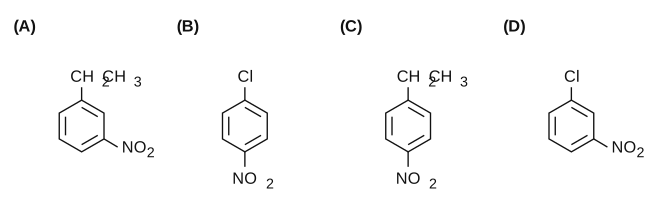
›Reveal solutionSolution
The reaction sequence converts n-hexane to benzene (via aromatization), then ethylates it to ethylbenzene, and finally nitrates it to give para-ethylnitrobenzene as the major product. The correct option is (C).
The key to this problem is recognizing that each step in the sequence is a classic organic transformation, and the final product’s structure is determined by the directing effects of substituents already on the ring. Let’s walk through it step by step.
-
First step: Aromatization of n-hexane
n-Hexane (C6H14) is treated with V2O5 at 20 atm and 773 K. This is a typical catalytic reforming or dehydrogenation condition. Vanadium pentoxide acts as a catalyst to cyclize and dehydrogenate the straight-chain alkane into an aromatic ring. The product [P1] is benzene (C6H6).
Why? Under high temperature and pressure, alkanes with six or more carbons can undergo dehydrocyclization — losing hydrogen atoms and forming a stable aromatic ring. No other functional groups are introduced here.
-
Second step: Friedel–Crafts alkylation
Benzene ([P1]) reacts with ethyl chloride (C2H5Cl) in the presence of anhydrous AlCl3 under heat (△). This is a classic Friedel–Crafts alkylation: the AlCl3 generates an ethyl carbocation (or an ethyl–AlCl3 complex) that attacks the benzene ring.
The product [P2] is ethylbenzene (C6H5CH2CH3).
Note: Alkylation gives a mono-substituted product because the ethyl group is an activating, ortho/para-directing group, but under these conditions further alkylation is minimal (or we assume mono-substitution as the intended step).
-
Third step: Nitration of ethylbenzene
Ethylbenzene ([P2]) is treated with concentrated nitric acid and sulfuric acid (a nitrating mixture) at 333 K. This is an electrophilic aromatic substitution. The nitronium ion (NO2+) is the attacking species.
The ethyl group is an ortho/para-directing group (it donates electron density via hyperconjugation and inductive effect). Therefore, the nitro group will preferentially attach at the ortho or para positions relative to the ethyl group. …
-
- COMEDK 2026Set 2026-M1 markMCQQ.
[!FORMULA] The decreasing order of reactivity towards electrophilic substitutions is:
(A) IV>I>II>IH (B) III>I>II>IV (C) I>II>IH>IV (D) I>III>IV>II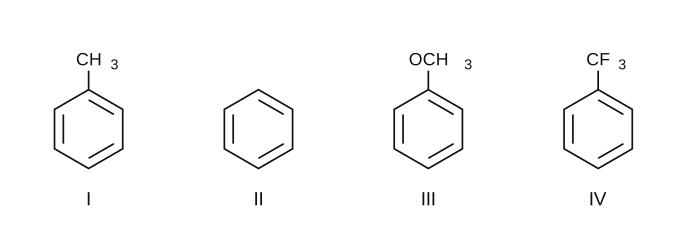
›Reveal solutionSolution
The reactivity of a benzene ring toward electrophilic substitution is governed by the electron-donating or electron-withdrawing nature of its substituent. The correct decreasing order is III (anisole) > I (toluene) > II (benzene) > IV (trifluoromethylbenzene), which corresponds to option (B).
Concept & Intuition
Electrophilic substitution on benzene proceeds via a positively charged intermediate (the arenium ion). Substituents that donate electrons (by resonance or induction) stabilize this intermediate and activate the ring, making it more reactive than benzene itself. Substituents that withdraw electrons destabilize the intermediate and deactivate the ring. The key is to compare the net electronic effect of each group:
- –OCH₃ (methoxy): Strongly activating. The oxygen lone pairs donate into the ring by resonance, overwhelming the weak inductive withdrawal.
- –CH₃ (methyl): Mildly activating. It donates electrons by hyperconjugation and the +I effect.
- –H (benzene): The reference point — no substituent effect.
- –CF₃ (trifluoromethyl): Strongly deactivating. The three fluorine atoms pull electrons inductively, and there is no resonance donation to compensate.
Thus the order is: anisole > toluene > benzene > trifluoromethylbenzene.
Step-by-step reasoning
-
Identify the substituent effects
- III (–OCH₃): The oxygen lone pairs are conjugated with the π-system, creating strong resonance donation (the methoxy group is ortho/para-directing and strongly activating).
- I (–CH₃): The methyl group donates via hyperconjugation (C–H σ bonds overlap with the ring π-orbitals) and a small +I effect. This is a mild activator.
- II (–H): No substituent — reactivity is the baseline.
- IV (–CF₃): The highly electronegative fluorines pull electron density through σ-bonds (strong –I effect). No resonance donation is possible, so the ring becomes electron-poor and deactivated.
-
Rank the activating power
Strongest activator → weakest activator → deactivator:
–OCH₃ > –CH₃ > –H > –CF₃.
-
Translate to reactivity order …
- COMEDK 2026Set 2026-M1 markMCQQ. Match reactions in Column I with the corresponding products formed as given in Column II. .tg {border-collapse:collapse;border-spacing:0;} .tg td{border-color:black;border-style:solid;border-width:1px;font-family:Arial, sans-serif;font-size:14px; overflow:hidden;padding:10px 5px;word-break:normal;} .tg th{border-color:black;border-style:solid;border-width:1px;font-family:Arial, sans-serif;font-size:14px; font-weight:normal;overflow:hidden;padding:10px 5px;word-break:normal;} .tg .tg-baqh{text-align:center;vertical-align:top} Column I Column I A C6H5 N2+Cl−+ warm H2O→ P p-Bromophenol B C6H5OH+273 KBr2 in CS2→ Q 2,4,6-Tribromophenol C C6H5OH+( ii )HCl( i )CHCl3+NaOH( aq )→ R Phenol D C6H5OH+Br2(aq)→ S 2-Hydroxybenzaldehyde (A) A−RB−PC−SD−Q (B) A−QB−PC−SD−R (C) A−SB−RC−QD−P (D) A−QB−RC−SD−P
›Reveal solutionSolution
The key is to match each reaction with its characteristic product by recalling the specific conditions: diazonium hydrolysis gives phenol, bromination in CS₂ at low temperature gives p-bromophenol, Reimer–Tiemann reaction gives salicylaldehyde, and aqueous bromination gives 2,4,6-tribromophenol. The correct matching is A→R, B→P, C→S, D→Q, which corresponds to option (A).
Concept and Intuition
This problem tests your knowledge of four classic organic reactions of benzene derivatives. Each reaction is distinguished by the reagent and conditions, which dictate the product. Instead of memorizing blindly, think about why each condition leads to a specific outcome:
- Diazonium salts are excellent leaving groups; in warm water, they simply hydrolyze to give phenol.
- Bromination of phenol can be controlled: in a non-polar solvent (CS₂) at low temperature, only one bromine substitutes at the para position (due to steric and electronic control). In aqueous solution, the reaction is much more vigorous, leading to trisubstitution.
- Reimer–Tiemann reaction uses chloroform and strong base to install a formyl group ortho to the phenol – a classic example of a carbene intermediate.
Let’s go through each match step by step.
Step-by-Step Matching
1. Reaction A: Diazonium salt with warm water
- Benzenediazonium chloride (C6H5N2+Cl−) is unstable in water. The N2+ group is a very good leaving group, and upon heating, it is replaced by a hydroxyl group from water.
- Product: Phenol (C6H5OH).
- So A → R (Phenol).
2. Reaction B: Phenol with Br2 in CS2 at 273 K
- In a non-polar solvent like carbon disulfide and at low temperature, bromination of phenol is monosubstitution. The –OH group is strongly activating and ortho/para-directing. However, the ortho positions are somewhat sterically hindered; the major product is the para isomer.
- Product: p-Bromophenol.
- So B → P (p-Bromophenol).
3. Reaction C: Phenol with CHCl3 and aqueous NaOH, then HCl
- This is the Reimer–Tiemann reaction. Chloroform in the presence of strong base generates dichlorocarbene (:CCl2), which attacks the electron-rich ortho position of the phenoxide ion. After hydrolysis with HCl, the product is an ortho-hydroxybenzaldehyde.
- Product: 2-Hydroxybenzaldehyde (salicylaldehyde). …
- KCET 2026Set D31 markMCQQ.Nitration of aniline in strong acidic medium gives significant amount of m-nitroaniline because (A) In electrophilic substitution reaction, amino group is meta directing (B) In strong acidic medium, aniline is present as anilinium ion (C) -NH2 group always directs to meta position (D) m-nitroaniline has higher molar mass than o&p nitroanilines
›Reveal solutionSolution
Protonation of aniline's amino group under strongly acidic nitrating conditions removes the usual ortho/para-directing effect of −NH2 and replaces it with the meta-directing effect of the positively charged −NH3+ group.
Step 1 — Normal behaviour of aniline
Free aniline's −NH2 group has a lone pair that donates electron density into the ring by resonance, strongly activating the ring and directing electrophiles to the ortho and para positions.
Step 2 — What happens in strongly acidic medium
Nitration uses a mixture of concentrated HNO3 and H2SO4, a highly acidic environment. Under these conditions, the nitrogen lone pair of aniline is protonated before nitration can occur, converting −NH2 into −NH3+ (the anilinium ion).
Step 3 — Why anilinium directs meta …
- KCET 2025Set D-41 markMCQQ.Which of the following reagents are suitable to differentiate Aniline and N-methylaniline chemical (A) Acetic anhydride (B) Br2 water (C) Conc. Hydrochloric acid and anhydrous zinc chloride (D) Chloroform and Alcoholic potassium hydroxide
›Reveal solutionSolution
The two compounds differ only in being a primary versus a secondary amine, so we need a test that is exclusive to primary amines — the carbylamine test (CHCl3 + alc. KOH).
Step 1 — Classify the two amines.
- Aniline, C6H5−NH2 — the nitrogen carries two hydrogens and one carbon → primary (1°) aromatic amine.
- N-methylaniline, C6H5−NH−CH3 — the nitrogen carries one hydrogen and two carbons → secondary (2°) amine.
So any reagent that distinguishes them must respond differently to 1° versus 2° amines. Anything that only probes the aromatic ring or the basicity of −NH− will react with both.
Step 2 — Test each reagent.
(A) Acetic anhydride. Acetylation needs an N–H bond. Aniline has two, N-methylaniline has one — both react:
C6H5NH2+(CH3CO)2O⟶C6H5NHCOCH3+CH3COOH
C6H5NH(CH3)+(CH3CO)2O⟶C6H5N(CH3)COCH3+CH3COOH
Both give a substituted amide, so no distinction.
(B) Br2 water. The −NH2 and −NHCH3 groups are both strongly activating, ortho/para-directing groups. Both anilines therefore undergo rapid ring bromination to give a white precipitate of the 2,4,6-tribromo derivative. No distinction.
(C) Conc. HCl + anhydrous ZnCl2. This is Lucas reagent — it is a test for alcohols (1°/2°/3°), distinguishing them by how fast a turbidity of the alkyl chloride appears. It has nothing to do with telling two amines apart; both amines simply form soluble ammonium salts with the acid. Not applicable. …
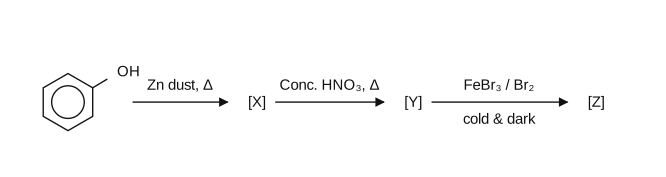
- COMEDK 2025Set 2025-M1 markMCQQ.What is the final product [Z] formed when the given reactions take place? (A) 4-Bromonitrobenzene. (B) 2-Bromonitrobenzene. (C) 2, 4, 6-tribromonitrobenzene. (D) 3-Bromonitrobenzene.
›Reveal solutionSolution
The reaction sequence converts phenol to benzene (via reduction), then nitrates it to nitrobenzene, and finally brominates it at the meta position relative to the nitro group, giving 3-bromonitrobenzene. The correct option is (D).
Concept & Intuition
This problem tests your understanding of how functional groups direct electrophilic aromatic substitution, and how a reaction sequence can completely change the directing effect. The key is to track the activating/deactivating and directing nature of the substituent at each step. Phenol’s –OH group is strongly activating and ortho/para-directing. But the first step (Zn dust, heat) removes that –OH entirely, giving benzene. Then nitration adds a meta-directing nitro group. Finally, bromination under conditions that prevent side reactions (cold & dark, FeBr₃) will place bromine meta to the nitro group. A common pitfall is to forget that the –OH is gone after step 1, and to mistakenly apply phenol’s directing effects to later steps.
Step-by-step reasoning
-
Step 1: Reduction of phenol to benzene
Phenol (CX6HX5OH) is heated with zinc dust. This is a classic reduction that removes the hydroxyl group, replacing it with hydrogen. The product [X] is benzene (CX6HX6).
Why? Zinc dust at high temperature acts as a reducing agent, cleaving the C–O bond and adding H (from trace moisture or the Zn itself). No substituent remains to direct further reactions — we now have a plain benzene ring.
-
Step 2: Nitration of benzene to nitrobenzene
Benzene [X] is treated with concentrated nitric acid and heat. This is standard electrophilic nitration. The product [Y] is nitrobenzene (CX6HX5NOX2).
Why? The nitronium ion (NOX2X+) attacks the benzene ring. Since there is no activating or deactivating group yet, the first substitution occurs at any position equally, but the product is simply nitrobenzene. The nitro group is strongly deactivating and meta-directing for further substitutions.
-
Step 3: Bromination of nitrobenzene …
-
- COMEDK 2024Set 2024-A1 markMCQQ.Arrange the following compounds in the decreasing order of reactivity towards electrophilic substitution reaction. (I) Chlorobenzene (II) Nitrobenzene (III) Benzene (IV) Isopropylbenzene (A) IV > III > I > II (B) I>II>IV>III (C) IV>I>II>III (D) III>II>IV>I
›Reveal solutionSolution
Electrophilic aromatic substitution is fastest on the ring bearing an activating group and slowest on the ring bearing a strong deactivator: isopropyl (activating) > benzene (reference) > chloro (weak deactivator) > nitro (strong deactivator), i.e. IV > III > I > II.
Rate of electrophilic substitution tracks the electron density of the ring:
- Isopropylbenzene (IV): the isopropyl group is electron-donating (+I, hyperconjugation) → activated, most reactive.
- Benzene (III): the unsubstituted reference. …
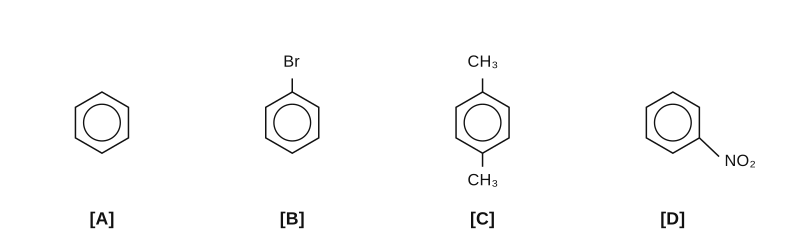
- COMEDK 2024Set 2024-E1 markMCQQ.Arrange the following compounds in the increasing order of their reactivity when each of them is reacted with chloroethane / anhydrous AlCl3. (A) D < A < B < C (B) C < D < B < A (C) D < B < A < C (D) C < B < A < D ![The figure shows four benzene-ring structures drawn side by side and labelled [A], [B], C
›Reveal solutionSolution
Reactivity in Friedel–Crafts alkylation follows the ring's electron density: nitro (strong deactivator) < bromo (weak deactivator) < benzene < methyl (activator). The increasing order is D < B < A < C, option (C).
Concept
Friedel–Crafts alkylation is an electrophilic aromatic substitution, and its rate is set by how electron-rich the ring is. Electron-donating groups raise the electron density and activate the ring; electron-withdrawing groups lower it and deactivate the ring. The stronger the effect, the larger the change in reactivity.
Solution
- D (nitrobenzene): −NO2 withdraws electrons strongly by both resonance and induction — the ring is the most deactivated, so D is least reactive.
- B (bromobenzene): −Br is net deactivating (inductive withdrawal dominates), so B is less reactive than plain benzene.
- A (benzene): the reference, with no substituent. …
- KCET 2023Set D-21 markMCQQ.Aniline does not undergo (A) Nitration (B) Sulphonation (C) Friedel-Craft reaction (D) Bromination
›Reveal solutionSolution
Aniline is highly activated and basic, so it reacts with the Lewis acid in Friedel-Crafts conditions to form a salt that deactivates the ring — making the reaction fail. The correct option is (C).
The key here is to understand how the amino group (−NH2) in aniline behaves. It is a strongly activating and ortho/para-directing group because the lone pair on nitrogen can donate into the benzene ring through resonance. That makes aniline extremely reactive toward electrophilic substitution — too reactive, in fact, for some conditions.
But the same lone pair also makes aniline basic. In the presence of a strong Lewis acid (like AlCl3), the nitrogen donates its lone pair to the acid, forming a salt. That salt has a positive charge on nitrogen, which is a powerful electron-withdrawing group. The ring becomes deactivated, and the Friedel-Crafts reaction fails.
Let’s go through each option.
-
Nitration — Aniline undergoes nitration readily. In fact, it is so reactive that direct nitration with HNO3/H2SO4 gives a mixture including meta-product due to oxidation of the amino group. To avoid this, the amino group is first protected (e.g., by acetylation to acetanilide), then nitrated. But the point is: nitration does occur, so this is not the answer.
-
Sulphonation — Aniline reacts with concentrated H2SO4 to form anilinium hydrogen sulphate at low temperature. On heating, it undergoes sulphonation to give ortho- and para-aminobenzenesulphonic acids. So sulphonation is possible.
-
Friedel-Crafts reaction — This is the one that fails. In a Friedel-Crafts alkylation or acylation, the catalyst is a Lewis acid like AlCl3. Aniline, being a strong base, forms a complex with AlCl3: …
-
- COMEDK 2021Set 20211 markMCQQ.Coupling reaction is an example of (A) nucleophilic addition reaction. (B) nucleophilic substitution reaction. (C) electrophilic substitution reaction. (D) electrophilic addition reaction.
›Reveal solutionSolution
That mechanism - electrophile attacks the aromatic ring, H+ is lost, aromaticity restored - is precisely electrophilic aromatic SUBSTITUTION (the ring's H is replaced by the -N=N-Ar group).
Concept: Diazo coupling.
In a coupling reaction the benzenediazonium ion, C6H5-N2+, acts as a weak ELECTROPHILE and attacks a highly activated aromatic ring (phenol in mild alkali, or aniline in mildly acidic medium). The activated ring's pi cloud attacks the terminal N of the diazonium ion, a sigma (arenium) complex forms, and loss of H+ restores aromaticity, giving the azo dye Ar-N=N-Ar'. …
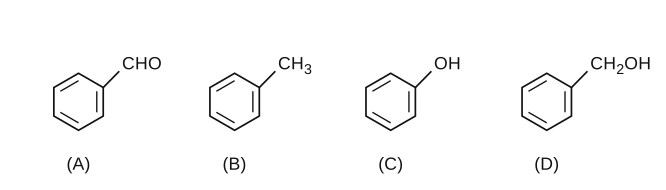
- COMEDK 2021Set 20211 markMCQQ.What is the product formed when benzene react with CO and HCl in presence of anhydrous AlCl3? (A) (B) (C) (D)
›Reveal solutionSolution
Benzene undergoes a Gattermann–Koch formylation with CO and HCl in the presence of anhydrous AlCl₃, giving benzaldehyde as the product.
The reaction you’re asking about is the Gattermann–Koch reaction — a classic method to introduce an aldehyde group directly onto an aromatic ring. The key idea is that carbon monoxide (CO) and hydrogen chloride (HCl) combine, under the Lewis acid catalysis of anhydrous AlCl₃, to generate a reactive electrophile: the formyl cation (HCO+). This electrophile then attacks the electron-rich benzene ring in an electrophilic aromatic substitution.
Why does this work? AlCl₃ coordinates with CO, polarising it, and then HCl provides the proton, forming a complex that effectively acts as HCO+. This is a strong electrophile, capable of substituting a hydrogen on benzene. The product is benzaldehyde — no further substitution occurs because the aldehyde group is deactivating and meta-directing, so the reaction stops at mono-formylation.
Let’s walk through the mechanism step by step.
- Generation of the electrophile Anhydrous AlCl₃ (a strong Lewis acid) coordinates with the oxygen of carbon monoxide, pulling electron density away from the carbon. This makes the carbon highly electrophilic. HCl then adds, forming a complex that can be thought of as HCO+ (formyl cation) stabilised by AlCl4−:
CO+HCl+AlCl3→HCO+AlCl4−
- Electrophilic attack on benzene The formyl cation attacks the benzene ring, forming a sigma complex (arenium ion). The positive charge is delocalised over the ring:
C6H6+HCO+→C6H6−CHO+
- Deprotonation to restore aromaticity The AlCl4− ion (or a chloride ion) abstracts a proton from the sigma complex, regenerating the aromatic ring and yielding benzaldehyde: …
🎓Unlock everything free for 14 days
- ✓Full step-by-step solutions
- ✓Concept-first explanations
- ✓Methods, shortcuts & mistakes
- ✓PYQ mapping + timed mock tests
Full access for 14 days. No credit card required.