Q.Predict the major product of acid catalysed dehydration of
Concept understanding — Electrophilic Addition Reactions
Electrophilic Aromatic Substitution – The First Meeting
Imagine you have a benzene ring — that perfect, flat hexagon of six carbons with alternating double bonds. It's stable, almost stubbornly so. You want to attach something new to it, say a bromine atom or a nitro group. But benzene doesn't react like an alkene. It doesn't just add across a double bond. Instead, it does something more elegant: it kicks out a hydrogen and keeps its aromatic ring intact.
That's the heart of Electrophilic Aromatic Substitution (EAS).
The Intuition: Why "Substitution" and Not "Addition"?
Benzene's stability comes from its delocalised π electrons — a cloud above and below the ring. This cloud is electron-rich, so it attracts electrophiles (electron-loving species). But if an electrophile simply added to a double bond, the ring would break its aromaticity, losing that huge stabilisation. That would be energetically costly.
So benzene does something smarter: it lets the electrophile attack, temporarily breaks aromaticity to form a high-energy intermediate (the arenium ion), and then loses a proton to restore the aromatic ring. The net result? A hydrogen is replaced by the electrophile. The ring is back to its stable, aromatic self.
The key trade-off: temporary loss of aromaticity is acceptable because the final product regains it. Addition reactions would permanently destroy aromaticity — benzene avoids that.
The Precise Statement
Electrophilic Aromatic Substitution is a reaction in which an electrophile (E+) replaces a hydrogen atom on an aromatic ring, proceeding through a sigma complex (arenium ion) intermediate, and restoring aromaticity after deprotonation.
The general equation:
Ar−H+EX+Ar−E+HX+
where Ar represents an aromatic ring.
The Mechanism in Three Steps
-
Generation of the electrophile – Many EAS reactions need a catalyst to create a strong enough E+. For example, bromination uses FeBrX3 to polarise BrX2 into BrX+.
-
Attack by the aromatic ring – The π electrons of benzene attack the electrophile, forming a sigma complex (also called the arenium ion or Wheland intermediate). This intermediate is non-aromatic — it has four π electrons delocalised over five carbons, and one sp3 carbon bearing the electrophile and a hydrogen.
Benzene+E+⟶Sigma complex (non-aromatic)
- Deprotonation – A base (often the counterion of the catalyst, like FeBrX4X−) removes the proton from the sp3 carbon. The pair of electrons from the C–H bond flows back into the ring, restoring the aromatic sextet.
Sigma complex+Base⟶Product+HX+
The sigma complex is not aromatic. It's a high-energy intermediate. Students often mistakenly think it's still aromatic — it isn't. That's why the step is fast and the complex is short-lived.
Why This Matters for Exams
EAS is the gateway to understanding how to put groups onto benzene rings. The rate-determining step is usually the formation of the sigma complex (step 2). The regiochemistry (where the electrophile goes) depends on whether the ring already has a substituent — that's the topic of activating/deactivating groups and ortho/para vs. meta directors.
But for now, remember this:
In EAS, the aromatic ring substitutes a hydrogen for an electrophile, never adds across a double bond. The ring's aromaticity is temporarily lost and then regained — that's the entire reason the reaction works.
A Quick Example: Nitration of Benzene
| Step | What happens |
|---|---|
| 1 | HNOX3+HX2SOX4NOX2X+ (nitronium ion, the electrophile) |
| 2 | Benzene attacks NOX2X+, forming the sigma complex |
| 3 | HSOX4X− removes a proton, restoring aromaticity → nitrobenzene |
The final product: CX6HX5NOX2.
One Common Pitfall
Don't confuse EAS with nucleophilic aromatic substitution (NAS). In EAS, the ring is electron-rich and attacks an electrophile. In NAS, the ring has a strong electron-withdrawing group and is attacked by a nucleophile — a completely different mechanism.
If you ever see a benzene ring reacting with something positively charged (or a neutral molecule made more positive by a catalyst), you're likely looking at EAS.
Electrophilic addition reactions are a core mechanism taught in the NCERT/CBSE Class 11 Chemistry chapter on Hydrocarbons, and ‘electrophilic addition reaction mechanism’ is a heavily searched important-question topic for board exams, JEE Main and NEET organic chemistry. Distinguishing electrophilic addition from electrophilic aromatic substitution is a frequently tested conceptual question in competitive chemistry exams.
Why this formula?
Electrophilic Addition Reactions: Why the Mechanism Works
Electrophilic addition is a cornerstone of alkene and alkyne chemistry. Instead of memorising the "arrow pushing," let's understand why the reaction proceeds the way it does — driven by electron density, stability, and charge.
1. The Core Idea: Why Alkenes React This Way
Alkenes have a π-bond — a cloud of electrons above and below the plane of the σ-bond. This π-electron cloud is:
- Electron-rich (nucleophilic)
- Exposed (not shielded by σ-bonds like in alkanes)
An electrophile (electron-lover) is attracted to this high electron density. The reaction is electrophilic addition because the electrophile attacks first.
Key principle: The π-bond acts as a Lewis base (electron donor). The electrophile is a Lewis acid (electron acceptor).
2. The General Mechanism (Two-Step)
Step 1: Formation of a Carbocation (or Bridged Intermediate)
The electrophile (E⁺) attacks the π-bond. The π-electrons form a new σ-bond to E⁺, leaving the other carbon with a positive charge — a carbocation.
C=C+EX+⟶CX+−C−E
Why does this happen?
The π-bond is weaker than a σ-bond (~260 kJ/mol vs ~350 kJ/mol). Breaking the π-bond to form a σ-bond is energetically favourable because the new σ-bond is stronger. The carbocation is a high-energy intermediate, but it's stabilised by:
- Hyperconjugation (alkyl groups donate electron density)
- Inductive effect (alkyl groups push electrons toward the positive carbon)
Step 2: Nucleophilic Attack
A nucleophile (Nu⁻) attacks the carbocation, forming a second σ-bond.
CX+−C−E+NuX−⟶C−Nu−C−E
Why does this happen?
The carbocation is electron-deficient (positive charge). The nucleophile is electron-rich. Opposite charges attract — this is electrostatic and orbital overlap driven.
3. The Key "Formula" — Markovnikov's Rule
Statement: In the addition of HX to an unsymmetrical alkene, the hydrogen attaches to the carbon with more hydrogens already, and the X attaches to the carbon with fewer hydrogens.
Why does this rule hold? (The reasoning)
Consider propene: CHX3−CH=CHX2 + HBr.
- Possible carbocations:
- Primary carbocation: CHX3−CHX+−CHX2Br (less stable)
- Secondary carbocation: CHX3−CHBr−CHX2X+ (more stable)
The more substituted carbocation (secondary > primary) is more stable due to:
- Hyperconjugation: More alkyl groups = more C–H σ-bonds that can donate electron density into the empty p-orbital of the carbocation.
- Inductive effect: Alkyl groups are electron-donating, stabilising the positive charge.
Result: The reaction proceeds via the more stable carbocation, leading to Markovnikov addition.
Markovnikov's rule is not a law — it's a consequence of carbocation stability.
4. The "Anti-Markovnikov" Exception (Why It Happens)
With HBr in the presence of peroxides (ROOR), the addition is anti-Markovnikov — Br goes to the less substituted carbon.
Why? The mechanism changes from ionic to free-radical.
- Peroxide decomposes to radicals: ROOR2RO⋅
- RO• abstracts H from HBr: RO⋅+HBrROH+Br⋅
- Br• adds to the alkene — at the less substituted carbon (because the radical formed is more stable — tertiary > secondary > primary).
- The new radical abstracts H from another HBr, regenerating Br•.
Key: The radical intermediate is stabilised by the same factors as carbocations (hyperconjugation, inductive effect), but the radical stability favours the more substituted radical — which forms when Br• attacks the less substituted carbon.
5. Why the Reaction is "Addition" Not "Substitution"
Alkenes have a π-bond that can be broken without breaking a σ-bond. In contrast, alkanes have only σ-bonds, which require high energy to break (radical substitution). The π-bond is a reactive handle — it's easier to break than a σ-bond, so addition is kinetically and thermodynamically favoured over substitution.
6. Summary of "Why" — The Big Picture
| Concept | Why it holds |
|---|---|
| Electrophile attacks first | π-bond is electron-rich; electrophile is electron-deficient |
| Carbocation intermediate | π-bond breaks, σ-bond forms — energetically favourable |
| Markovnikov rule | More stable carbocation (more substituted) forms faster |
| Anti-Markovnikov (peroxide effect) | Radical mechanism; more stable radical dictates regiochemistry |
| Addition, not substitution | π-bond is weaker than σ-bond; easier to break |
7. Exam-Relevant Takeaway
When solving problems:
- Identify the electrophile (H⁺, Br⁺, etc.)
- Draw the two possible carbocations (or radical intermediates)
- Choose the more stable one (more substituted = more stable)
- Add the nucleophile to the carbocation carbon
Never memorise the product — derive it from stability.
Concept: Acid-catalysed dehydration of alcohols follows Zaitsev’s rule — the more substituted alkene is the major product, formed via carbocation rearrangement when a more stable carbocation is possible.
- 1-Methylcyclohexanol Protonation and loss of water gives a tertiary carbocation at the 1-position. No rearrangement is needed. Elimination of a proton from the adjacent carbon (C-2) yields the more substituted alkene — 1-methylcyclohexene.
- Butan-1-ol
Protonation and loss of water gives a primary carbocation (unstable). A 1,2-hydride shift converts it to the more stable secondary carbocation at C-2. Elimination then gives but-2-ene (major), which is more substituted than but-1-ene.
✓Final answer
The major products are (i) 1-methylcyclohexene and (ii) but-2-ene.
Acid-catalysed dehydration of alcohols follows Zaitsev’s rule (the more substituted alkene is major) and can involve carbocation rearrangements. For 1-methylcyclohexanol, the major product is 1-methylcyclohexene; for butan-1-ol, the major product is but-1-ene (no rearrangement possible here).
The Concept: Why Dehydration Works This Way
Acid-catalysed dehydration of alcohols is an elimination reaction (E1 mechanism under these conditions). The alcohol’s –OH group is a poor leaving group, so we first protonate it with acid (usually H₂SO₄ or H₃PO₄) to turn it into –OH₂⁺, which leaves as water. This creates a carbocation intermediate.
Once the carbocation forms, two things can happen:
- Elimination: A base (often water or the conjugate base of the acid) removes a β-hydrogen, forming a double bond.
- Rearrangement: If the carbocation can shift to a more stable position (via a hydride or alkyl shift), it will do so before elimination.
The major product is the most substituted alkene (Zaitsev’s rule) — unless rearrangement leads to an even more stable alkene.
Let’s apply this to each case.
(i) 1-Methylcyclohexanol
Step 1: Protonation and loss of water
The –OH group gets protonated by H⁺ from the acid:
CX6HX10(CHX3)OH+HX+CX6HX10(CHX3)OHX2X+
Water leaves, forming a tertiary carbocation at the carbon that originally held the –OH (the 1-position of the ring, which also bears the methyl group).
CX6HX10(CHX3)OHX2X+CX6HX10(CHX3)X++HX2O
This carbocation is tertiary — already quite stable. No rearrangement is needed because a tertiary carbocation is more stable than any secondary or primary alternative.
Tertiary carbocations are the most stable (due to hyperconjugation and inductive effects). If you start with a tertiary alcohol, you usually get a tertiary carbocation directly — no rearrangement.
Step 2: Elimination of a β-hydrogen
Now a base (water or HSO₄⁻) removes a hydrogen from a carbon adjacent to the carbocation. There are two possible β-positions:
- Removing a hydrogen from the ring carbon next to the carbocation (say, C2) gives 1-methylcyclohexene (the double bond between C1 and C2).
- Removing a hydrogen from the methyl group itself would give methylenecyclohexane (double bond exocyclic to the ring).
Which is major? Zaitsev’s rule says: the more substituted alkene is favoured. 1-Methylcyclohexene is trisubstituted (three alkyl groups on the double bond carbons), while methylenecyclohexane is disubstituted. So 1-methylcyclohexene is the major product.
A common mistake is to think that the exocyclic alkene (methylenecyclohexane) might form because the methyl group’s hydrogens are more accessible. But stability of the alkene product, not accessibility, determines the major product under thermodynamic control. The trisubstituted alkene is more stable.
Final product for (i): 1-methylcyclohexene.
(ii) Butan-1-ol
Step 1: Protonation and loss of water
Butan-1-ol is a primary alcohol. Protonation gives butan-1-olium ion, and water leaves to form a primary carbocation (CH₃CH₂CH₂CH₂⁺).
CHX3CHX2CHX2CHX2OH+HX+CHX3CHX2CHX2CHX2OHX2X+CHX3CHX2CHX2CHX2X++HX2O
A primary carbocation is very unstable. So before elimination can occur, the carbocation will rearrange via a 1,2-hydride shift to form a more stable secondary carbocation.
CHX3CHX2CHX2CHX2X+1,2-hydride shiftCHX3CHX2CHX+CHX3
This secondary carbocation (butan-2-ylium) is more stable.
›Proof
Why a hydride shift happens:
The primary carbocation has only two alkyl groups donating electron density (hyperconjugation from adjacent C–H bonds). The secondary carbocation has three such groups. The activation energy for the 1,2-hydride shift is low enough that it occurs almost instantly under typical dehydration conditions (concentrated H₂SO₄, heat). So the primary carbocation never accumulates — it rearranges immediately.
Step 2: Elimination from the secondary carbocation
Now we have a secondary carbocation at C2. Elimination of a β-hydrogen can occur in two directions:
- Remove a hydrogen from C1 (the end carbon) → gives but-1-ene (CH₂=CH–CH₂–CH₃).
- Remove a hydrogen from C3 → gives but-2-ene (CH₃–CH=CH–CH₃).
But-2-ene is more substituted (disubstituted) than but-1-ene (monosubstituted), so Zaitsev’s rule predicts but-2-ene as the major product. However, but-2-ene exists as two stereoisomers: cis and trans. The trans isomer is more stable (less steric hindrance) and is usually the major stereoisomer.
So the major product from butan-1-ol is trans-but-2-ene, with some cis-but-2-ene and a little but-1-ene.
Butan-1-ol gives a mixture, but the major product is trans-but-2-ene. If the question asks for “the major product” without specifying stereochemistry, “but-2-ene” (or “2-butene”) is acceptable, but specifying trans is more precise.
Final product for (ii): trans-but-2-ene (or simply but-2-ene as the major alkene).
Summary Table
| Alcohol | Carbocation intermediate | Major alkene product |
|---|---|---|
| 1-Methylcyclohexanol | Tertiary (no rearrangement) | 1-Methylcyclohexene |
| Butan-1-ol | Primary → rearranges to secondary | trans-But-2-ene |
The major product from 1-methylcyclohexanol is 1-methylcyclohexene, and from butan-1-ol is trans-but-2-ene (or simply but-2-ene).
Method: Zaitsev’s Rule (Saytzeff’s Rule) for Acid-Catalysed Dehydration of Alcohols
This is an E1 elimination reaction (unimolecular elimination) under acidic conditions. The key idea: the more substituted alkene (more alkyl groups on the double-bond carbons) is the major product.
General Steps
- Protonation of the –OH group by acid (H+).
- Loss of water to form a carbocation intermediate.
- Rearrangement (if a more stable carbocation is possible via hydride or alkyl shift).
- Deprotonation (loss of H+ from a neighbouring carbon) to form the alkene.
- Apply Zaitsev’s Rule: the major alkene is the one with the most substituted double bond (more alkyl groups = more stable).
(i) 1-Methylcyclohexanol
Starting molecule:
A cyclohexane ring with an –OH and a –CH3 on the same carbon (C1).
Step-by-step:
- Protonation of –OH → OH2+ leaves as water → forms a tertiary carbocation at C1 (already stable, no rearrangement needed).
- Deprotonation can occur from:
- C2 (gives 1-methylcyclohexene — double bond between C1 and C2)
- C6 (gives methylenecyclohexane — double bond between C1 and C6, exocyclic)
Apply Zaitsev’s Rule:
1-methylcyclohexene has a trisubstituted double bond (C1 has –CH3, C2 has two ring carbons).
Methylenecyclohexane has a disubstituted double bond (exocyclic, less substituted).
Major product: 1-methylcyclohexene
(ii) Butan-1-ol
Starting molecule:
CH3CH2CH2CH2OH (primary alcohol).
Step-by-step:
- Protonation and loss of water → forms a primary carbocation (very unstable).
- Hydride shift occurs: a hydrogen from C2 moves to C1 → forms a secondary carbocation at C2 (more stable).
- Deprotonation can occur from:
- C1 (gives but-1-ene — double bond between C1 and C2)
- C3 (gives but-2-ene — double bond between C2 and C3)
Apply Zaitsev’s Rule:
But-2-ene has a disubstituted double bond (both C2 and C3 have one alkyl group each).
But-1-ene has a monosubstituted double bond (terminal).
Major product: But-2-ene (exists as cis/trans isomers, but both are more substituted than but-1-ene)
Final Answer Summary
| Alcohol | Major Product | Reason |
|---|---|---|
| 1-Methylcyclohexanol | 1-Methylcyclohexene | Trisubstituted alkene (Zaitsev) |
| Butan-1-ol | But-2-ene | Disubstituted alkene after hydride shift (Zaitsev) |
Key takeaway: Always check for carbocation rearrangement first, then apply Zaitsev’s rule to find the most substituted alkene.
Here are the common mistakes students make with acid-catalysed dehydration of alcohols, specifically for the two examples you gave, along with how to avoid each.
Mistake 1: Forgetting Carbocation Rearrangement (1-methylcyclohexanol)
The Mistake: Students often simply remove water from 1-methylcyclohexanol and draw the direct alkene (1-methylcyclohexene). They miss the possibility of a hydride shift or methyl shift to form a more stable carbocation.
Why it happens: The reaction starts with protonation of the OH group, then loss of water to form a carbocation. In 1-methylcyclohexanol, the initial carbocation is secondary (on the carbon that had the OH). Students assume this is the final intermediate.
How to avoid it:
- Always check carbocation stability. A secondary carbocation can rearrange to a tertiary carbocation via a 1,2-hydride shift (or methyl shift) if a more substituted carbon is adjacent.
- For 1-methylcyclohexanol, the initial secondary carbocation can undergo a hydride shift from the adjacent tertiary carbon (the one with the methyl group) to give a tertiary carbocation.
- The major product is then 1-methylcyclohexene (the more substituted alkene, obeying Zaitsev’s rule) — but only after considering that the tertiary carbocation leads to the same alkene as the direct product. However, if a different shift were possible (e.g., ring expansion), the product would change. Always draw the carbocation and check for shifts.
Correct approach:
- Step 1: Protonate OH → OHX2X+ leaves → secondary carbocation.
- Step 2: Check adjacent carbons for more stable carbocation. Here, a hydride shift from the tertiary carbon (bearing the methyl) gives a tertiary carbocation.
- Step 3: Deprotonation from the tertiary carbocation gives the most substituted alkene: 1-methylcyclohexene.
Mistake 2: Ignoring Zaitsev’s Rule (butan-1-ol)
The Mistake: For butan-1-ol (a primary alcohol), students often draw but-1-ene as the major product, thinking the OH leaves from C1 and the double bond forms between C1 and C2.
Why it happens: They forget that acid-catalysed dehydration of primary alcohols proceeds via an E1 mechanism (not E2) under these conditions, and that the carbocation formed (if any) is unstable. Actually, for primary alcohols, the mechanism is often E2-like or involves a carbocation rearrangement to a more stable one.
How to avoid it:
- Primary alcohols do not form stable primary carbocations. Instead, the reaction proceeds via a concerted E2 mechanism (with acid catalysis) or via a rearrangement to a secondary carbocation.
- For butan-1-ol, the initial protonation and loss of water would give a primary carbocation (very unstable). Instead, a 1,2-hydride shift occurs to form a secondary carbocation (more stable).
- Then, deprotonation follows Zaitsev’s rule: the more substituted alkene is but-2-ene (as a mixture of cis/trans), not but-1-ene.
Correct approach:
- Step 1: Protonate OH → loss of water → primary carbocation (unstable).
- Step 2: Hydride shift from C2 to C1 → secondary carbocation at C2.
- Step 3: Deprotonation from C3 (adjacent to C2) gives but-2-ene (major), not but-1-ene.
Mistake 3: Forgetting Stereochemistry (cis/trans in but-2-ene)
The Mistake: Students write "but-2-ene" without specifying the stereoisomers, or they assume only one isomer forms.
Why it happens: They focus only on the carbon skeleton and ignore that the double bond can have E/Z (cis/trans) isomers.
How to avoid it:
- In acid-catalysed dehydration, the deprotonation step is not stereoselective — both cis and trans isomers form.
- For but-2-ene, the trans isomer is more stable (less steric hindrance) and is the major product.
- Always indicate the major stereoisomer if the question asks for the major product.
Correct answer: Major product is trans-but-2-ene (along with some cis-but-2-ene and a little but-1-ene).
Mistake 4: Not Considering Ring Expansion (for cyclic alcohols)
The Mistake: For 1-methylcyclohexanol, students don’t check if a ring expansion (e.g., from a six-membered ring to a seven-membered ring) is possible.
Why it happens: They assume the ring stays the same size.
How to avoid it:
- In cyclic alcohols, if a carbocation forms adjacent to a ring carbon, a 1,2-alkyl shift can expand the ring (e.g., cyclopentyl to cyclohexyl).
- For 1-methylcyclohexanol, the initial secondary carbocation is adjacent to a tertiary carbon (with the methyl). A methyl shift would give a tertiary carbocation but no ring expansion because the methyl is a side group, not part of the ring. However, if the OH were on a different carbon (e.g., 2-methylcyclohexanol), ring expansion to a cycloheptane derivative is possible.
- Always check for ring expansion when a carbocation is on a ring carbon adjacent to a ring junction.
Summary Table of Mistakes and Fixes
| Mistake | Example | How to Avoid |
|---|---|---|
| Forgetting carbocation rearrangement | 1-methylcyclohexanol → direct alkene | Always check for hydride/methyl shifts to more stable carbocation |
| Ignoring Zaitsev’s rule | butan-1-ol → but-1-ene | Primary alcohols rearrange to secondary carbocation; deprotonate to more substituted alkene |
| Omitting stereochemistry | but-2-ene without cis/trans | Indicate major stereoisomer (trans is more stable) |
| Missing ring expansion | Cyclic alcohols | Check if a 1,2-alkyl shift can enlarge the ring |
Final Correct Answers (for your reference)
- 1-methylcyclohexanol → Major product: 1-methylcyclohexene (via tertiary carbocation, no ring expansion here)
- butan-1-ol → Major product: trans-but-2-ene (via hydride shift to secondary carbocation, then Zaitsev deprotonation)
- COMEDK 2026Set 2026-M1 markMCQQ.A compound with molecular formula C5H10 that gives acetone on ozonolysis is: (A) 2-methyl-2-butene (B) 2-methyl-1-butene (C) 3-methyl-1-butene (D) Cyclopentane
›Reveal solutionSolution
Ozonolysis cleaves alkenes at the double bond to give carbonyl compounds; here, acetone (a ketone) is produced, so the alkene must have a double bond that yields exactly two carbonyl fragments, one of which is acetone. The only option that fits is 2-methyl-2-butene, which gives acetone + acetaldehyde.
Concept & Intuition
Ozonolysis is a reaction that cleaves a carbon–carbon double bond and replaces each of the two doubly bonded carbons with a carbonyl group (C=O). If the carbon originally had two alkyl groups attached (i.e., it was a disubstituted carbon in the double bond), it becomes a ketone; if it had one or zero alkyl groups, it becomes an aldehyde or formaldehyde.
Here, the product is acetone, which is a ketone with the structure (CH₃)₂C=O. That means the original alkene must have had a carbon in the double bond that was attached to two methyl groups — i.e., a (CH₃)₂C= fragment. The other half of the double bond can be anything, but the overall formula is C₅H₁₀, so we need to check which of the given alkenes has that exact structural feature.
Step-by-step reasoning
- Identify the structural requirement for acetone formation Acetone = (CH₃)₂C=O. This comes from a carbon in the double bond that had two methyl groups attached. So the alkene must contain the fragment
(CH3)2C=C
(the other carbon can have H or alkyl groups).
-
Examine each option
- (A) 2-methyl-2-butene Structure: CH₃–C(CH₃)=CH–CH₃ The double bond is between C2 and C3. C2 has two methyl groups (one from the main chain, one as a branch) → exactly the (CH₃)₂C= fragment. Ozonolysis:
(CH3)2C=CHCH3O3(CH3)2C=O+CH3CHO
Acetone + acetaldehyde. ✓-
(B) 2-methyl-1-butene
Structure: CH₂=C(CH₃)–CH₂–CH₃
The double bond is terminal (C1=C2). C1 has two H’s → would give formaldehyde (H₂C=O), not acetone. C2 has one methyl and one ethyl → would give a ketone, but not acetone (it would be butanone). ✗
-
(C) 3-methyl-1-butene
Structure: CH₂=CH–CH(CH₃)₂
Terminal double bond again: C1 gives formaldehyde, C2 gives isobutyraldehyde. No acetone. ✗
-
(D) Cyclopentane
This is a saturated alkane (no double bond), so ozonolysis does not occur. ✗
- Confirm the molecular formula 2-methyl-2-butene is C₅H₁₀ (5 carbons, 10 hydrogens) — matches perfectly.
Watch outA common mistake is to think that any alkene with five carbons could give acetone, but the key is the substitution pattern around the double bond. Only a double bond with a gem-dimethyl group (two methyls on one carbon) yields acetone upon cleavage.
TipYou can quickly test by drawing the alkene and mentally “cutting” the double bond: if one piece is (CH₃)₂C=O, you’ve found your answer.
✓Final answerThe correct option is (A).
ANSWER: A
- COMEDK 2026Set 2026-M1 markMCQQ.When 2-butyne is treated with dilute H2SO4/HgSO4, the product formed is: (A) Butanal (B) 1-butanol (C) Butanone (D) 2-butanol
›Reveal solutionSolution
Hydration of an internal alkyne (2‑butyne) with dilute H₂SO₄/HgSO₄ follows Markovnikov’s rule via an enol intermediate that tautomerizes to a ketone. The product is butanone (methyl ethyl ketone).
Concept & Intuition
The reaction is acid‑catalyzed hydration of an alkyne using Hg²⁺ as a catalyst (the classic “oxymercuration” of alkynes). For an internal alkyne like 2‑butyne (CH₃–C≡C–CH₃), the two triple‑bond carbons are equally substituted (both secondary). Markovnikov’s rule says the –OH adds to the more substituted carbon, but here both are equally substituted, so the enol formed is symmetrical. That enol immediately tautomerizes to the more stable keto form — a ketone, not an aldehyde. The key is that terminal alkynes give aldehydes; internal alkynes give ketones.
Step‑by‑Step Reasoning
-
Identify the substrate
2‑butyne is CH₃–C≡C–CH₃. It is an internal alkyne (the triple bond is not at the end of the chain).
-
Reaction conditions
Dilute H₂SO₄ with HgSO₄ provides Hg²⁺ ions, which coordinate to the triple bond, making it more electrophilic. Water then attacks the activated π‑bond.
-
Regiochemistry (Markovnikov addition)
For an unsymmetrical alkyne, the –OH ends up on the more substituted carbon. Here both carbons are equally substituted (each has one methyl group), so the water can add to either carbon with equal probability. The immediate product is an enol:
CH3–C(OH)=CH–CH3
(the exact placement of the double bond is the same either way because the molecule is symmetric).
- Tautomerization The enol is unstable and rapidly undergoes keto‑enol tautomerization. The hydrogen on the carbon adjacent to the –OH shifts to the oxygen, and the double bond moves to become a carbonyl:
CH3–C(OH)=CH–CH3⟶CH3–C(=O)–CH2–CH3
This is butanone (also called methyl ethyl ketone).
- Check the options
- (A) Butanal is an aldehyde — would come from a terminal alkyne.
- (B) 1‑butanol is a primary alcohol — not formed here.
- (C) Butanone is a ketone — matches our product.
- (D) 2‑butanol is a secondary alcohol — would require full reduction, not hydration.
Watch outA common mistake is to think that hydration of any alkyne gives an aldehyde. That is only true for terminal alkynes (e.g., 1‑butyne). Internal alkynes always give ketones.
TipRemember the mnemonic: “Terminal → aldehyde; Internal → ketone.” For symmetrical internal alkynes like 2‑butyne, the product is a single ketone with no isomer mixture.
✓Final answerThe correct option is (C).
ANSWER: C
-
- COMEDK 2025Set 2025-E1 markMCQQ.The number of grams of bromine that will completely react with 5 g of pentene is : [Atomic mass of Br=80u ] (A) 22.4 g (B) 8.4 g (C) 11.4 g (D) 54.2 g
›Reveal solutionSolution
The key is that pentene (C₅H₁₀) adds one Br₂ molecule per double bond. 5 g of pentene corresponds to about 0.0714 mol, which reacts with 0.0714 mol Br₂ (≈ 11.4 g). So the correct option is (C).
Concept and Intuition
Pentene is an alkene with one carbon‑carbon double bond. The characteristic reaction of alkenes is electrophilic addition — here, bromine (Br₂) adds across the double bond. Each molecule of pentene consumes exactly one molecule of Br₂. So the problem reduces to a simple stoichiometric calculation: find how many moles of pentene are in 5 g, then the same number of moles of Br₂ is needed, and convert that to grams.
A common mistake is to forget that Br₂ is diatomic (Br₂, not Br), so its molar mass is 160 g/mol, not 80 g/mol. We’ll watch for that.
Step‑by‑Step Solution
- Determine the molecular formula of pentene The name “pentene” tells us it has 5 carbon atoms and one double bond. For an alkene with one double bond, the general formula is CₙH₂ₙ. So for n = 5:
Pentene=C5H10
- Calculate the molar mass of pentene Atomic masses: C = 12 u, H = 1 u.
M(C5H10)=5×12+10×1=60+10=70 g/mol
- Find the number of moles in 5 g of pentene
npentene=molar massmass=70 g/mol5 g=141 mol≈0.0714 mol
- Relate moles of pentene to moles of bromine The addition reaction is:
C5H10+Br2→C5H10Br2
The mole ratio is 1:1. Therefore:
nBr2=npentene=141 mol
- Calculate the mass of Br₂ required Bromine is diatomic: Br₂. Its molar mass is:
M(Br2)=2×80=160 g/mol
So the mass of Br₂ is:
massBr2=nBr2×M(Br2)=141×160=14160=780 g
780≈11.4286 g
- Match with the given options The value 11.4 g corresponds to option (C).
Watch outA frequent error is to use atomic mass of Br (80 g/mol) instead of molecular mass of Br₂ (160 g/mol). That would give half the correct mass (~5.7 g), which is not among the options — but if you misread, you might pick a wrong answer. Always check: bromine gas is Br₂.
TipYou can also think in terms of “grams per gram”: 70 g of pentene reacts with 160 g of Br₂. So 1 g of pentene reacts with 160/70 ≈ 2.2857 g of Br₂. Then 5 g reacts with 5 × 2.2857 = 11.4285 g. This is a quick cross‑multiplication.
✓Final answerThe correct option is (C).
ANSWER: C
- COMEDK 2025Set 2025-E1 markMCQQ.Which of the following alkene on reductive ozonolysis gives ketones only as the product (A) 1, 2-butadiene (B) 1, 4-cyclohexadiene (C) But-2-ene (D) 2,3-dimethylbut-2-ene
›Reveal solutionSolution
Reductive ozonolysis cleaves alkenes at the double bond, converting each vinylic carbon into a carbonyl group. To get only ketones, every vinylic carbon must be disubstituted (i.e., have two alkyl groups attached). The only alkene among the options that satisfies this is 2,3-dimethylbut-2-ene, which gives only acetone.
Concept & Intuition
Ozonolysis of an alkene adds ozone across the C=C bond, forming an ozonide. Reductive workup (e.g., with Zn/H₂O or dimethyl sulfide) cleaves the ozonide into two carbonyl compounds. The key rule:
- A vinylic carbon with two hydrogens (terminal =CH₂) becomes formaldehyde (HCHO).
- A vinylic carbon with one hydrogen (=CHR) becomes an aldehyde (RCHO).
- A vinylic carbon with no hydrogens (=CR₂) becomes a ketone (RCOR).
Thus, to get only ketones, every vinylic carbon in the starting alkene must be of the =CR₂ type — no =CH₂ or =CHR groups allowed.
Step-by-step analysis
-
Option (A): 1,2-butadiene
Structure: CH₂=C=CH–CH₃. This is an allene (cumulated diene), not a simple alkene. Reductive ozonolysis of an allene cleaves both double bonds, giving a mixture: one terminal =CH₂ yields formaldehyde, the central carbon becomes CO₂ or a ketone depending on substitution, and the other end gives an aldehyde. Definitely not only ketones.
Result: mixture includes aldehydes.
-
Option (B): 1,4-cyclohexadiene
Structure: a six-membered ring with two double bonds at positions 1 and 4. Each double bond is of the type –CH=CH– (one H on each vinylic carbon). Reductive ozonolysis cleaves both double bonds, producing dialdehydes (specifically, a linear dialdehyde with four carbons between the two aldehyde groups). No ketones.
Result: only aldehydes.
-
Option (C): But-2-ene
Structure: CH₃–CH=CH–CH₃. Each vinylic carbon has one H and one alkyl group (=CHR). Reductive ozonolysis gives two molecules of acetaldehyde (CH₃CHO), an aldehyde.
Result: only aldehydes.
-
Option (D): 2,3-dimethylbut-2-ene
Structure: (CH₃)₂C=C(CH₃)₂. Each vinylic carbon has two methyl groups and no hydrogen (=CR₂). Reductive ozonolysis cleaves the double bond to give two molecules of acetone (CH₃COCH₃), a ketone.
Result: only ketones.
TipA quick check: count the number of alkyl groups on each vinylic carbon. If both carbons have exactly two alkyl groups (and no H), the product is two ketones. If any carbon has a hydrogen, an aldehyde (or formaldehyde) will appear.
Watch outA common mistake is to think that “only ketones” means the alkene must be symmetrical. While symmetry helps, the real condition is that every vinylic carbon must be fully substituted (no H). For example, 2-methylbut-2-ene would give one ketone and one aldehyde — not allowed.
✓Final answerThe correct option is (D).
ANSWER: D
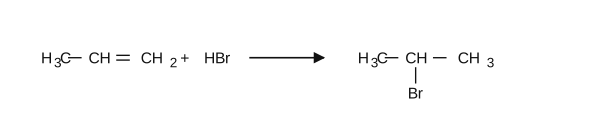
- COMEDK 2025Set 2025-E1 markMCQQ.Identify the type of reaction: (A) Electrophilic addition (B) Free radical substitution (C) Nucleophilic addition (D) Free radical addition
›Reveal solutionSolution
The reaction of propene with HBr under standard conditions (no peroxides, no light) follows Markovnikov’s rule, giving the more stable secondary carbocation intermediate, so the product is 2‑bromopropane. This makes it an electrophilic addition — option (A).
The key concept here is electrophilic addition to alkenes. Alkenes are electron‑rich (due to the π bond) and act as nucleophiles. When HBr approaches, the H⁺ (an electrophile) attacks first, forming a carbocation. The stability of that carbocation determines which carbon the Br⁻ ends up on. Under normal conditions (no peroxides, no light), the reaction follows Markovnikov’s rule: the hydrogen adds to the less‑substituted carbon, and the bromine adds to the more‑substituted carbon. Here, that gives 2‑bromopropane.
Let’s walk through it step by step:
-
Identify the substrate and reagent
Propene is CHX3−CH=CHX2, an unsymmetrical alkene. HBr is a polar molecule with a partial positive charge on H and partial negative on Br. No special conditions (peroxide, light, catalyst) are shown — so we assume ionic, not radical, mechanism.
-
First step: electrophilic attack
The π electrons of the double bond attack the H⁺ of HBr. This forms a carbocation and a bromide ion. Two possible carbocations could form:
- Primary carbocation (if H⁺ adds to the middle carbon): CHX3−CHX2−CHX2X+ (less stable)
- Secondary carbocation (if H⁺ adds to the terminal carbon): CHX3−CHX+−CHX3 (more stable, because it’s stabilised by two alkyl groups)
TipThe secondary carbocation is about 40 kJ/mol more stable than the primary one. This energy difference is the driving force for Markovnikov addition.
-
Second step: nucleophilic attack
The bromide ion (Br⁻) quickly attacks the positively charged carbon of the carbocation. In the secondary carbocation, that carbon is the middle carbon (C‑2). So Br⁻ attaches there, giving CHX3−CHBr−CHX3 — exactly the product shown.
-
Classify the reaction type
- Electrophilic addition: The alkene adds a molecule across the double bond, with the first step being attack by an electrophile (H⁺). This matches perfectly.
- Free radical substitution: Requires radicals (e.g., from peroxides or UV light) and typically replaces a hydrogen, not adds across a double bond.
- Nucleophilic addition: Alkenes are not electrophilic enough for direct nucleophilic attack; this would require a carbonyl or similar.
- Free radical addition: Would occur if peroxides were present (anti‑Markovnikov product), but here the product is Markovnikov, and no radical initiator is shown.
Watch outA classic pitfall: if you see HBr + alkene and no conditions, many students jump to “free radical addition” because they remember the peroxide effect. But the peroxide effect requires explicit presence of peroxides or light. Without them, the ionic Markovnikov mechanism dominates.
-
Confirm the product matches
The figure shows CHX3−CHBr−CHX3 (Br on the middle carbon). That is exactly the Markovnikov product. So the reaction is electrophilic addition.
✓Final answerThe correct option is (A).
ANSWER: A
-
- COMEDK 2025Set 2025-M1 markMCQQ.Which one of the following statements is correct?. (A) The major product formed when 2- Methylpropene reacts with dilute H2SO4 is tert. butyl alcohol. (B) The Electrophilic addition to an unsymmetrical alkene always occurs through the formation of a more stable Carbanion intermediate. (C) Between the two alkenes -(i) (CH3)2−C=CH−CH3 and (ii). C6H5−CH=CH−CH2−CH3, compound(i) will show geometrical isomerism (D) Greater the number of alkyl groups attached to the double bonded Carbon atoms, the less stable is the alkene.
›Reveal solutionSolution
The question tests fundamental concepts in alkene chemistry: acid-catalyzed hydration follows Markovnikov’s rule via a carbocation intermediate, not a carbanion; geometrical isomerism requires specific substitution patterns; and alkene stability increases with more alkyl substituents. The only correct statement is (A).
Let’s examine each statement carefully, using the principles of organic reaction mechanisms and structural theory.
-
Statement (A): “The major product formed when 2-methylpropene reacts with dilute H₂SO₄ is tert-butyl alcohol.”
- 2-Methylpropene is (CH₃)₂C=CH₂. In dilute H₂SO₄, the alkene undergoes electrophilic addition of water (hydration). The mechanism: the alkene protonates to form the more stable carbocation. Protonation can occur at either carbon of the double bond.
- Protonation at the terminal CH₂ gives a tertiary carbocation: (CH₃)₃C⁺ (very stable).
- Protonation at the central carbon gives a primary carbocation: (CH₃)₂CH–CH₂⁺ (much less stable).
- The reaction proceeds exclusively via the tertiary carbocation, which then reacts with water to give tert-butyl alcohol, (CH₃)₃COH.
- This is a textbook example of Markovnikov addition. So statement (A) is correct.
- 2-Methylpropene is (CH₃)₂C=CH₂. In dilute H₂SO₄, the alkene undergoes electrophilic addition of water (hydration). The mechanism: the alkene protonates to form the more stable carbocation. Protonation can occur at either carbon of the double bond.
-
Statement (B): “The electrophilic addition to an unsymmetrical alkene always occurs through the formation of a more stable carbanion intermediate.”
- This is false on two counts. First, the intermediate in electrophilic addition is a carbocation, not a carbanion. Second, the regioselectivity is governed by the stability of the carbocation (Markovnikov’s rule), not a carbanion.
- A carbanion would be involved in nucleophilic addition, not electrophilic addition. So (B) is incorrect.
-
Statement (C): “Between the two alkenes — (i) (CH₃)₂C=CH–CH₃ and (ii) C₆H₅–CH=CH–CH₂–CH₃ — compound (i) will show geometrical isomerism.”
- Geometrical isomerism (cis/trans or E/Z) requires that each carbon of the double bond has two different substituents.
- For (i): (CH₃)₂C=CH–CH₃. The left carbon has two methyl groups (identical), so it cannot show geometrical isomerism.
- For (ii): C₆H₅–CH=CH–CH₂–CH₃. The left carbon has H and C₆H₅ (different), the right carbon has H and CH₂CH₃ (different). So (ii) can show geometrical isomerism.
- Thus statement (C) is incorrect.
- Geometrical isomerism (cis/trans or E/Z) requires that each carbon of the double bond has two different substituents.
-
Statement (D): “Greater the number of alkyl groups attached to the double bonded carbon atoms, the less stable is the alkene.”
- In reality, alkyl groups are electron-donating and stabilize the double bond via hyperconjugation and inductive effects. More alkyl substituents mean greater stability.
- For example, tetramethylethylene (four alkyl groups) is more stable than ethylene (zero alkyl groups). So the statement is the opposite of the truth. Hence (D) is incorrect.
Watch outA common mistake is to confuse the intermediate in electrophilic addition (carbocation) with that in nucleophilic addition (carbanion). Also, for geometrical isomerism, both carbons of the double bond must have two different groups — a carbon with two identical groups (like two methyls) kills the possibility.
TipTo quickly recall alkene stability: more substituted alkenes are more stable. The order: tetrasubstituted > trisubstituted > disubstituted > monosubstituted > unsubstituted.
✓Final answerThe correct option is (A).
ANSWER: A
-
- KCET 2024Set B-21 markMCQQ.8.8 g of monohydric alcohol added to ethyl magnesium iodide in ether liberates 2240 cm3 of ethane at STP. This monohydric alcohol when oxidised using pyridinium-chlorochromate, forms a carbonyl compound that answers silver mirror test (Tollens’ test). The monohydric alcohol is : (A) butan-2-ol (B) 2,2-dimethyl propan-1-ol (C) pentan-2-ol (D) 2,2-dimethyl ethan-1-ol
›Reveal solutionSolution
The ethane volume fixes the moles of alcohol, giving a molar mass of 88 g/mol (a C5 alcohol). The Tollens-positive oxidation product means the alcohol is primary. The only primary C5 alcohol among the options is 2,2-dimethylpropan-1-ol (neopentyl alcohol) — option (B).
Two clues pin down the alcohol. The ethane released with the Grignard reagent gives its molar mass; the positive Tollens (silver-mirror) test on the oxidation product shows that product is an aldehyde, so the alcohol must be primary.
- Molar mass from the gas volume. A monohydric alcohol reacts with ethyl magnesium iodide as:
ROH+C2H5MgI→R–O–MgI+C2H6↑
One mole of alcohol releases one mole of ethane. At STP, 1 mole occupies 22400 cm3, so:
moles of ethane=224002240=0.1 mol
Thus moles of alcohol =0.1, and:
molar mass=0.18.8=88 g/mol
- Identify the carbon count. For CnH2n+2O:
12n+(2n+2)+16=88⟹14n+18=88⟹n=5
So the alcohol is C5H12O — a pentanol isomer.
-
Use the Tollens test to fix the structure.
PCC oxidises primary alcohols to aldehydes and secondary alcohols to ketones; only an aldehyde gives a silver mirror. So the alcohol is primary. Of the options, butan-2-ol (A) and pentan-2-ol (C) are secondary (they give ketones), and 2,2-dimethylethan-1-ol (D) is only a C4 name with molar mass 74 — it fails the mass check. The primary C5 alcohol is 2,2-dimethylpropan-1-ol (B).
-
Confirm the molar mass of the answer.
C5H12O: 5(12)+12(1)+16=88 g/mol — matches exactly.
Watch outDon't confuse "2,2-dimethylethan-1-ol" with neopentyl alcohol. Neopentyl alcohol is 2,2-dimethylpropan-1-ol (C5, molar mass 88); the "ethan" name has only 4 carbons (molar mass 74) and does not fit the gas data.
TipNeopentyl alcohol is the only primary C5 alcohol among the choices, so the Tollens test alone eliminates the secondary options even before the molar-mass calculation — a shortcut worth remembering for NCERT Class 12 Chemistry and JEE/NEET aldehyde–alcohol questions.
✓Final answerThe monohydric alcohol is 2,2-dimethylpropan-1-ol, which corresponds to option (B).
- COMEDK 2024Set 2024-M1 markMCQQ.
[!FORMULA] Identify [B] and [C] formed in the reactions given below.
(A) [B] Propene [C] Propanal (B) [B] Cyclopropane [C] Ethanal (C) [B] Propane [C] Ethanol (D) [B] Propyne [C] Propanone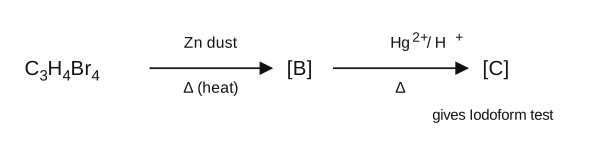
›Reveal solutionSolution
The key is to recognize that C₃H₄Br₄ is 1,1,2,2‑tetrabromopropane; Zn dust eliminates four bromines to give propyne ([B]), which then undergoes hydration with Hg²⁺/H⁺ to form propanone ([C]), which gives a positive iodoform test. The correct option is (D).
Concept and intuition:
The molecular formula C₃H₄Br₄ suggests a saturated four‑bromine derivative of propane. When treated with Zn dust and heat, vicinal dibromides lose Br₂ to form alkenes; here, with four bromines, two successive eliminations occur, yielding a triple bond. The product [B] is therefore an alkyne. Then, Hg²⁺/H⁺ hydration of terminal alkynes gives methyl ketones (Markovnikov addition), and methyl ketones give the iodoform test. So [C] must be a methyl ketone with three carbons — propanone (acetone). Let’s verify step by step.
- Identify the starting compound C₃H₄Br₄ With 3 carbons and 4 bromines, the only possible saturated structure is 1,1,2,2‑tetrabromopropane:
CH3–CBr2–CHBr2
(Other arrangements like 1,1,1,2‑tetrabromopropane would have a different H count; here H₄ fits exactly.)
- Reaction with Zn dust (dehalogenation) Zn dust removes vicinal bromine pairs. The first elimination gives an alkene:
CH3–CBr2–CHBr2ZnCH3–CBr=CHBr+ZnBr2
The second elimination (still with excess Zn) removes the remaining two bromines:
CH3–CBr=CHBrZnCH3–C≡CH+ZnBr2
So [B] is propyne (methylacetylene).
- Hydration of [B] with Hg²⁺/H⁺ Hg²⁺/H⁺ adds water across the triple bond following Markovnikov’s rule: the OH ends up on the more substituted carbon. For propyne:
CH3–C≡CH+H2OHg2+/H+CH3–C(OH)=CH2
The enol tautomerizes immediately to the more stable keto form:
CH3–C(OH)=CH2→CH3–CO–CH3
Thus [C] is propanone (acetone).
- Iodoform test confirmation Acetone (CH₃COCH₃) has a methyl group attached to the carbonyl carbon, so it gives a positive iodoform test (yellow precipitate of CHI₃). This matches the problem statement.
Watch outA common mistake is to think that Zn dust only removes two bromines to give an alkene, but here the reagent is in excess and heat drives the second elimination, giving an alkyne. Also, hydration of an internal alkyne would give a ketone, but propyne is terminal — yet the product is still a methyl ketone, so the iodoform test is positive.
TipRemember: terminal alkynes (R–C≡CH) always give methyl ketones (R–CO–CH₃) upon Hg²⁺/H⁺ hydration. This is a classic route to convert an alkyne into a ketone.
✓Final answerThe correct option is (D).
ANSWER: D
- KCET 2023Set D-21 markMCQQ.
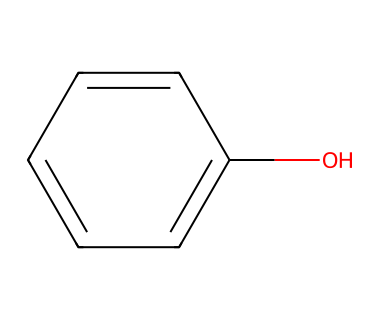 C6H5OH NaOH A(i) CO2(ii) H+B(i) (CH3CO)2O(ii) H+Y (Major product)
Y in the above reaction is
(A) Salicylaldehyde
(B) Aspirin
(C) Cumene
(D) Picric acid
C6H5OH NaOH A(i) CO2(ii) H+B(i) (CH3CO)2O(ii) H+Y (Major product)
Y in the above reaction is
(A) Salicylaldehyde
(B) Aspirin
(C) Cumene
(D) Picric acid›Reveal solutionSolution
Phenol → sodium phenoxide (NaOH) → salicylic acid (Kolbe–Schmitt, CO₂/H⁺) → acetylation with acetic anhydride gives aspirin.
Step 1 — A: sodium phenoxide.
Phenol is weakly acidic (pKa≈10) because the phenoxide left behind is resonance-stabilised. NaOH therefore deprotonates it:
C6H5OH+NaOH⟶C6H5O−Na++H2O
A=sodium phenoxide
Why this step is needed: the phenoxide ion is a far stronger activator of the ring than phenol itself (the full negative charge is delocalised onto the ortho and para carbons), making the ring nucleophilic enough to attack a weak electrophile like CO2 in the next step.
Step 2 — B: the Kolbe–Schmitt reaction → salicylic acid.
Sodium phenoxide is heated with CO2 under pressure (~400 K, 4–7 atm). The electron-rich ortho carbon attacks CO2 (electrophilic substitution on the ring); acidification with H+ then liberates the free acid:
C6H5O−Na+(i) CO2 (ii) H+ (2-hydroxybenzoic acid)o-HO-C6H4-COOH
B=salicylic acid
(The ortho product dominates because the incoming carboxylate is held near the phenoxide oxygen — chelation with Na+.)
Step 3 — Y: acetylation with acetic anhydride → aspirin.
Salicylic acid still has a free phenolic −OH. Acetic anhydride, (CH3CO)2O, acetylates that −OH to an ester (−OCOCH3), leaving the −COOH untouched:
o-HO-C6H4-COOH (CH3CO)2O/H+ o-CH3COO-C6H4-COOH
Y=acetylsalicylic acid=ASPIRIN
This is exactly the industrial preparation of aspirin, the analgesic/antipyretic (and antiplatelet) drug.
Step 4 — Eliminate the distractors.
- (A) Salicylaldehyde — that is the Reimer–Tiemann product (phenol + CHCl3/NaOH), not this route; and it would be intermediate B-like, never the final acetylated product.
- (C) Cumene — made by Friedel–Crafts alkylation of benzene with propene; it is a precursor of phenol, not a product of it.
- (D) Picric acid — 2,4,6-trinitrophenol, from nitration of phenol with conc. HNO3; no nitrating agent appears here.
✓Final answerThe correct option is (B) Aspirin — the sequence is phenol → sodium phenoxide → (Kolbe–Schmitt) salicylic acid → (acetylation) acetylsalicylic acid.
ANSWER: B
- KCET 2022Set B-31 markMCQQ.In Kolbes reaction the reacting substances are (A) Sodium phenate and CCl4 (B) Phenol and CHCl3 (C) Sodium phenate and CO2 (D) Phenol and CCl4
›Reveal solutionSolution
Kolbe’s reaction is a carboxylation of phenol using sodium phenoxide and carbon dioxide under pressure, giving salicylic acid. The correct reactants are sodium phenate and CO₂ — option (C).
The Kolbe–Schmitt reaction (commonly called Kolbe’s reaction) is a classic method to introduce a carboxyl group (–COOH) directly onto the aromatic ring of phenol. The key insight is that phenol itself is not reactive enough toward CO₂; you need the more nucleophilic phenoxide ion (from sodium phenate) to attack the electrophilic carbon of CO₂. The reaction proceeds under high pressure and temperature, and after acidification, yields ortho-hydroxybenzoic acid (salicylic acid).
Let’s walk through the reasoning step by step.
- What the reaction actually does Kolbe’s reaction converts phenol into salicylic acid. The overall transformation is:
C6H5OH1. NaOH, CO2,pressure, heatthen H+o-HO-C6H4-COOH
The carboxyl group attaches ortho to the –OH group. This is an electrophilic aromatic substitution where CO₂ acts as the electrophile.
-
Why sodium phenate is necessary
Phenol (C₆H₅OH) is a weak acid. Treating it with NaOH gives sodium phenoxide (C₆H₅O⁻Na⁺). The phenoxide ion is far more electron-rich than phenol itself — the negative charge on oxygen is delocalised into the ring, making the ortho and para positions strongly nucleophilic. CO₂ is a weak electrophile, so only the activated phenoxide can attack it.
Watch outA common mistake is to think phenol reacts directly with CO₂. It does not — the reaction requires the phenoxide ion. So the reactants are sodium phenate and CO₂, not phenol and CO₂.
-
The role of CO₂
Carbon dioxide is the source of the carboxyl group. Under pressure (about 4–7 atm) and heat (125–150°C), CO₂ inserts into the ortho position of the phenoxide ring. The intermediate is a salicylate salt, which upon acidification yields salicylic acid.
-
Eliminating the other options
- (A) Sodium phenate and CCl₄: CCl₄ is not involved in Kolbe’s reaction. It is used in the Reimer–Tiemann reaction (with CHCl₃) to introduce a formyl group.
- (B) Phenol and CHCl₃: This is the Reimer–Tiemann reaction, which gives salicylaldehyde, not salicylic acid.
- (D) Phenol and CCl₄: No standard reaction; CCl₄ does not carboxylate phenol. Only option (C) matches the actual reagents: sodium phenate and CO₂.
TipTo remember: Kolbe = Karboxylation (carboxyl group), uses CO₂ and the sodium salt of phenol. Reimer–Tiemann = Ring formylation, uses CHCl₃ and base.
✓Final answerThe correct option is (C) Sodium phenate and CO₂.
- KCET 2019Set A-11 markMCQQ.0.1 mole of XeF6 is treated with 1.8 g of water. The product obtained is (A) XeO3 (B) XeOF4 (C) XeO2F2 (D) Xe+XeO3
›Reveal solutionSolution
Compare moles: 0.1 mol XeF6 to 0.1 mol H2O is a 1 : 1 ratio, which gives partial hydrolysis to XeOF4, not full hydrolysis to XeO3.
Step 1 — Convert the water mass to moles.
M(H2O)=2(1)+16=18 g mol−1
n(H2O)=18 g mol−11.8 g=0.1 mol
Step 2 — Compare with the XeF6.
n(XeF6)=0.1 mol
⇒n(XeF6):n(H2O)=0.1:0.1=1:1
The whole question turns on this ratio — the stoichiometry of the water decides which product forms.
Step 3 — The hydrolysis ladder of XeF6.
XeF6 hydrolyses in stages, each water molecule replacing two F atoms by one O:
Water taken Reaction Product 1 mol (partial) XeF6+H2O→XeOF4+2HF XeOF4 2 mol (partial) XeF6+2H2O→XeO2F2+4HF XeO2F2 3 mol (complete) XeF6+3H2O→XeO3+6HF XeO3 Step 4 — Pick the stage set by our 1 : 1 ratio.
With exactly one mole of water per mole of XeF6, hydrolysis stops at the first stage:
XeF6+H2O⟶XeOF4+2HF
So 0.1 mol of XeOF4 (and 0.2 mol HF) is obtained.
Step 5 — Reject the others.
- (A) XeO3 — would require 0.3 mol (5.4 g) of water; we only have 1.8 g. This is the trap for anyone who ignores the stoichiometry.
- (C) XeO2F2 — needs 0.2 mol (3.6 g) of water. Not available.
- (D) Xe+XeO3 — that is the disproportionation of XeF6 in basic solution / hydrolysis of XeF4, not this reaction.
✓Final answerThe correct option is (B) XeOF4 — the product of partial (1 : 1) hydrolysis.
ANSWER: B
- KCET 2018Set A-11 markMCQQ.When the vapours of tertiary butyl alcohol are passed through heated copper at 573 K, the product formed is (A) But-2-ene (B) 2-Butanone (C) 2-Methyl propene (D) Butanal
›Reveal solutionSolution
Tertiary alcohols undergo dehydration to alkenes when passed over hot copper; the product is 2-methylpropene (isobutylene).
The key here is recognising what happens when an alcohol vapour is passed over heated copper at 573 K. This is a classic dehydration reaction — the copper acts as a catalyst, and the high temperature drives the elimination of water. For tertiary alcohols, the reaction follows Zaitsev’s rule, but because the alcohol is tertiary, the most substituted alkene is also the only possible one due to the carbon skeleton.
Let’s walk through it step by step.
-
Identify the alcohol. Tertiary butyl alcohol is (CH3)3COH — a tertiary carbon (attached to three methyl groups) bonded to an –OH group.
-
Recall the reaction conditions. Passing alcohol vapours over heated copper at 573 K is a standard method for dehydration. The copper catalyses the elimination of water, forming an alkene. This is similar to using concentrated H2SO4 at high temperature, but with a solid catalyst.
-
Determine the elimination product. Dehydration removes the –OH and a hydrogen from an adjacent carbon. In (CH3)3COH, the carbon bearing the –OH has no hydrogen atoms (it’s tertiary and fully substituted with methyl groups). So the hydrogen must come from one of the three methyl groups.
Removing a hydrogen from any methyl group gives the same alkene: the double bond forms between the central carbon and that methyl carbon. The product is (CH3)2C=CH2, which is 2-methylpropene (also called isobutylene).
-
Check the options.
- (A) But-2-ene: CH3CH=CHCH3 — requires a four-carbon straight chain, not possible here.
- (B) 2-Butanone: a ketone, not an alkene — no oxidation occurs under these conditions.
- (C) 2-Methylpropene: (CH3)2C=CH2 — matches our product.
- (D) Butanal: an aldehyde, again not formed by simple dehydration.
Watch outA common mistake is to think that tertiary butyl alcohol gives but-2-ene. But the carbon skeleton is branched — the central carbon is attached to three methyl groups, so elimination can only produce a branched alkene, not a straight-chain one.
TipFor any tertiary alcohol with identical alkyl groups (like three methyls), all β-hydrogens are equivalent, so only one alkene forms. This makes the product predictable without worrying about regioselectivity.
✓Final answerThe correct option is (C) 2-Methylpropene.
-
🎓Unlock everything free for 14 days
- ✓Full step-by-step solutions
- ✓Concept-first explanations
- ✓Methods, shortcuts & mistakes
- ✓PYQ mapping + timed mock tests
Full access for 14 days. No credit card required.