Q.(i) Give reasons :
🔒You're viewing a preview — the full solution, concept, methods & PYQ mapping are locked.
🔒 Start your 14-day free trial to unlock the full solution →Concept understanding — Nucleophilic Addition
Nucleophilic Addition – From Intuition to Precision
Imagine you have a molecule with a carbon–oxygen double bond — a carbonyl group (C=O). That oxygen is greedy for electrons; it pulls them away from carbon, leaving the carbon slightly positive (δ+) and the oxygen slightly negative (δ−). Now, if you bring a species that is rich in electrons (a nucleophile, meaning "nucleus-loving"), it will naturally be attracted to that electron-deficient carbon. The nucleophile attacks the carbon, the π bond breaks, and the oxygen picks up a proton (or some other electrophile) to become stable. That, in a nutshell, is nucleophilic addition.
The key idea: a nucleophile adds across a polar multiple bond (usually C=O or C≡N), breaking the π bond and forming two new sigma bonds.
The Precise Statement
Nucleophilic addition is a reaction in which a nucleophile (an electron-rich species) forms a sigma bond with an electrophilic carbon atom of a polar multiple bond (typically a carbonyl group, C=O, or a nitrile, C≡N), while the π bond breaks. The resulting intermediate then captures a proton (or another electrophile) to give a neutral product.
In general form:
RX2C=O+NuX−HX+RX2C(OH)Nu
The nucleophile (NuX−) attacks the carbonyl carbon; the oxygen becomes negatively charged; then a proton (HX+) from the medium attaches to the oxygen, yielding an alcohol.
Why It Happens – The Driving Force
The carbonyl carbon is electrophilic because:
- Oxygen is more electronegative than carbon, so the C=O bond is polarised: CXδ+=OXδ−.
- The π bond is weaker than a σ bond, so it can break relatively easily.
A nucleophile (like OHX−, CNX−, or NHX3) has a lone pair or a negative charge. It seeks positive centres. The attack forms a new σ bond, and the π electrons move entirely to oxygen, creating an alkoxide ion (RX2C−OX−). This intermediate is then quenched by a proton.
A common mistake: thinking the nucleophile attacks the oxygen. No — oxygen is already electron-rich; the nucleophile goes to the carbon because it is electron-deficient.
A Concrete Example – Addition of HCN to a Ketone
Take acetone (CHX3COCHX3) and hydrogen cyanide (HCN). In the presence of a base, CNX− (the nucleophile) attacks the carbonyl carbon:
CHX3COCHX3+CNX−CHX3C(OX−)(CN)CHX3
The alkoxide intermediate then picks up a proton from HCN (or from water) to give a cyanohydrin:
CHX3C(OX−)(CN)CHX3+HX+CHX3C(OH)(CN)CHX3
The product is acetone cyanohydrin. Notice: two new sigma bonds formed (C−CN and O−H), and the π bond is gone.
What Makes a Good Nucleophile?
Strong nucleophiles are usually negatively charged or have lone pairs:
- OHX−, CNX−, NHX2X−, CHX3OX−, HX− (from hydride reagents like NaBHX4 or LiAlHX4)
- Neutral but polarisable: NHX3, HX2O (weaker, but can add under acidic conditions) …
Why this formula?
Nucleophilic Addition: Why the Mechanism Works the Way It Does
Let's build this from first principles — understanding why nucleophilic addition happens, not just memorising the steps.
1. The Core Problem: Why Does Addition Happen at All?
A carbonyl group (C=O) has a polarised double bond:
- Oxygen is more electronegative than carbon → it pulls electron density toward itself.
- This creates a partial positive charge on carbon (δ+) and a partial negative charge on oxygen (δ−).
CXδ+=OXδ−
Key insight: The carbon is electron-deficient — it wants electrons. A nucleophile (Nu⁻) is electron-rich — it wants to give electrons. This is a natural match.
2. The Two-Step Mechanism (Why Two Steps?)
Step 1: Nucleophilic Attack (Slow, Rate-Determining)
The nucleophile donates its lone pair to the electrophilic carbonyl carbon.
NuX−+C=O[Nu−C−O]X−
Why this happens:
- The π bond between C and O breaks — the electrons move entirely to oxygen.
- Oxygen now has a full negative charge (alkoxide ion).
- The carbon changes from sp2 (trigonal planar) to sp3 (tetrahedral).
This step is slow because the π bond must break — it requires energy.
Step 2: Protonation (Fast)
The negatively charged oxygen picks up a proton (HX+) from the solvent or acid.
[Nu−C−O]X−+HX+Nu−C−OH
Why this happens:
- The alkoxide ion is a strong base — it wants to neutralise its charge.
- Protonation gives a stable neutral alcohol product.
3. The Key Formula: Rate Law Derivation
For a general nucleophilic addition:
NuX−+RX2C=Okproducts
The rate law comes from the slow step (Step 1):
Rate=k[Nu−][RX2C=O]
Why this form?
- The reaction is bimolecular — two species must collide with correct orientation.
- Doubling either concentration doubles the rate (first order in each).
- This is second order overall.
Exam tip: This is why nucleophilic addition is often called addition-elimination when followed by loss of a leaving group (like in acyl substitution), but here it's just addition.
4. Why the Tetrahedral Intermediate Forms (And Why It's Unstable)
The intermediate is tetrahedral (sp3 hybridised carbon):
- Bond angles: ~109.5°
- Four groups around carbon: Nu, R, R', O⁻
Why it's unstable:
- The negative charge on oxygen is high-energy.
- The tetrahedral geometry is sterically crowded (especially with bulky R groups).
- The intermediate collapses quickly — either back to starting materials or forward to product. …
These test carbonyl reactivity, acidity of substituted acids and α-hydrogens, and simple distinguishing tests (iodoform); the OR part covers HVZ, Rosenmund, Cannizzaro and short conversions. …
(i) HCHO more reactive (no +I/steric alkyl); nitroacetic acid more acidic (–I of NO2); α-H acidic due to enolate resonance. (ii) iodoform distinguishes ethanal/pentan-2-one from propanal/pentan-3-one. OR: HVZ, Rosenmund, Cannizzaro products + two conversions.
Concept. Reactivity, acidity and characteristic tests of carbonyl compounds and carboxylic acids — CBSE Class-12 aldehydes-ketones-and-carboxylic-acids.
(i) Reasons.
- In nucleophilic addition of HCN, the nucleophile attacks the carbonyl carbon. In HCHO there is no alkyl group, whereas CH3CHO has a methyl group that (i) donates electrons (+I effect), lowering the carbon's positive character, and (ii) sterically hinders attack. So HCHO is more reactive.
- The −NO2 group is strongly electron-withdrawing (–I). In O2N-CH2-COOH it stabilises the conjugate base (carboxylate) by dispersing its negative charge, so the acid ionises more readily — lower pKa (stronger acid) than CH3COOH, whose CH3 is electron-donating.
- The α-hydrogen is acidic because, on its removal, the resulting carbanion is stabilised by resonance with the adjacent carbonyl group (delocalisation onto oxygen — the enolate ion).
(ii) Distinguishing tests.
(a) Ethanal vs propanal: Ethanal (CH3CHO) has a CH3-CO- group and gives a positive iodoform test (yellow precipitate of CHI3 with I2/NaOH); propanal (CH3CH2CHO) does not.
(b) Pentan-2-one vs pentan-3-one: Pentan-2-one, CH3-CO-CH2CH2CH3, is a methyl ketone and gives a positive iodoform test; pentan-3-one, CH3CH2-CO-CH2CH3, has no CH3-CO- group and is iodoform-negative.
OR — Alternative.
(i) Products:
(a) HVZ reaction: CH3CH2COOHCl2/red PCH3-CHCl-COOH (2-chloropropanoic acid).
(b) Rosenmund reduction: C6H5COClH2,Pd-BaSO4C6H5CHO (benzaldehyde) + HCl. …
Showing the 12 most recent of 29 on this concept.
- COMEDK 2026Set 2026-M1 markMCQQ.An aliphatic compound [X], Molecular formula (C4H10O) can be prepared from Acetone and R−Mg−X. [X] with 20% Phosphoric acid gives an unsaturated compound C4H8[Y]. Compound [Y] is also obtained on heating [X] with Copper metal at 573 K . [X] shows no reaction with PCC but on heating with acidified KMnO4 it forms Acetone +CO2+H2O. Compounds [X] and [Y] are ____ and ____ (A) [X]: Butan-2-ol [Y]: But-2-ene (B) [X]: 2-Methylpropan-1-ol [Y]: But-1-ene (C) [X]: 2-Methylpropan-2-ol [Y]: 2-Methylpropene (D) [X]: Butan-1-ol [Y]: But-1-ene
›Reveal solutionSolution
The key is to identify the alcohol that can be made from acetone via a Grignard reaction, dehydrates to an alkene, and oxidatively cleaves back to acetone and CO₂. The only match is 2‑methylpropan‑2‑ol (tert‑butyl alcohol) and 2‑methylpropene (isobutylene), so the correct option is (C).
We start with the molecular formula C₄H₁₀O — that’s an alcohol or an ether. The clues will narrow it down to a specific alcohol, and then to its dehydration product.
Concept & Intuition
The problem is a classic organic detective puzzle. Each reaction is a fingerprint:
- A Grignard reaction with acetone tells us the alcohol has a specific carbon skeleton.
- Dehydration with H₃PO₄ gives an alkene.
- The same alkene forms from catalytic dehydrogenation over copper.
- No reaction with PCC means it’s a tertiary alcohol (PCC oxidizes 1° and 2° alcohols, but not 3°).
- Hot acidic KMnO₄ cleaves alkenes or oxidizes alcohols; here it gives back acetone + CO₂, which reveals the structure of the original alcohol.
Let’s walk through step by step.
- Grignard synthesis from acetone Acetone is (CH₃)₂C=O. A Grignard reagent R–Mg–X adds to the carbonyl, and after hydrolysis we get a tertiary alcohol:
(CH3)2C=O+R–Mg–XH3O+(CH3)2C(OH)–R
The product has the formula C₄H₁₀O. Acetone contributes C₃H₆O; adding R gives C₄H₁₀O, so R must be –CH₃. Thus the alcohol is
(CH3)2C(OH)CH3=2‑methylpropan‑2‑ol (tert‑butyl alcohol).
This already rules out butan‑1‑ol, butan‑2‑ol, and 2‑methylpropan‑1‑ol — none of those can be made from acetone in one Grignard step.
- Dehydration with 20% H₃PO₄ Tertiary alcohols dehydrate easily (E1 mechanism) to the most substituted alkene (Zaitsev’s rule).
(CH3)3C–OHH+(CH3)2C=CH2+H2O
That’s 2‑methylpropene (isobutylene), C₄H₈. So [Y] is 2‑methylpropene.
-
Copper catalysis at 573 K
Heating an alcohol over copper at ~570 K causes dehydrogenation to a carbonyl if it’s a 1° or 2° alcohol, but for a tertiary alcohol it dehydrates to an alkene (because no α‑H is available for carbonyl formation). Indeed, tert‑butyl alcohol gives isobutylene. This matches [Y].
-
No reaction with PCC
PCC (pyridinium chlorochromate) oxidizes 1° alcohols to aldehydes and 2° alcohols to ketones, but tertiary alcohols are not oxidised. [X] shows no reaction — consistent with a tertiary alcohol.
-
Hot acidic KMnO₄ oxidation
This is the clincher. Hot KMnO₄ is a strong oxidant. It cleaves alkenes at the double bond, and also oxidises alcohols. Here it produces acetone + CO₂ + H₂O.
- If [X] were a 1° or 2° alcohol, it would be oxidised to a carboxylic acid or ketone, not cleaved to acetone and CO₂. …
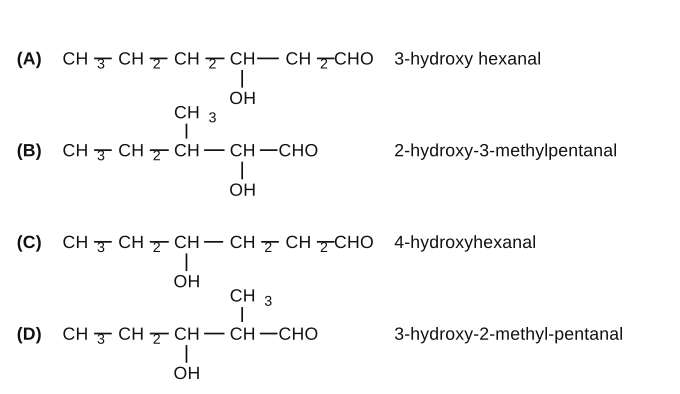
- COMEDK 2026Set 2026-M1 markMCQQ.Propanal on reaction with dilute NaOH , undergoes aldol condensation resulting in the formation of a compound A . identify the correct structure of A and name of the compound. (A) (B) (C) (D)
›Reveal solutionSolution
Propanal undergoes aldol condensation with dilute NaOH to form 3‑hydroxy‑2‑methylpentanal, which matches the structure in option (B).
Concept & Intuition
Aldol condensation between two identical aldehydes (here, propanal) begins with the formation of an enolate ion on one molecule. That enolate attacks the carbonyl carbon of another propanal molecule, creating a new carbon–carbon bond. The product is a β‑hydroxy aldehyde (an “aldol”). Because propanal has α‑hydrogens only on the carbon next to the CHO group, the reaction is regioselective: the new bond always forms between the α‑carbon of one molecule and the carbonyl carbon of another. The resulting aldol has a hydroxyl group on the β‑carbon relative to the aldehyde, and the chain length increases by three carbons (the original three plus the two from the α‑carbon of the attacking unit, but careful counting gives a five‑carbon backbone).
Step‑by‑Step Reasoning
-
Identify the reactive site
Propanal is CH3CH2CHO. The α‑carbon (the carbon adjacent to the carbonyl) is CH2—it has two hydrogens that can be removed by dilute NaOH to form an enolate.
-
Enolate formation
NaOH abstracts an α‑hydrogen, giving a resonance‑stabilized enolate:
CH3CH2CHO+OH−→CH3CH=CH(O−)+H2O
The negative charge is delocalized onto the oxygen, making the α‑carbon nucleophilic.
- Nucleophilic attack The enolate attacks the carbonyl carbon of a second propanal molecule:
CH3CH=CH(O−)+CH3CH2CHO→CH3CH2CH(O−)CH(CH3)CHO
This forms a new C–C bond between the α‑carbon of the first molecule and the carbonyl carbon of the second.
- Protonation The alkoxide intermediate picks up a proton from water (or from the solvent), yielding the neutral aldol product:
CH3CH2CH(OH)CH(CH3)CHO
This is 3‑hydroxy‑2‑methylpentanal. The longest carbon chain containing the aldehyde group has five carbons: the aldehyde carbon (C1), then C2 with a methyl branch, C3 with the OH, and C4–C5 as an ethyl group.
- Match with options
- Option (A): 3‑hydroxyhexanal — six‑carbon chain, no methyl branch. Incorrect. …
-
- COMEDK 2026Set 2026-M1 markMCQQ.Which of the following is NOT TRUE about nucleophilic addition reactions of aldehydes? (A) 2,4 DNP derivatives are useful to identify aldehydes and ketones (B) Hemiacetals are gem-dialkoxy compounds (C) The hydrogensulphite addition product is useful for separation and purification of aldehydes (D) Aldehydes and ketones react very slowly with pure HCN to yield cyanohydrins
›Reveal solutionSolution
The question asks which statement about nucleophilic addition reactions of aldehydes is not true. The key is to recall that hemiacetals contain one alkoxy and one hydroxyl group on the same carbon, not two alkoxy groups — so option (B) is false. The correct answer is (B).
Concept & Intuition
Nucleophilic addition to the carbonyl group of aldehydes (and ketones) is a fundamental reaction in organic chemistry. Each option tests a specific fact about these reactions. To find the false statement, we need to recall the exact definitions and reactivity patterns:
- 2,4-DNP derivatives are indeed used for identification.
- Hemiacetals are not gem-dialkoxy compounds; that description fits acetals.
- Bisulfite addition products are useful for purification.
- HCN adds slowly to pure carbonyl compounds, but is catalyzed by base.
Let’s examine each option carefully.
Step-by-step reasoning
-
Option (A): “2,4 DNP derivatives are useful to identify aldehydes and ketones”
- 2,4-Dinitrophenylhydrazine (2,4-DNP) reacts with the carbonyl group to form a bright orange/red precipitate (a hydrazone).
- This is a classic test for aldehydes and ketones, and the melting point of the derivative helps identify the specific compound.
- True.
-
Option (B): “Hemiacetals are gem-dialkoxy compounds”
- A hemiacetal forms when one molecule of alcohol adds to a carbonyl group: the carbon gains one –OR (alkoxy) and one –OH (hydroxyl) group.
- “Gem-dialkoxy” means two alkoxy groups on the same carbon — that describes an acetal, not a hemiacetal.
- Therefore, this statement is false.
-
Watch out
A common mistake is confusing hemiacetals (one –OR, one –OH) with acetals (two –OR groups). Remember: “hemi” means half — only one alkoxy group. …
- KCET 2026Set D31 markMCQQ.Match the reagents in List - I with products obtained from their carbonyl compounds in List - II. List - I:(a) NH2OH(b) R-NH2(c) R-OH(d) H-C≡N List - II:(i) Cyanohydrin(ii) Oxime(iii) Schiff base(iv) Acetal Codes: (A) a - ii, b - iii, c - iv, d - i (B) a - i, b - ii, c - iii, d - iv (C) a - iii, b - ii, c - i, d - iv (D) a - i, b - iii, c - ii, d - iv
›Reveal solutionSolution
Match each nitrogen/oxygen/carbon nucleophile to the standard named product it forms on addition to a carbonyl (aldehyde/ketone) compound.
Step 1 — NH2OH (hydroxylamine) → Oxime
Hydroxylamine's nitrogen attacks the carbonyl carbon; after loss of water the C=O becomes C=N−OH, an oxime. So a → (ii).
Step 2 — R−NH2 (primary amine) → Schiff base
A primary amine condenses with a carbonyl compound, again losing water, to form an imine C=N−R, commonly called a Schiff base. So b → (iii).
Step 3 — R−OH (alcohol) → Acetal …
- KCET 2025Set D-41 markMCQQ.Oxidation of Toluene with chromyl chloride followed by hydrolysis gives Benzaldehyde. This reaction is known as (A) Etard reaction (B) Kolbe reaction (C) Stephen reaction (D) Cannizzaro Reaction
›Reveal solutionSolution
Toluene + CrO2Cl2 → a chromium complex → hydrolysis → benzaldehyde: this is the named Etard reaction.
Step 1 — The reaction.
C6H5CH3CrO2Cl2CS2 or CCl4(brown chromium complex)H3O+C6H5CHO
The methyl group of toluene is oxidised to a –CHO group, giving benzaldehyde.
Step 2 — Why it is a named reaction: the over-oxidation problem it solves.
The methyl side-chain of toluene is easy to oxidise, but too easy — ordinary oxidising agents like acidic KMnO4 or K2Cr2O7 blow straight past the aldehyde stage and give benzoic acid:
C6H5CH3KMnO4/H+C6H5COOH
Chromyl chloride is special because the first-formed product is not the free aldehyde but a stable chromium complex (the Etard complex). Being locked up in that complex, the carbon is protected from further oxidation. Only on hydrolysis in a separate step is the aldehyde released — by which time the oxidant is spent. That two-stage trapping is precisely what makes the reaction stop at −CHO.
Step 3 — Identify the name.
The oxidation of a methylarene to an aryl aldehyde using chromyl chloride, followed by hydrolysis, is the Etard reaction.
Step 4 — Rejecting the other named reactions.
- (B) Kolbe reaction — carboxylation of sodium phenoxide with CO2 under pressure, giving salicylic acid. Involves phenol, not toluene, and no chromyl chloride. …
- COMEDK 2025Set 2025-A1 markMCQQ.Choose the incorrect statement. (A) The increasing order of boiling points of 5 compounds having comparable molar masses is as follows: Methoxyethane < Propanone < Propanal < Propan-1-ol (B) During nucleophilic addition of HCN to RCHO , the hybridisation changes from sp2 to sp3 and a tetrahedral intermediate is formed. (C) Acetone undergoes Wolff Kishner reaction to yield Propane. (D) The order of reactivity towards Nucleophilic attack is Methanal > Di-tert.butyl ketone > Benzaldehyde > Acetophenone
›Reveal solutionSolution
Statement (A) reverses propanone and propanal: a ketone boils higher than the isomeric aldehyde, so the correct order is methoxyethane < propanal < propanone < propan-1-ol. Hence (A) is the incorrect statement.
Check each statement:
- (A) Given order: methoxyethane < propanone < propanal < propan-1-ol. Actual boiling points (comparable masses ~58–60): methoxyethane ≈7∘C (ether, no H-bonding), propanal ≈49∘C, propanone ≈56∘C, propan-1-ol ≈97∘C (strong H-bonding). Because ketones (dipole slightly larger, two alkyl groups) boil higher than the isomeric aldehydes, the correct order is methoxyethane < propanal < propanone < propan-1-ol. Statement (A) places propanone below propanal, which is wrong. Incorrect.
- (B) Nucleophilic addition of HCN to RCHO changes carbonyl carbon from sp2 to sp3, giving a tetrahedral (cyanohydrin) intermediate — correct. …
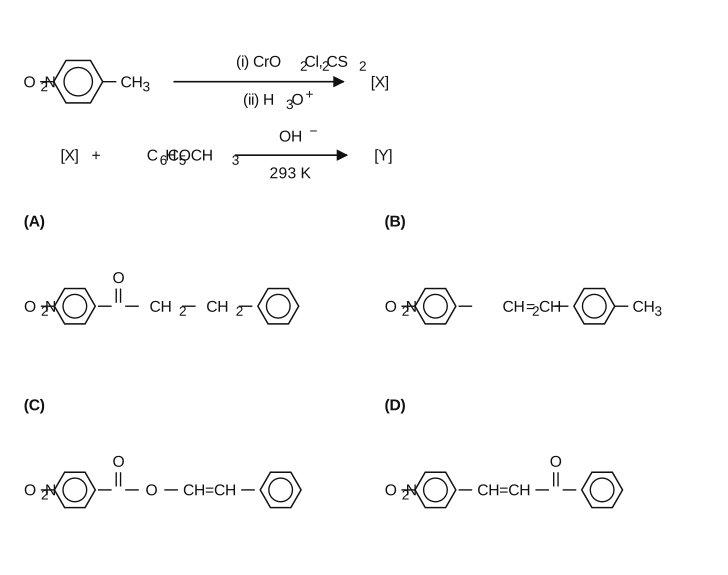
- COMEDK 2025Set 2025-E1 markMCQQ.Identify the final product [Y] in the following reaction. (A) (B) (C) (D)
›Reveal solutionSolution
The reaction sequence is an Etard oxidation of 4-nitrotoluene to 4-nitrobenzaldehyde, followed by a crossed aldol (Claisen–Schmidt) condensation with acetophenone under basic conditions, yielding an α,β-unsaturated ketone — specifically (E)-4-nitrochalcone — which corresponds to option (D).
The key concept here is the Etard reaction followed by a crossed aldol condensation (specifically a Claisen–Schmidt reaction). The Etard reaction selectively oxidizes a methyl group directly attached to an aromatic ring to an aldehyde, without over-oxidizing to the carboxylic acid. Then, under basic conditions, the aldehyde undergoes a condensation with a ketone that has an α-hydrogen (acetophenone), forming a conjugated enone. The product is an α,β-unsaturated ketone where the double bond is between the two aromatic systems and the carbonyl is adjacent to the unsubstituted phenyl ring.
Let’s walk through it step by step.
- Step 1: Etard oxidation of 4-nitrotoluene The starting material is para-nitrotoluene (a benzene ring with a nitro group at one end and a methyl group at the opposite end). Reagent: CrO₂Cl₂ (chromyl chloride) in CS₂, followed by aqueous H₃O⁺. This is the classic Etard reaction. Chromyl chloride forms a complex with the benzylic methyl group, which upon hydrolysis gives a benzaldehyde. The nitro group is unaffected. Therefore, [X] is 4-nitrobenzaldehyde:
O2N−C6H4−CHO
-
Step 2: Crossed aldol (Claisen–Schmidt) condensation
[X] (4-nitrobenzaldehyde) is reacted with acetophenone (C₆H₅COCH₃) in the presence of OH⁻ at 293 K.
Acetophenone has an α-hydrogen on the methyl group adjacent to the carbonyl. Under basic conditions, this α-hydrogen is abstracted, forming an enolate.
The enolate attacks the electrophilic carbonyl carbon of 4-nitrobenzaldehyde. This is a crossed aldol because one partner (the aldehyde) has no α-hydrogens (so it cannot self-condense), and the other (the ketone) provides the enolate.
The initial aldol addition product is a β-hydroxy ketone, but under the reaction conditions (base, mild heat) it immediately undergoes dehydration to form a conjugated enone.
The dehydration occurs because the resulting α,β-unsaturated system is highly stabilized by conjugation with both the nitro-substituted ring and the carbonyl group.
-
Structure of the final product [Y]
The dehydration removes a water molecule from the β-hydroxy ketone, creating a carbon-carbon double bond between the α and β carbons relative to the carbonyl.
The double bond is formed between the carbon that was the aldehyde carbon (now β to the carbonyl) and the α-carbon of the original acetophenone.
Thus, the product is:
- COMEDK 2025Set 2025-M1 markMCQQ.Which one of the following reactions does not give the correct combination of reactants and the major products formed in the reaction? (A) CH3−CO−CH3+NH2−NH−CO−NH2( weakly basic )→(CH3)2C=N−NH−CO−NH2 (B) CH3CHO+2C2H5OH( dry HCl gas )⇋CH3−CH−(OC2H5)2 (C) CH3−CH=CH−CH2−CH2−CN (i). DIBAL-H (ii). H2OCH3−(CH2)4−CHO (D) C6H5−CO−CH3+I2+Na2CO3( Heat )→CHI3+C6H5COO−−
›Reveal solutionSolution
The key is to check each reaction for the correct major product under the given conditions. Only option (C) fails because DIBAL-H reduces a nitrile to an aldehyde but stops at the aldehyde stage only when the reaction is quenched under controlled conditions; here the product shown is a saturated aldehyde, but the starting material has a double bond that would also be reduced, so the given product is not the major one.
Concept & Intuition
Each reaction tests a specific named reaction or functional-group transformation. To spot the incorrect one, you must recall the exact conditions and the regioselectivity/chemoselectivity of the reagents. The pitfall in (C) is that DIBAL-H (diisobutylaluminium hydride) reduces a nitrile to an aldehyde, but it also reduces carbon‑carbon double bonds if they are present — and here the starting material contains an alkene. The product shown ignores that reduction, so it is not the major product.
Step‑by‑Step Reasoning
-
Option (A): Acetone reacts with semicarbazide (NH₂–NH–CO–NH₂) under weakly basic conditions to form a semicarbazone. The carbonyl oxygen is replaced by =N–NH–CO–NH₂. This is the classic semicarbazone formation; the product shown is correct. ✓
-
Option (B): Acetaldehyde reacts with two equivalents of ethanol in the presence of dry HCl gas to form an acetal. The mechanism: protonation of the carbonyl, nucleophilic attack by ethanol, loss of water, then a second ethanol attack gives the geminal diether. The product CH₃–CH(OC₂H₅)₂ is the correct acetal. ✓
-
Option (C): The starting material is an unsaturated nitrile: CH₃–CH=CH–CH₂–CH₂–CN. DIBAL‑H at low temperature reduces the nitrile to an imine, which upon aqueous work‑up gives an aldehyde. However, DIBAL‑H also reduces isolated alkenes (it is a strong hydride donor). The double bond would be hydrogenated under these conditions. Therefore the major product after work‑up would be the saturated aldehyde CH₃–(CH₂)₄–CHO, but the reaction as written shows the same saturated aldehyde — wait, that is exactly what is shown! Let’s re‑examine: the product given is CH₃–(CH₂)₄–CHO, which is indeed the fully saturated aldehyde. So why is this wrong? Because the starting material has a double bond between C3 and C4 (numbering from the methyl end). After reduction, the double bond is gone, so the product should be CH₃–(CH₂)₄–CHO. That matches. But the problem says “does not give the correct combination”. The catch: DIBAL‑H is typically used at –78 °C to selectively reduce nitriles to aldehydes without touching other reducible groups. At that low temperature, the alkene might survive. However, the reaction conditions here are not specified with a low temperature; they simply say “(i) DIBAL‑H, …
-
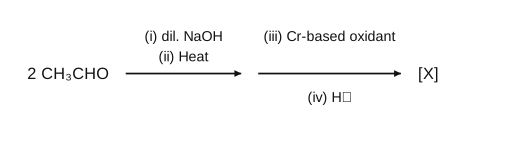
- COMEDK 2025Set 2025-M1 markMCQQ.Identify [X], the final product formed when 2 moles of Ethanal undergoes the following series of reactions with reagents [(i) to (iv)] (A) But-3-enoic acid (B) But-2-enoic acid (C) Propanoic acid (D) Ethanoic acid
›Reveal solutionSolution
The reaction sequence is an aldol condensation of acetaldehyde followed by oxidation of the resulting α,β-unsaturated aldehyde to the corresponding carboxylic acid. The final product is but-2-enoic acid (crotonic acid), so the correct option is (B).
Concept & Intuition
This problem tests your understanding of two classic carbonyl reactions in sequence:
- Aldol condensation – When two molecules of acetaldehyde are treated with dilute NaOH and then heated, they undergo a base-catalyzed aldol addition followed by dehydration. The result is an α,β-unsaturated aldehyde (crotonaldehyde).
- Oxidation of an aldehyde to a carboxylic acid – The aldehyde group in crotonaldehyde is then oxidized by a chromium-based reagent (like chromic acid, H₂CrO₄, or K₂Cr₂O₇/H⁺) to give the corresponding carboxylic acid. The carbon–carbon double bond remains intact under these mild oxidative conditions.
The key insight: the double bond formed in the aldol step is conjugated with the carbonyl, and it survives the oxidation step. So the final product is an unsaturated carboxylic acid with four carbons.
Step-by-step reasoning
- Aldol addition Two molecules of acetaldehyde (CH₃CHO) react in the presence of dilute NaOH. One molecule acts as the enolate (nucleophile) and attacks the carbonyl carbon of the other. This gives 3-hydroxybutanal (aldol):
CH3CHO+CH3CHOdil. NaOHCH3CH(OH)CH2CHO
- Dehydration (heat) On heating, the β-hydroxy aldehyde undergoes elimination of water to form a conjugated α,β-unsaturated aldehyde. The more stable trans isomer is the major product:
CH3CH(OH)CH2CHOΔCH3CH=CHCHO+H2O
This compound is crotonaldehyde (but-2-enal).
- Oxidation with Cr(VI) reagent The aldehyde group is oxidized to a carboxylic acid by a chromium-based oxidant (e.g., H₂CrO₄ or K₂Cr₂O₇ in acidic medium). The double bond is not affected under these conditions:
- COMEDK 2024Set 2024-A1 markMCQQ.Which of the following compounds undergo Aldol condensation followed by dehydration to give 3-phenylprop-2-en-1-al? (A) Benzaldehyde and Acetophenone (B) Two molecules of Benzaldehyde (C) Benzaldehyde and Acetone (D) Benzaldehyde and Ethanal
›Reveal solutionSolution
The target, 3-phenylprop-2-en-1-al (cinnamaldehyde), is the crossed-aldol/dehydration product of benzaldehyde and ethanal: benzaldehyde lacks α-H, so the enolate of ethanal (CH3CHO) attacks it, and loss of water gives C6H5CH=CH−CHO.
The product 3-phenylprop-2-en-1-al is cinnamaldehyde, C6H5−CH=CH−CHO (3 carbons in the propenal chain + phenyl).
A crossed aldol needs one carbonyl without α-hydrogen (benzaldehyde) and one with α-hydrogen (ethanal):
C6H5CHO+CH3CHOOH−C6H5−CH(OH)−CH2−CHO−H2OC6H5−CH=CH−CHO …
- COMEDK 2024Set 2024-E1 markMCQQ.What is/are the product/s formed when Benzaldehyde and Ethanal react in presence of dil. NaOH followed by heating the intermediate product formed? (A) 2-Methylpent-2-enal & But-2-enal (B) 3-Phenylprop-2-enal & But-2-enal (C) Only product is But-2-enal (D) Only product is 2-Phenylprop-2-enal
›Reveal solutionSolution
The reaction is a crossed aldol condensation between benzaldehyde and ethanal in dilute NaOH, followed by dehydration. The major products are 3-phenylprop-2-enal (cinnamaldehyde) from the crossed reaction and but-2-enal from self-condensation of ethanal. The correct option is (B).
The key concept here is the crossed (mixed) aldol condensation between an aromatic aldehyde (benzaldehyde) and an aliphatic aldehyde (ethanal) under basic conditions. Benzaldehyde has no alpha-hydrogens, so it cannot form an enolate; it can only act as the electrophile. Ethanal has alpha-hydrogens and can form an enolate, acting as the nucleophile. In dilute NaOH, both self-condensation of ethanal and crossed condensation with benzaldehyde occur. Upon heating, the intermediate β-hydroxy aldehydes dehydrate to form α,β-unsaturated aldehydes.
-
Identify the reactants and their roles
- Benzaldehyde (C₆H₅CHO): no α-hydrogens → cannot form enolate; acts only as the electrophile (carbonyl carbon).
- Ethanal (CH₃CHO): has α-hydrogens → forms enolate in base; acts as the nucleophile.
-
Self-condensation of ethanal
Two molecules of ethanal undergo aldol addition:
CH3CHO+CH3CHOdil. NaOHCH3CH(OH)CH2CHO
This is 3-hydroxybutanal. On heating, it dehydrates:
CH3CH(OH)CH2CHOΔCH3CH=CHCHO+H2O
The product is but-2-enal (crotonaldehyde).
- Crossed condensation (benzaldehyde + ethanal) The enolate of ethanal attacks the carbonyl carbon of benzaldehyde:
C6H5CHO+CH3CHOdil. NaOHC6H5CH(OH)CH2CHO
This is 3-hydroxy-3-phenylpropanal. On heating, it dehydrates:
C6H5CH(OH)CH2CHOΔC6H5CH=CHCHO+H2O
The product is 3-phenylprop-2-enal (cinnamaldehyde).
-
Why no other crossed product?
Benzaldehyde cannot form an enolate, so it cannot attack another aldehyde. Thus, the only possible crossed product is the one where ethanal enolate attacks benzaldehyde.
-
Heating step …
-
- COMEDK 2024Set 2024-E1 markMCQQ.Compounds A and B, having the same molecular formula (C4H8O), react separately with CH3MgBr, followed by reaction with dil. HCl to form compounds X and Y respectively. Compound Y undergoes acidic dehydration in presence of Conc. H2SO4 much more readily than X. Compound Y also reacts with Lucas reagent, much more readily than X, with appearance of turbidity. Identify X and Y. (A) X= Pentan −1−olY= Pentan −2−ol (B) X= Butan-2-ol Y= 2-Methylpropan-2-ol (C) X= Pentan-1-ol Y=2− Methylpentan-2-ol (D) X= Pentan-2-ol Y=2-Methylbutan-2-ol
›Reveal solutionSolution
The key is that A and B are C₄H₈O carbonyl compounds (likely an aldehyde and a ketone) that react with CH₃MgBr to give alcohols X and Y. Y dehydrates and reacts with Lucas reagent much faster, so Y must be a tertiary alcohol. The only option where Y is tertiary and X is primary/secondary from C₄H₈O precursors is (B).
Concept & Intuition
The molecular formula C₄H₈O suggests either an aldehyde or a ketone (or possibly an enol, but here they react with Grignard reagent). When a carbonyl compound reacts with CH₃MgBr, the Grignard adds a methyl group, forming an alcohol after acidic workup. The product’s structure depends on whether the starting carbonyl was an aldehyde (giving a secondary alcohol) or a ketone (giving a tertiary alcohol).
The key difference: tertiary alcohols dehydrate easily under acidic conditions (via a stable carbocation) and react instantly with Lucas reagent (ZnCl₂/HCl) to form a cloudy alkyl chloride. Primary alcohols do neither readily; secondary alcohols do so slowly. So Y must be tertiary, X must be primary or secondary.
We also know A and B have the same formula C₄H₈O — so they are isomers. After adding CH₃MgBr, the alcohols X and Y will have one more carbon (C₅H₁₂O). Let’s check each option.
Step-by-step reasoning
-
Identify the starting compounds A and B
Each is C₄H₈O. After reaction with CH₃MgBr (adds CH₃) and then dilute HCl, we get an alcohol with formula C₅H₁₂O. So X and Y are pentanol isomers (or methyl-substituted butanols). The options list various C₅ alcohols.
-
Analyze the reactivity clues
- Y undergoes acidic dehydration much more readily than X.
- Y reacts with Lucas reagent much more readily than X (turbidity appears quickly). Both point to Y being a tertiary alcohol (forms a stable tertiary carbocation). X is either primary or secondary.
-
Check each option
- (A) X = pentan-1-ol (primary), Y = pentan-2-ol (secondary). Secondary alcohol dehydrates and reacts with Lucas faster than primary, but not “much more readily” — both are slow compared to tertiary. Also, pentan-2-ol is not tertiary. So this doesn’t fit the “much more readily” clue.
- (B) X = butan-2-ol (secondary, C₄), Y = 2-methylpropan-2-ol (tertiary, C₄). Wait — these are C₄ alcohols, but we need C₅ alcohols after Grignard? Let’s check: Starting from C₄H₈O, adding CH₃ gives C₅H₁₂O. But butan-2-ol is C₄H₁₀O — that would mean the starting compound was C₃H₆O? No, that’s inconsistent. Actually, option (B) says X = butan-2-ol (C₄) and Y = 2-methylpropan-2-ol (C₄). That would mean the starting A and B were C₃H₆O? But the problem says A and B are C₄H₈O. So (B) is impossible — the alcohols must have 5 carbons. So (B) is out.
- (C) X = pentan-1-ol (primary, C₅), Y = 2-methylpentan-2-ol (tertiary, C₆?). 2-Methylpentan-2-ol has 6 carbons — that would require starting from a C₅ carbonyl, not C₄. So (C) is wrong.
- (D) X = pentan-2-ol (secondary, C₅), Y = 2-methylbutan-2-ol (tertiary, C₅). This fits: both are C₅ alcohols. Starting from C₄H₈O: …
-
🎓Unlock everything free for 14 days
- ✓Full step-by-step solutions
- ✓Concept-first explanations
- ✓Methods, shortcuts & mistakes
- ✓PYQ mapping + timed mock tests
Full access for 14 days. No credit card required.