Q.Give reasons for the following :
You're viewing a preview — the full solution, concept, methods & PYQ mapping are locked.
Start your 14-day free trial to unlock the full solution →Carboxylic acids boil higher than alcohols due to stronger, extended hydrogen bonding (dimeric association). Alpha hydrogens are acidic because the conjugate base is resonance-stabilised. Nucleophilic addition of ammonia derivatives fails in strong acid because the carbonyl oxygen gets protonated, destroying the electrophilic carbon.
(a) Carboxylic acids have higher boiling point than alcohols of comparable molecular masses.
Concept & Intuition
Boiling point depends on the strength and extent of intermolecular forces. Both carboxylic acids and alcohols form hydrogen bonds, but the key difference lies in how they do it. An alcohol has one O–H group; a carboxylic acid has both an O–H and a C=O group. This allows the acid to form cyclic dimers — two molecules held together by two hydrogen bonds in a stable ring. Breaking these dimers requires more energy than breaking the linear chains of hydrogen bonds in alcohols.
Step-by-step reasoning
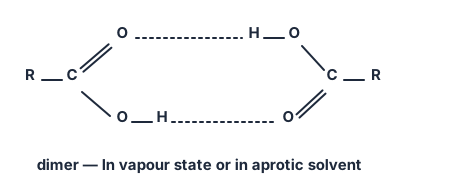
- Nature of hydrogen bonding In alcohols, each molecule can form hydrogen bonds with neighbours, but the network is essentially linear or chain-like. In carboxylic acids, the –OH and –C=O groups on adjacent molecules align to form a dimeric structure:
This dimer is held by two strong O–H···O hydrogen bonds, effectively doubling the molecular mass of the associating unit.
-
Energy required for vaporisation
To boil, these dimers must be completely broken into individual molecules. The enthalpy of vaporisation is therefore much higher for carboxylic acids than for alcohols of similar molar mass. For example, acetic acid (M = 60 g/mol, b.p. 118 °C) vs. propan-1-ol (M = 60 g/mol, b.p. 97 °C).
-
Comparison with alcohols
Alcohols of comparable molecular mass (e.g., butan-1-ol, M = 74, b.p. 117 °C) do form hydrogen bonds, but only one per molecule. The absence of a second hydrogen-bonding site means the intermolecular forces are weaker overall.
A common mistake is to think that only the strength of a single hydrogen bond matters. The real reason is the number of hydrogen bonds per molecule and the dimeric association — two bonds per pair of molecules, not one.
For a carboxylic acid dimer:
This is roughly double the hydrogen bond energy in an alcohol dimer.
(b) Alpha () hydrogens of aldehydes and ketones are acidic in nature.
Concept & Intuition
Acidity of a C–H bond means the hydrogen can be removed as a proton () by a strong base. Normally, C–H bonds are very weak acids (pKa ~ 50 for alkanes). But when the carbon is adjacent to a carbonyl group, the resulting carbanion (enolate) is stabilised by resonance with the C=O π-bond. This dramatically lowers the pKa to about 17–20.
Step-by-step reasoning
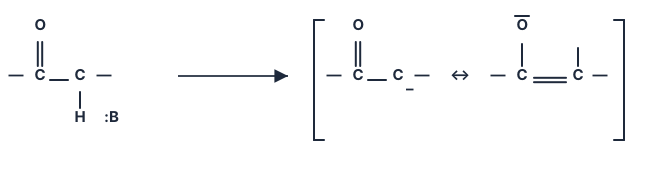
- The enolate ion When a base abstracts an α-hydrogen, the negative charge left on the α-carbon can be delocalised onto the more electronegative oxygen:
The carbanion exists as a resonance hybrid:
-
Why this stabilises the conjugate base
The negative charge is shared between carbon and oxygen. Oxygen is more electronegative and can accommodate the charge better. This resonance stabilisation is not available in alkanes or simple alkenes.
-
Quantitative measure
The pKa of an α-hydrogen in acetone is about 19–20, compared to ~50 for a methane C–H. That’s a factor of in acidity — a huge difference.
The acidity of α-hydrogens is the basis for enolate chemistry — the backbone of aldol reactions, Claisen condensations, and alkylation of carbonyl compounds. Always remember: the carbonyl group acts as an electron sink.
The conjugate base (enolate) is ambident — it can react at either the carbon or the oxygen atom, depending on conditions.
(c) Nucleophilic addition of ammonia and its derivatives does not occur with carbonyl group in strongly acidic medium.
Concept & Intuition …
Unlock everything free for 14 days
- Full step-by-step solutions
- Concept-first explanations
- Methods, shortcuts & mistakes
- PYQ mapping + timed mock tests
Full access for 14 days. No credit card required.