Q.An organic compound contains 69.77% carbon, 11.63% hydrogen and rest oxygen. The molecular mass of the compound is 86. It does not reduce Tollens' reagent but forms an addition compound with sodium hydrogensulphite and give positive iodoform test. On vigorous oxidation it gives ethanoic and propanoic acid. Write the possible structure of the compound.
🔒You're viewing a preview — the full solution, concept, methods & PYQ mapping are locked.
🔒 Start your 14-day free trial to unlock the full solution →Concept understanding — Cannizzaro Reaction
Clemmensen Reduction & Cannizzaro Reaction: Two Completely Different Reactions
These two reactions are often grouped together in textbooks because they both involve carbonyl compounds (C=O), but they do entirely different things. Let's take them one at a time.
Clemmensen Reduction
Intuition first. Imagine you have a ketone or aldehyde — a molecule with a C=O group. You want to remove that oxygen entirely and replace the C=O with two hydrogen atoms, turning it into a simple hydrocarbon chain. That's a reduction (adding hydrogen, removing oxygen). The Clemmensen reduction is a brute-force way to do this using a strongly acidic, reducing environment.
The precise reaction:
A ketone or aldehyde is heated with zinc amalgam (Zn-Hg) and concentrated hydrochloric acid (HCl). The C=O group is reduced to a CH₂ group.
R−C(=O)−RX′+4[H]Zn(Hg),HCl,heatR−CHX2−RX′+HX2O
Aldehyde or KetoneZn(Hg), conc. HCl, ΔHydrocarbon
Key points for exams:
- Works only for ketones and aldehydes that are stable in strong acid.
- Does not work for compounds that get destroyed by conc. HCl (e.g., acid-sensitive groups like esters, nitriles).
- The mechanism is complex and not usually tested in detail — just know it's a reductive removal of C=O.
- The product is always a saturated hydrocarbon (alkane).
Clemmensen reduction cannot reduce carboxylic acids, esters, or amides. Only aldehydes and ketones.
Example:
Acetophenone (CX6HX5−CO−CHX3) → Ethylbenzene (CX6HX5−CHX2−CHX3)
Cannizzaro Reaction
Intuition first. This is a disproportionation reaction — one molecule of aldehyde gets oxidised (to a carboxylic acid) while another gets reduced (to an alcohol). It happens only with aldehydes that have no alpha-hydrogen atoms (i.e., the carbon next to the C=O has no H). Why? Because if there were alpha-hydrogens, the aldehyde would undergo aldol condensation instead.
The precise reaction:
An aldehyde without α-hydrogen is treated with concentrated aqueous or alcoholic base (NaOH/KOH). Two molecules of aldehyde react: one becomes a carboxylate salt, the other becomes a primary alcohol.
2R−CHO+OHX−R−COOX−+R−CHX2OH
After acidification, the carboxylate salt gives the carboxylic acid.
2HCHOconc. NaOHHCOONa+CH3OH
(Formaldehyde → sodium formate + methanol)
Key points for exams:
- Only works for aldehydes with no α-hydrogen: formaldehyde, benzaldehyde, trimethylacetaldehyde, etc.
- The base must be concentrated (dilute base won't work).
- Formaldehyde is the most common example — it gives formic acid (as formate) and methanol.
- Crossed Cannizzaro: When formaldehyde is mixed with another aldehyde (like benzaldehyde), formaldehyde is always the one that gets oxidised (to formate), and the other aldehyde gets reduced (to alcohol). This is because formaldehyde is the strongest reducing agent among aldehydes.
In a crossed Cannizzaro, formaldehyde always becomes the carboxylate. The other aldehyde becomes the alcohol. This is a common exam question.
Example: …
Why this formula?
Cannizzaro Reaction: Why the Key Formulas Hold
The Cannizzaro reaction is a disproportionation reaction of aldehydes (without α-hydrogens) in the presence of a strong base. Let's build the understanding from the ground up.
1. What Happens in the Reaction?
An aldehyde (like formaldehyde or benzaldehyde) reacts with concentrated base to give:
- One molecule is oxidized to a carboxylic acid (or its salt)
- Another molecule is reduced to a primary alcohol
General equation (for two identical aldehydes):
2RCHO+OH−→RCOO−+RCH2OH
2. Why Does Disproportionation Occur?
The Key Insight: No α-Hydrogen
- Aldehydes with α-hydrogens undergo aldol condensation instead.
- Without α-hydrogens, the only available reaction path is hydride transfer.
The Mechanism (Step-by-Step Reasoning)
-
Nucleophilic attack: OH− attacks the carbonyl carbon of one aldehyde molecule.
- Forms a tetrahedral intermediate (a gem-diolate).
-
Hydride shift: The intermediate acts as a hydride donor (H−) to a second aldehyde molecule.
- This is the rate-determining step.
- The hydride comes from the C–H bond of the intermediate (not from the OH).
-
Products:
- The donor aldehyde becomes a carboxylate ion (oxidized).
- The acceptor aldehyde becomes an alkoxide ion (reduced).
-
Protonation: In workup, the carboxylate gives the acid, and the alkoxide gives the alcohol.
3. The Key Formula(e) and Their Derivation
Formula 1: Stoichiometry
2RCHO+OH−→RCOO−+RCH2OH
Why this holds:
- One aldehyde loses a hydride (H−) → gains an oxygen → oxidation state increases by 2.
- The other aldehyde gains a hydride → oxidation state decreases by 2.
- The base (OH−) is consumed stoichiometrically (one per two aldehydes).
Formula 2: Oxidation State Change
For an aldehyde carbon (carbonyl carbon):
- In RCHO: oxidation state = +1
- In RCOO−: oxidation state = +3 (gain of +2)
- In RCH2OH: oxidation state = -1 (loss of -2)
Net change: +2 (oxidation) + (−2) (reduction) = 0 — consistent with disproportionation.
Formula 3: Rate Law (for the hydride transfer step)
Rate=k[aldehyde]2[OH−]
Why:
- First aldehyde reacts with OH− to form the hydride donor (first order in each).
- Second aldehyde accepts the hydride (first order in aldehyde).
- Overall: second order in aldehyde, first order in base.
4. Why Only Certain Aldehydes Work?
Condition: Aldehyde must have no α-hydrogen atoms.
- Examples: HCHO (formaldehyde), C6H5CHO (benzaldehyde), (CH3)3CCHO (pivalaldehyde). …
Concept: Cannizzaro Reaction — but here the key is identifying an aldehyde/ketone that gives iodoform and cleaves into two acids on oxidation.
Step 1: Find the molecular formula.
% oxygen = 100−(69.77+11.63)=18.60%.
Moles per 100 g: C = 1269.77≈5.814, H = 111.63=11.63, O = 1618.60≈1.1625.
Divide by smallest (1.1625): C ≈ 5, H ≈ 10, O ≈ 1 → empirical formula = C5H10O.
Molecular mass = 86, empirical mass = 86 → molecular formula = C5H10O.
Step 2: Interpret the chemical tests.
- Does not reduce Tollens’ reagent → not an aldehyde (so it’s a ketone).
- Forms addition compound with NaHSO₃ → confirms a carbonyl group (ketone).
- Positive iodoform test → must have a CH3CO− group (methyl ketone).
- Vigorous oxidation gives ethanoic acid (CH3COOH) and propanoic acid (C2H5COOH) → the carbon skeleton breaks at the carbonyl, giving a 2‑carbon and a 3‑carbon acid. …
The compound is C5H10O (mol. mass 86), a methyl ketone (positive iodoform, no Tollens reduction) whose oxidation to ethanoic + propanoic acid fixes the carbon skeleton as pentan-2-one, CH3COCH2CH2CH3.
1. Molecular formula from composition
O%=100−(69.77+11.63)=18.60%. Taking 100 g:
C: 1269.77=5.81,H: 111.63=11.63,O: 1618.60=1.16
Dividing by the smallest (1.16): C:H:O=5:10:1, so the empirical formula is C5H10O (mass =86). Since the molecular mass is also 86, the molecular formula is C5H10O.
2. Interpreting the tests
- Does not reduce Tollens/Fehling -> not an aldehyde, so it is a ketone.
- Forms an addition compound with NaHSO3 -> confirms a >C=O group.
- Positive iodoform test -> contains a CH3CO− group.
So (A) is a methyl ketone of formula C5H10O: either pentan-2-one or 3-methylbutan-2-one.
3. Using the oxidation products …
Method: Retrospective Analysis from Chemical Tests & Combustion Data
This method works backwards from the given data — first determine the molecular formula, then use chemical tests to narrow down the functional groups, and finally deduce the structure from the oxidation products.
Step 1: Find the molecular formula from percentage composition
- Carbon: 1269.77=5.814
- Hydrogen: 111.63=11.63
- Oxygen (by difference): 100−(69.77+11.63)=18.6% 1618.6=1.1625
Divide by the smallest (1.1625):
- C: 1.16255.814≈5
- H: 1.162511.63≈10
- O: 1.16251.1625=1
Empirical formula: C5H10O
Empirical mass: 5×12+10×1+16=86
Given molecular mass = 86, so molecular formula = C5H10O
Step 2: Interpret the chemical tests
| Test | Observation | Inference |
|---|---|---|
| Tollens' reagent | Does not reduce | No aldehyde group (−CHO) |
| NaHSO3 addition | Forms addition compound | Contains a carbonyl group (ketone or aldehyde) |
| Iodoform test | Positive | Contains CH3CO− group or CH3CH(OH)− group |
Since it’s not an aldehyde (no Tollens reduction) but has a carbonyl (NaHSO3 test) and gives iodoform — it must be a methyl ketone (CH3CO−).
Step 3: Use oxidation products to find the carbon skeleton
- Vigorous oxidation gives ethanoic acid (CH3COOH) and propanoic acid (CH3CH2COOH).
- This means the original molecule had a carbon chain that breaks at the carbonyl group during oxidation. …
Here are the common mistakes students make when solving this exact type of problem (Cannizzaro + iodoform + oxidation), and how to avoid each.
1. Mistake: Calculating the wrong empirical formula
The error:
Students often round off percentages incorrectly or forget that oxygen is the remainder.
- Given: C = 69.77%, H = 11.63%
- Rest oxygen = 100−(69.77+11.63)=18.60%
- Moles:
- C: 1269.77≈5.814
- H: 111.63≈11.63
- O: 1618.60≈1.1625
Dividing by smallest (1.1625):
- C: 5.814/1.1625≈5
- H: 11.63/1.1625≈10
- O: 1.1625/1.1625=1
Empirical formula: C5H10O
Empirical mass: 5(12)+10(1)+16=86
Since molecular mass is also 86, molecular formula = C5H10O.
How to avoid:
- Always calculate oxygen by subtraction.
- Divide each mole value by the smallest mole value.
- Check if empirical mass matches given molecular mass — if yes, they are the same.
2. Mistake: Ignoring the "does not reduce Tollens' reagent" clue
The error:
Students assume the compound is an aldehyde because it forms an addition compound with NaHSOX3.
Why it's wrong:
- Tollens' reagent is reduced only by aldehydes (and α-hydroxy ketones).
- A negative Tollens' test means no aldehyde group is present.
- But it still forms a bisulfite addition compound — this is possible with ketones (especially methyl ketones) and some cyclic ketones.
How to avoid:
- Remember: Both aldehydes and ketones form bisulfite addition products.
- Negative Tollens' → not an aldehyde → must be a ketone.
3. Mistake: Misinterpreting the positive iodoform test
The error:
Students think any ketone gives a positive iodoform test.
Correction:
Iodoform test is positive only for:
- Methyl ketones (R−CO−CHX3)
- Ethanol and secondary alcohols with CHX3CH(OH)X− group
- Acetaldehyde (CHX3CHO)
Since the compound is a ketone (from clue 2), it must have the CHX3COX− (methyl carbonyl) group.
How to avoid:
- Memorise the exact structural requirement: CHX3COX− or CHX3CH(OH)X−.
- For a CX5HX10O ketone, the only way to have a methyl carbonyl is: CHX3CO−CHX2CHX2CHX3 or CHX3CO−CH(CHX3)X2.
4. Mistake: Forgetting the oxidation product clue
The error:
Students stop after identifying the methyl ketone and don't check the oxidation products.
Given: Vigorous oxidation gives ethanoic acid (CHX3COOH) and propanoic acid (CHX3CHX2COOH).
What this means:
- Vigorous oxidation of a ketone cleaves the carbon chain at the carbonyl group.
- The two fragments become carboxylic acids.
- If we get CHX3COOH and CHX3CHX2COOH, the original ketone must be: CHX3COCHX2CHX2CHX3 (pentan-2-one)
How to avoid:
- Draw the oxidation cleavage: R−CO−RX′ → R−COOH + RX′−COOH …
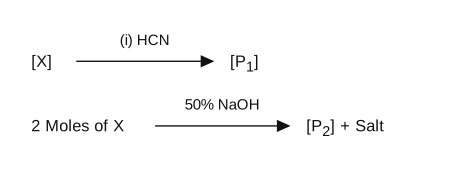
- COMEDK 2026Set 2026-A1 markMCQQ.(ii) } \mathrm{H}_3 \mathrm{O}^{+}]{\text {(i) } \mathrm{SnCl}_2 / \mathrm{HCl} / \text { ether }}[\mathrm{X}] \end{aligned} (A) \left[\mathrm{P}_1\right] \text { Phenol and }\left[\mathrm{P}_2\right] \text { Sodium benzoate } (B) \left[\mathrm{P}_1\right] \text { Benzoyl chloride. and }\left[\mathrm{P}_2\right] \text { Acetophenone } (C) \left[P_1\right] \text { Acetophenone. } \quad \text { and } \quad\left[P_2\right] \text { Benzoic acid } (D) \left[\mathrm{P}_1\right] \alpha \text {-Hydroxy phenylacetic acid and }\left[\mathrm{P}_2\right] \text { Benzyl alcohol } $$
›Reveal solutionSolution
The key is to recognise that the first step (SnCl₂/HCl/ether) reduces the nitrile to an imine that hydrolyses to an aldehyde (benzaldehyde), not a carboxylic acid; the second step (HCN then hydrolysis) gives a cyanohydrin that hydrolyses to an α‑hydroxy acid; the third step (2 moles of X + 50% NaOH) is a Cannizzaro reaction of the aldehyde, yielding benzyl alcohol and sodium benzoate. The correct option is (D).
The problem presents a multi‑step sequence starting from benzonitrile. The trick is to track the functional‑group transformations carefully, because the reagents in the first step are not the usual acidic hydrolysis of a nitrile. Let’s unpack each stage.
Concept & Intuition
- SnCl₂/HCl in ether is a selective reducing agent for nitriles: it converts –C≡N to –CH=NH (an imine), which then hydrolyses to an aldehyde (–CHO) upon aqueous work‑up. This is the Stephen reduction.
- The resulting aldehyde (benzaldehyde) then reacts with HCN to form a cyanohydrin, which upon hydrolysis gives an α‑hydroxy acid.
- Finally, treating two moles of the aldehyde with concentrated NaOH triggers a Cannizzaro reaction (since benzaldehyde has no α‑hydrogen), producing one molecule of benzyl alcohol and one molecule of sodium benzoate.
Step‑by‑step reasoning
- Stephen reduction of benzonitrile Benzonitrile (C₆H₅–C≡N) reacts with SnCl₂/HCl in dry ether. The SnCl₂ reduces the triple bond to an imine:
CX6HX5−C≡NSnClX2/HClCX6HX5−CH=NHX2X+ ClX−
On adding water (H₃O⁺), the imine hydrolyses to an aldehyde:
CX6HX5−CH=NHX2X+HX3OX+CX6HX5−CHO+NHX4X+
So the product [X] is benzaldehyde.
- Formation of [P₁] – cyanohydrin then α‑hydroxy acid Benzaldehyde reacts with HCN (in the presence of a trace of base) to give the cyanohydrin:
CX6HX5−CHO+HCNCX6HX5−CH(OH)−CN
Acidic hydrolysis of the cyanohydrin converts the –CN group to –COOH:
CX6HX5−CH(OH)−CNHX3OX+CX6HX5−CH(OH)−COOH
This product is α‑hydroxy phenylacetic acid (also called mandelic acid). Hence [P₁] is α‑hydroxy phenylacetic acid.
- Formation of [P₂] – Cannizzaro reaction of benzaldehyde …
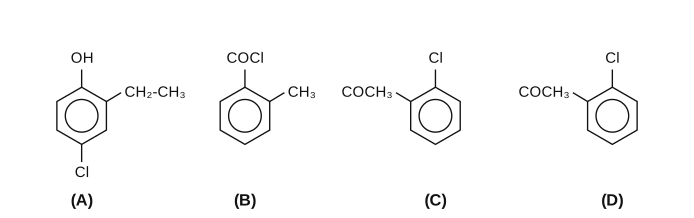
- COMEDK 2025Set 2025-M1 markMCQQ.An organic compound [X] reacts with H2/Pd−BaSO4 to give compound [Y] which reduces Tollen's reagent and undergoes Cannizzaro's reaction. On rigorous oxidation of [Y] in presence of KMnO4/H+Phthalic acid is the product obtained. What is [X] ? (A) (B) (C) (D)
›Reveal solutionSolution
The key is to work backwards from the final product (phthalic acid) and the reactions of compound Y (reduces Tollen’s reagent, undergoes Cannizzaro reaction) to deduce that Y is an aromatic aldehyde with no α-hydrogen, and X is its acyl chloride precursor. The correct option is (B).
We start by understanding the clues. Compound Y reduces Tollen’s reagent — that means Y is an aldehyde (or an α-hydroxy ketone, but here it’s an aldehyde). Y also undergoes the Cannizzaro reaction, which is a disproportionation of an aldehyde that has no α-hydrogen atoms (i.e., the carbon next to the –CHO group has no hydrogen). So Y must be an aromatic aldehyde like benzaldehyde or a substituted benzaldehyde.
Next: On rigorous oxidation with acidic KMnO₄, Y gives phthalic acid. Phthalic acid is benzene-1,2-dicarboxylic acid. That means the original aldehyde group in Y must be on a benzene ring that also has another carbon-containing substituent at the ortho position, which gets oxidized to a –COOH group. So Y is an ortho-substituted benzaldehyde, where the substituent is something that can be oxidized to –COOH (like –CH₃, –CH₂OH, –CHO, etc.).
Now, Y comes from X by reaction with H₂ / Pd–BaSO₄. This is the Lindlar catalyst — it reduces an acyl chloride (–COCl) to an aldehyde (–CHO) without over-reducing it to an alcohol. So X must be an acyl chloride. Therefore, X has a –COCl group on the benzene ring, and the other ortho substituent is something that, after reduction of –COCl to –CHO, gives Y, which then oxidizes to phthalic acid.
Let’s check the options:
-
Option (A): Benzene with –OH, –CH₂CH₃, and –Cl. No –COCl group. So reduction with H₂/Pd–BaSO₄ would not give an aldehyde. Eliminated.
-
Option (B): Benzene with –COCl and –CH₃ (ortho to each other).
- Reduction: –COCl → –CHO, giving ortho-methylbenzaldehyde.
- This aldehyde has no α-hydrogen (the –CHO carbon is attached directly to the ring), so it undergoes Cannizzaro reaction.
- It also reduces Tollen’s reagent (aldehyde). …
-
- COMEDK 2024Set 2024-E1 markMCQQ.Given are the names of 4 compounds. Two of these compounds will not undergo Cannizzaro's reaction. Identify the two. A. 2-Chlorobutanal B. 2,2-Dimethylpropanal C. Benzaldehyde D. 2-Phenyl ethanol (A) A & D (B) D & C (C) C & B (D) A & B
›Reveal solutionSolution
Cannizzaro reaction requires an aldehyde with no alpha‑hydrogen; 2‑chlorobutanal has an alpha‑hydrogen (so it undergoes aldol instead) and 2‑phenyl ethanol is not an aldehyde at all — so the two that will not undergo Cannizzaro are A and D, making the correct option (A).
Concept & Intuition
The Cannizzaro reaction is a disproportionation of an aldehyde (without an α‑hydrogen) into a carboxylic acid and an alcohol, under strong base. The key condition: no α‑hydrogen (i.e., no H on the carbon next to the –CHO group). Why? Because if an α‑hydrogen exists, the base will instead deprotonate that position, leading to an enolate and then an aldol reaction — not Cannizzaro. So to identify which compounds will not undergo Cannizzaro, we check each for the presence of α‑hydrogens. Also, the compound must be an aldehyde — alcohols don’t undergo Cannizzaro at all.
Step‑by‑step reasoning
-
Compound A: 2‑Chlorobutanal
Structure: CH₃–CH₂–CH(Cl)–CHO
The carbon next to the –CHO (the α‑carbon) has a hydrogen (the carbon is CH(Cl)–). That hydrogen is an α‑hydrogen. Therefore, under basic conditions, this aldehyde will form an enolate and undergo aldol condensation, not Cannizzaro.
→ Will NOT undergo Cannizzaro.
-
Compound B: 2,2‑Dimethylpropanal (pivalaldehyde)
Structure: (CH₃)₃C–CHO
The α‑carbon is fully substituted with three methyl groups — no hydrogen attached. Hence no α‑hydrogen. This is a classic example of an aldehyde that undergoes Cannizzaro reaction.
→ Will undergo Cannizzaro.
-
Compound C: Benzaldehyde
Structure: C₆H₅–CHO
The α‑carbon is part of the aromatic ring; there is no α‑hydrogen (the carbon adjacent to –CHO is a quaternary aromatic carbon). Benzaldehyde is the textbook example of an aldehyde that undergoes Cannizzaro. …
-
- COMEDK 2024Set 2024-M1 markMCQQ.Identify the Reagents I and II to be used in the course of the given reactions. (A) Reagent I: DIBAL- H/H2O Reagent II: conc. KOH/ heat (B) Reagent I: Zn/Hg in conc. HCl Reagent II: [Ag(NH3)2]+ (C) Reagent I: NH2NH2/KOH Reagent II: Cr2O72−/H+ (D) Reagent I: H2/Pd−BaSO4 Reagent II: CrO3/(CH3CO)2
![A reaction scheme drawn on one line. At the far left is the starting compound labelled [A]](/figures/comedk/2024-M-chemistry-q39.svg)
›Reveal solutionSolution
The final "self oxidation & reduction" step is a Cannizzaro reaction, so Reagent I must stop the reduction at the aldehyde (DIBAL-H/H2O) and Reagent II must be the strong base that drives the disproportionation (conc. KOH/heat). The correct option is (A).
Concept
The Cannizzaro reaction disproportionates an aldehyde that has no α-hydrogen (aromatic aldehydes qualify) using a strong base: one molecule is oxidised to a carboxylate and another reduced to an alcohol. The phrase "undergoes self-oxidation and reduction" is the signature of this reaction, and it fixes what the two reagents must accomplish.
Solution
Tracing the scheme:
- Cu2+/OH− step: one −CHO of the aromatic dialdehyde is oxidised to a carboxylate.
- C2H5OH/H+ step: Fischer esterification converts that acid into an ethyl ester, leaving one aldehyde and one ester group.
- Reagent I: to regenerate the second aldehyde needed for Cannizzaro, the ester must be reduced only as far as the aldehyde. DIBAL-H at low temperature followed by aqueous work-up is the classic reagent for ester → aldehyde.
- Zn/Hg-HCl (Clemmensen) and NH2NH2/KOH (Wolff-Kishner) reduce all the way to −CH2−; H2/Pd-BaSO4 (Lindlar) is for alkynes. None fit. …
- COMEDK 2023Set 2023-E1 markMCQQ.What would be the products obtained when a mixture of p-Methoxy benzaldehyde and Methanal are heated with 50% concentrated Caustic soda solution? (A) p- Methoxy sodium benzoate and sodium acetate. (B) p-Methoxy benzyl alcohol and sodium formate. (C) p- Methoxy benzyl alcohol and methanol. (D) p- Methoxy sodium benzoate and sodium formate
›Reveal solutionSolution
A crossed Cannizzaro reaction: methanal is oxidised to sodium formate and p-methoxybenzaldehyde is reduced to p-methoxy benzyl alcohol.
Both p-methoxybenzaldehyde and methanal (HCHO) lack α-hydrogens, so with concentrated NaOH they undergo a crossed Cannizzaro (disproportionation) reaction.
Formaldehyde is the strongest reducing agent among aldehydes, so it is preferentially oxidised to formate:
HCHO→HCOO−Na+ (sodium formate) …
- KCET 2022Set B-31 markMCQQ.The general name of the compound formed by the reaction between aldehyde and alcohol is (A) Glycol (B) Acetate (C) Ester (D) Acetal
›Reveal solutionSolution
The reaction between an aldehyde and an alcohol forms an acetal (or hemiacetal) via nucleophilic addition, not an ester or glycol. The correct option is (D).
The key here is to recognise what functional group chemistry is at play. An aldehyde has a carbonyl group (C=O) that is electrophilic at the carbon. An alcohol has an −OH group that can act as a nucleophile. When they react, the oxygen of the alcohol attacks the carbonyl carbon, leading to addition — not substitution or elimination. This is fundamentally different from ester formation (which requires a carboxylic acid, not an aldehyde) or glycol formation (which requires two −OH groups on adjacent carbons, typically from diols).
Let’s walk through the reaction step by step.
- Nucleophilic addition of one alcohol molecule The lone pair on the alcohol oxygen attacks the electrophilic carbonyl carbon of the aldehyde. The π bond of C=O breaks, and the oxygen picks up a proton (from the alcohol or from the medium). This gives a hemiacetal — a molecule with both an −OH and an −OR group on the same carbon. For a generic aldehyde RCHO and alcohol RX′OH:
RCHO+RX′OHRCH(OH)(ORX′)
- Further reaction with a second alcohol molecule The hemiacetal is still reactive. Under acidic conditions, the −OH group can be protonated and leave as water, generating a carbocation-like intermediate. A second molecule of alcohol then attacks, replacing the −OH with another −ORX′ group. The final product is an acetal:
RCH(OH)(ORX′)+RX′OHRCH(ORX′)X2+HX2O
- Why the other options are wrong …
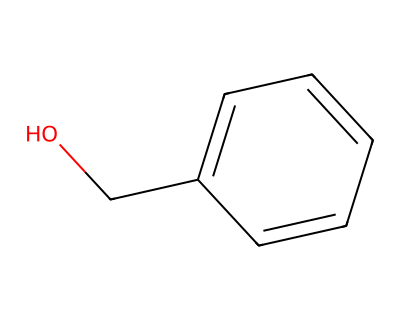
- KCET 2021Set B-21 markMCQQ.A compound 'A' (C7H8O) is insoluble in NaHCO3 solution but dissolve in NaOH and gives a characteristic colour with neutral FeCl3 solution. When treated with Bromine water compound 'A' forms the compound B with the formula C7H5OBr3. 'A' is (A)
 (B)
(B) 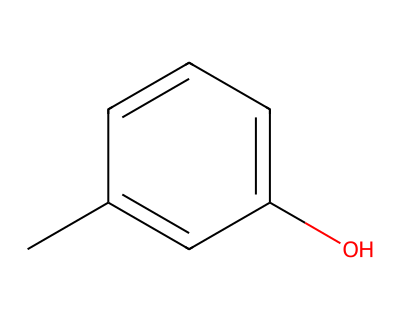 (C)
(C) 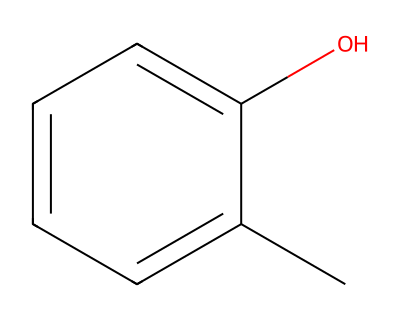 (D)
(D) 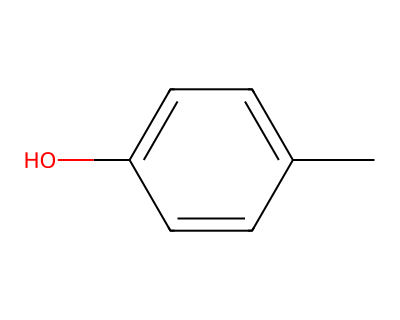
›Reveal solutionSolution
The tests identify a cresol; the tri-bromo product then fixes the isomer, because only m-cresol leaves all three o/p positions of the −OH free.
Step 1 — Interpret the three tests.
- Insoluble in NaHCO3: 'A' is not a carboxylic acid (only acids stronger than carbonic acid dissolve in NaHCO3 with effervescence).
- Dissolves in NaOH: 'A' is acidic enough to form a salt with a strong base — the hallmark of a phenol (pKa≈10), whose phenoxide is resonance-stabilised.
- Characteristic colour with neutral FeCl3: the classic confirmatory test for a phenolic −OH (a violet/blue coloured iron–phenoxide complex).
So 'A' contains an −OH directly attached to the ring. This rules out (A) benzyl alcohol, whose −OH is on a side chain: it is neutral, does not dissolve in NaOH, and gives no colour with FeCl3.
Step 2 — Use the molecular formula.
C7H8O with a phenolic OH ⇒ a cresol (methylphenol). The remaining candidates are the o-, m- and p-isomers, (C), (B) and (D).
Step 3 — Use the bromine-water product, C7H5OBr3.
Going from C7H8O to C7H5OBr3 means three ring hydrogens have been replaced by three Br atoms. Bromine water brominates a phenol only at the positions ortho and para to the −OH (these are the positions activated by the strongly electron-donating −OH through resonance). So 'A' must have three free o/p positions relative to its OH.
Number the ring with −OH at C-1; the activated positions are C-2, C-4 and C-6. …
🎓Unlock everything free for 14 days
- ✓Full step-by-step solutions
- ✓Concept-first explanations
- ✓Methods, shortcuts & mistakes
- ✓PYQ mapping + timed mock tests
Full access for 14 days. No credit card required.